Should we expect to know what God’s reason is for allowing evil and suffering?

Lets take a closer look at a puzzle

Here is an article by Steven Cowan about the problems of evil and suffering.

Intro:

The problem of evil is no doubt the most serious challenge to belief in God. Even religious believers find it troubling that evil exists in the world—and so much evil! It is puzzling, to say the least, that an all-powerful, absolutely good being would allow evil to exist in his creation. And yet it does. Evil and suffering exist and they are often overwhelming in their magnitude.

Now let’s find out what a noseeum is, and how it relates to the existence of evil and suffering:

However, perhaps God’s existence is incompatible with a certain kind of evil that exists. For example, the atheist William Rowe has argued that God’s existence is inconsistent with pointless or gratuitous evil. By “pointless evil,” Rowe means evil that does not and cannot serve a greater good. And Rowe believes that there is such pointless evil in the world. He thus concludes that God does not exist. Rowe’s argument may be simply stated as follows:

  1. If God exists, there would be no pointless evil.
  2. There is pointless evil.
  3. Therefore, God does not exist.

[…]But, is there pointless evil in the world? Rowe thinks there is. To show that there is pointless evil, Rowe introduces what he calls the “noseeum inference.” Like the pesty little bugs that some readers may be familiar with, a “noseeum” is something that you cannot see—it is a “no-see-um.” And a noseeum inference is a conclusion drawn on the basis of what one does not see. The basic structure of all noseeum inferences looks like this:

  1. I cannot see an x.
  2. Therefore, there probably is no x.

We all make noseeum inferences everyday of our lives. Every time I go to cross a street, I look both ways and I step out into the street only after I “no-see-um” a car coming.

[…]Rowe applies this kind of noseeum reasoning to God and evil. Rowe suggests that if we cannot see a reason for a particular instance of evil, then there is probably not a reason. Suppose we hear about a very young child who is tortured to death to amuse some psychotic person. We think about this event and we examine all the circumstances surrounding it. No matter how hard we try, we cannot see any good reason why this child had to suffer the way she did. Since we cannot see a reason why God would allow this child to suffer, there probably is not a good reason—the child’s suffering was pointless. Of course, Rowe would be quick to point out that he is not speaking merely hypothetically. There are cases like this in the news every day—real-life cases in which we shake our heads in frustration, wondering why God would allow such a thing.

Is Rowe correct in his conclusion? Do such examples prove that there is pointless evil in the world? I don’t think so. To see why, we must recognize that noseeum inferences are not all created equal. Some noseeum inferences, as we have seen, are reasonable and appropriate. But, many are not. Suppose I look up at the night sky at the star Deneb and I do not see a planet orbiting that star. Would it be reasonable for me to conclude that there is no planet orbiting Deneb? Of course not. Suppose that using the best telescopes and other imaging equipment presently available, I still cannot see a planet around Deneb. I would still be unjustified in concluding that there was no such planet.

In that example, the planet is the noseeum. Just because you look really hard, you can’t be confident that the planet is not there. And similarly with the problem of evil and suffering, looking really hard and finding no reason does not mean that there is no reason. It just means that you are not in a good position to see the reason. You don’t know enough to to be sure that there is no reason, because of your limitations as a human being.

To know that any given instance of evil or suffering is gratuitous/pointless requires a high level of knowledge. How much knowledge? Well, consider this paper by the late William Alston of Syracuse University, who lists six problems with the idea that humans can know that any particular instance of evil and suffering is gratuitous. (You can get the PDF here)

According to the paper, human beings just do not have the capability to know for certain that God has NO morally sufficient reason for allowing any particular instance of evil and/or suffering. God’s morally sufficient reason is a noseeum. To know for sure that there is no reason, we would need to have more knowledge than we do.

Also, remember that on the Christian view, the good aim that God has is NOT to make humans have happy feelings in this life, regardless of their knowledge, wisdom and character. That’s what atheists think, though. They think that God, if he exists, is obligated to make them feel happy all the time. They don’t think that God’s goal is being actively involved in forming their knowledge, wisdom and character. God has a purpose – to work in the world so that everyone who can freely respond to him will respond to him. The Bible says that allowing pain and suffering is one of the ways that he gets that group of people who are willing to respond to respond to him – FREELY. To be able to claim that evil is gratuitous, the atheist has to show that God can achieve his goal of saving all the people he wants to save while permitting less suffering in the world. And that is a very difficult thing for an atheist to show, given our human cognitive limitations.
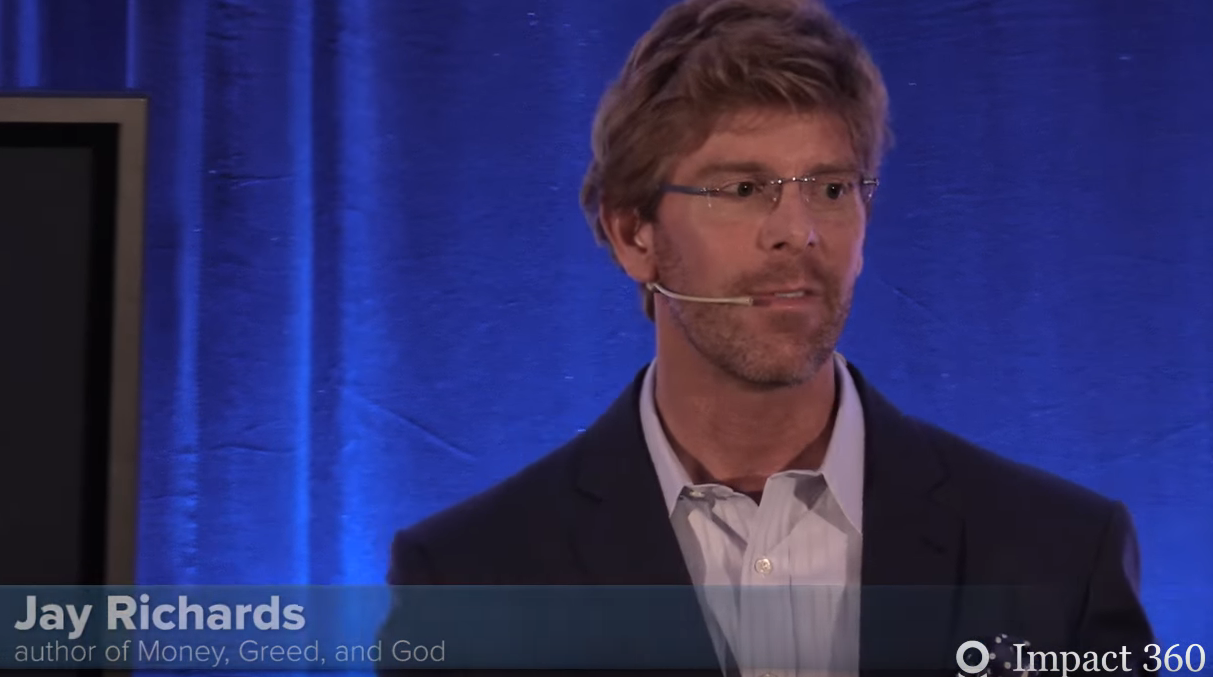

Jay Richards: How to end poverty in 10 tough steps

Jay Richards: How to end poverty in 10 tough steps

Why are some nations more prosperous than others? Is it because the wealthier nations exploit the poorer ones, keeping them poor? Or are there certain policies, laws, and cultural beliefs that lead to prosperity? Dr. Jay Richards delivers a lecture for Impact 360, in which he identifies 10 different factors that lift nations out of poverty, and explains why they work.

Summary:

  1. Establish and maintain the rule of law.
  2. Focus the jurisdiction of government on maintaining the rule of law, and limit its jurisdiction over the economy and the institutions of civil society.
  3. Implement a formal property system with consistent and accessible means for securing a clear title to property one owns.
  4. Encourage economic freedom: Allow people to trade goods and services unencumbered by tariffs, subsidies, price controls, undue regulation, and restrictive immigration policies.
  5. Encourage stable families and other important private institutions that mediate between the individual and the state.
  6. Encourage belief in the truth that the universe is purposeful and makes sense.
  7. Encourage the right cultural mores—orientation to the future and the belief that progress but not utopia is possible in this life; willingness to save and delay gratification; willingness to risk, to respect the rights and property of others, to be diligent, to be thrifty.
  8. Instill a proper understanding of the nature of wealth and poverty—that wealth is created, that free trade is win-win, that risk is essential to enterprise, that trade-offs are unavoidable, that the success of others need not come at your expense, and that you can pursue legitimate self-interest and the common good at the same time.
  9. Focus on your comparative advantage rather than protecting what used to be your competitive advantage.
  10. Work hard.

Solving economic problems is just like solving any other problem. First, we read to learn what has been proven to work. Then, we do what works. I want to encourage Christians to move beyond good intentions to good results when voting for economic policies. Often, people on the left want to “fix” inequalities by doing what feels good to them, or what sounds good to them. Economics is about choosing policies that we know have worked in other times and places.

Let’s talk more about #4 from Richards’ list.

Economic freedom linked to prosperity

Consider the book “The Poverty of Nations: A Sustainable Solution” by famous conservative theologian Wayne Grudem.

You can even read an article about it from the left-wing Christian Post here:

In a presentation of his new book at the Family Research Council, biblical theologian Wayne Grudem argued that poor countries can become rich only by producing their own prosperity, and that the free market is not only the economic answer, but in tune with the Bible’s moral teachings.

“Every nation that has escaped poverty has done so by producing its own prosperity,” said Grudem, professor of theology and biblical studies at Phoenix Seminary in Arizona. Perhaps best known for his book Systematic Theology: An Introduction to Biblical Doctrine, Grudem presented the key themes in his new book The Poverty of Nations: A Sustainable Solution. The very first of his 79 factors to help nations escape poverty in “a free market economy.”

[…]Grudem argued that the wealth of a country is determined by its per-capita income – the average amount of money each citizen makes. The only way to increase this is to increase the production of goods and services, creating more wealth for everyone, he said.

[…]The professor pointed to 79 factors to help a country produce more goods and services, in three different key areas: the economic system, government, and cultural beliefs and values.

For the economic system, Grudem mentioned the Index of Economic Freedom, a report put out by the Heritage Foundation to judge each country’s openness to trade and wealth creation.

You can find the Heritage Foundation Index of Economic Freedom right here. Take a look at the countries at the top… these countries also have a very high per capita income. Their citizens are earning a lot of money by selling what they produce to willing customers. The ones at the bottom are run by socialist governments. You wouldn’t want to try to make a living in Venezuela or Cuba or North Korea. But these are the places that American socialists admire and support. Does that tell you something about what they would do to you, if they got hold of the reins of government?

The Fraser Institute in Canada did a similar ranking of economic freedom (economic freedom = low taxes, low regulation, free trade), and they concluded:

Countries in the top quartile (25 per cent) of economic freedom (such as the U.K., Japan and Ireland) had an average per-capita income of US$40,376 in 2016 compared to US$5,649 for the bottom quartile countries (such as Venezuela, Iran and Zimbabwe). And life expectancy is 79.5 years in the top quartile of countries compared to 64.4 years in the bottom quartile.

Economic freedom works best.

Is the Bible’s definition of faith opposed to logic and evidence?

Bible study that hits the spot
Theology that hits the spot

Probably the biggest misconception that I encounter when defending the faith is the mistaken notion of what faith is. Today we are going to get to the bottom of what the Bible says faith is, once and for all. This post will be useful to Christians and atheists, alike.

What is faith according to the Bible?

I am going to reference this article from apologist Greg Koukl of Stand to Reason in my explanation.

Koukl cites three Biblical examples to support the idea that faith is not blind leap-of-faith wishing, but is based on evidence.

  1. Moses went out into the wilderness and he had that first encounter with the burning bush, and God gave him the directive to go back to Egypt and let his people go. Moses said, Yeah, right. What’s going to happen when they say, why should we believe you, Moses?God said, See that staff? Throw it down.Moses threw it down and it turned into a serpent.God said, See that serpent? Pick it up.And he picked it up and it turned back into a staff.God said, Now you take that and do that before the Jewish people and you do that before Pharaoh. And you do this number with the hail, and the frogs, and turning the Nile River into blood. You put the sun out. You do a bunch of other tricks to get their attention.And then comes this phrase: “So that they might know that there is a God in Israel.”
  2. [I]n Mark 2 you see Jesus preaching in a house, and you know the story where they take the roof off and let the paralytic down through the roof. Jesus said, “Your sins are forgiven.” And people get bugged because how can anyone forgive sins but God alone?Jesus understood what they were thinking and He said this: What’s harder to say, your sins are forgiven, or to rise, take up your pallet and go home?Now, I’ll tell you what would be harder for me to say : Arise, take up your pallet and go home. I can walk into any Bible study and say your sins are forgiven and nobody is going to know if I know what I am talking about or not. But if I lay hands on somebody in a wheelchair and I say, Take up your wheelchair and go home, and they sit there, I look pretty dumb because everyone knows nothing happened.But Jesus adds this. He says, “In order that you may know that the Son of Man has the power and authority to forgive sins, I say to you, arise, take up your pallet and go home.” And he got up and he got out. Notice the phrase “In order that you may know”. Same message, right?
  3. Move over to the Book of Acts. First sermon after Pentecost. Peter was up in front of this massive crowd. He was talking about the resurrection to which he was an eyewitness. He talked about fulfilled prophecy. He talked about the miraculous tongues and the miraculous manifestation of being able to speak in a language you don’t know. Do you think this is physical evidence to those people? I think so. Pretty powerful.Peter tells them, These men are not drunk as it seems, but rather this is a fulfillment of prophecy. David spoke of this. Jesus got out of the grave, and we saw him, and we proclaim this to you.Do you know how he ends his sermon? It’s really great. Acts 2:36. I’ve been a Christian 20 years and I didn’t see this until about a year ago. This is for all of those who think that if you can know it for sure, you can’t exercise faith in it. Here is what Peter said. Acts 2:36, “Therefore let all the house of Israel know for certain that God has made him both Lord and Christ, Messiah, this Jesus whom you crucified.” There it is again. “Know for certain.”

What is faith according to Bible-based theologians?

I am going to reference this article from theologian C. Michael Patton of Parchment and Pen in my explanation.

Patton explains that according to Reformation (conservative, Bible-based) theologians, faith has 3 parts:

  1. notitia – This is the basic informational foundation of our faith. It is best expressed by the word content. Faith, according to the Reformers must have content. You cannot have faith in nothing. There must be some referential propositional truth to which the faith points. The proposition “Christ rose from the grave,” for example, is a necessary information base that Christians must have.
  2. assensus – This is the assent or confidence that we have that the notitia is correct… This involves evidence which leads to the conviction of the truthfulness of the proposition… This involves intellectual assent and persuasion based upon critical thought… assensus… says, “I am persuaded to believe that Christ rose from the grave.”
  3. fiducia – This is the “resting” in the information based upon a conviction of its truthfulness. Fiducia is best expressed by the English word “trust.”… Fiducia is the personal subjective act of the will to take the final step. It is important to note that while fiducia goes beyond or transcends the intellect, it is built upon its foundation.

So, Biblical faith is really trust. Trust(3) can only occur after intellectual assent(2), based on evidence and thought. Intellectual assent(2) can only occur after the propositional information(1) is known.

The church today accepts 1 and 3, but denies 2. I call this “fideism” or “blind faith”. Ironically, activist atheists, (the New Atheists), also believe that faith is blind. The postmodern “emergent church” denies 1 and 2. A person could accept 1 and 2 but deny 3 by not re-prioritizing their life based on what they know to be true.

How do beliefs form, according to Christian philosophers?

I am going to reference a portion of chapter 3 of J.P. Moreland’s “Love Your God With All Your Mind” (i.e. – LYGWYM).

J.P. Moreland explains how beliefs form and how you can change them.

  1. Today, people are inclined to think that the sincerity and fervency of one’s beliefs are more important than the content… Nothing could be further from the truth… As far as reality is concerned, what matters is not whether I like a belief or how sincere I am in believing it but whether or not the belief is true. I am responsible for what I believe and, I might add, for what I refuse to believe because the content of what I do or do not believe makes a tremendous difference to what I become and how I act.
  2. A belief’s strength is the degree to which you are convinced the belief is true. As you gain ,evidence and support for a belief, its strength grows for you… The more certain you are of a belief… the more you rely on it as a basis for action.

But the most important point of the article is that your beliefs are not under the control of your will.

…Scripture holds us responsible for our beliefs since it commands us to embrace certain beliefs and warns us of the consequences of accepting other beliefs. On the other hand, experience teaches us that we cannot choose or change our beliefs by direct effort.

For example, if someone offered you $10,000 to believe right now that a pink elephant was sitting next to you, you could not really choose to believe this… If I want to change my beliefs about something, I can embark on a course of study in which I choose to think regularly about certain things, read certain pieces of evidence and argument, and try to find problems with evidence raised against the belief in question.

…by choosing to undertake a course of study… I can put myself in a position to undergo a change in… my beliefs… And… my character and behavior… will be transformed by these belief changes.

I think definition of faith is important, because atheists seemed to want to substitute their own definition of faith as blind belief for this Biblical definition, but there is no evidence for their view that faith is belief without evidence. I think this might be another case of projection by atheists. Blind faith is how they arrive at their views, so they are trying to push it onto us. But the Bible is clearly opposed to it.

Positive arguments for Christian theism