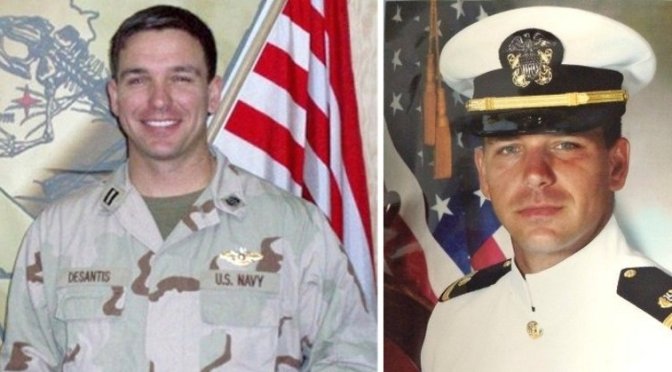
Who should the Republican candidate for president be in 2024?

I have a candidate in mind for Republican nominee for president in 2024. His name is Ron DeSantis, and he’s doing an amazing job as governor of purple-state Florida.  I thought it might be a good idea for us all to learn a little something about him. His policies are quite tough, but he has a more mature attitude than Trump.

He was in the news this week for these comments about Joe Biden:

“So I think the question is, we can either have a free society, or we can have a biomedical security state,” DeSantis said. “And I can tell you, Florida, we’re a free state, people are going to be free to choose, to make their own decisions about themselves, about their families, about their kid’s education, and about putting food on the table.”

“And Joe Biden suggests that if you don’t do lockdown policies, then you should quote, ‘get out of the way,’” DeSantis continued. “But let me tell you this, if you’re coming after the rights of parents in Florida, I’m standing in your way, I’m not going to let you get away with it.”

“If you’re trying to deny kids a proper in person education, I’m gonna stand in your way and I’m gonna stand up for the kids in Florida,” DeSantis continued. “If you’re trying to restrict people, impose mandates, if you’re trying to ruin their jobs and their livelihoods and their small business, if you are trying to lock people down, I am standing in your way and I’m standing for the people of Florida.”

“So why don’t you do your job? Why don’t you get this border secure?” DeSantis added. “And until you do that, I don’t want to hear a blip about COVID from you. Thank you.”

Video:

He was in the news for taking on the education bureaucrats, too:

Broward County Public Schools has changed its masking policy after Republican Florida Governor Ron DeSantis released an executive order giving parents the power to decide whether their children should wear masks at school.

[…]As The Daily Wire previously reported, “Florida Governor Ron DeSantis (R) signed an executive order late this week that allows parents to make the choice of whether they want to have their children wear masks in school, which comes in response to the Biden administration making new recommendations through the CDC about wearing masks in school.”

The executive order makes sure that local school boards “do not violate Floridians’ constitutional freedoms,” “do not violate parents’ right under Florida law to make health care decisions for their minor children,” and ensures that “children with disabilities or health conditions who would be harmed by certain protocols such as face masking requirements” are protected.

I don’t like words. I like actions.

Here’s Governor DeSantis’ biography:

Governor Ron DeSantis is the former U.S. Representative for Florida’s Sixth District.

A native Floridian with blue-collar roots, Ron worked his way through Yale University, where he graduated with honors and was the captain of the varsity baseball team. He also graduated with honors from Harvard Law School. While at Harvard, he earned a commission in the U.S. Navy as a JAG officer. During his active-duty service, he supported operations at the terrorist detention center at Guantanamo Bay, Cuba and deployed to Iraq as an adviser to a U.S. Navy SEAL commander in support of the SEAL mission in Fallujah, Ramadi and the rest of Al Anbar province.  His military decorations include the Bronze Star Medal for Meritorious Service and the Iraq Campaign Medal.

After active-duty service, Ron served as a federal prosecutor, where he targeted and convicted child predators.  He was first elected to Congress in 2012, where he fought for term limits, the No Budget/No Pay Act, and to cut taxes.  While serving in Congress, Ron refused his Congressional pension and health insurance plan because he is against special deals for politicians.  He also sponsored legislation to make it easier for the military to prosecute sexual assault and authored the bill to end the secret taxpayer-funded slush fund for members of Congress to make hush payoffs for sexual harassment.

Ron is married to Casey DeSantis, an Emmy Award winning television host. Together, they’re the proud parents of their daughters, Madison and Mamie, and their son, Mason.

Look for him in 2024. I really hope that conservative parents are making more like him.

Why did evangelicals for Biden oppose pro-Christian policies and Christian moral values?

During the 2020 election, conservatives said that Democrat legislation like the Equality Act and the Women’s Health Protection Act would hurt Christians in areas like religious liberty and right to life. But many people felt that Democrats would not hurt Christian values and liberties. Well, it turns out that the facts people were right, and the feelings people were wrong.

Now we get this story, from Daily Caller:

Medical professionals are suing President Joe Biden’s administration over a mandate requiring doctors to perform transgender surgeries in violation of their religious beliefs or medical judgement.

Represented by the Alliance Defending Freedom, the American College of Pediatricians, the Catholic Medical Association and an OB-GYN doctor specializing in adolescent care filed suit in the U.S. District Court for the Eastern District of Tennessee at Chattanooga Thursday against the U.S. Department of Health and Human Services.

[…]The two medical associations represent 3,000 doctors and health care professionals, ADF said in a press release.

I’m just imagining myself being in a position where the secular left government forced me to violate my conscience. It makes me sick.

So, why were so many Christians tricked by the Democrats? Well, it turns out that a large number of people who identify as Christian actually just apply the label Christian to a set of values and a worldview that is defined entirely by their feelings. They believe that what is “moral” is what makes them feel good. In this culture, people have decided that it is better to be “compassionate”, “tolerant” and “non-judgmental”. What that means is that the strong adults do what they want to do, and the weak, e.g. children, suffer.

Take the Women’s Health Protection Act. It’s a bill that’s been already passed in the House by Democrats that eliminates ALL restrictions on abortion at the state level. This bill would make it easier for women to kill their unwanted unborn children. No Christian should support it. But evangelicals for Biden do.

Suppose you approached an evangelical for Biden with an argument like this:

  • P1. If the unborn are humans, then it’s wrong to kill the unborn.
  • P2. The unborn are humans, as per the science of embryology.
  • C. Therefore, it’s morally wrong to kill the unborn.

Now, you would think that an argument like this would work on evangelicals for Biden. But it doesn’t. They deny premise 2, because they have a feeling that it’s false, and that feeling cannot be overturned by the science found in embryology textbooks.

Evangelicals for Biden don’t think logically, and they don’t care about scientific evidence. Their views (including their self-serving caricature of “Christianity”) are formed by their emotions and peers. And they don’t read any non-fiction or watch any debates that might change their minds. They surround themselves with people who agree with them. Anyone who tries to reason with them, or use evidence, is ejected from their lives.

This kind of failure to choose policy using reason and evidence applies to dozens of issues that are of interest to Christians. Not just abortion and higher gas prices, but also foreign policy disasters we are seeing in Afghanistan now, and in places like Vietnam before. They never learn. They never learn, because for them, a worldview is not about having true beliefs that achieve good results. For them, it’s about feeling good, looking good, and surrounding themselves with people who agree with them.

Just this past week, I was reading comments from one of these “Christian” Democrats who had hooked up with a hot bad boy in her youth, then had an abortion. She became “Christian” later in life, to escape the feelings of shame from her past. When Trump came along, she only had one thing on her mind, and it wasn’t policy or the Supreme Court. She identified Trump with the bad boy (who she freely chose) who got her pregnant, and she hated him for it. She did not want anyone voting for this man, because he made her feel bad. To correct herself, she would have had to have buckled down, and done some research. But since learning is hard work, and hard work makes her feel bad, she never learned a thing.

Evangelicals for Biden were never interested in Trump’s pro-life record, or the unemployment rate, or the elimination of ISIS in Iraq. They didn’t care about his record of achievements. They cared about themselves. They wanted to avoid being shamed for their selfishness past, present and future.  They didn’t care who would be hurt by a Biden presidency.

Well, I was a Never Trump conservative in 2016. but after 4 years of pro-life wins, a booming stock market, record low unemployment, no new wars, and tough sanctions for our enemies, I changed to be a Trump supporter. That doesn’t mean that I look to Trump for moral or spiritual leadership. I just wanted the policies and the judges. The 2020 Never Trump people wanted BIDEN policies and BIDEN judges.

And now when you are looking at all of these horrors in the news, including the violation of the consciences of Christian pediatricians, maybe everyone will understand that “Christians” who form their view by feelings (compassion, tolerance, non-judgement), experiences and peer approval are not Christians at all. Next time, don’t be tricked by virtue-signalers. Real Christians want to know how the world works. We would rather GET GOOD RESULTS than FEEL GOOD.

Tonight: Tim Stratton debates Calvinist juggernaut James White

Here are the details of the debate:

Is Molinism Biblical? Christian apologists James White and Tim Stratton tackle an increasingly debated question in the Church today.

Okay, you may not know what Molinism is or why it matters. Well, the old-fashioned debates within Christianity around free will (say, Reformed vs. Arminianism) are at the heart of this debate. Do all things come to pass because God has decreed them? Or does God possess counterfactual (middle) knowledge of what would happen in a variety of possible worlds? This question gets to the heart of God’s sovereignty, how it is applied, and whether God, for example, ends up being the “author of evil.” Few would ever want to deny God’s sovereignty. But how does that square with man’s free will? Doesn’t something have to give? Molinism seems to be a creative response to this problem. But does it square with the Bible? James White is a Reformed Baptist who holds to the traditional Calvinist/Reformed position of God’s sovereignty. Tim Stratton holds to the Molinist position and recently received his Ph.D on this topic. Both men will bring their best to this important conversation.

The debate is Friday February 11th at 7 PM Central time, which is 8 PM Eastern, and 5 PM Pacific. You can join the live stream 15 minutes early, it’s here:

Dr, Stratton has a new book out on this issue, published with a prestigious academic press. But you won’t have time to read that before the debate, so I found you a brand new post by Tyson James.

He writes:

Christian thinkers who affirm both that God is sovereign over all of creation and that humans have freedom sufficient for moral responsibility draw support from various biblical passages…

However, the Bible doesn’t really spell out for us the relationship between these two affirmations. What we want to know is how these puzzle pieces can fit together. Many explanations have been proposed, but, according to some of the most acclaimed Christian thinkers today, the most promising one was formulated by a Jesuit monk named Luis de Molina in the late 1500s.[1]

Molina’s idea was rather simple: God knew prior to creation that he could create free creatures, that is, creatures who could make choices which would not simply be the necessary outcome of preceding factors. In addition to knowing he could create free creatures, God knew prior to his decision to create what those creatures would freely do in whatever circumstance he could place them. Molina called this middle knowledge because it is situated between God’s knowledge of what could be and what will be. With this knowledge, God could incorporate creatures’ free choices into his exhaustive planning of history, thus preserving complete divine sovereignty and the creaturely freedom necessary for moral responsibility.

I do think this Bible passage is related to the view he outlined above:

Acts 17:24-27

24 The God who made the world and everything in it, being Lord of heaven and earth, does not live in temples made by man,

25 nor is he served by human hands, as though he needed anything, since he himself gives to all mankind life and breath and everything.

26 And he made from one man every nation of mankind to live on all the face of the earth, having determined allotted periods and the boundaries of their dwelling place,

27 that they should seek God, and perhaps feel their way toward him and find him. Yet he is actually not far from each one of us,

In that passage, God is using his power to create to place his creatures in the times and places where they will freely respond to his drawing them to him. If they resist his drawing, they are responsible. But he is doing all the work of drawing them.

Tyson lists out a bunch of theological problems that are fully or partially resolved if Molinism is true: the problem of evil, doctrine of inspiration, fate of the unevangelized, perseverance of the saints, etc.

If you have read articles on the Reasonable Faith web site, then you’ll have read some of these before, like this one on inspiration. Or this one on the fate of the unevangelized. I’m so old now, that I remember reading both of those when I was an undergraduate student! I’m sure some of you reading got through college by reading articles like this.

Anyway, if you like to debate, Tyson’s article is filled with useful answers, like this:

“If God already knows what I’m going to choose, doesn’t that mean I have to choose it? That doesn’t sound like free will.”

This statement confuses certainty (a psychological state) with necessity (a property of propositions, or the way something exists or occurs). God knows and is certain about what we would or will choose, but our choices themselves are contingent. That is, they are not necessitated by prior factors. We don’t have to choose what we will choose, but God is certain about what choices we will (or would) choose.

I was asked this by a co-worker named Sean in my first job. I was 23 years old. Sean had a PhD in computer science from Northwestern, and I still defeated him on this, using an answer like Tyson’s.

Here’s one that James White is SURE to ask, because he asks it in all of his videos:

“On Molinism, it seems like God’s knowledge is based on creatures, which means he’s depending on something other than himself for something he knows. Doesn’t that mean he’s not sovereign?”

This statement assumes that the way God knows our free choices is by looking at creatures and seeing what choices they would or will make. We call this a perceptual view of divine knowledge. But since God knows our choices even prior to our existing, there’s simply nothing for him to “look” at in order to discover this information. Instead, it’s better to think of God’s knowing these things as purely mental: God perfectly conceives in his mind the creatures he can create and what they would or will freely choose. We call this a conceptual view of divine knowledge.

If you think you’d like to learn how to think about this issue, then tune into the debate. I think White is a tough opponent, an exceptional debater, and excellent on church history, theology and politics. But I’ll be cheering for Stratton.