Canadian Liberal Party proposes ban on shotguns and hunting rifles

Canada is ahead of the United States on policy by about 10 years. Whatever you see the Canadians doing – infanticide, euthanasia, mass importation of unskilled immigrants who don’t speak English – Canada will do it 10 years before the US does. So, we should all be concerned when Canada introduces legislation to ban almost all shotguns and hunting rifles.

Here’s the latest from National Post – the less progressive of Canada’s two national newspapers:

Quietly tabled by Liberal MP Paul Chiang last month while the bill is debated at committee, two new amendments to Bill C-21 would widen the definition of “prohibited weapon” to include “a firearm that is a rifle or shotgun, that is capable of discharging centre-fire ammunition in a semi-automatic manner and that is designed to accept a detachable cartridge magazine with a capacity greater than five cartridges of the type for which the firearm was originally designed,” as well as add new firearms to its regulation schedules that, if approved, would outlaw many popular hunting and sport rifles.

Got that? It’s not banning magazines of size greater than 5 rounds. It’s banning guns that COULD accept a magazine with more than 5 rounds. That means all revolvers, all semi-automatics, and basically all rifles.

And it’s worse than that.

In an earlier article from CBC, Canada’s state-run, government-funded, far-left propaganda outlet:

The list also names guns that fall afoul of two rules nominally intended to ban powerful military weapons such as .50-calibre sniper rifles and mortars. One rule bans long guns that can generate more than 10,000 joules of energy, and the other bans guns with a muzzle wider than 20 millimetres. Critics say those rules would ban everything from antique blunderbusses to the Nine O’clock Gun in Vancouver’s Stanley Park.

Lastly, the amendment prohibits, by name, a large number of semi-automatic firearms that do not have detachable magazines and don’t meet the definition of an “assault-style firearm,” or infringe the other two rules, but which the government wants to ban anyway. They include a number of long guns in wide use by Canadian hunters.

What about .22 rifles, used for hunting very small animals?

[…][O]ne version of the [Mossberg 702 .22 Plinkster long rifle]… is individually listed for prohibition in the amendments.

There isn’t anyone in the Liberal Party of Canada who has read anything about the evidence on how firearm ownership reduces rates of violent crime. They not only haven’t read anything about it, they couldn’t even formulate the idea that firearms owned by law-abiding citizens would deter criminals from committing crimes. It literally makes no sense to them.

Gun ownership up, gun violence down

The peer-reviewed research

Whenever I get into discussions about gun control, I always mention two academic books by John R. Lott and Joyce Lee Malcolm.

The book by economist John Lott, linked above, compares the crime rates of all U.S. states that have enacted concealed carry laws, and concludes that violent crime rates dropped after law-abiding citizens were allowed to carry legally-owned firearms. That’s the mirror image of Dr. Malcolm’s Harvard study, which shows that the 1997 UK gun ban caused violent crime rates to MORE THAN DOUBLE in the four years following the ban. But both studies affirm the same conclusion – more legal firearm ownership means less crime.

One of the common mistakes I see anti-gun advocates making is to use the metric of all “gun-related deaths”. First of all, this completely ignores the effects of hand gun ownership on violent crime, as we’ve seen. Take away the guns from law-abiding people and violent crime skyrockets. But using the “gun-related deaths” number is especially wrong, because it includes suicides committed with guns. This is the majority (about two thirds) of gun related deaths, even in a country like America that has a massive inner-city gun violence problem caused by the epidemic of single motherhood by choice. If you take out the gun-related SUICIDES, then the actual number of gun homicides has decreased as gun ownership has grown.

For a couple of useful graphs related to this point, check out this post over at the American Enterprise Institute.

So, back to Canada’s Liberal Party. Their answer to law-abiding people who are about to have their homes broken into by burglars, rapists and murderers is “who cares?” They have nothing for you to defend yourself. And if you do defend yourself, you would probably be arrested, treated like a criminal, and punished, for making the real criminal feel bad.

Why was Twitter so focused on banning people who opposed sexualizing children?

I cannot even keep up with all of the news that is coming out about the Biden administration’s collusion with Twitter in order to interfere with the 2020 election. Last week, I wrote about part one and part two of the Twitter dumps. In this post, I’ll have to cover two in order to catch up: 3) federal departments collusion with Twitter, and 4) the banning of Donald Trump by Twitter.

Here’s part 3 from Daily Wire:

The third installment of the so-called “Twitter Files” released Friday night showed that federal agencies were in contact with Twitter during the 2020 presidential election and were involved in censoring content on the platform.

[…]Then-Twitter Policy Director Nick Pickles appeared to admit that the platform was meeting officials from the FBI and DHS regarding some of the actions that it was taking.

Yoel Roth, then-Twitter Global Head for Trust & Safety, confirmed in an internal message that he was meeting with the FBI, DHS, and Director of National Intelligence about election security and about the Hunter Biden laptop story. The DHS, FBI, and DOJ said during the election that the laptop story was not disinformation, which the former Director of National Intelligence confirmed to The Daily Wire on Friday night.

We’ll come back to Yoel Roth in a minute, but first let’s see what was in part 4 of the “Twitter Files”, reported in the Daily Wire:

The fourth installment of “The Twitter Files” released over the weekend revealed new information about the actions that led up to the platform banning former President Donald Trump following the January 6, 2021, riot in the nation’s capital.

[…]Shellenberger… noted tweets from former Twitter Global Lead of Trust & Safety Yoel Roth that were derogatory towards conservatives, which has been public knowledge for years and has previously been reported on.

[…]The next tweet showed that Roth told a senior executive Dorsey intended for Trump to be banned for “*ANY* policy violation” after the 12-hour suspension was lifted on his account. Roth said that due to the unique circumstances of everything that was happening that Twitter was, in Trump’s case, dropping its “public interest” policy which previously let Trump stay on the platform despite violations because what Trump had to say was deemed to be relevant to public policy. In essence, Twitter altered its processes and rules in real-time to adapt to the situation the company was dealing with.

They changed their policies just for the Republican candidate for president, just before the 2020 election.

Why was Yoel Roth so filled with hatred for conservatives? What issue was driving him to collude with the Biden administration in order to use Twitter to help the Democrat party?

Here is a little more about his “education”:

During the fall semester, Yoel Roth ’11 returned to campus to deliver a lecture titled “Swiping Left: Identity, Preference, and the Politics of Online Dating.” In the lecture, Roth gives an overview of the development of online dating sites and explores notions of privacy and self-expression with a particular focus on the case studies of Tinder and Grindr.

Roth earned his B.A. from Swarthmore College with honors in political science. He received his Ph.D. from the Annenberg School for Communication at the University of Pennsylvania. His research focuses on the privacy and self-expression choices of gay men using geosocial networking services like Grindr. He currently works on the Trust & Safety team at Twitter, developing policies and products to promote the privacy and safety of Twitter users worldwide.

Grindr, as you may know, is the hook-up app primarily used by gay men. I didn’t know you could do a PhD in gay hook-up apps. I had to write code in order to earn my graduate degree in computer science.

Yoel Roth is not known for his skills in computer science, which makes me wonder why he works for Twitter?

According to his LinkedIn, Roth has a bachelor’s degree in film and media studies and political science from Swarthmore College… Roth has full professional proficiency in English and Hebrew, according to his LinkedIn page.

Film Studies and political science.

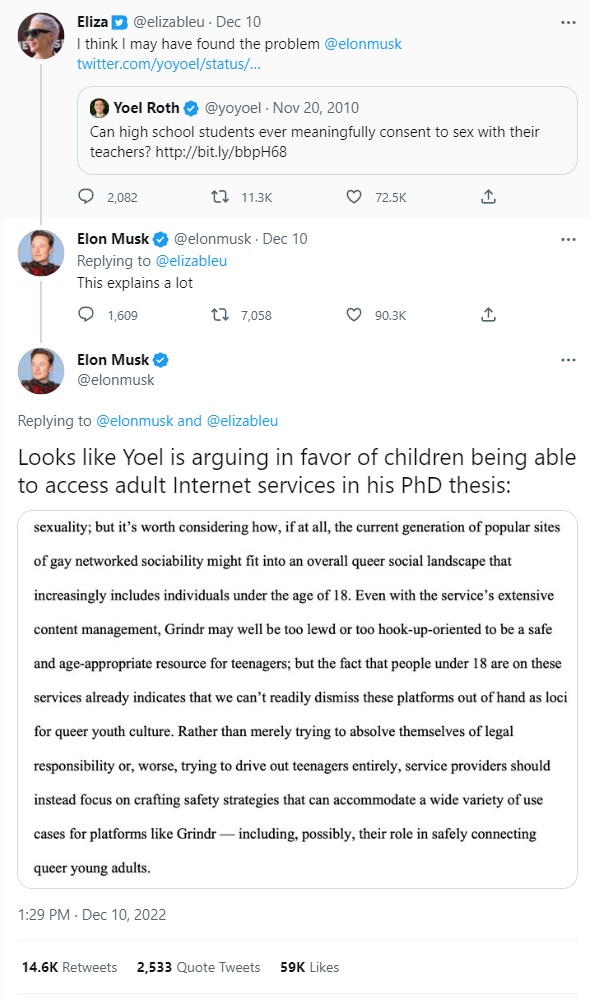
Here is Elon Musk talking about Yoel’s PhD thesis:

Yoel Roth Groomer

You might remember that Twitter also banned a lot of accounts that were critical of “grooming”, including Gay Against Groomers, which is an excellent association of gay people who are extremely opposed to grooming children for sex with adults. But Twitter banned them. Tweeting about grooming got you an immediate ban. I think they also made the #groomer hashtag  illegal. Why so much hostility to people who oppose grooming children for sex, Yoel Roth?

There is a nice thread of his previous tweets here, if you want to understand him better.

Here is something interesting from Heavy.com:

Roth is married. He wrote, “This reminds me of the time both of my husband’s boots suffered cascading failures 2 days into a hiking trip in a remote part of Japan. Turns out Japanese super-glue is extremely effective.”

Roth is male, and he has a husband. Not a wife.

N.T. Wright: what is the best explanation for the early belief in a bodily resurrection?

Here’s a lecture from N.T. Wright, whose multi-volume case for the historicity of the bodily resurrection of Jesus seems to be getting a lot of respect from the other side, (although I strongly disagree with his economic and political views, which are progressive). Wright has taught at Cambridge University, Oxford University, Duke University, McGill University, and lectured on dozens of prestigious campuses around the world. He’s published 40 books.

Here’s a video of his case for the resurrection:

You can read an article similar to the lecture here.

N.T. Wright’s historical case for the bodily resurrection of Jesus

Wright basically argues that the resurrection cannot have been a myth invented by the early Christian community, because the idea of the Messiah dying and being bodily resurrected to eternal life was completely unexpected in Jewish theology, and therefore would not have been fabricated.

In Judaism, when people die, they stay dead. At the most, they might re-appear as apparitions, or be resuscitated to life for a while, but then die again later. There was no concept of the bodily resurrection to eternal life of a single person, especially of the Messiah, prior to the general resurrection of all the righteous dead on judgment day.

Wright’s case for the resurrection has 3 parts:

  • The Jewish theological beliefs of the early Christian community underwent 7 mutations that are inexplicable apart from the bodily resurrection of Jesus
  • The empty tomb
  • The post-mortem appearances of Jesus to individuals and groups, friends and foes

Here’s the outline of Wright’s case:

The Christian claim from the beginning was that the question of Jesus’s resurrection was a question, not of the internal mental and spiritual states of his followers a few days after his crucifixion, but about something that had happened in the real, public world.

This “something” left not only an empty tomb, but a broken loaf at Emmaus and footprints in the sand by the lake among its physical mementoes. It also left his followers with a lot of explaining to do, but with a transformed worldview which is only explicable on the assumption that something really did happen, even though it stretched their existing worldviews to breaking point.

What I want to do here is to examine this early Christian claim, to ask what can be said about it historically, and to enquire, more particularly, what sort of “believing” we are talking about when we ask whether we – whether “we” be scientists or historians or mathematicians or theologians – can “believe” that which “the resurrection” actually refers to.

And here are the 7 mutations:

  1. Christian theology of the afterlife mutates from multiples views (Judaism) to a single view: resurrection (Christianity). When you die, your soul goes off to wait in Sheol. On judgment day, the righteous dead get new resurrection bodies, identical to Jesus’ resurrection body.
  2. The relative importance of the doctrine of resurrection changes from being peripheral (Judaism) to central (Christianity).
  3. The idea of what the resurrection would be like goes from multiple views (Judaism) to a single view: an incorruptible, spiritually-oriented body composed of the material of the previous corruptible body (Christianity).
  4. The timing of the resurrection changes from judgment day (Judaism) to a split between the resurrection of the Messiah right now and the resurrection of the rest of the righteous on judgment day (Christianity).
  5. There is a new view of eschatology as collaboration with God to transform the world.
  6. There is a new metaphorical concept of resurrection, referred to as being “born-again”.
  7. There is a new association of the concept of resurrection to the Messiah. (The Messiah was not even supposed to die, and he certainly wasn’t supposed to rise again from the dead in a resurrected body!)

There are also other historical puzzles that are solved by postulating a bodily resurrection of Jesus.

  1. Jewish people thought that the Messiah was not supposed to die. Although there were lots of (warrior) Messiahs running around at the time, whenever they got killed, their followers would abandon them. Why didn’t Jesus’ followers abandon him when he died?
  2. If the early Christian church wanted to communicate that Jesus was special, despite his shameful death on the cross, they would have made up a story using the existing Jewish concept of exaltation. Applying the concept of bodily resurrection to a dead Messiah would be a radical departure from Jewish theology, when an invented exaltation was already available to do the job.
  3. The early church became extremely reckless about sickness and death, taking care of people with communicable diseases and testifying about their faith in the face of torture and execution. Why did they scorn sickness and death?
  4. The gospels, especially Mark, do not contain any embellishments and “theology historicized”. If they were made-up, there would have been events that had some connection to theological concepts. But the narratives are instead bare-bones: “Guy dies public death. People encounter same guy alive later.” Plain vanilla narrative.
  5. The story of the women who were the first witnesses to the empty tomb cannot have been invented, because the testimony of women was inadmissible under almost all circumstances at that time. If the story were invented, they would have invented male discoverers of the tomb. Female discovers would have hampered conversion efforts.
  6. There are almost no legendary embellishments in the gospels, while there are plenty in the later gnostic forgeries. No crowds of singing angels, no talking crosses, and no booming voices from the clouds.
  7. There is no mention of the future hope of the general resurrection, which I guess they thought was imminent anyway.

To conclude, Wright makes the argument that the best explanation of all of these changes in theology and practice is that God raised Jesus (bodily) from the dead. There is simply no way that this community would have made up the single resurrection of the Messiah – who wasn’t even supposed to die – and then put themselves on the line for that belief.

And remember, the belief in a resurrected Jesus was something that the earliest witnesses could really assess, because they were the ones who saw him killed and then walking around again after his death. They were able to confirm or deny their belief in the resurrection of Jesus based on their own personal experiences with the object of those beliefs.