
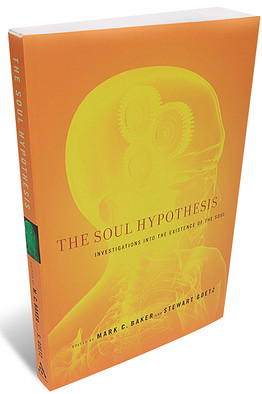
New collection of essays published to defend mind-body dualism

Here’s the new book on J.P. Moreland’s web site.

Full text:

In the Soul Hypothesis: Investigations into the Existence of the Soul (Continuum), co-editors Mark C. Baker and Stewart Goetz have assembled an impressive interdisciplinary team of scholars to address questions about the existence and nature of the soul.

“The Soul of the Matter” – Charles Taliaferro
“Minds, Brains and Brains in Vats” – Daniel N. Robinson
“Brains and Souls; Grammar and Speaking” – Mark Baker
“Making Things Happen: Souls in Action” – Stewart Goetz
“Energy of the Soul” – Robin Collins
“The Measure of All Things: Quantum Mechanics and the Soul” – Dean Zimmerman
“From Seeing to Seer” – Hans Halvorson
“Souls Beastly and Human” – William Hasker
“A Scientific Case for the Soul” – Robin Collins

You can preview the book here.

The book is unique is combining philosophical and scientific arguments for dualism, and the result is a rigorous, exciting, persuasive presentation of the issues and a stimulating challenge to so much of the reductionism that reigns in the sciences. As was noted in a recent review of the book in the WSJ,

Sooner or later, the contributors to “The Soul Hypothesis” warn, scientists will pinpoint the exact three neurons whose firing accompanies the thought of our deciding to make a phone call or, if you prefer, deciding to get up and get a beer from the refrigerator. As ever more such micro-couplings are observed, we will—so scientists tell us with unseemly glee— gradually come to see that our cherished conscious life is nothing but a long series of electrical impulses, not an autonomous realm of free will and free thought. Co-editor Mark C. Baker cites the psychologist Steven Pinker, who finds it plausible to say that neural “activity in the brain” simply “is the mind.”

The book’s contributors set out this scientific challenge fully and engagingly, but they also expose its fallacies. They note, for instance, that even if two things differ in their essential nature, as do mental thoughts and physical actions—or legislatures and laws—there is no reason why the one can’t cause the other. As David Hume argued, what establishes our idea of cause and effect is the regular “conjunction” of two events. That a physical act regularly follows a mental decision suggests, as co-editor Stewart Goetz writes, that the one is “causing” the other and that voluntary human action exists.

The Soul Hypothesis is an excellent text that is sure to provoke a vigorous dialog about its content. I highly recommend it.

I really would like to be able to use this argument more – I just need a good book. I’m a big admirer of Charles Taliaferro. I even met him once at a conference!

A great article that explains what is at stake with “net neutrality”

From the American Spectator. (H/T ECM)

Excerpt:

Yet, without compelling reason, law or even politics on their side, on December 21, on a 3-2 party line vote, the FCC voted to impose its “net neutrality” rules on the Internet. What net neutrality means is that the government now has the power to decide how ISPs and broadband operators manage the access they provide to the Internet. It is as if the government decided to regulate how FedEx delivers its overnight mail, and what routes and what vehicles they use.

The FCC starts out by proclaiming that its net neutrality rules are just meant to ensure equal access by all to the Web. But as George Orwell showed us, that is how socialism started out too, until we later discovered that some were more equal than others. Once the founding principle is laid for government regulation and control, then that power can be used to regulate and control access to the Internet “in the public interest.” In English translation, that means in the special interest of the Ruling Class. There are precedents in China and Iran for how that has worked out in practice.

Dissenting FCC Commissioner Robert McDowell explained further in the Wall Street Journal on December 20 why the FCC’s net neutrality regulation makes no sense:

Nothing is broken and needs fixing, however. The Internet has been open and freedom-enhancing since it was spun off from a government research project in the early 1990s. Its nature as a diffuse and dynamic global network of networks defies top-down authority. Ample laws to protect consumers already exist. Furthermore, the Obama Justice Department and the European Commission both decided this year that net neutrality regulation was unnecessary and might deter investment in next-generation Internet technology and infrastructure.

But what I have learned in life is that when something doesn’t make sense, that means there is something else behind it that people are trying to hide.

And that is exactly what we have here. For what is behind the FCC’s net neutrality crusade is reflected by an organization calling itself Free Press. That is an Orwellian title in this case, because what Free Press is for is the opposite of a free press. Free Press is one of those pseudo-Marxist front groups that Barack Obama has always traveled with so easily throughout his life. It is a grown-up, slick, sophisticated version of those campus radicals who shout down college speakers with whom they don’t agree.

That is what Free Press is after with its “net neutrality” regulation. It is laying the groundwork for government control of the Internet. Once that it is established, it will be able to shout down websites with which it doesn’t agree, if not shut them out altogether.

The entering wedge for net neutrality so far is not public freedom to access and navigate the Internet, which no one can credibly claim is not currently as free as could be. The entering wedge for now is use of Internet access and broadband services by competing commercial concerns like Netflix and YouTube, which consume huge proportions of bandwidth that can consequently interfere with use by consumers and others.

The problem has not become unmanageable yet, but threatens to be. The concern is that broadband operators will limit use of their service by other commercial operations that are effectively bandwidth hogs, to preserve the viability of their service for the general public, which is exactly what they should do. The supposed purpose of net neutrality regulation so far is to prevent broadband operators from doing this.

The solution is for broadband operators to charge heavier commercial users of their service heavier fees to cover the costs. Those heavier fees can then be used to build even bigger and better broadband and Cyberspace access, sufficient to fully accommodate even the heaviest commercial broadband users.

But that [solution] doesn’t involve the expanded government power that Obama’s FCC and net neut advocates like Free Press are after. So it is not on the table as the answer. Government takeover is the only answer they will consider, just as in health care. But if the government is going to take control over the big investment bucks broadband providers put in the ground or into orbit, America is not going to get the Internet investment and access it needs. That is why America’s Internet access is already lagging behind other countries.

[…]This FCC episode raises a broader question about the Obama Administration in the next two years. Because what we see here is what we are already seeing elsewhere in the Administration as well, from HHS Secretary Sebelius’s takeover of health insurance, to the EPA’s takeover of the economy based on global warming fantasies. That broader question is: Are we going to be governed by democracy and the rule of law in America, or not?

Worth reading. I am trying to write about the problems in Obamacare and with the EPA raising energy costs on American consumers and businesses. But taking over the Internet could be an even bigger disaster if the government can prevent the truth about what they are doing from being reported.

What if Christians were treated like Muslims and vice versa?

ECM found this neat article in Human Events, a conservative news magazine.

Excerpt:

If Christians were treated like Muslims, conspicuous Christianity would be celebrated by our elites as a sign of our diversity and open-mindedness, not disparaged as an embarrassment, a nuisance and a breach of the law.

If Christianity were treated like Islam, our students would be taught a white-washed version of Christian history, with the troubling bits miscast or omitted from textbooks and lesson plans.

If Christianity were treated like Islam, if an evangelical Christian committed an evil act in the name of his faith, he would be portrayed in the media as a deviation from, not a personification of, the Gospel message. Meanwhile, our political and media elites would hasten to assure the public that evangelical Christianity is a religion of peace and that the vast majority of evangelical Christians do not support terrorism.

[…]If Christianity were treated like Islam, Christmas and Easter would be publicly celebrated for what they are — the signature events of Christianity, marking the birth and the death and Resurrection of Christ — not stripped of all their theological meaning and transformed into secular holidays devoted to crass consumerism.

If Christians were treated like Muslims, NASA would be tasked with reaching out to Christians and recognizing their faith’s profound achievements and contributions to science, math and engineering, instead of being told to make Muslims feel good about their rather meager scientific accomplishments.

[…]If Christians were treated like Muslims in America, amusement parks would celebrate “Christian Family Day,” (Six Flags recently celebrated “Muslim Family Day”), and Christians would be asked to embrace, not set aside, their religious convictions at the door when they entered the public square. Meanwhile, Muslim imams, not Christian pastors, would fear hate crimes lawsuits for preaching orthodox views of sexuality and sin.

This is a pretty clever article, and I wish I had written it.

Non-Christian sometimes ask me whether I believe in Hell and whether I think that they are going there. And the answer is YES, I do believe in Hell, and YES, they are going there. And one of the reasons why they are going there to roast for an eternity (oh yes, I have the traditional view of Hell) is because of the way that people treat Christians in the here and now. I am talking about in the university, in the the news media, and in Hollywood. Christians always seem to be the only group that you can make feel bad for what they believe. I think that this factor will play a significant part in the degree of punishment that non-Christians get in the afterlife. (And that doesn’t mean that I’m going to treat them people badly because my goal is to persuade people and that means being nice to them).

Here’s a tip for non-Christians who read my blog. You can fight with Christians all you like about whether Christianity is true, and no harm done. But whatever you do, do not be found on that day guilty of making us feel bad about our faith. Do not make it harder for us to be who we are. Do not be one of the people who pressures us to keep silent about what we believe. I understand that non-Christians do not like the things we do, like chastity and sobriety and being pro-life and pro-marriage. Those are good things that prevent harm and evil, and they should not be opposed.