Communist China interfered in Canadian elections to help Justin Trudeau

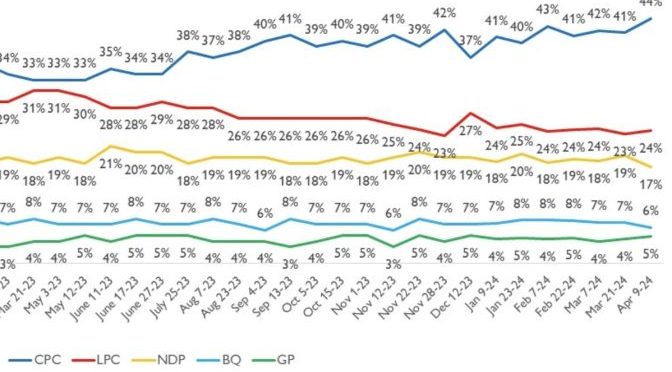
According to a recent Abacus Data Poll, the Conservative Party of Canada is now leading the Liberal Party 44% to 24%, putting the conservatives in a position to win a supermajority of Canadian ridings. But now news is emerging that foreign nations interfere in Canadian elections, and Liberal Party leader Justin Trudeau not only knew about it, but he let it happen.

Here’s the story from The Federalist:

On Monday, Ottawa’s lead spy agency, the Canadian Security Intelligence Service (CSIS), confirmed that Communist China interfered in Canada’s 2019 and 2021 federal elections. These efforts “focused primarily on supporting those viewed to be either ‘pro-PRC’ or ‘neutral’ on issues of interest to the [Chinese] government,” a slide shown to Canadian officials reads, according to Reuters.

According to The Toronto Star, the briefing provided to the Foreign Interference Commission further revealed that, during the 2021 contest, the CCP specifically aimed “to deter Canadians, especially those ‘of Chinese heritage,’ from backing the Conservative party, then-leader Erin O’Toole, and B.C. Conservative candidate Kenny Chiu.” Conservative candidates took a hardline approach to China during the 2021 campaign, often highlighting the CCP’s brutal treatment of Uyghurs and criticizing Huawei, a Chinese tech giant suspected of facilitating spyware for Beijing.

Chiu ultimately lost his 2021 election bid, while Trudeau’s Liberal Party won both the 2019 and 2021 elections.

The language of the articles that interfered with the elections was similar to the language of articles published by Communist China’s state-run media:

“The timing of these efforts to align with Conservative polling improvement; the similarities in language with articles published by PRC state media; and the partnership agreements between these Canada-based outlets and PRC entities; all suggest that these efforts were orchestrated or directed by the PRC,” the CSIS assessment reads, according to the Star.

Trudeau is using all of his authority as a part-time drama teacher and former snowboarding instructor to explain why people should believe him, rather than believe Canada’s most prestigious intelligence agency:

Despite CSIS’s findings, Trudeau seemingly isn’t convinced that China’s 2021 efforts were designed to benefit the Liberal Party.

According to The Epoch Times, the prime minister cast doubt on intelligence suggesting Beijing was attempting to boost his party’s electoral prospects, saying: “While individual officials may well have expressed a preference or another … it would just seem very improbable that the Chinese government itself would have a preference in the election.”

As noted above, these remarks contradict the intelligence provided by CSIS, which highlighted the CCP’s aim to undermine Conservative Party candidates.

The next Canadian election is scheduled for October 2025, unless the Liberal Party fascists fail a no-confidence vote. So far, the communist New Democrat Party has been backing the fascist Liberal Party every time a no-confidence vote has been held, including supporting the fascist Liberal Party’s back-breaking carbon tax.

But there are signs that support may be ending, as more and more NDP voters are turning away from the communist NDP. A recent article from the state-run propaganda outlet CBC states “NDP MPs Charlie Angus, Carol Hughes and Rachel Blaney all announced Thursday that they will not be seeking re-election.”

You’ll notice from the recent poll I posted above that the communist NDP’s numbers are also declining. They know that the writing is on the wall, and a quick election is their best hope for not losing ALL of their voters. The longer that Canadian voters have to live under the poverty-inducing policies of the fascist-communist coalition, the worse the results will be for the secular left.

Peter J. Williams debates Bart Ehrman on his book “Misquoting Jesus”

I have to re-post this debate between Bart Ehrman and Peter J. Williams, because Dr. Williams just followed me on Twitter. I noticed that he had re-tweeted one of the two senators I follow on Twitter, so I re-tweeted him. I like Tom Cotton and Josh Hawley, and he re-tweeted Senator Hawley talking about free speech.

Bart Ehrman posted the debate audio on YouTube:

Details:

Bart Ehrman is the US author of the bestselling book “Misquoting Jesus” (In the UK “Whose word is it?”).  He calls into question the authority of the New Testament as scribal changes over time have changed the documents.

So can we trust the scripture? Bible scholar Peter Williams believes in the reliability of the New Testament and that Bart’s prognosis is far too pessimistic.

This post is a re-post from 2011. I have been listening to this lecture by Peter J. Williams on “Misquoting Jesus” this week, and it reminded me to re-post this debate. (I checked to make sure the MP3 link is still good, and it is)

Summary of the Williams-Ehrman debate:

Note: this summary is snarky. If you want an accurate view of the debate, then listen to it. My summary is meant to be humorous.

Ehrman:

  • I had a mystical experience in childhood and became an evangelical Christian
  • I went to Moody Bible Institute, and they told me that the Bible was inerrant
  • For a while, I was committed to the view that there are no mistakes in the Bible
  • At Princeton, I was taught and graded by professors who did not accept inerrancy
  • By a strange coincidence, I began to see that the Bible did have errors after all!
  • We don’t have the original documents written by the original authors, we only have thousands of copies
  • if the words of the Bible are not completely inerrant, then none of it is historical
  • if all of the words in all the copies of the Bible are not identical, then none of it is historical

Williams:

  • I would say the New and Old testaments are the Word of God
  • We don’t need to have the original Greek writings in order to believe in the authority of the Bible
  • I believe in inerrancy, but doesn’t mean there are no problems
  • the doctrine of inerrancy has always referred to the original Greek copies, not the translations

Moderator:

  • what are the main points of Misquoting Jesus?

Ehrman:

  • we don’t have the originals of any of the books of the New Testament
  • we have copies that are much later, sometimes even centuries later!!1!
  • the copies we have all differ from one another – they were changed by scribes!!1!
  • we have 5000 manuscripts in the original Greek language
  • there are hundreds of thousands of differences!!1!
  • most of the differences don’t matter
  • some differences are significant for meaning or doctrine
  • errors are propagated because the next scribe inherits the mistake of their source copy
  • a large gap between the time of writing and the first extant copy means more errors have crept in

Williams:

  • the reason we have so many variants is because the number of manuscripts is large

Angry Jesus or compassionate Jesus in Mark

Ehrman:

  • most manuscripts say that Jesus was compassionate when healing a leper, but one says he was angry
  • it makes a huge huge huge really really big difference if Jesus is compassionate or angry
  • the whole Bible needs to be thrown out because of this one word between different in one manuscript

Williams:

  • this variant is important for understanding the passage, but it has no great meaning
  • the change is probably just an accident – the two words are very similar visually in Greek
  • it’s just an accident – it emerged in one manuscript, and it impacted a few more
  • the tiny number of manuscripts that have the error are geographically isolated
  • I’m pretty sure that WK prefers the angry Jesus anyway – so who cares?

Ehrman:

  • no! someone changed it deliberately! it’s a conspiracy! you should buy my book! it’s a *big deal*!!!!!1!!1!one!!eleventy-one!

The woman caught in adultery in John

Ehrman:

  • it is isn’t in any of the earliest manuscripts
  • this is an apocryphical story that some scribe deliberately inserted into the text
  • most people don’t even know about this! it’s a cover-up! you need to buy my scandalous book!

Williams:

  • that’s right, it’s a late addition by some overzealous scribe
  • and it’s clearly marked as such in every modern Bible translation
  • the only people who don’t know about this are people who don’t read footnotes in their Bible
  • and in any case, this isn’t a loss of the original words of the New Testament – it’s an addition

Grace of God or apart from God in Hebrews

Ehrman:

  • well this is just a one word difference, but it makes a huge huge really really big difference!
  • the words are very similar, so it’s could be an accident I guess
  • but it wasn’t! this was a deliberate change! it’s a conspiracy! it’s a cover-up! scandal!
  • buy my book! It’s almost as good as Dan Brown!

Moderator:

  • hmmmn…. I kind of like “apart from God” – why is this such a big scandal again?

Ehrman:

  • you don’t care? how can you not care? it has to be inerrant! or the whole thing is false!
  • Moody Bible Institute says!

Williams:

  • yeah Bart is always saying that every change is deliberate but it’s just an accident
  • the words are very similar, just a few letters are different, this is clearly an accident
  • I have no problem with apart from God, or by the Grace of God
  • please move on and stop screaming and running around and knocking things over

Moderator:

  • but what if pastors try to use this passage in a sermon?

Williams:

  • well, one word doesn’t make a big different, the meaning that appears is fine for preaching
  • it’s only a problem for people who treat the Bible as a magic book with magical incantations
  • they get mad because if one word is out of place then the whole thing doesn’t work for their spell
  • then they try to cast happiness spells but the spells don’t work and they experience suffering
  • the suffering surprises them since they think that fundamentalism should guarantee them happiness
  • then they become apostates and get on TV where they look wide-eyed and talk crazy

Ehrman:

  • hey! are you talking about me? a lot of people buy my books! i am a big success!
  • it is very important that people don’t feel bad about their sinning you know!

Is Misquoting Jesus an attack?

Williams:

  • it’s rhetorically imbalanced and misleading
  • it tries to highlight change and instability and ignore the majority of the text that is stable
  • he makes a big deal out of 5 or so verses that are different from the mainstream text
  • he says that scribes deliberately changed the scriptures, but he doesn’t prove that
  • it’s just as likely that the differences are just scribal errors made by accident

Ehrman:

  • well, maybe the variants aren’t a big deal, but what about one angel vs. two angels?
  • that’s a significant issue! significant enough for me to become an apostate – a rich apostate
  • if one word is different because of an accident, then the whole Bible cannot be trusted
  • it has to be completely inerrant, so a one word difference means the whole thing is unreliable
  • we don’t even know if Jesus was even named Jesus, because of one angel vs two angels!!!1!
  • buy my book! you don’t have to read it, just put it on your shelf, then you’ll feel better about not having a relationships with God – because who’s to say what God really wants from you? Not the Bible!

There are Roman Catholics in my family but I’m not one: why not?

In this post, I explain why I’m not Roman Catholic. And I also explain how Protestant Christians arrive at their beliefs. We’ll start with J. Warner Wallace on Purgatory, then I’ll go second.

Purgatory

Here’s the first article from Cold Case Christianity, by the Master of the Evidence J. Warner Wallace. He writes about the Roman Catholic doctrine of purgatory, and his experience with studying and then rejecting it.

Here is his introduction:

The notion of purgatory assumes many of us die with unforgiven sins that need to be purged from our account; some of us are not good enough to go to heaven, but not bad enough to go to hell. Purgatory, therefore, is a temporary, intermediate place (or state of being) where good deeds and works can be performed in order to purge our impurity prior to our final destiny with God. Although millions of Catholics believe purgatory to be a reality, the idea needs to be tested in light of the Scripture. Is purgatory something we, as Bible believing Christians, should accept as true?

He’s got a stack of Bible verses to make two points against Purgatory: first, that Jesus’ death on the cross is sufficient to atone for all our rebellion against God, and we don’t need to endure any suffering or punishment to supplement it. And second, the teaching about the afterlife in the Bible says that believers are immediately ushered into the presence of God after they die (without resurrection bodies, yet), while unbelievers are separated away from God.

Here’s what he says about the first point:

Our Salvation Isn’t Based On Our Good Works
According to the Biblical doctrine of Salvation, forgiveness is not based on the good works of the believer. For this reason, deeds or works performed for those in purgatory are both unnecessary and ineffectual:

Romans 3:21-24, 27-28
But now a righteousness from God, apart from law, has been made known, to which the Law and the Prophets testify. This righteousness from God comes through faith in Jesus Christ to all who believe. There is no difference, for all have sinned and fall short of the glory of God, and are justified freely by his grace through the redemption that came by Christ Jesus… Where, then, is boasting? It is excluded. On what principle? On that of observing the law? No, but on that of faith. For we maintain that a man is justified by faith apart from observing the law.

Romans 8:1
Therefore, there is now no condemnation for those who are in Christ Jesus, because through Christ Jesus the law of the Spirit of life set me free from the law of sin and death. For what the law was powerless to do in that it was weakened by the sinful nature, God did by sending his own Son in the likeness of sinful man to be a sin offering.

Our Salvation Is Based On Jesus’ Work on the Cross
According to the Biblical doctrine of Salvation, Jesus’ work on the cross (His blood) purifies us from allsin. For this reason, there isn’t a lingering sin problem requiring the existence of a place like purgatory:

Titus 2:13-14
…we wait for the blessed hope—the glorious appearing of our great God and Savior, Jesus Christ, who gave himself for us to redeem us from all wickedness and to purify for himself a people that are his very own, eager to do what is good.

1John 1:7b
…the blood of Jesus, his Son, purifies us from all sin.

1John 1:9b
…he is faithful and just and will forgive us our sins and purify us from all unrighteousness.

1John 2:2
He is the atoning sacrifice for our sins, and not only for ours but also for the sins of the whole world.

Hebrews 10:14
…because by one sacrifice he has made perfect forever those who are being made holy.

Our Salvation Has, Therefore, Already Been Guaranteed
According to the Biblical doctrine of Salvation, Jesus has already purified and purged believers of sin based on our faith in Him. For this reason, there is no need for a place like Purgatory where additional purging must be performed…

[…]The Biblical doctrine of Salvation clearly eliminates the need for purgatory.

I was never able to find anything in the Bible to support purgatory. It’s a very very late doctrine that was unknown to the early church until the late 2nd / early 3rd century, where it is spoken about by a handful of people. But lots of weird doctrines were creeping up on the fringe around that time, so we shouldn’t be surprised… the point is that they have no support from the Bible, and not in the community of believers for the first 150 years after the death of Jesus.

The bodily assumption of Mary

Anyway, my turn now. The Roman Catholic church teaches that Mary was “bodily assumed” into Heaven. Let’s see if that is in the Bible or in the early church.

Here’s what I found:

  1. To be a Roman Catholic, you need to believe in Papal infallibility in matters of dogma.
  2. In 1950, the Pope pronounced the assumption of Mary to be infallible dogma.
  3. This pronouncement was solicited by a petition featuring over 8 million signatures.
  4. There is no historical record of this doctrine in the Bible.
  5. No early church father mentions the assumption until 590 AD.
  6. Documents dated 377 AD state that no one knows how Mary died.
  7. The assumption appears for the first time in an apocryphal gospel dated about 495 AD.

Data

I only cite Roman Catholic sources for my facts.

6. “But if some think us mistaken, let them search the Scriptures. They will not find Mary’s death; they will not find whether she died or did not die; they will not find whether she was buried or was not buried … Scripture is absolutely silent [on the end of Mary] … For my own part, I do not dare to speak, but I keep my own thoughts and I practice silence … The fact is, Scripture has outstripped the human mind and left [this matter] uncertain … Did she die, we do not know … Either the holy Virgin died and was buried … Or she was killed … Or she remained alive, since nothing is impossible with God and He can do whatever He desires; for her end no-one knows.” (Epiphanius, Panarion, Haer. 78.10-11, 23. Cited by Juniper Carol, O.F.M. ed.,Mariology, Vol. II (Milwaukee: Bruce, 1957), pp. 139-40).

7. “The idea of the bodily assumption of Mary is first expressed in certain transitus–narratives of the fifth and sixth centuries. Even though these are apocryphal they bear witness to the faith of the generation in which they were written despite their legendary clothing. The first Church author to speak of the bodily ascension of Mary, in association with an apocryphal transitus B.M.V., is St. Gregory of Tours.” (Ludwig Ott, Fundamentals of Catholic Dogma(Rockford: Tan, 1974), pp. 209–210).

It should be noted that the apocryphal gospel in which the doctrine of the assumption of Mary first appeared was condemned as heretical by two Popes in the 5th and 6th centuries. However, I was not able to find a CATHOLIC source for this fact, so I deliberately chose not to use it in my case.

Conclusion

The first thing I want to say is that the Bible is not the only place you look to decide these issues. You also look in church history, and you are looking for a clear chain of custody of the doctrine as far back as it can go. Purgatory and the perpetual virginity of Mary have some track record, but the bodily assumption of Mary is just nowhere – not in the Bible, not in the Early Church fathers. So that’s the silver bullet against Roman Catholicism, since they made it “infallible”.

This post is more directed to non-Christians to sort of show you how we do our homework. I am the first Protestant in my family. We have half the family who is Muslim, and the other half mostly Hindu, with some Catholic. I had to debate all these people growing up, and I wiped the floor with them. It was not even close. I simply settled on the beliefs that allowed me to win every argument, every time. That’s how you do religion. If you have to go against your whole family in order to be right, you do it. It’s not good to be wrong about things just because that’s what your family believes. These things were not pushed hard on me by my parents, I studied them on my own in order to win arguments. After a while of winning, I found myself acting consistently with what I was arguing for. Although that might sound really weird to you, that’s probably the right way to do this. Don’t listen to parents and church, find your own way forward by winning arguments, and believing only what the evidence supports.

Although most people think that if I had kids, I’d bully them into my beliefs, I actually would not. Because that’s not what worked on me. What really works is fighting about evidence, welcoming questions, and allowing differences of opinion. Being free to pursue truth is more important in the long run than coercing your kids to act nicely.