According to the Military Times survey, active-duty troops reported a stunning drop in how they rated their overall quality of life: Just 56 percent call it good or excellent, down from 91 percent in 2009. The survey, conducted in July and August, found that 73 percent of troops would recommend a military career to others, down from 85 percent in 2009. And troops reported a significant decline in their desire to re-enlist, with 63 percent citing an intention to do so, compared with 72 percent a few years ago.
[…]Survey data show that service members are also feeling pain in their own wallets. Congress this year capped the military pay raise at 1 percent, rather than the 1.8 percent that would have kept pace with average annual growth in private-sector wages. It was the first military pay raise since 1999 that did not at least keep pace with private-sector wages, and it was also the lowest annual military pay raise in 40 years.
To save money, the Pentagon had sought to roll back the tax-free housing benefit provided to troops by, in effect, making troops pay 5 percent of their housing with out-of-pocket cash. The new deal on Capitol Hill will result in next year’s housing allowance covering 99 percent of estimated costs and troops themselves covering the 1 percent shortfall. Service members are unlikely to see an outright reduction in their housing allowance unless they change duty stations, but rates for troops moving into new areas will be set slightly lower when compared to projected housing costs.
Several services also have cut pay for special duty assignments — such as recruiters, divers, drill sergeants and others — while promotions in some fields slow as competition for jobs during a drawdown heats up. And of course, those troops who have frequently collected hazardous duty and deployment pay over the last decade may now have fewer opportunities to do so.
In 2009, 87 percent of active-duty troops who participated in Military Times’ survey rated their pay and allowances “good” or “excellent.” This year, the figure was just 44 percent. When asked how quality of life might change over the next several years, 70 percent of respondents predicted it would decline further.
A Navy fire controlman chief with 10 deployments said budget fears are contributing to a feeling of distrust and abandonment. “If sailors are worried about not getting paid, how am I supposed to do my job?” he said. “I’m not an effective warfighter if I don’t have the backing of my government at home.”
A pervasive sense of pessimism about the post-9/11 wars may also contribute to the overall feeling of dissatisfaction among troops and a feeling of detachment from the decision-makers who sent them to those fights. Of those surveyed, 52 percent said they had become more pessimistic about the war in Afghanistan in recent years. Nearly 60 percent felt the war in Iraq was somewhat unsuccessful or not at all successful.
[…]Troops today are pocketing far smaller annual pay raises. The 2014 bump of just 1 percent was the smallest in the 41-year history of the all-volunteer force. That compares with 3.9 percent in 2009 — and 6.9 percent in 2002. Congress may well vote to authorize just another 1 percent in 2015. In the best-case scenario, that might go to 1.8 percent.
On top of that, the once-vast pool of cash that flowed directly into service members’ pockets in the form of combat pays and re-enlistment bonuses has dried up. In 2014, troops received $3.8 billion in special pays and incentive pays, down from $6.1 billion, adjusted for inflation, in 2003, according to VisualDoD, a company that tracks Pentagon spending. For 2015, that budget is expected to fall to $3.5 billion.
Now we were in both Aghanistan and Iraq in 2009, at the beginning of the survey period, and morale was very high. What changed in 2009? Soldiers who are deployed want to win a war – they don’t want to be stuck in limbo. They don’t want a leader who views winning a war as an excessive use of force.
UPDATE: Defense policy expert Max Boot has an article explaining why he thinks morale is dropping at Commentary magazine.
There was a story about an alleged gang rape published in the Rolling Stone, which is an ultra-left wing magazine, which came under scrutiny from left-wing news sources like The New Republic and The Washington Post because it was not fact-checked and disagreed with known facts.
Rolling Stone has clarified its apology over a story that had reported a female student was gang-raped at a University of Virginia fraternity, telling readers the mistakes were the magazine’s fault, not the alleged victim’s.
[…]The magazine said that it shouldn’t have agreed to Jackie’s request not to contact the alleged assailants to get their side of the story, out of sensitivity to her. “These mistakes are on Rolling Stone, not on Jackie,” wrote the magazine’s managing editor, Will Dana. “We apologize to anyone who was affected by the story and we will continue to investigate the events of that evening.” The decision not to contact the alleged rapists prompted criticism from other news organizations.
[…]The allegations rocked the campus and elevated the issue of sexual assault, leading to protests, a suspension of fraternity activities and an emergency Board of Visitors meeting.
Dana’s updated message added some details calling into question the magazine’s original story. He noted that Phi Kappa Psi has denied the assault, and said it didn’t host an event on the night Jackie alleged she was raped. And Dana said that Jackie is now unsure that the man who allegedly lured her into a room to be gang-raped by seven men, identified as “Drew,” was a member of Phi Kappa Psi.
“According to the Washington Post, ‘Drew’ actually belongs to a different fraternity and when contacted by the paper, he denied knowing Jackie,” Dana wrote in the new note. “Jackie told Rolling Stone that after she was assaulted, she ran into ‘Drew’ at a UVA pool where they both worked as lifeguards. In its statement, the Phi Psi says none of its members worked at the pool in the fall of 2012.” Dana also cited the Post’s account of several of Jackie’s friends doubting her “narrative,” although Jackie told the Post she stood by the account she gave to Rolling Stone.
False rape charges actually occur quite frequently – remember the Duke University rape hoax or the Lehigh University rape hoax or the Hofstra University rape hoax? The left-wing media loves to cover them because it makes men look bad, and makes women think that they need to vote for bigger government in order to protect them from dangerous men.
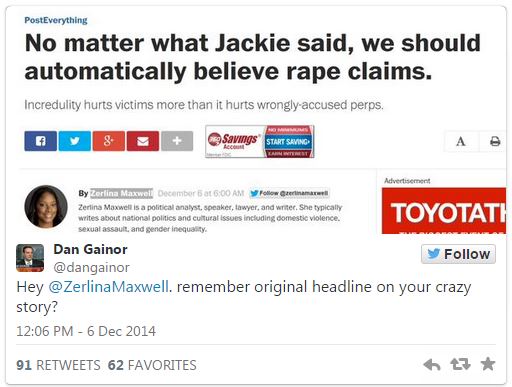
But what’s been fascinating is the reaction of feminists on the left to the Rolling Stone’s apology. Do they care about fact-checking rape charges, or do they think that all rape charges are “automatically” true?
She later changed the title of the article, but the URL still contains the word “automatically”. Automatically – believe the charge before checking the facts.
She writes:
Many people (not least UVA administrators) will be tempted to see this as a reminder that officials, reporters, and the general public should hear both sides of the story and collect all the evidence before coming to a conclusion in rape cases. This is what we mean in America when we say someone is “innocent until proven guilty.” After all, look what happened to the Duke lacrosse players.
In important ways, this is wrong. We should believe, as a matter of default, what an accuser says. Ultimately, the costs of wrongly disbelieving a survivor far outweigh the costs of calling someone a rapist. Even if Jackie fabricated her account, UVA should have taken her word for it during the period while they endeavored to prove or disprove the accusation.
The author’s bio:
Zerlina Maxwell is a political analyst, speaker, lawyer, and writer. She typically writes about national politics and cultural issues including domestic violence, sexual assault, and gender inequality.
This is how people on the left form their beliefs in college. They listen to what professors tell them, and insult anyone who questions what they believe by calling them names like “racist”, “sexist”, “homophobe” or “Islamophobe”. This is a college education – at least in non-STEM fields. People pay money to be indoctrinated like this. Lots of money.
Well, maybe this is just a lone outlier, though. One bad feminist who doesn’t care about truth.
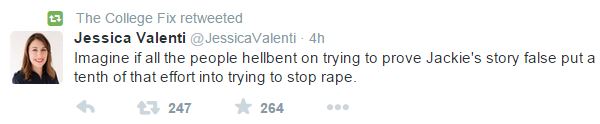
Nope! Here’s famous feminist Jessica Valenti, tweeting this:
Jessica Valenti: fake but accurate
Here’s another from Julia Horowitz, reported by Newsbusters: (links removed)
In a Politico magazine article on the UVA rape accusation debacle, in which the accuser’s allegations have unraveled, Julia Horowitz, an assistant managing editor at the college paper The Daily Cavalier, claimed “to let fact checking define the narrative would be a huge mistake.”
[I]t is becoming increasingly clear that the story that blew the lid off campus sexual assault has some major, major holes. Ultimately, though, from where I sit in Charlottesville, to let fact checking define the narrative would be a huge mistake….
It is no accident that the article came out, and it became apparent almost immediately that there were very tangible things we needed to discuss.
Yes, the story was sensational. But even the most sensational story, it seems, can contain frightening elements of truth.
Of course! Facts can be so, well, inconvenient. Viva the “narrative.” We’re with the Alice in Wonderland Queen: “sentence first — verdict afterwards.”
When the now-retracted article by the Rolling Stone magazine was published on November 19 about a brutal gang rape of a first-year student at the Phi Kappa Psi fraternity house at the University of Virginia (UVA), the major broadcast networks rushed to the story and devoted multiple segments to both the article and reaction on the school’s campus.
[…]The “big three” of ABC, CBS and NBC offered coverage on their evening newscasts over the course of November 23 and 24, with ABC’s World News Tonight and NBC Nightly News covering it on the 23rd. The following night, an additional report was filed by ABC and NBC each to go along with the first from the CBS Evening News with Scott Pelley. On those two evenings alone, the total network coverage was 11 minutes and 14 seconds.
While the three programs combined for just under 8 minutes of thorough coverage on Friday night, that does little to excuse their inability to investigate the story independently or even check the facts of the Rolling Stone piece on their own.
[…]On NBC Nightly News, anchor Brian Williams was the sole anchor to admit that his program had filed stories based off of the very article that he and NBC’s Kristen Welker would now report had major “discrepancies.”
Still, the networks had pitfalls in their coverage of the retraction. As suggested two sentences prior, ABC and CBS failed to join with NBC in not admitting to having previously blindly covered this subject.
Also, CBS and NBC fell short in only interviewing students who, respectively, suggested pieces like this are why victims hesitate coming forward and dismissed the fact that the story is now in severe doubt because the issue of sexual assault is “still a problem” on college campuses “even if it’s not real.”
Now, I thought that people who go to journalism school did nothing but learn how to discover the truth about a story. I thought that it was like police detective work – interviewing witnesses, checking facts, corroborating testimony, digging through records. How wrong I was. But I think I’ll be right about something else – I think a lot of people who read the original story will believe it based on intuitions and emotions, even now after significant portions of the story conflict with known facts. They’ll believe it because that’s what they’ve been brainwashed in non-STEM programs to believe. They’ve become incapable of critical thinking, incapable of updating their views according to evidence and incapable of respectful dialog with those who disagree with them.
This is an older article from Astrobiology magazine, but it shows how important Jupiter is for habitability.
Excerpt:
To a biologist, the ingredients needed to form life include water, heat and organic chemicals. But some in the astrophysics and astronomy community argue that life, at least advanced life, may require an additional component: a Jupiter-sized planet in the solar neighborhood.
“A long-period Jupiter may be a prerequisite for advanced life,” said Dr. Alan Boss, a researcher in planetary formation. Boss, who works at the Carnegie Institution of Washington, is a member of the NASA Astrobiology Institute (NAI).
In our own solar system, Jupiter, with its enormous gravitational field, plays an important protective role. By deflecting comets and asteroids that might otherwise hit Earth, Jupiter has helped to create a more stable environment for life to evolve here. It’s generally believed that a massive impact was responsible 65 million years ago for wiping out dinosaurs on Earth. If not for Jupiter, it’s possible that many other such impacts would have occurred throughout Earth’s history, preventing advanced life from ever gaining a foothold.
Jupiter is significant not only for its size but also for its location in our solar system, far from the Sun. Because it orbits at slightly more than 5 AU (astronomical units the distance between the Earth and the Sun is 1 AU), there is plenty of room in the inner part of our Solar System to accommodate a range of smaller planets.
Within the inner solar system there exists a region, known as the habitable zone, where liquid water, and therefore life, can potentially exist on a planet’s surface. Without liquid water, life as we know it is not possible. The habitable zone around our Sun stretches roughly from the orbit of Venus to the orbit of Mars. Venus is generally believed to be too hot to support life. Earth, it appears, is just right. And the jury is still out on Mars.
Understanding the role that Jupiter plays in our own Solar System helps astronomers focus their search for habitable planets around other stars. “If,” Boss explains, “a Jupiter-mass planet on a stable, circular orbit [around another star at] around 4 to 5 AU was found, without any evidence for other gas giant planets with shorter period orbits, such a discovery would be like a neon light in the cosmos pointed toward that star, saying ‘Look here!’. That star would be a prime target for looking for a habitable, Earth-like planet.”
People who are not curious about science sort of take these blessings for granted and push away the God who is responsible for the clever life-permitting design of our habitat. In contrast, theists are curious and excited about what science tells us about the Creator. Theists care about science, but naturalists have to sort of keep experimental science at arm’s length – away from the presuppositions and assumptions that allow them to have autonomy to live life without respect, accountability and gratitude. Naturalists take refuge in the relief provided by speculative science and science fiction. They like to listen to their leaders speculate about speculative theories, and willingly buy up books by snarky speculators who think that nothing is really something (Krauss), or who think that the cosmic fine-tuning is not real (Stenger), or who think that silicon-based life is a viable scenario (Rosenberg), etc. But theists prefer actual science. Truth matters to us, and we willingly adjust our behavior to fit the scientific facts.





 WINTERY KNIGHT