Is Fox News biased? Two peer-reviewed studies shed light on news media bias

Let’s take a look at peer-reviewed academic studies of media bias and see whether Fox News is biased.

Here’s a UCLA study on media bias.

Excerpt:

Of the 20 major media outlets studied, 18 scored left of center, with CBS’ “Evening News,” The New York Times and the Los Angeles Times ranking second, third and fourth most liberal behind the news pages of The Wall Street Journal.

Only Fox News’ “Special Report With Brit Hume” and The Washington Times scored right of the average U.S. voter.

The most centrist outlet proved to be the “NewsHour With Jim Lehrer.” CNN’s “NewsNight With Aaron Brown” and ABC’s “Good Morning America” were a close second and third.

“Our estimates for these outlets, we feel, give particular credibility to our efforts, as three of the four moderators for the 2004 presidential and vice-presidential debates came from these three news outlets — Jim Lehrer, Charlie Gibson and Gwen Ifill,” Groseclose said. “If these newscasters weren’t centrist, staffers for one of the campaign teams would have objected and insisted on other moderators.”

The fourth most centrist outlet was “Special Report With Brit Hume” on Fox News, which often is cited by liberals as an egregious example of a right-wing outlet. While this news program proved to be right of center, the study found ABC’s “World News Tonight” and NBC’s “Nightly News” to be left of center. All three outlets were approximately equidistant from the center, the report found.

“If viewers spent an equal amount of time watching Fox’s ‘Special Report’ as ABC’s ‘World News’ and NBC’s ‘Nightly News,’ then they would receive a nearly perfectly balanced version of the news,” said Milyo, an associate professor of economics and public affairs at the University of Missouri at Columbia.”

Here’s a Harvard University study on media bias.

Excerpt:

The programming studied on Fox News offered a somewhat more positive picture… of Republicans and more negative one of Democrats compared with other media outlets. Fox News stories about a Republican candidate were most likely to be neutral (47%), with the remainder more positive than negative (32% vs. 21% negative). The bulk of that positive coverage went to Giuliani (44% positive), while McCain still suffered from unflattering coverage (20% positive vs. 35% negative).

When it came to Democratic candidates, the picture was more negative. Again, neutral stories had a slight edge (39%), followed by 37% negative and 24% positive. And, in marked contrast from the rest of the media, coverage of Obama was twice as negative as positive: 32% negative vs. 16% positive and 52% neutral.

But any sense here that the news channel was uniformly positive about Republicans or negative about Democrats is not manifest in the data.”

From the Washington Examiner, a study of the political contributions made by the mainstream media.

Excerpt:

Senior executives, on-air personalities, producers, reporters, editors, writers and other self-identifying employees of ABC, CBS and NBC contributed more than $1 million to Democratic candidates and campaign committees in 2008, according to an analysis by The Examiner of data compiled by the Center for Responsive Politics.

The Democratic total of $1,020,816 was given by 1,160 employees of the three major broadcast television networks, with an average contribution of $880.

By contrast, only 193 of the employees contributed to Republican candidates and campaign committees, for a total of $142,863. The average Republican contribution was $744.

[…]The data on contributions by broadcast network employees was compiled by CRP at the request of The Examiner and included all 2008 contributions by individuals who identified their employer as one of the three networks or subsidiaries. The data does not include contributions by employees of the three networks who did not identify their employer.

The CRP is the organization behind OpenSecrets.org, the web site that for more than a decade has put campaign finance data within reach of anybody with an Internet connection.

President Obama received 710 such contributions worth a total of $461,898, for an average contribution of $651 from the network employees. Republican presidential nominee Sen. John McCain received only 39 contributions totaling $26,926, for an average donation of $709.

And more from a study done by the radically leftist MSNBC.

Excerpt:

MSNBC.com identified 143 journalists who made political contributions from 2004 through the start of the 2008 campaign, according to the public records of the Federal Election Commission. Most of the newsroom checkbooks leaned to the left: 125 journalists gave to Democrats and liberal causes. Only 16 gave to Republicans. Two gave to both parties.

The donors include CNN’s Guy Raz, now covering the Pentagon for NPR, who gave to Kerry the same month he was embedded with U.S. troops in Iraq; New Yorker war correspondent George Packer; a producer for Bill O’Reilly at Fox; MSNBC TV host Joe Scarborough; political writers at Vanity Fair; the editor of The Wall Street Journal’s weekend edition; local TV anchors in Washington, Minneapolis, Memphis and Wichita; the ethics columnist at The New York Times; and even MTV’s former presidential campaign correspondent.

Those are the facts.

So what?

Now consider this column from Brent Bozell, which explains the difference media bias makes to political intelligence.

Excerpt:

A 2008 survey by the Pew Research Center asked media consumers three questions: which party was in control of Congress (Democrats), who was the secretary of state (Condi Rice) and who was the prime minister of Britain (Gordon Brown).

Let’s document how the viewers of “Hannity & Colmes” were better informed than Stewart’s “Daily Show”  gigglers on basic political facts. Hannity viewers beat Stewart’s on the Democratic majority (84 percent to 65 percent correct answers), Condi Rice (a dramatic 73 percent to 48 percent gap) and Gordon Brown (49 percent to 36). Overall, as a percentage getting all three questions right, Hannity won 42-30.

Just keep that in mind when you are watching the mainstream media news shows. A very good site to bookmark and read is Newsbusters, which documents mainstream media bias daily.

New study: Politifact fact-checker is biased against Republicans

How accurate is the fact-checking site Politifact, a project of the Tampa Bay Times newspaper?

The Weekly Standard reports on a recent study from George Mason University.

Excerpt:

The Center for Media and Public Affairs (CMPA) at George Mason University is out with a new study on media fact checkers, and unsurprisingly, their results suggest that PolitiFact has it out for Republicans. Dylan Byers at Politico summarized CMPA’s findings:

The fact-checking organization PolitiFact has found Republicans to be less trustworthy than Democrats, according to a new study.

Fifty-two percent of Republican claims reviewed by the Tampa Bay Times fact-checking operation were rated “mostly false,” “false” or “pants on fire,” versus just 24 percent of Democratic statements, according to George Mason University’s Center for Media and Public Affairs. By the same token, 54 percent of Democratic statements were rated as “mostly true” or “true,” compared to just 18 percent of Republican statements.

The CMPA looked at 100 statements — 46 by Democrats, 54 by Republicans — that were fact-checked by PolitiFact between January 20 and May 22.

[…]This is also not the first academic study that concluded PolitiFact might be putting their thumb on the scale when it comes to selecting and evaluating political statements. Last year, during the height of campaign season, the CMPA tallied up PolitiFact ratings. That study also showed PolitiFact tends to be much harder on Republicans:

The study examined 98 election-related statements by the presidential candidates, their surrogates, and campaign ads fact-checked by PolitiFact.com from June 1 to September 11. Major findings:

PolitiFact checked the assertions of Democrats slightly more often than those of Republicans (54% vs. 46% of all statements).

However, PolitiFact rated Democratic statements as “mostly true” or “entirely true” about twice as often as Republican statements — 42% true ratings for Democrats vs. 20% for Republicans.

Conversely, statements by Republicans were rated as entirely false about twice as often as Democratic statements – 29% false ratings for GOP statements vs. 15% false ratings for Democrats. (This includes categories labeled “false” and “pants on fire.”)

Further, the University of Minnesota School of Public Affairs looked at over than 500 PolitiFact stories from January 2010 through January 2011. Their conclusion:

Current and former Republican officeholders have been assigned substantially harsher grades by the news organization than their Democratic counterparts. In total, 74 of the 98 statements by political figures judged ‘false’ or ‘pants on fire’ over the last 13 months were given to Republicans, or 76 percent, compared to just 22 statements for Democrats (22 percent).

In other words, they are cherry-picking statements that are false for Republicans and true for Democrats. But maybe that’s just because Republicans lie more than Democrats right before an election? Maybe, just before an election, Republicans suddenly start to lie uncontrollably while Democrats suddenly start to tell the truth all the time?

Let’s take a look at one famous case and see.

This is from Avik Roy, health care policy expert at Forbes magazine.

2008 PolitiFact before the election: ‘We rate his statement True’

Roy writes: (links removed)

On October 9, 2008, Angie Drobnic Holan of PolitiFact published an article using the site’s “Truth-O-Meter” to evaluate this claim: “Under Barack Obama’s health care proposal, ‘if you’ve got a health care plan that you like, you can keep it.’” The article assures us in its headline that “Obama’s plan expands [the] existing system,” and continues that “Obama is accurately describing his health care plan here…It remains to be seen whether Obama’s plan will actually be able to achieve the cost savings it promises for the health care system. But people who want to keep their current insurance should be able to do that under Obama’s plan. His description of his plan is accurate, and we rate his statement True.”

The 2008 Obama plan, among other things, sought to transform the individual insurance market; it proposed to bar insurers from charging different premiums to the healthy and the sick, and to require them to offer plans to all comers, regardless of prior health status. According to PolitiFact, however, there was no need to worry that these provisions would be disruptive to existing health plans.

As per PolitiFact’s usual M.O., Holan didn’t seek out any skeptical health-policy experts to suss out the veracity of Senator Obama’s signature claim. Instead, its sources included Jonathan Cohn, a passionate Obamacare supporter at The New Republic, and various interviews and statements of Mr. Obama. Holan simply took the “keep your plan” promise at face value, dismissing as dishonest anyone who dared suggest that Obama’s claim would be impossible to keep. “His opponents have attacked his plan as ‘government-run’ health care,” she wrote, the scare-quotes around “government-run” being visible to all.

PolitiFact’s pronouncements about Obamacare were widely repeated by pro-Obama reporters and pundits, and had a meaningful impact on the outcome of the election. Indeed, in 2009, PolitiFact won the Pulitzer Prize for its coverage of the 2008 campaign.

Here’s the screen capture from 2008:

Politifact caught with its pants on fire

2013 PolitiFact after the election: ‘We rate his statement Pants On Fire’

Roy writes: (links removed)

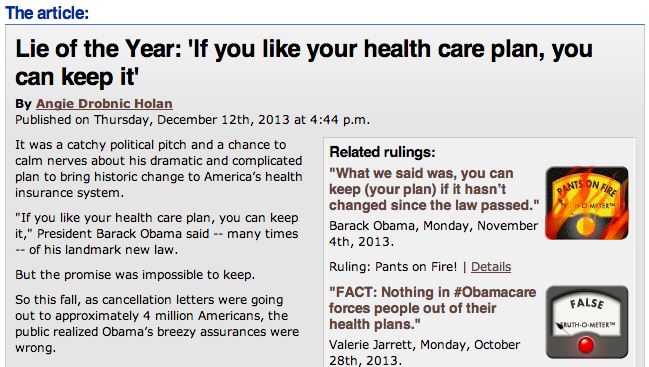
On December 12, [2013] the self-appointed guardians of truth and justice at PolitiFact named President Obama’s infamous promise—that “if you like your health care plan, you can keep it”—its 2013 “Lie of the Year.”

[…]So that brings us back to the fall of 2013. As Obamacare’s battle station became operational, and tens of millions of health plans became illegal, PolitiFact was caught with its flaming pants down. Louis Jacobson rapped Valerie Jarrett for tweeting that “nothing in Obamacare forces people out of their health plans”—a claim Jacobson rated as “False,” even though PolitiFact had rated it as “True” and “Half True” before.

On November 4, Jacobson rated as “Pants on Fire” the President’s new claim that “what we said was, you can keep [your plan] if it hasn’t changed since the law passed.” Both pieces were edited by Angie Drobnic Holan, who had initially granted PolitiFact’s seal of approval to Senator Obama’s 2008 promise. Holan delivered the coup de grâce, declaring as PolitiFact’s “Lie of the Year” the “keep your plan” promise.

“The promise was impossible to keep,” says Holan in her December piece. Now she tells us! But none of the key facts that made that promise “impossible” in 2008 had changed by 2013. The President’s plan had always required major disruption of the health insurance market; the Obamacare bill contained the key elements of that plan; the Obamacare law did as well. The only thing that had changed was the actual first-hand accounts of millions of Americans who were losing their plans now that Obamacare was live.

And the screen capture from 2013:

Politifact says: we were just kidding! Kidding!

So when Politifact rates a statement by a Democrat as true, what they really mean is that it’s pants-on-fire-false, but it’s election time so they don’t say that.

The Tampa Bay Times. Politifact. It’s a catchy name, isn’t? It’s telling us the Facts about Politics. I suppose the same people who think that Politifact is a reliable fact checker also believe that the Affordable Care Act would lower premiums by $2500, as Obama said. It actually raised them $3000 in objective reality, though. But it says Affordable Care Act in the name, so missing the target by $5500 must be “affordable”.

I think this case demonstrates how people on the political left allow their emotions to overturn objective reality. You can keep your doctor. You can keep your health plan. Benghazi was caused by a Youtube video. The e-mails and e-mail backups of all the IRS employees were lost. The Department of Justice did not target Associated Press journalists. The assault weapons were not gun-walked to Mexican drug cartels. They will believe anything that makes them feel superior and noble, even pinned down by the heavy weight of countervailing facts.

Can relationships succeed independently from the efforts of the people involved?

A few days ago, I blogged about the soul mate / fairy tale view of marriage, which I think is the dominant view of marriage among young people today. This view of marriage basically says that there is a person in the world out there who will match up so perfectly with each one of us that we will have to expend no effort and perform no actions and take responsibility for nothing in order for the relationship to work.

I’ve decided to link to this recent article by Matt Walsh which is on that same topic.

He writes:

The disease is the fanciful, unrealistic, fictionalized perceptions that both males and females harbor about marriage.

For example, think of the glamorization of the “mysterious” and “damaged” guy from the “wrong side of the tracks.” Hollywood makes him seem alluring and sexy, but forgets to mention that most of the time, in the real world, that dude probably has herpes, a coke habit, and a criminal record.

Still, that bit of propaganda is nothing compared to the underlying misconception that so many of us carry around consciously or subconsciously, because we’ve seen it on TV and in the movies, and read it in books a million times since childhood: namely, that there is just one person out there for us. Our soul mate. Our Mr. or Mrs. Right. The person we are “meant to be with.”

Matt thinks this view of relationships is not realistic:

I didn’t marry my wife because she’s The One, she’s The One because I married her. Until we were married, she was one, I was one, and we were both one of many. I didn’t marry The One, I married this one, and the two of us became one. I didn’t marry her because I was “meant to be with her,” I married her because that was my choice, and it was her choice, and the Sacrament of marriage is that choice. I married her because I love her — I chose to love her — and I chose to live the rest of my life in service to her. We were not following a script, we chose to write our own, and it’s a story that contains more love and happiness than any romantic fable ever conjured up by Hollywood.

Indeed, marriage is a decision, not the inevitable result of unseen forces outside of our control. When we got married, the pastor asked us if we had “come here freely.” If I had said, “well, not really, you see destiny drew us together,” that would have brought the evening to an abrupt and unpleasant end. Marriage has to be a free choice or it is not a marriage. That’s a beautiful thing, really.

God gave us Free Will. It is His greatest gift to us because without it, nothing is possible. Love is not possible without Will. If we cannot choose to love, then we cannot love. God did not program us like robots to be compatible with only one other machine. He created us as individuals, endowed with the incredible, unprecedented power to choose. And with that choice, we are to go out and find a partner, and make that partner our soul mate.

That’s what we do. We make our spouses into our soul mates by marrying them. We don’t simply recognize that they are soul mates and then just sort of symbolically consecrate that recognition through what would then be an effectively meaningless marriage sacrament. Instead, we find another unique, dynamic, wholly individualized human being, and we make the monumental, supernatural decision to bind ourselves to them for eternity.

It’s a bold and risky move, no matter how you look at it. It’s important to recognize this, not so that you can run away like a petrified little puppy and never tie the knot with anyone, but so that you can go into marriage knowing, at least to some extent, what you’re really doing. This person wasn’t made for you. It wasn’t “designed” to be. There will be some parts of your relationship that are incongruous and conflicting. It won’t all click together like a set of Legos, as you might expect if you think this coupling was fated in the stars.

It’s funny that people get divorced and often cite “irreconcilable differences.” Well what did they think was going to happen? Did they think every difference would be reconcilable? Did they think every bit of contention between them could be perfectly and permanently solved?

Finally, regarding his own marriage:

There were literally millions of things that either of us could have done. An innumerable multitude of possible outcomes, but this was our outcome because we chose it. Not because we were destined or predetermined, not because it was “meant to happen,” but because we chose it. That, to me, is much more romantic than getting pulled along by fate until the two of us inevitably collide and all that was written in our horoscopes passively comes to unavoidable fruition.

We are the protagonists of our love story, not the spectators.

I think that when problems arise between two people who are largely compatible, the right thing to do is to engage and solve the problems. Yes, work isn’t required in pop culture notions of romance, but those things don’t reflect the real world anyway. In the real world, actions to solve a problem count for more than words that avoid the problem. Engineering principles and self-sacrificial attitude are infinitely more useful in a relationship than all the pop culture descriptions of ideal men and ideal women and ideal relationships combined. Why would you believe a bunch of promiscuous, self-centered, materialistic Hollywood people anyway?