What criteria do historians use to get to the minimal facts about the historical Jesus?

Have you ever heard Gary Habermas, Michael Licona or William Lane Craig defend the resurrection of Jesus as the best explanation for the “minimal facts” about Jesus? The lists of minimal facts that they use are typically agreed to by their opponents during the debates.

For example, in his debate with Bart Ehrman, Craig was able to quote Ehrman’s own writings where he agreed that all four facts were probably true.

Excerpt:

Now in his early published work Dr. Ehrman expressed skepticism about these facts. He insisted that we cannot really affirm these facts.

[…]Dr. Ehrman has himself come to re-think his position on these issues. Inconsistencies in the details notwithstanding, he now recognizes that we have “solid traditions,” not only for Jesus’ burial, but also for the women’s discovery of the empty tomb, and therefore, he says, we can conclude with “some certainty” that Jesus was in fact buried by Joseph of Arimathea in a tomb and that three days later the tomb was found empty. 

When I discovered that Professor Ehrman had reversed himself on this question, my admiration for his honesty and scholarly objectivity shot up. Very few scholars, once they’ve gone into print on an issue, have the courage to re-think that issue and admit that they were wrong. Dr. Ehrman’s reversal of his opinion on these matters is testimony, not merely to the force of the evidence for these four facts, but also to his determination to follow the evidence wherever it leads. What this means is that my first contention is not an issue of disagreement in tonight’s debate.

So what are the criteria that historians use to derive a list of minimal facts about Jesus?

Dr. Craig explains them in this article.

Excerpt:

The other way, more influential in contemporary New Testament scholarship, is to establish specific facts about Jesus without assuming the general reliability of the Gospels. The key here are the so-called “Criteria of Authenticity” which enable us to establish specific sayings or events in Jesus’ life as historical. Scholars involved in the quest of the historical Jesus have enunciated a number of these critieria for detecting historically authentic features of Jesus, such as dissimilarity to Christian teaching, multiple attestation, linguistic semitisms, traces of Palestinian milieu, retention of embarrassing material, coherence with other authentic material, and so forth.

It is somewhat misleading to call these “criteria,” for they aim at stating sufficient, not necessary, conditions of historicity. This is easy to see: suppose a saying is multiply attested and dissimilar but not embarrassing. If embarrassment were a necessary condition of authenticity, then the saying would have to be deemed inauthentic, which is wrong-headed, since its multiple attestation and dissimilarity are sufficient for authenticity. Of course, the criteria are defeasible, meaning that they are not infallible guides to authenticity. They might be better called “Indications of Authenticity” or “Signs of Credibility.”

In point of fact, what the criteria really amount to are statements about the effect of certain types of evidence upon the probability of various sayings or events in Jesus’ life. For some saying or event S and evidence of a certain type E, the criteria would state that, all things being equal, the probability of S given E is greater than the probability of S on our background knowledge alone. So, for example, all else being equal, the probability of some event or saying is greater given its multiple attestation than it would have been without it.

What are some of the factors that might serve the role of E in increasing the probability of some saying or event S? The following are some of the most important:

(1) Historical congruence: S fits in with known historical facts concerning the context in which S is said to have occurred.

(2) Independent, early attestation: S appears in multiple sources which are near to the time at which S is alleged to have occurred and which depend neither upon each other nor a common source.

(3) Embarrassment: S is awkward or counter-productive for the persons who serve as the source of information for S.

(4) Dissimilarity: S is unlike antecedent Jewish thought-forms and/or unlike subsequent Christian thought-forms.

(5) Semitisms: traces in the narrative of Aramaic or Hebrew linguistic forms.

(6) Coherence: S is consistent with already established facts about Jesus.

For a good discussion of these factors see Robert Stein, “The ‘Criteria’ for Authenticity,” in Gospel Perspectives I, ed. R. T. France and David Wenham (Sheffield, England: JSOT Press, 1980), pp. 225-63.

Notice that these “criteria” do not presuppose the general reliability of the Gospels. Rather they focus on a particular saying or event and give evidence for thinking that specific element of Jesus’ life to be historical, regardless of the general reliability of the document in which the particular saying or event is reported. These same “criteria” are thus applicable to reports of Jesus found in the apocryphal Gospels, or rabbinical writings, or even the Qur’an. Of course, if the Gospels can be shown to be generally reliable documents, so much the better! But the “criteria” do not depend on any such presupposition. They serve to help spot historical kernels even in the midst of historical chaff. Thus we need not concern ourselves with defending the Gospels’ every claim attributed to Jesus in the gospels; the question will be whether we can establish enough about Jesus to make faith in him reasonable.

And you can see Dr. Craig using these criteria to defend minimal facts in his debates. For example, in his debate with Ehrman, he alludes to the criteria when making his case for the empty tomb.

Here, he uses multiple attestation and the criteria of embarrassment:

Among the reasons which have led most scholars to this conclusion are the following:

1. The empty tomb is also multiply attested by independent, early sources.

Mark’s source didn’t end with the burial, but with the story of the empty tomb, which is tied to the burial story verbally and grammatically. Moreover, Matthew and John have independent sources about the empty tomb; it’s also mentioned in the sermons in the Acts of the Apostles (2.29; 13.36); and it’s implied by Paul in his first letter to the Corinthian church (I Cor. 15.4). Thus, we have again multiple, early, independent attestation of the fact of the empty tomb.

2. The tomb was discovered empty by women.

In patriarchal Jewish society the testimony of women was not highly regarded. In fact, the Jewish historian Josephus says that women weren’t even permitted to serve as witnesses in a Jewish court of law. Now in light of this fact, how remarkable it is that it is women who are the discoverers of Jesus’ empty tomb. Any later legendary account would certainly have made male disciples like Peter and John discover the empty tomb. The fact that it is women, rather than men, who are the discoverers of the empty tomb is best explained by the fact that they were the chief witnesses to the fact of the empty tomb, and the Gospel writers faithfully record what, for them, was an awkward and embarrassing fact.

There are actually a few more reasons for believing in the empty tomb that he doesn’t go into in the debate, but you can find them in his written work. For example, in his essay on Gerd Ludemann’s “vision” hypothesis. That essay covers the reasons for all four of his minimal facts.

So, if you are going to talk about the resurrection with a skeptic, you don’t want to invoke the Bible as some sort of inerrant/inspired Holy Book.

Try this approach instead:

  1. Explain the criteria that historians use to get their lists of minimal facts
  2. Explain your list of minimal facts
  3. Defend your list of minimal facts using the criteria
  4. Cite skeptics who admit to each of your minimal facts, to show that they are widely accepted
  5. List some parts of the Bible that don’t pass the criteria (e.g. – guard at the tomb, Matthew earthquake)
  6. Explain why those parts don’t pass the criteria, and explain that they are not part of your case
  7. Challenge your opponent to either deny some or all the facts, or propose a naturalistic alternative that explains the facts better than the resurrection
  8. Don’t let your opponent attack any of your minimal facts by attacking other parts of the Bible (e.g. – the number of angels being one or two, etc.)

And just keep in mind that there is no good case for the resurrection that does not make heavy use of the early creed in 1 Corinthians 15:3-8. You have to use that – it’s the law.

Back to the minimal facts criteria. The best essay on the minimal facts criteria that I’ve read is the one by Robert H. Stein in “Contending with Christianity’s Critics“. It’s a good short essay that goes over all the historical criteria that are used to derive the short list of facts from which we infer the conclusion “God raised Jesus from the dead”. That whole book is really very, very good.
Scott Walker’s new budget: tax cuts, spending cuts, school choice, smaller government

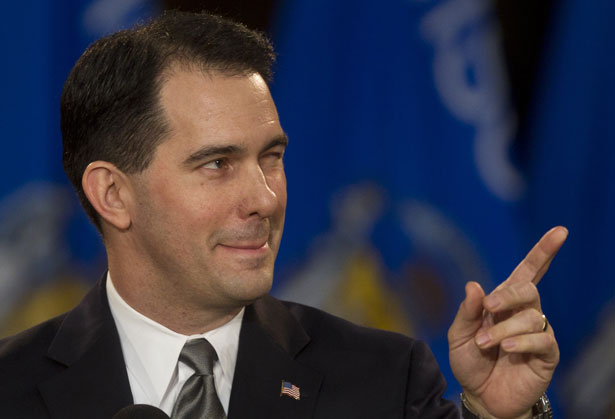
Wisconsin Governor Scott Walker

Scott Walker announces some of the items in his new Wisconsin budget.

The Daily Signal reports:

Gov. Scott Walker unveiled his proposal for Wisconsin’s state budget on Tuesday night, and he did not shy away from offering bold ideas.

The second-term Republican governor has proposed a budget for 2015-17 that would cut property taxes again, eliminate the cap on the state’s school choice program, and reform government by merging agencies.

Walker’s budget would also spin off the public University of Wisconsin System as a separate state entity and require those receiving government benefits to take a drug test.

Tax cuts, expanding school choice, smaller government.

Here are the details on the school choice expansion:

The governor also talked about expanding the state’s school choice program.

“I am excited to announce our plans to lift the cap on vouchers so more families … can have the choice to find the best school for their children,” Walker said. “Every child deserves the chance to succeed.”

If passed by the GOP-led legislature, all students living under 185 percent of the federal poverty level and currently attending a public school would have access to a voucher to attend a private school.

This expansion is on top of school choice programs already in place in the cities of Milwaukee and Racine.

Walker’s budget also expands public school choice in the form of independent charter schools. Wisconsin currently authorizes these schools in the city of Milwaukee, but nowhere else in the state. Independent charter schools are public schools, but do not operate under the auspice of the local school board or teachers’ union.

The governor has proposed a statewide board, which would authorize new charter schools statewide. In Milwaukee, the independent charter schools have repeatedly outperformed their traditional public school peers.

Oh no! What will the leftist public schools do when parents can choose not to give them money? WHO CARES!

And welfare reform:

Walker also introduced a plan recently that would build on his previous entitlement reforms.

“Our budget expands the requirement for able-bodied adults to be enrolled in an employment and training program in order to receive food stamps,” Walker announced. “Now, some might claim that we’re making it harder to get government assistance. We’re not. We’re making it easier to get a job.”

He is mean. Mean to lazy people!

The leftist New York Times reports that the streamlining of government will result in 400 public sector positions (some of which are vacant) being eliminated.

The article also reminds us why conservatives love Scott Walker:

Mr. Walker came to national prominence in 2011 largely because of his first statewide budget proposal, which relied on cuts to collective bargaining rights and increased health and pension costs for most public workers to help solve an expected budget gap.

That got rid of the massive $3.6 billion deficit he inherited from his Democrat predecessor.

But there is more. What do you think the deepest, darkest place is in the United States? I think it’s the university.

The NYT article continues:

Mr. Walker’s proposal calls for cutting about $300 million, or 13 percent, in state funds from the University of Wisconsin System, which includes 13 four-year universities and enrolls some 180,000 students. Mr. Walker’s plan would also take the unusual step of removing the university system from direct state control to a “quasi-governmental” authority that could act autonomously on issues of personnel, procurement, capital projects and tuition.

As word spread in recent days that proposed cuts were coming, some in the university system expressed deep concern, likening the focus on the universities to Mr. Walker’s earlier clashes with public-sector labor unions. At the University of Wisconsin-Madison, the Faculty Senate this week condemned the proposal. Students said they intended to organize opposition.

He went after the leftist public sector unions, and now the bloated leftist public universities. He is so mean to them! Oh well. (Fake cry)

Just ask yourself – what if the guy we chose as the Republican candidate for president actually knew what he was doing? Wouldn’t that be interesting? What if our candidate for President could do more than just play golf and read a teleprompter? What if our candidate for President could actually tell the truth instead of saying “let me be clear”, then lying, then saying “period” after the lie?

When the Green Bay Packers play NFL MVP Aaron Rodgers at quarterback, the Green Bay fans understand that he actually knows how to play football – and he is actually good at it, based on past experiences playing football. What if we chose a candidate who could actually do the job? And talk about past experiences doing the job? Wouldn’t that be something? Picking Scott Walker to be president would be like picking William Lane Craig to debate in favor of Christianity.

Not just #1 in Iowa: Scott Walker leads in latest New Hampshire GOP primary poll

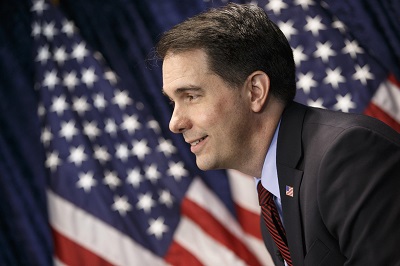
Wisconsin Governor Scott Walker

Here’s the story from the Washington Times.

They write:

Wisconsin Gov. Scott Walker leads a host of potential 2016 GOPpresidential contenders in a new poll in the early presidential state of New Hampshire out Wednesday.

Mr. Walker leads the NH1 automated poll, conducted Feb. 2-3, with 21.2 percent of the vote, followed by former Florida Gov. Jeb Bush at 14.4 percent, Sen. Rand Paul of Kentucky at 8.3 percent, and retired neurosurgeon Ben Carson at 8.2 percent.

Mr. Walker managed to ride a well-received performance at last month’s “Iowa Freedom Summit” into a place atop a recent Bloomberg Politics/Des Moines Register poll in the Hawkeye State among like caucus-goers there. He is scheduled to attend a GOP event in New Hampshire next month.

A NH1 “pulse poll” taken two weeks ago, prior to 2012 GOP presidential nominee Mitt Romney’s announcement that he would not run for president in 2016, had Mr. Romney well ahead at 29 percent, with Mr. Bush at 11 percent and Mr. Walker at 8 percent.

In the poll out Wednesday, which was conducted by REACH Communications, New Jersey Gov. Chris Christie was next at 7 percent, followed by former Arkansas Gov. Mike Huckabee at 6.8 percent and Sen. Marco Rubio of Florida at 5.4 percent.

Next was Sen. Ted Cruz of Texas at 3.3 percent, former Texas Gov. Rick Perry at 2.7 percent, former New York Gov. George Pataki at 2.2 percent, and former Hewlett-Packard CEO Carly Fiorina at 1.7 percent.

Among the names left out of the survey were former Sen. Rick Santorum of Pennsylvania and Louisiana Gov. Bobby Jindal, who are also weighing presidential bids.

About 19 percent of the 1,012 voters were undecided or wanted someone else.

The poll included registered Republicans and undeclared voters that lean Republican and are likely to vote in the 2016 GOP primary, and has a margin of error of plus or minus 3.08 points.

Just a quick flashback to the Iowa poll I blogged about before:

Presidential stage newcomer Scott Walker, the conservative reform pit bull who inspired death threats from the left, has become the one to watch in the race for the Republican nomination a year out from the Iowa caucuses.

At 15 percentage points, he leads a big, tightly packed field of potential contenders in a new Des Moines Register/Bloomberg Politics Iowa Poll of likely Republican caucusgoers. The caucuses are scheduled for Feb. 1, 2016.

The Wisconsin governor is also the No. 2 most popular choice for likely caucusgoers who want an establishment candidate, and he’s the No. 2 for those who want an anti-establishment candidate, the poll shows.

[…]The day after polling wrapped up, Romney announced he’s out of the competition. When the numbers in this poll are shuffled — by giving Romney’s votes to the contenders his supporters named as their second-choice pick — the five others in the top tier gain support.

[…]Walker’s support has jumped 11 points since the last Iowa Poll. In October, only 4 percent of likely caucusgoers named Walker as their first choice for president.

[…]At the same time, the favorability rating for Walker has climbed 11 percentage points; Carson, 9; Huckabee, 7; Cruz, 6; Santorum, 5; and Paul, 5, the new poll shows.

And this is also interesting – the Drudge Report also started a GOP primary poll. With 450,000 votes counted, Walker leads with 44%, and Cruz is second with 13%.

I like winning. I don’t see how you can take a regular Joe like Scott Walker and lose to a rich, entitled Democrat elite like Hillary. Trust me on this, we need to nominate a regular person who has a record of smashing deficits without raising taxes. That’s the winning message. People will vote for the economy and jobs first. And they will also happen to get a President who passed socially conservative laws as governor of Wisconsin. We run on real fiscal achievements, and we get the social conservatism for free.

If you want to learn more about Scott Walker, I recommend Walker’s new book. I actually got the audio version, and it’s read by Governor Walker himself.

Related posts