
Is the probability of getting a universe that supports complex life 100%?

Apologetics and the progress of science

Let’s have a quick review of the famous fine-tuning argument to start.

The argument from cosmic fine-tuning looks at various constants and quantities in our universe that are set at particular values and notes that if any of the values of these constants and quantities were to change, then complex embodied life of any kind could not exist. The argument is fully in line with the standard Big Bang cosmology, and is based on mainstream science.

There are two kinds of finely-tuned initial conditions: 1) constants and 2) quantities. These constants and quantities have to be set within a narrow range in order to permit intelligent life. There are three explanations for this observation: law, chance or design. Law is rejected because the numerical values of constants and quantities are set at the beginning of the universe – when there was no matter, space or time. The values of the constants and quantities were not determined by anything causally prior to the moment the universe began to exist. Chance is not a good explanation, because the probabilities are far, far too small for us to reasonably believe them (e.g. – the chance is 1 in X, where X is much higher than the number of subatomic particles in the visible universe). Since the fine-tuning is not due to law or chance, it must be due to design.

Here’s one example of something that is set correctly to allow complex, embodied life from The New Scientist:

The feebleness of gravity is something we should be grateful for. If it were a tiny bit stronger, none of us would be here to scoff at its puny nature.

The moment of the universe‘s birth created both matter and an expanding space-time in which this matter could exist. While gravity pulled the matter together, the expansion of space drew particles of matter apart – and the further apart they drifted, the weaker their mutual attraction became.

It turns out that the struggle between these two was balanced on a knife-edge. If the expansion of space had overwhelmed the pull of gravity in the newborn universe, stars, galaxies and humans would never have been able to form. If, on the other hand, gravity had been much stronger, stars and galaxies might have formed, but they would have quickly collapsed in on themselves and each other. What’s more, the gravitational distortion of space-time would have folded up the universe in a big crunch. Our cosmic history could have been over by now.

Only the middle ground, where the expansion and the gravitational strength balance to within 1 part in 1015 at 1 second after the big bang, allows life to form.

Changing the value at all means there would be no complex, embodied life of any kind anywhere in this universe.

Here’s a quick video clip to explain what The New Scientist is saying:

Now, this is going to surprise you, but there are some non-theists who try to argue that the finely-tuned constants and quantities that were set up at the beginning of the universe – long before we ever existed – are actually explained by our existence today. 

Atheist Jeffery Lowder summarizes a debate between William Lane Craig and Doug Jesseph, and Jesseph says something like this:

Craig’s argument is like asking the question, “What are your chances of landing in a universe hospitable to life, assuming you were tossed into any old universe whatever.” That is precisely not the point. It’s presupposed in the question that you’re already in a universe which favors life. Confuses conditional probability with unconditional probability.

Unlike me, Lowder is never snarky in his summaries, so this is guaranteed to be accurate.

Here’s what Dr. William Lane Craig says to that idea that our being here explains the fine-tuning:

Now some people have tried to avoid this conclusion by saying that we really shouldn’t be surprised at the enormous improbability of the fine-tuning of the universe because, after all, if the universe were not fine-tuned then we wouldn’t be here to be surprised about it. Given that we are here we should expect the universe to be fine-tuned. But I think the fallacy of this reasoning can be made clear simply by a parallel illustration. Imagine that you were traveling abroad in a third world country and you were arrested on trumped up drug charges, and you were dragged in front of a firing squad of 100 trained marksmen, all with rifles aimed at your heart to be executed. And you hear the command given – “Ready, aim, fire!” And you hear the deafening roar of the guns. And then you observe that you are still alive, that all of the 100 marksmen missed! Now, what would you conclude? Well, I guess I really shouldn’t be surprised that they all missed; after all, if they hadn’t all missed I wouldn’t be here to be surprised about it. Given that I am here, I should expect them all to miss. Of course not. You would immediately suspect that they all missed on purpose. That the whole thing was a set up engineered by some person for some reason. And in exactly the same way, given the incomprehensible improbability of the fine-tuning of the initial conditions for intelligent life, it is rational to believe that this is not the result of chance but of design.

Does it make sense? It’s true that any arrangement of bullet holes in a condemned spy is as unlikely as any other, but the vast majority of possible arrangements of 100 bullet holes result in you being dead. Being marksmen, the shooters definitely know how to hit a target at close range. It doesn’t matter if some hit your head and some hit your heart and some hit your throat – the most common consequence of a hundred bullets fired by expert marksmen at you is “dead you” – regardless of the specific arrangement of bullet holes. If you find yourself not dead, that requires an explanation. The explanation is design.
Study: government-run pre-school programs fail to produce expected results

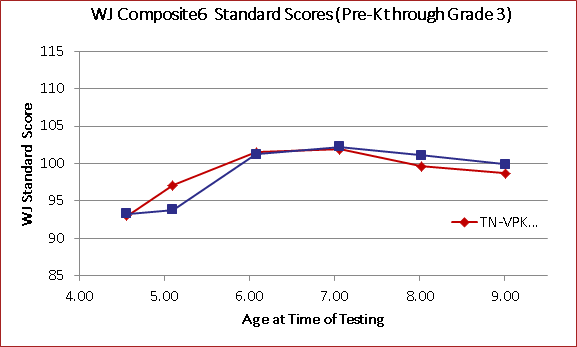
TNVPK data: pre-K program is in red, baseline is in blue

The Heritage Foundation talks about three recent studies on government-run pre-K programs.

The Head Start Impact Study. In late 2012, the Department of Health and Human Services released the Head Start Impact Study, a scientifically rigorous evaluation that tracked 5,000 three-year-old and four-year-old children through the end of third grade. The study found little to no impact on the parenting practices or the cognitive, social-emotional, and health outcomes of participants. Notably, on a few measures, access to Head Start had harmful effects on participating children.[7] For both the three-year-old and four-year-old cohorts, access to Head Start had no statistically measurable effects on any measure of cognitive ability, including reading, language, and math.[8] In other words, by the time they finished third grade, there was no difference between those children who attended Head Start and the control group of their peers who did not.

Vanderbilt Tennessee Voluntary Pre-K Study. In 2015, a team of researchers from Vanderbilt University released an evaluation of Tennessee’s Voluntary Pre-K (VPK) Program, a state-subsidized preschool program open to low-income children in the state. Some 18,000 children participate in the program, which was introduced in 1996. Proponents have long claimed Tennessee’s VPK program is a model state-based preschool program, with standards aligned to the Obama Administration’s Preschool for All initiative.[9] Teachers must be licensed, the child-adult ratio is limited to 10:1, and a structured “age-appropriate” curriculum must be used in classrooms. The program is available first to children from low-income Tennessee families, and then, space permitting, to children with special needs and children with limited English proficiency, among other children deemed “at-risk.” An earlier evaluation found that gains made by participating four-year-olds had faded by kindergarten. In a follow-up evaluation released in September 2015, Mark Lipsey, Dale Farrar, and Kerry Hofer reported that there were no sustained benefits for the same children through the end of third grade.[10]

[…]The authors analyzed the VPK program’s impact on children’s math skills, emergent literacy, and language skills, as well as the program’s impact on non-cognitive measures, such as behavior. “By the end of kindergarten, the control children had caught up to the TN-VPK children and there were no longer significant differences between them on any achievement measures. The same result was obtained at the end of first grade using both composite achievement measures.” And notably, by second grade, “the groups began to diverge with the TN-VPK children scoring lower than the control children on most of the measures. The differences were significant on both achievement composite measures and on the math subtests.” “Pre-K was generally thought to be better than Head Start, but that doesn’t seem to be the case in Tennessee,” stated University of California, Berkeley professor David L. Kirp in The New York Times.[11]

The findings of the TN-VPK program were not limited to academic outcomes. As Lipsey et al. explain:

In terms of behavioral effects, in the spring the first grade teachers reversed the fall kindergarten teacher ratings. First grade teachers rated the TN-VPK children as less well prepared for school, having poorer work skills in the classrooms, and feeling more negative about school. It is notable that these ratings preceded the downward achievement trend we found for VPK children in second and third grades.[12]

Quebec’s Negative Non-cognitive Results. The province of Quebec introduced universal low-cost day care for children through age four beginning in 1997. The program has had a large impact: privately funded child care arrangements have almost disappeared, and Quebec has the highest rate of subsidized child care in Canada, at 58 percent in 2011.[13] The program caused a 14.5 percent increase in the share of mothers of young children working outside the home.[14] The Quebec experience offers more guidance for the potential introduction of universal child care than small, targeted programs, because it implicitly includes indirect effects on non-participants and any general equilibrium effects due to the drastic shift in the way child care was funded and conducted.

Regrettably, new research has found that children who became eligible for the program in Quebec were more anxious as children and have committed more crimes as teenagers. The availability of day care clearly worsened children’s non-cognitive “soft” skills.

Michael Baker, Jonathan Gruber, and Kevin Milligan found that children exposed to the program were 4.6 percent more likely to be convicted of a crime and 17 percent more likely to commit a drug crime. Their health and life satisfaction were worse.

The programs are sold as a way of improving children’s abilities, but the studies show that it doesn’t work that way. So why do we have these programs?

Democrats like these programs because they transfer wealth from taxpayers to government, hire more government workers, and get children away from the “harmful” influence of their parents. It allows the government workers to push the agenda of the wealthy donors who back the Democrat politicians, e.g. – the abortion providers, the gay rights activists, the terrorism apologists, the global warming alarmists, the radical feminists, the socialist wealth redistributors, etc.

Ted Cruz holding Obama administration accountable for covering up Islamic terrorism

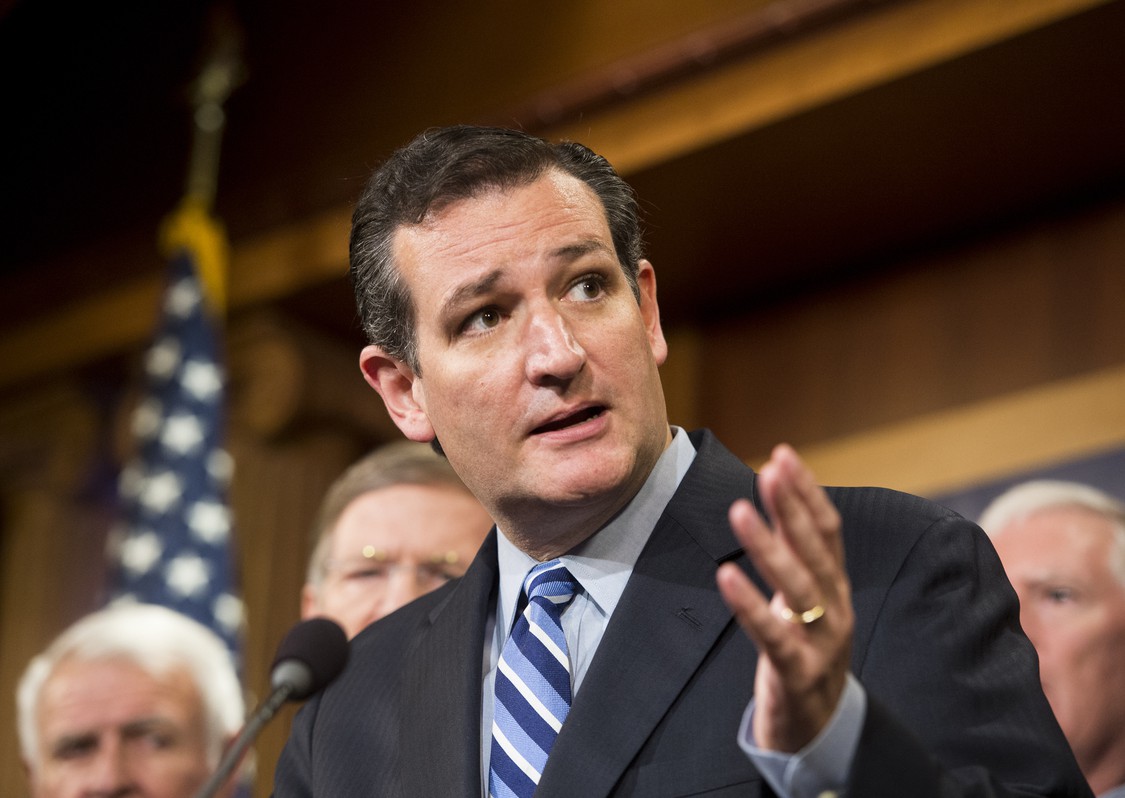
Texas Senator Ted Cruz

Last week, Ted Cruz decided to go after the Obama administration for covering up their deliberate weakness on Middle East foreign policy.

The Conservative Review reported on that:

Next Tuesday, June 28, Sen. Ted Cruz (R-TX), who chairs the Judiciary Subcommittee on Oversight, Agency Action, Federal Rights and Federal Courts, will conduct a hearing investigating the willful blindness on the part of the relevant law enforcement agencies to domestic Islamic terror networks.  The subject of the hearing is “Willful Blindness: Consequences of Agency Efforts To De-emphasize Radical Islam in Combating Terrorism.”

[…]This hearing will likely focus on which figures within the federal government worked to squelch any research connecting the dots between local Muslim Brotherhood officials, these individual terrorists, and foreign terror networks. Senators on the committee now have an opportunity to expose the Muslim Brotherhood influence within DHS and the FBI, their invidious “Countering Violent Extremism” Agenda, and their hand in covering up counter-terrorism investigations.  They can demonstrate how the federal government has hamstrung local law enforcement by refusing to cooperate and share information regarding jihadists living in their communities.

That hearing is happening tomorrow. If you want more details on what Cruz will talk about, you can read an op-ed that he wrote detailing his views here.

He writes:

President Obama’s politically correct reluctance to attribute the terrorist threat we face with radical Islam hobbles our ability to combat it by discouraging counterterrorism agents from taking radical Islam into account when evaluating potential threats. The examples of Fort Hood, Boston, San Bernardino, and Orlando demonstrate the harmful consequences of this administration’s willful blindness.

For example, before the Fort Hood massacre, the Obama administration knew that Nidal Hasan had been in communication with a radical Islamic cleric, Anwar al-Awlaki. The Obama administration knew that Nidal Hasan had asked al-Awlaki about the permissibility of waging jihad against his fellow soldiers. All of that was known beforehand, and yet the administration did nothing. Nidal Hasan went on to murder 14 innocent souls, yelling “Allahu Akbar” as he pulled the trigger. And yet, just to underscore the blindness of this administration, even after the terror attack, the administration insisted on characterizing the attack as “workplace violence.”

With respect to the Boston bombing, Russia had informed the Obama administration that the Tsarnaev brothers were connected with radical Islamic terrorism. The administration knew that. The FBI had even gone and interviewed them. And yet once again, the administration dropped the ball. It stopped monitoring them, so the government wasn’t even aware when the elder Tsarnaev brother posted a public call to jihad on YouTube.

San Bernardino is yet another example of the administration’s abhorrent handling of the threat of radical Islamic terrorism. Once again, the administration had ample information about the individuals in question. The female terrorist had given the administration a fake address in Pakistan, and yet the so-called vetting that this administration tells us it did had failed to discover that it was a fake address. She had made calls for jihad, and yet the administration failed to discover that.

And finally, as far as the events in Orlando last weekend, Omar Mateen was reportedly interviewed not once, not twice, but three times by the FBI in 2013 and 2014. The FBI interviewed him because he was talking at his place of employment, which, ironically, was a contractor to the Department of Homeland Security about his connection to terrorist organizations.

I’ve blogged about all four of these before, but no one is confronting the Obama administration about them, and making them pay for their moral relativism in the court of public opinion. Now Ted Cruz is going to hammer them at the highest level.

But that’s not all. Here’s another story from Conservative Review.

It says:

One week after Sen. Ted Cruz (R-TX) introduced legislation to fine the State Department for delaying its annual report on Iran’s human rights record, the Obama administration is acceding to his demand and finally producing the report.

After delaying the release of the report since late February, apparently in an effort to play nice with Iran, the State Department is scheduled to release the report on Thursday.  This comes just one week after Cruz introduced the Human Rights Accountability Act, which would have cut the State Department’s budget by 5% for every month they continued to delay release of the report.  Cruz’s tactic of shaming the administration for their appeasement and enacting deserved consequences has similarly netted results earlier this month when the Department of Defense was forced to release the annual report on the military power of Iran – another report they delayed for months.

Now, I have some Democrat friends at work, and I asked them what the Obama administration was doing specifically to protect taxpayers from the threat of radical Islamic terrorism. And they had no answer. What we’ve seen instead is a concerted effort by the Obama administration to cover up the connections between actual terrorist attacks and radical Islam, to punish those who point out the facts linking terrorism and radical Islam, and to shame those who had nothing to do with the attacks as being somehow guilty of them. I would like to see some light shed on how far up the chain these attitudes go, so we can get some accountability.