My gameplay videos of The Troop, a turn-based tactical wargame

Since it’s Christmas Day, I decided to play a new turn-based tactical wargame that was gifted to me by Desert Rose, who co-hosts the Knight and Rose Show podcast with me. I really enjoy reading military history, and learning about strategy and tactics. And in order to learn from a different angle, I enjoy playing realistic (but not gory) military simulations. So today I’ll show you what it looks like.

First, here’s the description of the game itself, which was developed by Giant Flame, and published by PLA Studios, based in London, England:

On the morning of the 6th June 1944 the Western Allies began the largest seaborne invasion in the history of warfare. D-Day would mark the start of a vicious campaign to wrestle North West Europe from German control. The following months would see the ancient fields, farms and villages serve as a battleground for new, lethal weapons that would become legendary.

The Troop follows the campaign of British and Canadian forces as they face the German Heer and SS in Normandy. Take command of infantry, motorised and armoured units in desperate tactical turn-based combat against an AI opponent that is challenging and unpredictable, but fair and fallible. Play as British/Canadian or German forces across over 30 maps and 4 play modes.

Simple, complete control – The Troop embraces the best traditions of classic tabletop war gaming combined with the interactivity and excitement the digital format affords. You have complete control over your units’ actions; tanks will not expose their weak side armour with unexpected pathing, hidden guns will not reveal their positions by firing prematurely, infantry will not flee inexplicably when victory is a few heroic paces away. You are free to take your time… but any mistakes are yours and yours alone.

The Troop contains stylised depictions of casualties being sustained in combat including representations of injury and death. The Troop does NOT contain any depictions of gore, blood or wounds.

I am a huge fan of games like Combat Mission, Steel Panthers, and Close Combat, and I have been delighted to see that The Troop is an even better game than all of my previous favorites. It’s the perfect game for me to put the lessons I learned from reading military history into practice.

Regarding the game mechanics, it is an I-go, you-go turn-based system on a hex map. Infantry units can move up to 4 hexes, but if they move 2 only, then they can remain prone. If they move 4 then they cannot fire. The more they move, the less accurate their fire. Also, if they were shot at and suppressed by enemy fire in a previous turn, then they will be less accurate. If an armored unit fires it’s main gun, then it ends its turn and cannot move further. This game models terrain effects, line of sight, smoke, armor penetration, morale, opportunity fire, and other features of realistic warfare.

So, in the two gameplay videos below, I am playing as the British armed forces, just after the June 1944 D-Day landings in Normandy, France. The first map is a beach landing, and the second map is a bocage / urban setting. In each case, my forces were pre-selected, but in other scenarios, you can purchase forces with points.

Here is the first scenario I recorded, “Per Mare, Per Terram”:

And here is the second scenario I recorded, “Crossroads”:

I posted these videos on my personal channel, to keep them separate from the Knight and Rose Show uploads. I want to thank Desert Rose again for gifting me this game. I hope that you all had a happy Christmas, got a great gift, and had as much fun as I did playing The Troop. If you have a Steam account, and want to get the game, it’s on sale for a few more days.

If you like these videos, let me know in the comments on YouTube, so I know to make more of them. It’s fun to play these scenarios, but it’s also fun to look at the maps and read them and think about them. It’s fun to be able to read terrain and make plans, and then make decisions, and see those decisions produce a result. I think it’s a very masculine behavior. It certainly appeals to my male nature to make plans, carry them out, and see the good result. I love it when a plan comes together.

By the way, I got myself a solitaire wargame for Christmas, as well: Carrier Battles: Philippine Sea, which you can read about on Boardgame Geek. It’s highly rated, and I am looking forward to doing the tutorial missions over the holidays, and then playing a real game.
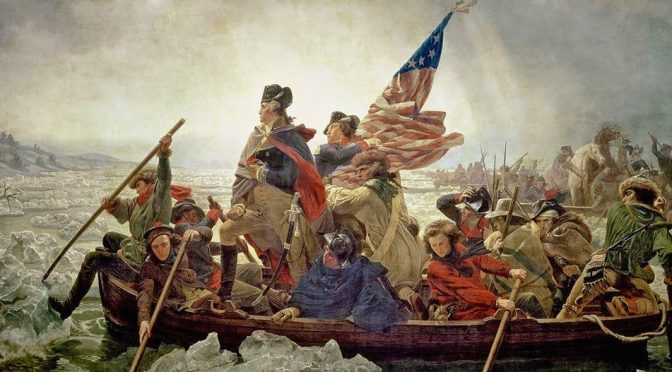
For Christmas Day, let’s remember George Washington and the Battle of Trenton

My favorite book about the American Revolutionary war by far is called “1776”. It’s written by famous historian David McCullough. The part of the book that really stuck out to me was the Battle of Trenton. I think that this battle really defines the essential character of America, as seen in the decision-making of its great general and first President, George Washington.

In the book, I learned about how George Washington and his revolutionary army had suffered a string of defeats at the hands of the powerful Commonwealth army, and their mercenary allies. It was the middle of a freezing cold winter, and the many of the sickly and ill-equipped American troops were just days from having their enlistment contracts run out. Some of the troops were not waiting for their enlistments to expire, they were just deserting. In droves.

Washington was losing, and was just days from losing his Continental Army. If the Americans lost the revolutionary war, then it would mean that every man who signed the Declaration of Independence would be hanged as a traitor. The American revolutionaries had risked everything for liberty, and they were about to lose everything – their money, their property and even their lives.

I found a page that summarizes the battles leading up to the Battle of Trenton.

First battle, a defeat for Washington:

The Battle of White Plains

October 28, 1776

RESULT: BRITISH VICTORY

With the British army maneuvering to make his Harlem Heights position untenable, George Washington withdrew from the island of Manhattan, and established a new encampment further north near White Plains, New York.

On October 28, 1776, a flank attack by the British on this new position resulted in the collapse of Washington’s line. Thankfully, he was able to orchestrate an orderly withdrawal that preserved the army. Unfortunately, Washington’s retreat further exposed Fort Washington, which remained garrisoned on Manhattan.

Next, another defeat for Washington:

The Battle of Fort Washington

November 16, 1776

RESULT: BRITISH VICTORY

Following the defeat of George Washington’s army at White Plains, New York, British General William Howe focused his army’s attention on Fort Washington, the last post defended by the Continental army on Manhattan.  Although Washington hoped to abandon the fort, his officers convinced him that it needed to be held in order to keep British ships from ascending the Hudson River.

During a carefully-orchestrated, all-out attack on November 16, 1776, British and Hessian forces overwhelmed the fort’s garrison after vicious fighting. When he heard the attack begin, Washington, who had stationed himself across the Hudson River in New Jersey, travelled across the river to the enter the fort and personally inspect its defenses. Several officers accompanied Washington, including Generals Israel Putnam, Hugh Mercer, and Nathanael Greene. They convinced Washington to leave the fort just 30 minutes before it was surrounded.

And then, another defeat for Washington:

Evacuation of Fort Lee

November 20, 1776

RESULT: BRITISH VICTORY

After the fall of Fort Washington, George Washington made plans for the evacuation of Fort Lee, which stood across the Hudson River in New Jersey. In a letter written to John Hancock on November 19, 1776, the general wrote that “…Fort Lee was always considered as only necessary in conjunction with [Fort Washington]…,” and that it would be abandoned as soon as provisions and other supplies were removed.

Unfortunately, a large British force succeeded in scaling the heights close to the fort on November 20, 1776. Faced with superior numbers, Washington called for the immediate evacuation of the fort, which resulted in the loss of dozens of cannon, 2-300 tents, and 1,000 barrels of flour.

That brings us to the Battle of Trenton. Across the Delaware river from Washington’s army was an encampment of Hessian mercenaries, fighting for the British. The Hessians believed that Washington’s Continental army was in full retreat. The British generals had already written home to the King to tell him that the war was nearly over, and that they had won. But had they?

Washington crosses the Delaware

Here is what Washington decided to do on December 25th, 1776:

General George Washington’s commitment to cross the Delaware River on Christmas 1776 foreshadowed the many hardships faced as well as the eventual victory of the Continental Army during the American Revolution. At first glance, the decision to transport 2,400 Continental soldiers across an icy river in one night, directly into a severe winter storm of sleet and snow seems irrational.

Washington’s decision, however, was based on strategic motivation, understanding that the Continental Army desperately needed a victory after months of intense fighting with several significant defeats and no major victories. Washington also understood that the element of surprise was the only way that he and his army stood a chance of defeating the highly trained Hessian mercenaries.

On the morning of December 25, 1776, Continental soldiers woke up in their camps along the Delaware River to a frozen, snowy covered ground. Weather conditions worsened and temperatures continued to drop throughout the day. Late in the afternoon, the Continentals left their tents and began to form along the river in anticipation of the night’s events. Washington kept almost all of the details of the crossing a secret; as a result, none of the soldiers knew anything about their upcoming mission.

Washington’s crossing of the Delaware River on December 25, 1776 allowed his army to strike the Hessians at Trenton the next morning.

Washington’s plan was to cross the river at night, march to the nearby town of Trenton, New Jersey, and attack the Hessian garrison right before dawn. Time was Washington’s greatest enemy; to combat it his orders called for the various regiments to assemble at their designated crossing points no later than sunset. The close proximity to the crossing points allowed the soldiers to begin the journey immediately after nightfall struck and complete the crossing no later than midnight. Once across, Washington intended for the armies to reassemble and march approximately ten miles to Trenton, arriving there no later than five o’clock in the morning to achieve surprise. Despite his meticulous planning, the schedule failed almost before it even began.

Many of the regiments did not arrive at the river until well after dark. Additionally, a severe winter storm that included wind, rain, snow, hail, and sleet met the soldiers at the banks of the river significantly slowing their crossing. Many of the boats had to combat ice jams and unfavorable currents. To make matters even worse, the extreme darkness caused by the storm made it hard for the boatmen to see the opposite shore.

The necessity of using larger ferries to carry pieces of artillery across the river caused even more delays. Washington crossed the river with John Glover’s Marblehead mariners and upon arrival debated whether or not to cancel the entire operation because it was more than three hours behind schedule. Washington decided it was too costly to retreat and he painfully watched as his army continued to trickle across the river.

If you were standing by the river along with Washington watching his sick, frozen, ill-equipped army struggle across the Delaware, then you would probably think that Washington had lost the element of surprise. This attack was just taking too long to happen. Maybe Washington would give up his plan, because things hadn’t gone his way. But Washington didn’t quit – he persisted.

The Battle of Trenton, December 25, 1776
The Battle of Trenton, December 25, 1776 (click for larger image)

The Battle of Trenton

This is how the battle went down in Trenton, New Jersey:

Immediately following his famous crossing of the Delaware River, General George Washington marched the Continental Army to Trenton, New Jersey. The army’s forces included horses, guns, wagons, and soldiers, stretching for nearly one mile. The weather was worse than it had been crossing the river, but the army continued to proceed as Washington rode up and down the column pressing his men to carry on.

Shortly after eight o’clock on the morning of December 26, 1776, the Continental Army started its charge on the city. Three columns marched through thick snow with Washington personally leading the middle charge. As the soldiers pushed forward, artillery began to fire. At the same time, German drums urgently called the Hessians to arms. To his astonishment, Washington had maintained the element of surprise.

Immediately after the firing began, three Hessian regiments ran from their quarters ready to fight, quickly forming ranks. As the Hessians grouped, the Continental Army entered the city at two points: John Stark marched into the city on River Road from the west, while Nathanael Greene and Washington arrived from the north.

Andreas von Wiederholdt, a Hessian lieutenant, incorrectly reported to Colonel Johann Rall that the Continental Army had surrounded Trenton and there was no available route for retreat. As a result, Rall decided to counterattack Washington within the city and not retreat across Assunpink Creek. This proved to be costly as Washington’s forces occupied the highest ground in the city and had clear views of all of Rall’s movements.

Time after time, Washington countered Rall’s efforts to outflank the Continentals. Eventually, Washington’s forces overpowered the Hessians. Rall was mortally wounded and many of his soldiers broke ranks, fleeing from the fighting. Normally very disciplined, Rall’s regiment was confused and disoriented without their commander. They retreated to an orchard east of Trenton where they were forced to surrender.

Despite the large number of Hessians that escaped Trenton, Washington still won a crucial strategic and material victory. In only one hour of fighting, the Continental Army captured nearly nine hundred Hessian officers and soldiers as well as a large supply of muskets, bayonets, swords, and cannons. Washington ordered his soldiers to treat the Hessian prisoners in a humane manner, and the general quickly focused his attention on what to do next. Washington assembled all of his officers in Trenton to discuss whether they should attack another post, hold their position in Trenton, or retreat back across the Delaware. Washington decided that because of the condition of his army, the best move was to return to their camps across the River.

When the Continental Army returned to camp on the Pennsylvania side of the Delaware River, soldiers were exhausted. They had marched and fought for two straight days through rain, snow, sleet, and hail. Washington knew that his army had far exceeded expectations at Trenton and that they faced many more challenges going forward.

Washington won two more battles in rapid succession. Many of his troops re-enlisted because of these victories. There were many battles remaining to fight, and many hardships such as the winter at Valley Forge. But the Battle of Trenton was the turning point of the revolution. George Washington would not let a string of defeats stop him.

Did the early church invent the divinity of Jesus over a long period of time?

How early is the doctrine of the divinity of Jesus? When I answer this question, I only want to use the earliest, most reliable sources – so I can defend them on historical grounds using the standard rules of historiography. The 4 sources that I would use are as follows:

  • The early creed in 1 Corinthians 15:3-8, and 1 Corinthians 1
  • A passage in Philippians 2
  • Two passages from Mark, the earliest gospel
  • A passage from Q, which is an early source of Matthew and Luke

So let’s see the passages.

1 Corinthians

I’ve written before about the early creed in 1 Corinthians 15:3-8, which skeptical scholars date to 1-3 years after the death of Jesus, for a variety of reasons I covered in the previous post. Here’s the creed which definitely makes Jesus out to be more than an ordinary man. Ordinary men don’t get resurrection bodies after they die.

Here’s the passage: (1 Cor 15:3-8)

3For what I received I passed on to you as of first importance: that Christ died for our sins according to the Scriptures,

4that he was buried, that he was raised on the third day according to the Scriptures,

5and that he appeared to Peter, and then to the Twelve.

6After that, he appeared to more than five hundred of the brothers at the same time, most of whom are still living, though some have fallen asleep.

7Then he appeared to James, then to all the apostles,

8and last of all he appeared to me also, as to one abnormally born.

Additionally, 1 Corinthians 1:21-25 talks about Jesus being “the power of God and the wisdom of God”. Paul is identifying Jesus with the divine.

21For since in the wisdom of God the world through its wisdom did not know him, God was pleased through the foolishness of what was preached to save those who believe.

22Jews demand miraculous signs and Greeks look for wisdom,

23but we preach Christ crucified: a stumbling block to Jews and foolishness to Gentiles,

24but to those whom God has called, both Jews and Greeks, Christ the power of God and the wisdom of God.

25For the foolishness of God is wiser than man’s wisdom, and the weakness of God is stronger than man’s strength.

But it gets even stronger! You all probably already know that the most important passages in the Old Testament for Jews is the famous “Shema“, which is found in Deuteronomy 6:4-9. The Shema is a strong statement of Jewish monotheism.

Here’s the passage:

4 Hear, O Israel: The LORD our God, the LORD is one.

5 Love the LORD your God with all your heart and with all your soul and with all your strength.

6 These commandments that I give you today are to be upon your hearts.

7 Impress them on your children. Talk about them when you sit at home and when you walk along the road, when you lie down and when you get up.

8 Tie them as symbols on your hands and bind them on your foreheads.

9 Write them on the doorframes of your houses and on your gates.

So how does Paul fit Jesus in with this strong statement of Jewish monotheism?

Paul alludes to the Shema in 1 Corinthians 8:4-6.

4So then, about eating food sacrificed to idols: We know that an idol is nothing at all in the world and that there is no God but one.

5For even if there are so-called gods, whether in heaven or on earth (as indeed there are many “gods” and many “lords”),

6yet for us there is but one God, the Father, from whom all things came and for whom we live; and there is but one Lord, Jesus Christ, through whom all things came and through whom we live.

Holy mackerel! How did that get in there? Paul is splitting the roles of God in the the Shema and identifying Jesus in one of the divine roles! Jesus is not an ordinary man. That passage “through whom all things came” foreshadows John identifying Jesus as “the Word of God”, which “became flesh and dwelt among us”. Holy snark – did you guys know that was all in here so early?

The date for 1 Corinthians is 55 AD. It should be noted that skeptical scholars like James Crossley accept these passages, and you can check it out in the debate audio yourself.

Philippians

Check out Philippians 2:5-11.

5Your attitude should be the same as that of Christ Jesus:

6Who, being in very nature God, did not consider equality with God something to be grasped,

7but made himself nothing, taking the very nature of a servant, being made in human likeness.

8And being found in appearance as a man, he humbled himself and became obedient to death— even death on a cross!

9Therefore God exalted him to the highest place and gave him the name that is above every name,

10that at the name of Jesus every knee should bow, in heaven and on earth and under the earth,

11and every tongue confess that Jesus Christ is Lord, to the glory of God the Father.

The date for Philippians is 60-61 AD. Still within the lifetime of the eyewitnesses, and written by an eyewitness who was in contact with the other eyewitnesses, like Peter and James, whom Paul spoke with numerous times on his journeys to Jerusalem.

Mark’s gospel

Mark’s gospel is the earliest and atheists like James Crossley date it to less than 40 AD, which is 10 years after the death of Jesus at most. When you read the gospel of Mark, you are getting the earliest and best information available about the historical Jesus, along with Paul’s epistles. So what does Mark say about Jesus? Is Jesus just a man, or is he something more?

Check out Mark 12:1-9:

1He then began to speak to them in parables: “A man planted a vineyard. He put a wall around it, dug a pit for the winepress and built a watchtower. Then he rented the vineyard to some farmers and went away on a journey.

2At harvest time he sent a servant to the tenants to collect from them some of the fruit of the vineyard.

3But they seized him, beat him and sent him away empty-handed.

4Then he sent another servant to them; they struck this man on the head and treated him shamefully.

5He sent still another, and that one they killed. He sent many others; some of them they beat, others they killed.

6“He had one left to send, a son, whom he loved. He sent him last of all, saying, ‘They will respect my son.’

7“But the tenants said to one another, ‘This is the heir. Come, let’s kill him, and the inheritance will be ours.’

8So they took him and killed him, and threw him out of the vineyard.

9“What then will the owner of the vineyard do? He will come and kill those tenants and give the vineyard to others.

And Mark 13:32, talking about the date of the final judgment.

32“No one knows about that day or hour, not even the angels in heaven, nor the Son, but only the Father.

And again, this passage is establishing a hierarchy such that Jesus is being exalted above all men and the angels, too. And the passage is embarrassing to the early church, because it makes Jesus look ignorant of something, so they would not have made this passage up. Jesus is not an ordinary man, he is above the angels – God’s unique Son.

The “Q” source for Matthew and Luke

Here’s Matthew 11:27, which is echoed in Luke 10:22:

27“All things have been committed to me by my Father. No one knows the Son except the Father, and no one knows the Father except the Son and those to whom the Son chooses to reveal him.

22“All things have been committed to me by my Father. No one knows who the Son is except the Father, and no one knows who the Father is except the Son and those to whom the Son chooses to reveal him.”

Since this passage is in both of Matthew and Luke, but not in Mark, scholars believe that it is in the earlier “Q” source used by both Matthew and Luke. Q predates both Matthew and Luke, and so it is also fairly early (maybe 67-68), although not as early as Mark and Paul. Bill Craig writes that this passage is also embarrassing because it says that no one knows Jesus.