
Should we only blame boys for the highly-sexualized culture?

Man helping a woman with proper handgun marksmanship

If you wanted to read just one article that summarizes a lot of my views on radical feminism and the Sexual Revolution, based on my experiences with young women in high school, college and the workplace, this article from The Federalist would be a good choice.

I am going to excerpt a piece of this for my post, but you really need to click through and read the whole thing.

Excerpt:

Let’s build on that foundation and ask why porn is driving expectations for young women.

As with the prevalence of porn among boys, the answer to this question has two parts. The victimization half of the answer is that we’ve deliberately avoided giving girls any other kinds of expectations. Think about it for a moment: Why should it be so hard to tell a guy “no,” as girls reported in the survey? Why should she think it’s mean?

Feminists would have you believe that all girls are shrinking violets who never learned how to lean in, but the far better answer is that these girls don’t really know of any good reason to say no. “I don’t want to” is a reason, but it’s the kind of reason one must weigh against others’ desires in any kind of voluntary relationship.

Chastity, which is the view that relationships work better when sex is confined to exclusive, permanent marital commitments, is out of favor in our society, thanks to feminism. In place of chastity, feminism encourages young people to have recreational sex outside of marriage.

What happened next?

If sex is just meaningless fun without any moral or spiritual dimension, and if youth is just a time for sexual adventures without any thought to actually forging a lasting relationship—as we are all taught these days—then surely it would indeed be mean to arbitrarily withhold that meaningless fun from someone she is fond of.

In a sexually amoral context, having sex with him so he’ll watch a movie with her is a decision with no more gravitas than watching “American Ninja Warrior” with him so he’ll watch “The Bachelorette” with her. Without bringing chastity back into the conversation, there’s no meaningful objection. The only expectation is that the boy and girl work out their different wants together, and they have already done so.

In the past, sexual expectations were founded in marriage and family—that sex is part of a permanent and exclusive partnership rooted in a mutual commitment to one another’s well-being and the promise of future children to whom that commitment is extended. Those are the expectations girls were taught, and they generally navigated relationships according to them. They provided a foundation to undergird their refusals.

Unfortunately, feminists found such expectations restrictive and demeaning, and over a generation successfully uprooted them only to replace them with… nothing of substance. It’s only natural that media depictions of sex—porn included—would fill that void and create new expectations.

[…]We cannot meaningfully condemn this situation unless we venture back into the world of sexual morality. After all, if our only concerns are for the desires of those involved, nothing proves the girls’ desire for emotional connection without providing sexual gratification is any better than the boys’ desire for sexual gratification without providing emotional connection.If this is the extent of our concern, then our response should not be the horror we feel in the pit of our collective stomach, but rather pride that these two different groups were able to negotiate terms by which both sides can get something they want. It would be like the end of a children’s program where everyone learned to compromise and work together.

If girls in general want a deal with terms more favorable to them, there’s always collective bargaining with the boys. Nevertheless, it’s difficult to see how the results would substantially differ from traditional sexual morality. After all, most girls would need to withhold sexual access until granted a commitment more meaningful than “I promise not to sleep with anyone else until I want to be done sleeping with you.” Accordingly, the “scabs” (to borrow union terminology) who give away access for less would have to be treated with less respect than those who maintain the bargaining position.

Meanwhile, the other side’s interests would need to be taken into account or they would have no incentive to come to the table. The popular boys are already getting what they want, and the rest are already going their own way. Providing sex couldn’t be held off for decades while education and career take a front seat.

Plus the long-term commitments boys offer as they become men could not be so one-sided that the woman could unilaterally dissolve these at any time and simultaneously claim a man’s home, children, and future income. In other words, any mutually beneficial bargain would have to restore chastity, slut-shaming, and early marriage while ending no-fault divorce. What collective bargaining will never achieve is the feminist pipe dream that boys be dutifully subject to feminine whim. They have no incentive for that.

And this part further down is really good too:

Is it really safe to assume these girls have hooked up with a completely random and evenly distributed sample of boys their age?

It would be more accurate to say that the boys who are popular with the girls are generally like this. After all, it seems rates of teen girls’ sexual activity are actually somewhat higher than those of their male peers—a gap particularly pronounced among whites. The disparity is probably even greater since other studies have shown that men are prone to exaggerating their sexual activity while women are prone to minimizing it.

All of this suggests that a larger pool of girls is competing for the attentions of a smaller pool of boys. Many anecdotal accounts reinforce this, suggesting a version of the 80/20 rule is at work in hookup culture (i.e., that 80 percent of the girls are sleeping with 20 percent of the guys). That particular proportion is almost certainly an exaggeration, but the disparity is there.

Most likely, the sexually inactive majority of boys aren’t receiving sex acts in exchange for their attention, just as the sexually inactive girls aren’t providing any. Plenty of boys are left out in the cold who would happily adopt a measure of chastity and provide emotional intimacy if it meant access to romantic relationships. The girls are simply choosing not to enter relationships with those boys. So why are the girls going for the boys who make the demands they reportedly despise?

I just don’t see how you can do better than that. This is a very conservative view, because it respects traditional morality, but it is not one that is championed by most “conservatives”, who want to just blame men for refusing to put out after feminism has re-made the culture.

In the old days, many men expected women to give them something physically if they spent money on dinner and movie. In the present day, fake man-blaming “conservatives” expect men to put out marriage for women who have done nothing at all to prepare themselves for it. In a world where chastity has been replaced by radical feminist hook-ups, and marriage has been replaced by no-fault divorce, there is no incentive for men to engage. Trying to get them to engage by attacking their manhood is just plain stupid, but unfortunately, most “man up” pastors and “conservatives” ARE just plain stupid.

Analysis: how much did each Obamacare mandate drive up health insurance premiums?

How each Obamacare mandate affected the health insurance premiums

Since 2010, we were inundated with reports and studies from various groups that argued that the new mandates in Obamacare would drive up the cost of health insurance. And that was actually observed to happen. Year after year, health insurance costs rose – usually by double digits. We knew why this was happening, too: Obamacare required health insurers to cover more conditions, many of them not even related to health insurance.

Here is an an analysis of which mandates caused health insurance costs to rise the most from the Daily Signal.

Excerpt:

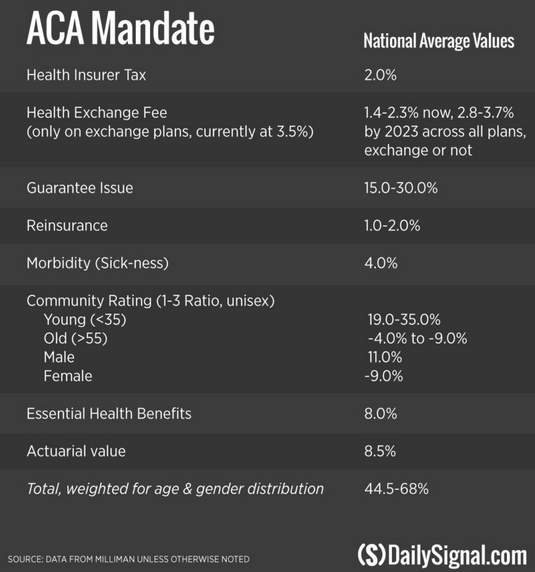
Obamacare caused premiums to rise for various reasons, chief among them being the vast new regulations the law imposed on insurance markets. A new analysis from Milliman backs this up. The study provided estimates of the average impact that various Obamacare regulations had on premiums.

[…]Changes in morbidity (or the sickness of the population) due to newly uninsured by itself caused 4 percent increases in premiums nationally, but in Ohio it raised premiums by 35-40 percent.

Age is also a factor in premium prices, and Obamacare disrupted the natural order by dictating the age banding, which disproportionately harmed young people. (Age banding here refers to how much the most expensive plans can be in comparison to the cheapest.)

Before Obamacare, the national rate of age banding was 1-to-5. In other words, the most expensive plan was five times more costly than the cheapest plan, with expense increasing with age.

Obamacare mandated that the rate be set at 1-to-3, so that the most expensive plan could be no more than three times as expensive. While elderly people’s premiums might have seen fewer increases—which is both due to banding and the fact that Obamacare is close to a death spiral—young people have suffered.

Overall, young people can expect to have rate increases between 58.9 percent and 91.8 percent using national averages. However, not every state had a 1-to-5 age band.

In places like Ohio, the effects are far worse—it had a 1-to-6 age band. Even accounting for the differences in its population from the national average, young people in Ohio can still expect to pay an average of 7.7 percent more on top of other increases.

In addition to this “youth tax,” mandates like the “essential health benefits” and actuarial requirements further punish all Americans with benefits that they don’t need, at prices they can’t afford. While in places like Maryland these mandates might only contribute 8 to 10 percent to premium increases, nationally they raise premiums by an average of 16.5 percent, up to 32 percent.

Overall, accounting for gender, age, and the relative proportions of all those groups, Americans are paying 44.5 to 68 percent more in premiums owing just to Title I regulations. That number is even higher when factoring all the other adverse effects of Obamacare.

Notice that “guaranteed issue”, which is so popular with those who feel that they can somehow be generous by spending other people’s money, is one of the biggest drivers of health insurance costs. When pollsters ask people whether they want to keep these provisions, they mostly say yes. But when the pollsters ask whether they want to keep these provisions if it means that their own health insurance costs will go up, they mostly say no. It’s amazing how American voters, especially Democrats, love the idea of spending other people’s money. As long as they don’t have to pay for it, then it’s a great idea to spend someone else’s money in order to buy the feeling (and the peer approval) of being generous and compassionate.

And after 8 years of Obama offering that feeling to his supporters, we now have a national debt of $20 trillion, instead of $10 trillion. Mind you, in decades of asking my co-workers, I’ve never yet met one Democrat who could tell me what the national debt was. I guess that would interrupt their feelings of generosity and compassion.


Hindu nationalists, led by Narendra Modi, crack down on religious liberty

Map of India
Map of India

This was reported by the Daily Signal.

Excerpt:

In a sad development, the government of India is clamping down on religious liberty, and impoverished children stand to lose the most.

Compassion International, a Christian organization that partners with local churches around the world to improve the lives of children in poverty, began shutting down its operations in India due to financial restrictions imposed on them by the Indian government. This will leave an estimated 145,000 children worse off.

The shutdown comes after months of attempts to convince the Indian government to reverse its decision, and the clampdown on Compassion International comes amid other government actions against nearly 11,000 faith-based and secular organizations operating in India.

Compassion International is a faith-based aid organization that provides humanitarian assistance for underprivileged children around the world, and has operated in India since 1968. The group is the largest single foreign provider of assistance in India, contributing around $45 million in humanitarian aid annually.

Stephen Oakley, general counsel for Compassion International, testified that the organization hosts programs that run five to six days a week, and provides meals, medical treatment, and tutoring, as well as financial assistance for school tuition.

While these programs are run out of the local Christian churches, Compassion International denies that any forced conversions take place and does not use adherence to Christianity as a condition for providing assistance. The aid is purely based on need.

[…]Nooruddin estimates that about half of the foreign aid organizations in India have been pushed out since 2012 due to an inability to renew their licenses—something the government has made more difficult in an attempt to reduce the influence of outside organizations in India.

The concept of charity is foreign to Hinduism in particular (but not Islam), simply because if a person is poor, this is seen as a result of bad karma that they have collected because of misdeeds in past lives. It’s nothing for anyone to fix, in short, and it’s seen as best to concentrate on one’s one’s grades and one’s own wealth-building. Although most Hindus don’t want to be bothered taking care of the poor themselves, they also don’t want Christians getting the credit for doing it. So, the easiest way to stop Christians getting credit with the poor for helping the poor is to stop Christians from helping the poor – leveling the playing field between the two religions.

Evangelism and Hindu tolerance

I come from a partially Hindu background, and I have to work with a lot of Indian people in my current job as a software engineer. And I have indeed noticed an aversion to Christianity from them. it’s actually very strange. When I ask them about religion, they can talk passionately about religious diversity and how tolerant their Hinduism is. But if you dig a little more under the surface, not only do they disagree with everything I believe, but they also don’t think I should allowed to express my views in public to anyone who doesn’t already agree with me.

So why is that? Well, although many East Indian people that I speak to know a great deal about computer science and making money, they actually know almost nothing about religions other than their own. For them, religion isn’t an area for investigation about what’s true or false. For them, religion is like their nationality or race or family or community. It’s beyond logic and evidence, it’s just design for social cohesion. So, if, for example, you tell a Hindu that their oscillating eternal cosmology is factually false, they get angry because that’s not religion is for them. They don’t care whether what they believe is true or false, so long as it helps them get along with their families and communities. And since Christianity would cause a break up in their families and communities (should anyone convert), they want to stop all logical and evidential discussions of it. For a Hindu, not eating meat is more important than how the universe began, because not eating meat is social, and how the universe began is factual. Bring up facts to people who are looking for social cohesion and unity gets you the kind of response that you see from Modi and the Hindu nationalists.