Category Archives: Polemics

Lori Alexander is right: serious Christian men prefer debt-free virgins without tattoos

Marriage stability vs sexual partners,(Teachman et al. JAMF, August 2010)

Christian writer Lori Alexander recently wrote a blog post (H/T Lindsay) urging Christian women to do 3 things:

  1. be a virgin before marriage
  2. be debt-free before marriage
  3. don’t get any tattoos

She also urged women to be cautious about college, because it often gets them into debt. I disagree with her a little here. I always urge young women to earn a STEM degree in college, then work a few years to pay off their loans (if any) before marrying. This is because women, like men, need to have the experience of doing something hard that they don’t “feel” like doing, in order to grow. STEM degrees teach young people that the world doesn’t revolve around them, and that their feelings don’t matter when trying to solve a problem in the real world. It’s a very useful way for women and men to break themselves out of the desire for free and easy happiness that is so common in our time.

Lori’s article drew enormous opposition from both secular and Christian sources. So far, the only people defending her are men’s rights sites, like Dalrock (Christian) and Spawny (non-Christian). Every other “Christian” blog or news site that I read disagreed her article, and argued that premarital sex was no big deal, that having debt was no big deal, and that having tattoos was no big deal.

Let’s take a look at her three points, then I’ll explain why her article is largely correct, and why she is correct about what she asserts about the criteria that godly men have for women.
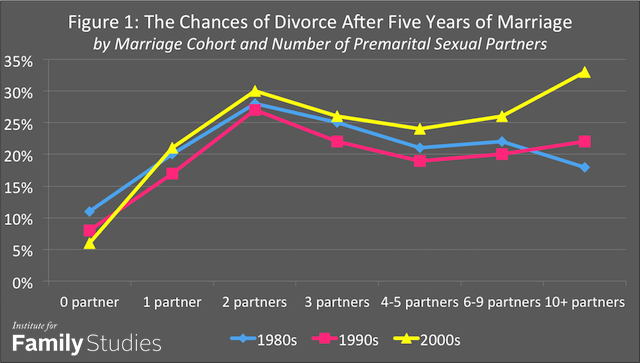
Even one non-husband premarital sex partner raises risk of divorce

Virginity

Regarding her first point, virginity is commanded by the Bible, it’s in line with peer-reviewed studies on marriage quality and stability. The reason that people find this difficult is that they want the freedom to give in to sexual desires without feeling shame. They want to believe that there is no permanent effect. It doesn’t help that parents and pastors are terrified of telling young people, and young women in particular, that promiscuity harms marital stability. Right now, the culture is drowning in feminism. Feminism tells women that the traditional male roles of provider, protector, and spiritual leader are “sexist”. The “best” men are good-looking pro-abortion bad boys. If a Christian woman is not able to think through the meaning of sex with respect to marriage enough to control herself, it seriously harms the stability of her future marriage.

Starting and Mid-Career salaries by profession (click for larger image)

Debt-free

Regarding her second point, almost everything a serious Christian man might plan to do for Christ with his marriage is impacted by finances. From education, to marriage timing, to number of children, to home ownership, early investment, to the success of children. to age of retirement. Less money means fewer choices, and less ability to counter challenges. Think of how important money for legal defense is to Christian-owned businesses who are being persecuted, for example. The reason that many people find the Bible’s teaching on stewardship difficult is that they don’t want to exercise self-control with money if they don’t feel like it. They want to waste money seeking fun and thrills, and then act like their poverty could not be avoided. Being debt-free is an indicator of practical wisdom and self-control in a woman.
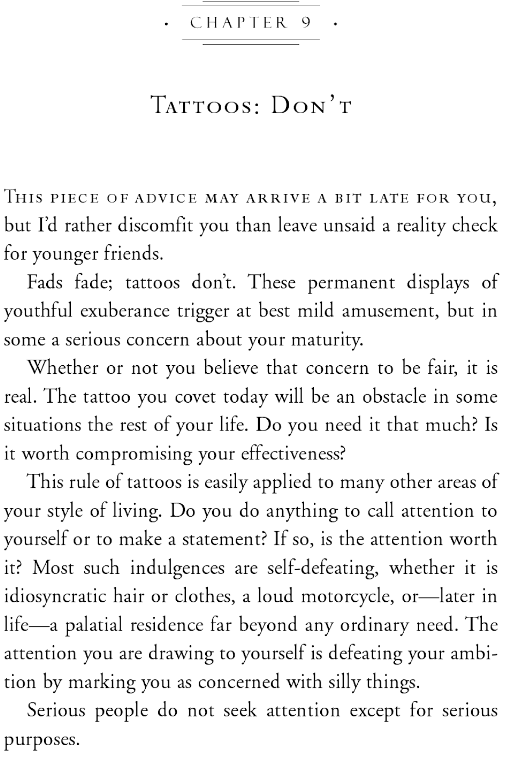
Hugh Hewitt's "In, But Not Of", Chapter 9: Tattoos, Don't
Chapter 9 of Hugh Hewitt’s “In, But Not Of: A Guide to Christian Ambition”

Tattoos

Tattoos are a problem for serious Christian men for several reasons. First, they cost money and for no gain, and can even cause you losses in your career. Second, most people get them because of low self-esteem or vanity or to look rebellious or to look dangerous. None of these motivations should be acted upon by someone with a robust Christian worldview. The money could be better used on charity, or investments, etc. Women show what their priorities really are by how they spend their money and time. Show me a woman’s bookshelf, and I’ll tell you how seriously she has thought about what it means to be a Christian in all areas of life. Instead of showing me your tattoos to demonstrate your “spirituality”, show me your apologetics books, to demonstrate your intellectual engagement. And tell me how you used that information to engage in conversations with educated non-Christians to answer their challenges to your faith. That way I’ll know that you use your money to train do hard things in order to have an influence for Christ in serious, practical, effective ways. A woman who can defend her faith and discuss Christianity with non-Christians is demonstrating her ability to raise Christian children in a secular society.

A family praying and reading the Bible

The goal of marriage is to serve God

Today, young people have been taught to follow their hearts, and to deny that there is any authority or practical wisdom that should govern their decisions. They always imagine themselves to be exempt from moral rules, statistics, cause and effect, etc. They think they know better than everyone else – even though they do almost no research on their own. Every adviser who tells them to study computer science instead of creative writing is wrong. Their same-age friends know more about what causes divorces than peer-reviewed research papers. And money should be spent on skydiving and zip-lining, regardless of what financial experts like Dave Ramsey might say.

A woman who has made many mistakes cannot fix those mistakes with words. Rationalizations, evasions, and blame-shifting do not work to show that there has been real repentance. The man can only assess whether grace has caused any real re-prioritization of goals by evaluating her outward actions over a long period of time. Furthermore, if a woman who has made mistakes attacks those who correct her from Bible’s teachings on chastity, stewardship, etc., then it’s a sign that there is no real repentance.

Choosing a wife wisely doesn’t mean that Christian men treat OTHER Christian women poorly. Christian men love all the Christian women. We care for them and support them. But when a man chooses a wife, he is choosing someone who will have more influence on his ability to serve God than anyone else. In my case, the goals for my marriage involve making a difference with apologetics in the church, having many children who will receive the educations and careers they need to have an influence, influencing government to promote Christian-friendly policies, charitable giving, mentoring young Christians, modeling a good marriage to others, and having a home that can serve to host discussions about issues that matter. These things are not free – they take careful planning and execution to achieve.

Lori’s advice is  intended for men who are serious about making their marriage produce a return for God. Men who are chaste themselves. Men who accept the Bible as an authority. Men who earned STEM degrees, instead of easy nonsense degrees that don’t lead to good careers. Men who earn 6-figure salaries, who buy houses for cash, and who are on track have a 7-figure net worth by age 50. Men who made good decisions cannot risk marrying someone who hasn’t prepared for marriage. The wrong woman in the home could ruin the man’s effort to produce a marriage that gives glory to God.

Not every man intends to achieve something for God with his marriage, but those who do need to choose a woman who has demonstrated ability at doing the job. For example, if the job requires marital fidelity, then chastity is a good indicator that the woman has the necessary self-control. If the job requires frugality, and practicality, then being debt-free, having a STEM degree, and having some private sector work experience are good indicators that she’s qualified for the role. Nothing valuable in life is ever been achieved by being lazy, wild and irresponsible. Serious Christian men look for wives who have applied themselves to difficult tasks that they didn’t feel like doing, who achieved success by remaining committed to the plan, in spite of their unhappy feelings and unmet desires.

We have a problem in the church such that we aren’t serious about teaching young people to develop marriage-ready character and to make serious plans for marriage. We are teaching them to follow their hearts, and that their feelings and desires are clues about God’s will for their happiness. We are teaching them to be uncomfortable with responsibilities, expectations and obligations to others. We are teaching them not to do their own research. We are teaching them not to make practical, wise plans. We are teaching them to ATTACK those who try to get them to be serious about doing what is likely to work. This approach is not working.

My own criteria for a wife are more demanding than Lori’s. My advice there is only for serious Christian men who want their marriage to serve God.


The psychological motivation of those who embrace postmodernism

Can a person be postmodern and a Christian? Not for long

Famous analytical philosopher John Searle has written a book “Mind, Language And Society: Philosophy In The Real World”, explaining what’s factually wrong with postmodernism. In the introduction, he explains what postmodernism is, and what motivates people to accept postmodernism.

He writes:

[…][W]hen we act or think or talk in the following sorts of ways we take a lot for granted: when we hammer a nail, or order a takeout meal from a restaurant, or conduct a lab experiment, or wonder where to go on vacation, we take the following for granted: there exists a real world that is totally independent of human beings and of what they think or say about it, and statements about objects and states of affairs in that world are true or false depending on whether things in the world really are the way we say they are. So, for example, if in pondering my vacation plans I wonder whether Greece is hotter in the summer than Italy, I simply take it for granted that there exists a real world containing places like Greece and Italy and that they have various temperatures. Furthermore, if I read in a travel book that the average summer temperature in Greece is hotter than in Italy, I know that what the book says will be true if and only if it really is hotter on average in the summer in Greece than in Italy. This is because I take it for granted that such statements are true only if there is something independent of the statement in virtue of which, or because of which, it is true.

[…]These two Background presuppositions have long histories and various famous names. The first, that there is a real world existing independently of us, I like to call “external realism.” “Realism,” because it asserts the existence of the real world, and “external” to distinguish it from other sorts of realism-for example, realism about mathematical objects (mathematical realism) or realism about ethical facts (ethical realism). The second view, that a statement is true if things in the world are the way the statement says they are, and false otherwise, is called “the correspondence theory of truth.” This theory comes in a lot of different versions, but the basic idea is that statements are true if they correspond to, or describe, or fit, how things really are in the world, and false if they do not.

The “correspondence theory of truth” is the view of truth assumed in books of the Bible whose genre is such that that they were intended by the authors to be taken literally, (with allowances for symbolism, figures of speech, metaphors, hyperbole, etc.).

But what about the postmodernists, who seek to deny the objectivity of external reality?

More Searle:

Thinkers who wish to deny the correspondence theory of truth or the referential theory of thought and language typically find it embarrassing to have to concede external realism. Often they would rather not talk about it at all, or they have some more or less subtle reason for rejecting it. In fact, very few thinkers come right out and say that there is no such thing as a real world existing absolutely, objectively, and totally independently of us. Some do. Some come right out and say that the so-called real world is a “social construct.”

What is behind the denial of objective reality, and statements about external reality that are warranted by evidence?

It is not easy to get a fix on what drives contemporary antirealism, but if we had to pick out a thread that runs through the wide variety of arguments, it would be what is sometimes called “perspectivism.” Perspectivism is the idea that our knowledge of reality is never “unmediated,” that it is always mediated by a point of view, by a particular set of predilections, or, worse yet by sinister political motives, such as an allegiance to a political group or ideology. And because we can never have unmediated knowledge of the world, then perhaps there is no real world, or perhaps it is useless to even talk about it, or perhaps it is not even interesting.

Searle is going to refute anti-realism in the rest of the book, but here is his guess at what is motivating the anti-realists:

I have to confess, however, that I think there is a much deeper reason for the persistent appeal of all forms of antirealism, and this has become obvious in the twentieth century: it satisfies a basic urge to power. It just seems too disgusting, somehow, that we should have to be at the mercy of the “real world.” It seems too awful that our representations should have to be answerable to anything but us. This is why people who hold contemporary versions of antirealism and reject the correspondence theory of truth typically sneer at the opposing view. 

[…]I don’t think it is the argument that is actually driving the impulse to deny realism. I think that as a matter of contemporary cultural and intellectual history, the attacks on realism are not driven by arguments, because the arguments are more or less obviously feeble, for reasons I will explain in detail in a moment. Rather, as I suggested earlier, the motivation for denying realism is a kind of will to power, and it manifests itself in a number of ways. In universities, most notably in various humanities disciplines, it is assumed that, if there is no real world, then science is on the same footing as the humanities. They both deal with social constructs, not with independent realities. From this assumption, forms of postmodernism, deconstruction, and so on, are easily developed, having been completely turned loose from the tiresome moorings and constraints of having to confront the real world. If the real world is just an invention-a social construct designed to oppress the marginalized elements of society-then let’s get rid of the real world and construct the world we want. That, I think, is the real driving psychological force behind antirealism at the end of the twentieth century.

Now, I’ll go one step further than Searle.

People, from the Fall, have had the desire to step into the place of God. It’s true that we creatures exist in a universe created and designed by God. But, there is a way to work around the fact that God made the universe and the laws that the universe runs on, including logic, mathematics and natural laws. And that way is to deny logic, mathematics and natural laws. Postmodernists simply deny that there is any way to construct rational arguments and support the premises with evidence from the real world. That way, they imagine, they are free to escape a God-designed world, including a God-designed specification for how they ought to live. The postmoderns deny the reliable methods of knowing about the God-created reality because logic and evidence can be used to point to God’s existence, God’s character, and God’s actions in history.

And that’s why there is this effort to make reality “optional” and perspectival. Everyone can be their own God, and escape any accountability to the real God – the God who is easily discovered through the use of logic and evidence. I believe that this is also behind the rise of atheists, who feign allegiance to logic and science, but then express “skepticism” about the origin of the universe, the fine-tuning of the universe, objective morality, the minimal facts concerning the historical Jesus, and other undeniables.

Why are Christians allowed to eat shellfish but not allowed to have sex before marriage?

I have a key that will unlock a puzzling mystery

Here’s a wonderful article from Peter Saunders.

The challenge:

An argument frequently advanced by those attempting to defend homosexual practice is that Christians ‘cherry pick’ the commands in the Bible – that is, they chose to emphasise some commands while ignoring others.

The Old Testament may forbid homosexual acts (Leviticus 18:2; 20:13) but it also forbids eating seafood without fins and scales (Leviticus 11:9-12; Deuteronomy 14:9, 10).

So how can Christians then justify upholding laws on sexual morality whilst at the same time ignoring the food laws from the very same books of the Bible? Why may they eat shellfish but not be allowed to have sex outside marriage? Isn’t this inconsistent and hypocritical?

The solution is that God enters into “covenants” with his people, and the terms of those covenants change.

Especially dietary laws:

The answer to this question lies in an understanding of biblical covenants.

A covenant is a binding solemn agreement made between two parties. It generally leaves each with obligations. But it holds only between the parties involved.

There are a number of biblical covenants: Noahic, Abrahamic, Sinaitic (Old), Davidic and New.

Under the Noahic covenant, which God made with all living human beings (Genesis 9:8-17), people were able to eat anything:

‘Everything that lives and moves about will be food for you. Just as I gave you the green plants, I now give you everything’ (Genesis 9:3).

But under the Sinaitic (Old) Covenant, which God made with the nation of Israel, people were able to eat certain foods, but not others.

Jesus clearly created a new covenant with his followers, where the dietary laws are lifted:

Jesus said that he had come to fulfil the ‘Law and the Prophets’ (Matthew 5:17; Luke 24:44). He would establish this new covenant with new laws, with himself as high priest based on his own sacrificial death on the cross.

This new covenant would completely deal with sin (Hebrews 10:1-18) and protect all those who put their faith in him from God’s wrath and judgement…

[…]‘In the same way, after the supper (Jesus) took the cup, saying, “This cup is the new covenant in my blood, which is poured out for you”’ (Luke 22:20). ‘…we have been made holy through the sacrifice of the body of Jesus Christ once for all’ (Hebrews 10:10)

People would come under the protection of this new covenant, not by virtue of belonging to the nation of Israel, but through faith in Christ. In fact the function of the Old Testament Law (Sinaitic covenant) was to point to Christ as its fulfilment.

[…]So what then did Christ say about foods? He pronounced all foods clean for his followers to eat:

‘ “Don’t you see that nothing that enters a person from the outside can defile them?  For it doesn’t go into their heart but into their stomach, and then out of the body.” (In saying this, Jesus declared all foods clean.) He went on: “What comes out of a person is what defiles them.  For it is from within, out of a person’s heart, that evil thoughts come—sexual immorality, theft, murder,  adultery, greed, malice, deceit, lewdness, envy, slander, arrogance and folly.  All these evils come from inside and defile a person.” (Mark 7:18-23)

Jesus was making that point that under the new covenant God required purity of the heart. Internal thoughts and attitudes were as important as external actions.

Food is OK for Christians, but sexual immorality – which includes premarital sex and adultery – are NOT OK for Christians.

I think sometimes when you are talking to people whose motivation is just to get rid of any objective moral law entirely, they tend to ask questions without really wanting a good answer. This is especially true when it comes to the morality of sex. They ask the question not to get an answer, but to justify getting rid of the moral rules governing sexuality. The answers are there for people who are willing to respect God in their decision-making to find. The answers are not found only by people who have a reason to not want to find them.

In case you’re wondering, I am one of those Christian men who takes chastity seriously. Marriage is about having a close connection with your spouse. Sure, I could break the rules and have a lot of fun now. A lot of Christians have a hard time turning down fun. But when I look at Jesus, I don’t see a man who is pursuing fun and thrills. I see a man who sees a need and then sacrifices his own interests to rescue others from peril.