Category Archives: News

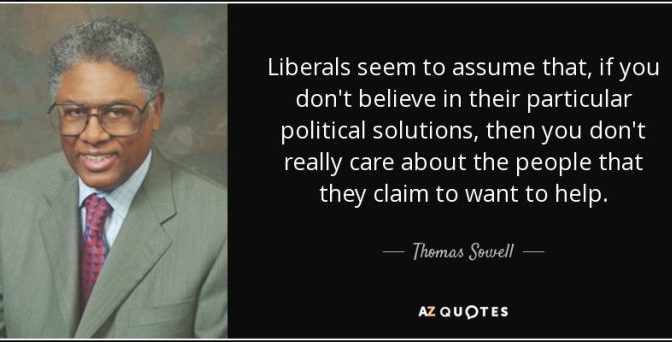
Economist Thomas Sowell explains the result of legislating price controls

My favorite economist is Thomas Sowell, who is famous for making the findings of academic economists accessible to ordinary people. I always joke to my friends that Thomas Sowell books are like Lay’s potato chips – you can’t read just one. Well, if you’ve read Dr. Sowell’s flagship book “Basic Economics”, you know that the early chapters are about how prices work in the economy.

So, I thought I would link to a VERY good article on price controls by Thomas Sowell. If you’ve never read him, I think you’ll really enjoy how me makes sense of the world for you. Learning how the world works is fun – now you see how to make good decisions.

This is “An Ancient Fallacy: Price Controls” from Capitalism Magazine.

He writes:

Those old enough to remember the gasoline crisis of 1979 may recall sitting in long lines of cars at filling stations, waiting — sometimes for hours — to reach the pump. This was one of the most common consequences of price control throughout history — a shortage. Yet how many Americans ever made the connection between the price controls of the 1970s and the gasoline shortages of the 1970s? How many have noticed that they haven’t been waiting in gasoline lines since Ronald Reagan got rid of the price controls on oil?

Why do price controls cause shortages? There are basically two reasons: supply and demand.

People will not supply as much at a lower price as they will at a higher price. Some oil wells that will repay their costs and earn a profit when the price of oil is $25 a barrel will not cover their costs when the price is $15 a barrel. Some people who will rent out a bungalow in their backyard when rents are high will not bother when rents are low. Some farmers will give up farming when food prices are kept below the point where they can earn a living.

On the demand side, people will demand more when the price is kept artificially low by price controls. Before rent control laws were passed in Sweden, less than one-fourth of unmarried adults there had their own separate housing units, but afterwards more than half did. People buy more of anything that is cheaper. With more being demanded and less being supplied, shortages are inevitable, whether with housing, food, medical care or whatever.

It is not just the quantity supplied that declines under price controls. Quality also declines.

When there are more people trying to rent apartments than there are apartments for rent, landlords no longer have to maintain the appearance of their buildings. They do not need to pay for painting, repairs or maintenance as often as they did when there was no housing shortage and they needed to attract tenants.

Sometimes quality deterioration takes the form of waiting — not just cars waiting in line at filling stations, but also sick people remaining on waiting lists for months to get surgery or other medical treatment they need. Cheap medical care is one of the most expensive things there is.

So, if you force producers to charge less for what they are making, you might see a shortage, you might see a decline in quality, or you might see waiting lists.

Now, one of the examples that Sowell uses in his books is the example of rent control. This is when the government responds to people complaining that “the rent is too damn high” by forcing landlords to charge less. If you’re paying attention, then you can predict what will happen next. There will be a shortage of housing, because people with capital invest it in other places, rather than building and renting out places to live. Why? Because there is no money to be made by investing in renting properties when the government is pushing prices down.

So, let’s look at a reverse case, where price controls are removed. What would you expect to see when a country that has had rent control laws for a long time repeals it?

Well, Argentina just elected a new free market capitalist government, and they repealed their rent control laws.

Newsweek reports on what happened next:

Argentina’s recent repeal of rent control by libertarian President Javier Milei has led to a surge in housing supply, with the freedom to negotiate contracts, previously restricted, directly causing a drop in rental prices.

Milei, a self-described “anarcho-capitalist” known for his free-market approach, repealed the 2020 Rental Law, enacted by former leftist President Alberto Fernández, which had imposed restrictions on landlords and led to a significant decline in rental availability.

[…]For many locals, finding a new apartment had become “mission impossible.” But after the repeal, Buenos Aires saw a doubling of available rental units, and rental prices have stabilized. Under the new rules, landlords and tenants have more freedom to agree on lease terms. If the duration isn’t specified, it defaults to two years.

“We’ve seen a significant increase in rental apartments, and in some cases, we had to lower prices in pesos because of fewer viewings,” Soledad Balayan, head of the real-estate agency Maure Inmobiliaria, told Argentine newspaper La Nación.

Since Millei’s repeal of rent control laws took effect on December 29, the supply of rental housing in Buenos Aires has jumped by 195.23%, according to the Statistical Observatory of the Real Estate Market of the Real Estate College (CI).

If you guessed that repealing price controls on rental properties would reverse the shortage and cause an abundance of high quality properties, then you guessed right. This is how the world works! Naturally, as supply increases, consumers have a lot more choice, and they get the benefit of better quality at a lower price, because of increased competition among suppliers of rental properties.

The article notes that Joe Biden has proposed rent control at the federal level, which is exactly the kind of policy that you would epect his successor, Kamala Harris, to push if she is elected President. If you know someone who rents, maybe you should tell them about the consequences of rent control laws?


Secular left fascism in the UK: 74-year-old pro-life woman arrested

Things are going very well for us in the United States in the new Trump administration. Pro-lifers are getting pardoned, government spending is being cut, the border is being secured. But what about in other countries that are ruled by the secular left? Are they like us, or are they different? I have a couple of stories in this post that will make you never want to set foot in the UK.

First story is new, and it’s from Daily Signal (my favorite news web site):

Police in Scotland arrested a 74-year-old grandmother for silently offering to speak to women outside an abortion facility, if they wished.

Rose Docherty stood outside the abortion wing of Queen Elizabeth Hospital in Glasgow holding a sign that read, “Coercion is a crime, here to talk, only if you want.” Two police officers insisted she desist, handcuffed the elderly woman, and charged her with violating the abortion facility’s “buffer zone” barring free speech within a wide radius of any abortion facility.

The pensioner’s arrest last week is the first made under Scotland’s Abortion Services (Safe Access Zones) Act. Those convicted face a fine of 10,000 pounds (approximately $12,600 U.S.) or an unlimited financial penalty if their expression is deemed serious.

The member of Scottish Parliament who wrote her own nation’s law, Gillian Mackay of the far-left Scottish Greens, denounced any and all peaceful pro-life advocacy outside abortion facilities as “utterly shameful and I am grateful to Police Scotland for acting so quickly.”

Here’s a photo of Gillian Mackay, so you know what secular left fascists look like:

Gillian Mackay Green Scotland Scottish

And by the way, this bill was not passed by a narrow margin. It was passed 118 votes to 1. So that should tell you something about free speech in the UK.

More:

Docherty’s arrest mirrors an English city’s charges last year’s against Livia Tossici-Bolt, 63, who held a sign outside an abortion facility in Bournemouth, England. Her sign read, “Here to talk, if you want.”

[…]“For several years now, I have been offering a helping hand to women who would like to consider other options to abortion, and pointing them to options where they can receive financial and practical support, if that’s what they would like,” said Tossici-Bolt. “There’s nothing wrong with offering help. There’s nothing wrong with two adults engaging in a consensual conversation on the street. I shouldn’t be treated like a criminal just for this.”

She would be fine in America, but not in the UK.

Here’s another article from Fox News that I saw that is from August 9, 2024, but I never blogged on it, because I somehow missed it.

It says:

London’s Metropolitan Police chief warned that officials will not only be cracking down on British citizens for commentary on the riots in the U.K., but on American citizens as well.

“We will throw the full force of the law at people. And whether you’re in this country committing crimes on the streets or committing crimes from further afield online, we will come after you,” Metropolitan Police Commissioner Sir Mark Rowley told Sky News.

So, the UK is not a very wealthy country. They have a health system that is bankrupt, and performing so poorly that the government actually pays hospitals to kill patients. So, it’s very funny to listen to this man threatening American citizens with deportation.

It’s not like the UK is doing a good job of enforcing the law against their many, many, many, many child sex-trafficking gangs. And that might be because certain people high up in the police are partakers in the child prostitution activities, and they want it covered up. Maybe they think that child sex-trafficking is OK for some cultures, and that it’s wrong to criticize it. They don’t arrest the child sex-traffickers very quickly in the UK. Complaints from the parents just get ignored and covered up by high-ranking policemen. So what do the high-ranking policemen focus on instead of child sex-trafficking? They’re more likely to arrest people who complain about children being sex-trafficked. That’s the big concern of police in the UK.

And remember, the UK does not want any inquiries about their child sex-trafficking:

British lawmakers voted against launching a national inquiry into the U.K. grooming gang scandal on Wednesday, after objections to the way the vote was being put forward – and amid international scrutiny of the crisis spearheaded by Elon Musk.

The House of Commons voted on an amendment to hold a statutory inquiry into the scandal – where it was revealed that men of predominantly Pakistani heritage had sexually abused girls for years in towns in northern England.

Again, not a country that Americans need to be visiting. Not a safe country. Not a country that respects basic human rights. Get out of there if you can, and never travel there. They are in decline.

Respectful dialog between Dr. Stephen C. Meyer and Saleem Ali

In the post below, please find the video and summary of a fairly recent dialog between my number one favorite Christian scholar, Dr. Stephen C. Meyer and Dr. Saleem Ali. The summary is not snarky, because this was a great respectful dialog!

Here is the video:

Here is the short summary:

Saleem Ali and Stephen Meyer debate the origins of order in nature on “Unbelievable.” Ali, an environmental planner with a PhD from MIT, argues in Earthly Order that natural laws and human constructs shape sustainability, remaining agnostic about a designer. Meyer, a Cambridge PhD and Discovery Institute scholar, asserts in The Return of the God Hypothesis that life’s specified complexity, cosmic fine-tuning, and the universe’s beginning suggest an intelligent design. They explore self-organization versus top-down causation, the nature of physical laws, and agency’s role, agreeing on order’s reality and determinism’s limits, but differing on its source—Ali favoring empirical humility, Meyer theistic inference.

And here is the long summary:

The conversation begins with Saleem Ali introducing his book, Earthly Order: How Natural Laws Define Human Life, published by Oxford University Press. Ali, chair of the Department of Geography and Spatial Sciences at the University of Delaware, frames his work as a quest to understand how order underpins a sustainable future. His intellectual journey traces back to his PhD at MIT, where he engaged with Stephen Jay Gould, whose concept of science and religion as “non-overlapping magisteria” sparked Ali’s interest in order’s functionality. Trained as an environmental planner, Ali seeks solutions-oriented insights, aiming to bridge natural laws with human constructs like economics and society. He spent nearly two decades refining this interdisciplinary approach, resulting in a book that spans physics, chemistry, biology, and social systems. Ali distinguishes between two Greek concepts of order: cosmos (natural order inherent in the universe) and taxis (constructed order imposed by humans). He illustrates this duality with examples—biomimicry in city planning reflects natural order beneficially, while stereotypes show constructed order gone awry. For Ali, order is both intrinsic to nature (e.g., physical laws) and a human projection, but he remains agnostic about whether it demands an explanation beyond material reality, emphasizing humility given empirical limits.

Stephen Meyer, from the Discovery Institute, counters with a perspective rooted in his book, The Return of the God Hypothesis. With a background in physics, earth science, and philosophy of science (PhD from Cambridge), Meyer argues that certain orders, particularly in biology, suggest a designing intelligence. He highlights three key evidences: the universe’s beginning, its fine-tuning, and the informational complexity of life, which he believes point to theism over materialism or pantheism. Meyer differentiates between repetitive order—like the crystalline structure of salt (NaCl), reducible to simple physical laws—and specified complexity, such as the genetic code in DNA. The latter, he asserts, involves a precise arrangement of parts for function, akin to software or language, and is not derivable from physics or chemistry alone. Drawing on historical science, he cites Kepler’s view that nature’s intelligibility reflects a rational creator, a belief that fueled the scientific revolution’s blend of confidence in discovery and rigorous testing against human fallibility. Meyer’s first book, Signature in the Cell, took nearly two decades to complete, mirroring Ali’s timeline, and argues that life’s digital code implies agency—an intelligence behind its origin.

Their discussion pivots to the origin of life, revealing a central tension. Meyer critiques bottom-up, self-organizational models proposed by scientists like Stuart Kaufman and Manfred Eigen. He acknowledges these models explain simple patterns—like vortices or crystals—but argues they fall short of accounting for specified complexity. For instance, Kaufman’s metabolic scenarios presuppose highly specific molecular arrangements, begging the question of their origin, while Eigen’s hypercycles assume pre-existing RNA and enzymes. Meyer bolsters this with experimental evidence: protein folds, essential for biological function, are rare and isolated in sequence space, as shown by Douglas Axe and Dan Toffik’s research. Modifying a stable fold risks losing function, suggesting new folds require external information—evidence, he claims, of top-down design. Ali responds by noting the contested nature of origin-of-life research. He references evolving theories—e.g., the shift from primordial soup to RNA world, and emerging ideas about metals like aluminum, abundant yet rejected by life for bioenergetic reasons. Citing Frances Arnold’s Nobel Prize-winning work on enzyme design, Ali argues that natural processes are “messier” than a neat top-down model implies, with redundancy and trial-and-error playing roles. He urges caution against over-interpreting patterns as deterministic causality, whether from intelligent design or speculative physics like string theory.

The nature of physical laws emerges as another focal point. Meyer views laws as descriptive rather than explanatory, critiquing the materialistic tendency to reify them as causes. He uses Newton’s gravity—consistent with both an apple falling and a rocket flying—to illustrate that laws permit many configurations without specifying them. At the fundamental level (e.g., gravitation, electromagnetism), laws describe recurring phenomena with precision, but their cause remains mysterious absent a deeper principle. Meyer proposes a theistic view: laws reflect God’s sustaining action, a medieval concept of potentia ordinata (ordinary power), offering a philosophical alternative to Hume’s skepticism (laws as mental habits) or positivist causation. Ali agrees that cosmos-type order exists—evident in constants like the fine-structure constant or Martin Rees’ “six numbers” defining a Goldilocks universe. However, his focus is practical: how do these laws, as constraints, inform environmental planning? In Earthly Order, he explores planetary boundaries and tipping points, noting humans can temporarily override natural limits (e.g., through technology), but long-term consequences enforce equilibrium. Ali donates his royalties to science literacy, underscoring his goal of fostering environmental awareness.

Consciousness and agency bridge their perspectives. Meyer sees life’s informational order as hinting at mind’s cosmic role, citing origin-of-life simulations where chemists impose constraints to achieve life-relevant outcomes—imparting information that mirrors top-down causation. He suggests these experiments reflect a need for intelligence in life’s origin. Ali, while open to consciousness as an emergent property, prioritizes its utility for sustainability over metaphysical resolution. Both reject determinism—scientific or theological—for negating agency. Meyer ties this to intelligent design’s push against methodological naturalism, which excludes agency as a scientific cause, advocating for intellectual pluralism rooted in early scientists like Newton. Ali concurs, noting determinism’s pitfalls in theology (e.g., fatalistic asceticism) and science, valuing human agency to navigate complexity.

Religiously, Ali identifies as a cultural Muslim, favoring allegorical over literal interpretations of faith. He’s agnostic about a divine mind, wary of exclusionary theism but open to benign frameworks that inspire hope, echoing Churchill’s view against stripping people of meaning. Meyer, a theist, embraces pluralism as a civic virtue, citing James Madison’s Christian-influenced advocacy for tolerance. He sees agency—human or divine—as a real ontological category, enriching reality beyond reductionism. Their shared disdain for rigid determinism and appreciation for order’s mystery forge common ground, despite Meyer’s evidence-driven theism and Ali’s pragmatic agnosticism.

In sum, Ali’s Earthly Order explores order’s spectrum from cosmos to human constructs, aiming for sustainability, while Meyer’s Return of the God Hypothesis infers a designing mind from life’s complexity and cosmic fine-tuning. They converge on order’s reality and agency’s importance, diverging on its source—Ali with empirical humility, Meyer with theistic inference.