
Category Archives: News

Should we have expected Brad Pitt and Angelina Jolie to divorce?

Marriage and family
Marriage and family

This article from Family Studies indicates four reasons why we should have expected Brad and Angelina to divorce.

Excerpt:

The Brangelina break-up is like the big earthquake that seismologists missed. Angelina Jolie serving Brad Pitt with divorce papers just two years into their marriage has sent shock waves through the entertainment and parenting press, inspiring panicked headlines like, “If Brad Pitt And Angelina Jolie Can’t Make It, Who Can?”But should we be so surprised?

The unfortunate truth is that if fans of the A-list couple had consulted family and marriage experts, this real-life plot twist might have looked fairly likely, if not predictable. In other words, it was more a matter of when than if.

[…]For starters, Britain’s Marriage Foundation recently conducted a study of 488 A-list celebrities. They found “that celebrities divorce at roughly twice the rate of the rest of us. . . . In the early years of their marriages, divorce among celebs is a lot more than twice as commonplace. During the first three years—as with Brad Pitt and Angelina Jolie—some 7 percent of celebs had divorced compared to 2 percent for [the rest of] us.”

Jolie and Pitt also match at least three of the individual risk factors for divorce that University of Denver research professor Scott Stanley, Ph.D., lists on his blog, Sliding vs Deciding. These include: being a child of divorce (as in Jolie’s case), both stars having had “a prior marriage that ended” (this will be Brad’s second divorce, and Jolie’s third), and “[p]rior to marrying, having sex with or cohabiting with someone other than your mate,” which looks applicable to the couple as well. They also match two other divorce risk factors for couples, including “having a child together before marriage,” and cohabiting “before either being married or at least engaged.”

Now, I’ve talked to women about these studies, and I’ve got two different responses from two different groups.

One group of those women says that the research is entirely correct, and that their future decisions need to be guided by the best practices shown in the research. They like that there is some data there that will help them to act in line what the Bible says. One lady I mentored who had an abortion actually started to mistrust her emotions when it came to choosing men and making decisions about whether to commit. We talked through my objectives, then she evaluated men using the best practices from the research. She wanted to make better decisions, and she thought that the problem was her – specifically, her feelings ruining her decision-making. She’s married to a super guy now, and doing great. Her view on emotions now, and I’m quoting, is “emotions are data, but you shouldn’t let them influence your decision-making more than reason and evidence”. Also, her husband is totally spoiled.

Another group of women expressed support for the Bible teachings and but their response to the best practices contained in the research studies is that they are “too strict” and that they only work “within a narrow scope”. And their past usually shows evidence of this habit they have of dismissing moral rules and best practices. Note: converting to Christianity doesn’t automatically change reckless, self-centered behavior. The talk could improve, but the actions could still be irresponsible and narcissistic. The truth is that some women just love to let their emotions control them, and it’s going to cause problems in a marriage if they don’t have self-control. I see a lot of women like this delaying marriage into their early and mid-30s, with no idea about how this affects their value to men. (They seem not to care about what men want from them, or from the marriage, and don’t see investing early in marriage to be a good way to make a difference, because it’s not fun). Marriages are most stable when the marriage takes place in the late 20s – not the mid 30s.

One last point. I have a male friend who also dismisses all the studies, and defends irresponsible Christian women who break all the rules and delay marriage for fun and thrills and travel. “She’s a Christian” he says. “She’s much better than most women I know” he says. “What does it matter if she marries at 40? Maybe she doesn’t want to have kids?” I show him the study about marriages succeeding when the woman is in her mid to late 20s, and he says “Who cares?” I showed him the study about credit score being connected to marital stability, and he dismissed that one, too. “How many of those women in the study are Christians?” he said. And finally “you can’t apply studies to individuals”. I don’t think that he should dismiss the studies like this – I think it will hurt him. For every divorce that happens, and for every case of sex-withholding, there was a man who first said “the studies don’t apply to me”.

The rules really do matter. You can’t dismiss the research studies and escape the consequences of doing so. And don’t assume that a person has learned her lesson just because she has become a Christian – it’s very possible for her to be saying responsible things while doing the same wild, irresponsible decision-making that she was doing as a non-Christian. One woman I know who had plans to literally marry an unemployed, penniless graduate student in his late 20s, told me that “men do have a provider role, and women should prefer men who work and have savings”. She literally introduced him to her parents – that’s how serious she was. Not one dime in his bank account, not one job on his resume. Her words say complementarian, but her actions say radical feminist rebellion against traditional male roles.

So, don’t believe the words, believe the actions. Show the candidate the studies, and look for actions that are in line with the best practices in the studies.
Are young people getting anything out of their support for the Democrat Party?

When I talk to young people, I am often told that my ideas about what to study, when to work and when to invest are “too strict”. They tell me: “your ideas only work within a narrow scope” and “don’t worry about me, everything will work out”.

Well, I happen to know that there are many crises right around the corner that will make things tougher for the next generation than they ever were for me. Trillion dollar student loan bubble, national debt doubled to $20 trillion, entitle programs going bankrupt, cost of health care and tuition skyrocketing, job growth at 1% quarter after quarter, breakdown of law and order, etc.

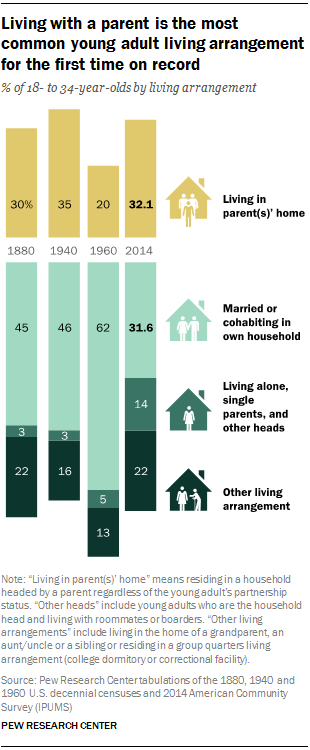
So how well are the young people equipped to deal with a challenging environment like this? Are they picking good majors and getting good jobs and controlling their spending and moving out of their parents’ houses?

Young adults failing to launch out of parents' homes
Young adults failing to launch out of parents’ homes

Here’s a new survey from the leftist Pew Research:

Broad demographic shifts in marital status, educational attainment and employment have transformed the way young adults in the U.S. are living, and a new Pew Research Center analysis of census data highlights the implications of these changes for the most basic element of their lives – where they call home. In 2014, for the first time in more than 130 years, adults ages 18 to 34 were slightly more likely to be living in their parents’ home than they were to be living with a spouse or partner in their own household.

This turn of events is fueled primarily by the dramatic drop in the share of young Americans who are choosing to settle down romantically before age 35. Dating back to 1880, the most common living arrangement among young adults has been living with a romantic partner, whether a spouse or a significant other. This type of arrangement peaked around 1960, when 62% of the nation’s 18- to 34-year-olds were living with a spouse or partner in their own household, and only one-in-five were living with their parents.

[…]The Great Recession (and modest recovery) has also been associated with an increase in young adults living at home. Initially in the wake of the recession, college enrollments expanded, boosting the ranks of young adults living at home. And given the weak job opportunities facing young adults, living at home was part of the private safety net helping young adults to weather the economic storm.

The job opportunities in the private sector are bad because of the Obama administration’s high taxes and burdensome regulations, which strangle private sector job creation. Dodd-Frank and Obamacare are two examples of bills that kill job creation. There was a good video put out by Prager University that showed how these taxes and regulations hurt entrepreneurs:

Where are the jobs for the young people supposed to come from, when the young people keep voting against the private sector businesses that create jobs? I don’t know that their parents and professors are explaining to them how the economy works. Taxes and regulations make job creation harder, and then you have nowhere to work, and just live at home.

The “weak job opportunities” that Pew Research mentioned are especially weak for young people who graduate from non-STEM programs. STEM (science, technology, engineering, mathematics) graduates are able to find jobs that pay enough. Liberal arts graduates end up serving coffee. And then they vote for more environmentalist regulations and a higher minimum wage, and find themselves out of a job entirely. The jobs just go elsewhere where there are lower taxes and fewer regulations.

It’s really important for young people to get into the workforce early and start building their resume and references with work experience. Two years of work experience is better than graduate school in most cases, too. Saving works much better when you start investing early, so watch your spending.

Every immigrant without a high school degree will cost taxpayers $640,000

Major welfare programs as of 2012

I am very much in favor of expanding and streamlining immigration processes for skilled immigrants, especially for areas where there is more demand than supply. But I am not in favor of letting in refugees or other unskilled immigrants, especially if they will be eligible to collect benefits paid for by other working taxpayers.

The Daily Signal explains what the cost is:

On Thursday, the National Academies of Sciences, Engineering, and Medicine will release its report on “The Economic and Fiscal Consequences of Immigration.” According to the report, first generation immigrants as a group increase the nation’s fiscal deficit. In other words, the government benefits they receive exceed the taxes paid.

The National Academies’ report provides 75-year fiscal projections for new immigrants and their descendants. The fiscal impact varies greatly according to the education level of the immigrant. Low-skill immigrants are shown to impose substantial fiscal costs that extend far into the future. The future government benefits they will receive greatly exceed the taxes they will pay.

On average, a nonelderly adult immigrant without a high school diploma entering the U.S. will create a net fiscal cost (benefits received will exceed taxes paid) in both the current generation and second generation. The average net present value of the fiscal cost of such an immigrant is estimated at $231,000, a cost that must be paid by U.S. taxpayers.

The concept of “net present value” is complex: it places a much lower value on future expenditures than on current expenditures.

One way to grasp net present value is that it represents the total amount of money that government would have to raise today and put in a bank account earning interest at 3 percent above the inflation rate in order to cover future costs.

Thus, as each adult immigrant without a high school diploma enters the country, the government would need to immediately put aside and invest $231,000 to cover the future net fiscal cost (total benefits minus total taxes) of that immigrant.

Converting a net present value figure into future outlays requires information on the exact distribution of costs over time. That data is not provided by the National Academies.

However, a rough estimate of the future net outlays to be paid by taxpayers (in constant 2012 dollars) for immigrants without a high school diploma appears to be around $640,000 per immigrant over 75 years. The average fiscal loss is around $7,551 per year (in constant 2012 dollars).

Slightly more than 4 million adult immigrants without a high school diploma have entered the U.S. since 2000 and continue to reside here. According to the estimates in the National Academies report, the net present value of the future fiscal costs of those immigrants is $920 billion.

If you want to take in refugees or unskilled immigrants or sponsor elderly family members, then they should not be allowed to collect benefits paid by other taxpayers. The family that is here already must provide for them, and be held accountable should anything go wrong. Unfortunately, that’s not how the system works now, and it’s not what the Democrats want. They want to import more people who will depend on big government, and then give them the right to vote.

Now, you might think that young American students who expect to find jobs will also expect to keep most of what they earn. It’s very surprising then that they keep voting for a party (the Democrats) that seeks to enslave them with the obligation to pay for other people. I know that the next generation will be paying more in taxes than I ever did during my lifetime.