Category Archives: News

Muslim Rollins College professor attacks Christian student for questioning her stupidity

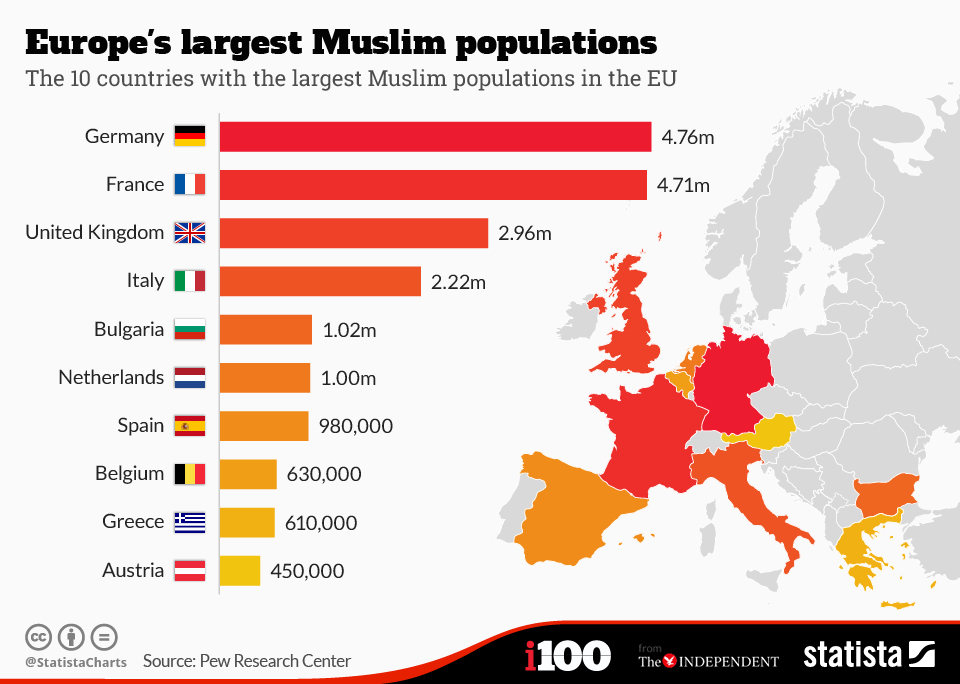
Muslim populations in Europe

To start this post, let’s review the minimal facts about the historical Jesus by citing prominent non-Christian historical Jesus scholar E.P. Sanders of Duke University.

Below is a list of facts about the historical Jesus that are accepted by ancient historians – Christian, non-Christian, atheist.

These are compiled by non-Christian scholar E.P. Sanders:

From his book “Jesus and Judaism” (1985):

  • Jesus was baptized by John the Baptist.
  • Jesus called disciples and spoke of there being twelve.
  • Jesus confined his activity to Israel.
  • Jesus was a Galilean who preached and healed.
  • Jesus engaged in a controversy about the temple.
  • Jesus was crucified outside Jerusalem by the Roman authorities.
  • After his death, his followers continued as an identifiable movement.
  • At least some Jews persecuted at least parts of the new movement.

From his book “The Historical Figure of Jesus” (1993):

  • Jesus was born c.4 BCE, near the time of the death of Herod the Great;
  • He spent his childhood and early adult years in Nazareth, a Galilean village;
  • He was baptized by John the Baptist;
  • He called disciples;
  • He taught in the towns, villages, and countryside of Galilee (apparently not the cities);
  • He preached “the kingdom of God”;
  • Around the year 30 he went to Jerusalem for Passover;
  • He created a disturbance in the temple area;
  • He had a final meal with the disciples;
  • He was arrested and interrogated by Jewish authorities, specifically the high priest;
  • He was executed on the orders of the Roman prefect, Pontius Pilate;
  • His disciples at first fled;
  • They saw him (in what sense is uncertain) after his death;
  • As a consequence they believed he would return to found the kingdom;
  • They formed a community to await his return and sought to win others to faith in him as God’s Messiah.

Now, the two facts in bold are denied by Muslim believers, for the simple reason that their holy book in Surah 4:157 denies the crucifixion of Jesus. As the list of nearly universally accepted facts above suggests, there is basically no PhD-credentialed ancient historian who holds the Muslim view. In particular, Jewish, secular and atheist historians would all grant that Jesus died of crucifixion.

Now, let’s see the story from the College Fix.

Excerpt:

A student says he was suspended from Rollins College for challenging his Muslim professor’s anti-Christian assertions, including her claim that Jesus’ crucifixion never took place.

Twenty-year-old Marshall Polston, a sophomore at the private, Florida-based four-year college, said that the professor of his Middle Eastern Humanities class also told students that Jesus’ disciples did not believe he was God.

[…]The professor, Areej Zufari, as well as a campus spokesperson, could not be reached by The College Fix late Sunday. However, the Central Florida Post reports that it tried numerous times to obtain comment from Rollins College and Professor Zufari to no avail.

Polston claims the situation began after he challenged Zufari’s assertions about Jesus and his disciples. Polston said this challenge led Zufari to file a complaint with a campus dean, claiming he made her feel “unsafe.”

Next, Polston received a 52 percent on a major essay.

“I was upset, understandably. I’ve never gotten anything less than straight A’s, so I was really interested in figuring out how to possibly improve or at least understand the grade,” Polston told the Post.

[…]Zufari, for her part, posted on Facebook to the ACLU of Florida, complaining about an unnamed student that is “making my life hell this semester. This one is spewing hatred at me, de-railing class, and just sent me a hateful email threatening me…I want to know if there is a way to hold the individual responsible for his harassment and hate speech. Any ideas? Thank you!”

According to the March 24 suspension letter, Polston’s “actions have constituted a threat of disruption within the operations of the College and jeopardize the safety and well-being of members of the College community and yourself.”

Those alleged actions are not spelled out within the document. Nonetheless, Polston was given strict directions not to set foot on campus or have any contact with Zufari in the letter.

So let’s find out about this alleged harassment.

A campus safety report obtained by The College Fixstates:

“Student ______ stated to me that she looked out the back glass door of the classroom and saw Mr. Polston staring into the room. He briefly stopped then proceeded on his way. Campus safety was immediately notified and responded at 19:36 hours. A search was conducted but Mr. Polston was not found. Ms. Zufari’s students were upset and did not feel comfortable being in the class. Ms. Zufari dismissed her class early at 20:07 hours.”

Polston has completely refuted these claims, however, offering video footage of his whereabouts — at a restaurant over a half-hour away from the school.

It would not be the first time that free speech was deemed offensive, or that a fake hate crime was alleged.
Analysis: how much did each Obamacare mandate drive up health insurance premiums?

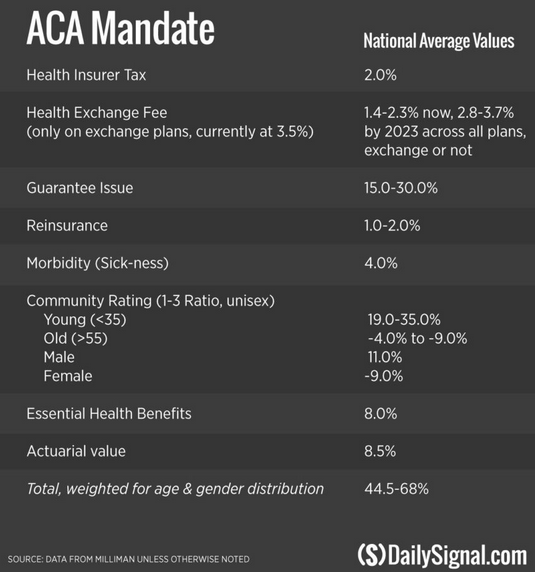
How each Obamacare mandate affected the health insurance premiums

Since 2010, we were inundated with reports and studies from various groups that argued that the new mandates in Obamacare would drive up the cost of health insurance. And that was actually observed to happen. Year after year, health insurance costs rose – usually by double digits. We knew why this was happening, too: Obamacare required health insurers to cover more conditions, many of them not even related to health insurance.

Here is an an analysis of which mandates caused health insurance costs to rise the most from the Daily Signal.

Excerpt:

Obamacare caused premiums to rise for various reasons, chief among them being the vast new regulations the law imposed on insurance markets. A new analysis from Milliman backs this up. The study provided estimates of the average impact that various Obamacare regulations had on premiums.

[…]Changes in morbidity (or the sickness of the population) due to newly uninsured by itself caused 4 percent increases in premiums nationally, but in Ohio it raised premiums by 35-40 percent.

Age is also a factor in premium prices, and Obamacare disrupted the natural order by dictating the age banding, which disproportionately harmed young people. (Age banding here refers to how much the most expensive plans can be in comparison to the cheapest.)

Before Obamacare, the national rate of age banding was 1-to-5. In other words, the most expensive plan was five times more costly than the cheapest plan, with expense increasing with age.

Obamacare mandated that the rate be set at 1-to-3, so that the most expensive plan could be no more than three times as expensive. While elderly people’s premiums might have seen fewer increases—which is both due to banding and the fact that Obamacare is close to a death spiral—young people have suffered.

Overall, young people can expect to have rate increases between 58.9 percent and 91.8 percent using national averages. However, not every state had a 1-to-5 age band.

In places like Ohio, the effects are far worse—it had a 1-to-6 age band. Even accounting for the differences in its population from the national average, young people in Ohio can still expect to pay an average of 7.7 percent more on top of other increases.

In addition to this “youth tax,” mandates like the “essential health benefits” and actuarial requirements further punish all Americans with benefits that they don’t need, at prices they can’t afford. While in places like Maryland these mandates might only contribute 8 to 10 percent to premium increases, nationally they raise premiums by an average of 16.5 percent, up to 32 percent.

Overall, accounting for gender, age, and the relative proportions of all those groups, Americans are paying 44.5 to 68 percent more in premiums owing just to Title I regulations. That number is even higher when factoring all the other adverse effects of Obamacare.

Notice that “guaranteed issue”, which is so popular with those who feel that they can somehow be generous by spending other people’s money, is one of the biggest drivers of health insurance costs. When pollsters ask people whether they want to keep these provisions, they mostly say yes. But when the pollsters ask whether they want to keep these provisions if it means that their own health insurance costs will go up, they mostly say no. It’s amazing how American voters, especially Democrats, love the idea of spending other people’s money. As long as they don’t have to pay for it, then it’s a great idea to spend someone else’s money in order to buy the feeling (and the peer approval) of being generous and compassionate.

And after 8 years of Obama offering that feeling to his supporters, we now have a national debt of $20 trillion, instead of $10 trillion. Mind you, in decades of asking my co-workers, I’ve never yet met one Democrat who could tell me what the national debt was. I guess that would interrupt their feelings of generosity and compassion.


Hindu nationalists, led by Narendra Modi, crack down on religious liberty

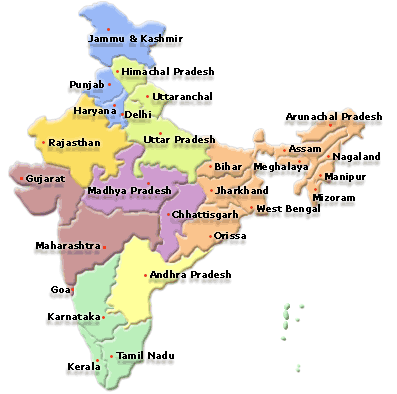
Map of India
Map of India

This was reported by the Daily Signal.

Excerpt:

In a sad development, the government of India is clamping down on religious liberty, and impoverished children stand to lose the most.

Compassion International, a Christian organization that partners with local churches around the world to improve the lives of children in poverty, began shutting down its operations in India due to financial restrictions imposed on them by the Indian government. This will leave an estimated 145,000 children worse off.

The shutdown comes after months of attempts to convince the Indian government to reverse its decision, and the clampdown on Compassion International comes amid other government actions against nearly 11,000 faith-based and secular organizations operating in India.

Compassion International is a faith-based aid organization that provides humanitarian assistance for underprivileged children around the world, and has operated in India since 1968. The group is the largest single foreign provider of assistance in India, contributing around $45 million in humanitarian aid annually.

Stephen Oakley, general counsel for Compassion International, testified that the organization hosts programs that run five to six days a week, and provides meals, medical treatment, and tutoring, as well as financial assistance for school tuition.

While these programs are run out of the local Christian churches, Compassion International denies that any forced conversions take place and does not use adherence to Christianity as a condition for providing assistance. The aid is purely based on need.

[…]Nooruddin estimates that about half of the foreign aid organizations in India have been pushed out since 2012 due to an inability to renew their licenses—something the government has made more difficult in an attempt to reduce the influence of outside organizations in India.

The concept of charity is foreign to Hinduism in particular (but not Islam), simply because if a person is poor, this is seen as a result of bad karma that they have collected because of misdeeds in past lives. It’s nothing for anyone to fix, in short, and it’s seen as best to concentrate on one’s one’s grades and one’s own wealth-building. Although most Hindus don’t want to be bothered taking care of the poor themselves, they also don’t want Christians getting the credit for doing it. So, the easiest way to stop Christians getting credit with the poor for helping the poor is to stop Christians from helping the poor – leveling the playing field between the two religions.

Evangelism and Hindu tolerance

I come from a partially Hindu background, and I have to work with a lot of Indian people in my current job as a software engineer. And I have indeed noticed an aversion to Christianity from them. it’s actually very strange. When I ask them about religion, they can talk passionately about religious diversity and how tolerant their Hinduism is. But if you dig a little more under the surface, not only do they disagree with everything I believe, but they also don’t think I should allowed to express my views in public to anyone who doesn’t already agree with me.

So why is that? Well, although many East Indian people that I speak to know a great deal about computer science and making money, they actually know almost nothing about religions other than their own. For them, religion isn’t an area for investigation about what’s true or false. For them, religion is like their nationality or race or family or community. It’s beyond logic and evidence, it’s just design for social cohesion. So, if, for example, you tell a Hindu that their oscillating eternal cosmology is factually false, they get angry because that’s not religion is for them. They don’t care whether what they believe is true or false, so long as it helps them get along with their families and communities. And since Christianity would cause a break up in their families and communities (should anyone convert), they want to stop all logical and evidential discussions of it. For a Hindu, not eating meat is more important than how the universe began, because not eating meat is social, and how the universe began is factual. Bring up facts to people who are looking for social cohesion and unity gets you the kind of response that you see from Modi and the Hindu nationalists.