
Category Archives: News

Mainstream media celebrates mass starvation and political prisons in North Korea

CNN raves about North Korea's brutal regime, yay communism!
CNN raves about North Korea’s brutal regime: Pretty! Glamorous! Stylish!

I’m sure everyone has heard about the mainstream media’s embrace of North Korea’s charming smiles at the Olympics. I like to listen to the Ben Shapiro podcast, the Andrew Klavan podcast, and the Daily Signal podcast and they ALL talked about it. But I wanted to tell people the truth, and remind people that this isn’t the first time that mainstream media types have covered up atrocities in order to make their heroes look good.

The Daily Signal posted celebratory tweets from seven different mainstream media sources: CNN, ThinkProgress, The New York Times, Politico, Reuters, and a bureau chief of the Washington Post.

The New York Times tweeted: “Without a word, only flashing smiles, Kim Jong-un’s sister outflanked Vice President Mike Pence in diplomacy” and Reuters tweeted: “North Korea judged winner of diplomatic gold at Olympics”.

Before we go any further, let’s learn a bit about starvation in North Korea from a radically leftist source: Newsweek.

Excerpt:

Roughly 18 million people in North Korea are not getting enough food, a United Nations report released this week found. That means 70 percent of the isolated nation’s population relies on food assistance to get by, including 1.3 million children under the age of five.

“Amidst political tensions, an estimated 18 million people across DPRK [North Korea] continue to suffer from food insecurity and undernutrition, as well as a lack of access to basic services,” the U.N. report said. “Furthermore, 10.5 million people, or 41 percent of the total population, are undernourished.”

North Koreans also need basic healthcare and sanitation, the U.N. report determined. Without safe water or better sanitation and hygiene, diarrhea and pneumonia have become the leading cause of death for children under five, the report said.

The radically-leftist NBC News reports on the concentration camps:

Atrocities committed by North Korea against its own people are “strikingly similar” to those perpetrated by the Nazis during World War II, the head of a United Nations panel said Monday after publishing an unprecedented report.

The year-long investigation called for urgent action by the international community to stop allleged crimes against humanity committed by Kim Jong Un and his regime.

[…]But the report also shed new light on the country’s darkest side – its labor camps.

As many as 120,000 North Koreans are thought to be imprisoned across the country, many of them in four large camps. This number may have shrunk in recent years, according to the report, but only because many of the inmates have been murdered or starved to death.

People and their families are held for arbitrary crimes such as “gossiping” about the state.

[…]The U.N. report contains more of this harrowing testimony, which it says is tantamount to “extermination, murder, enslavement, torture, imprisonment, rape, forced abortions and other sexual violence.” It compared conditions to camps run by the Nazis during World War II and gulags set up in Soviet Russia.

This is what the mainstream media declined to mention while they were praising a woman smiling and Mike Pence frowning as some great evidence of moral equivalence between North Korea and the United States of America.

Atheism in action: a satellite photo of North Korea at night
One big concentration camp: a satellite photo of North Korea at night

This is not the first time that the mainstream media has covered up for forced starvation, imprisonment and mass murders.

Here’s another case written about in The Weekly Standard.

Excerpt:

AT LONG LAST a Pulitzer Prize committee is looking into the possibility that the Pulitzer awarded to Walter Duranty, the New York Times Moscow correspondent whose dispatches covered up Stalin’s infamies, might be revoked.In order to assist in their researches, I am downloading here some of the lies contained in those dispatches, lies which the New York Times has never repudiated with the same splash as it accorded Jayson Blair’s comparatively trivial lies:

“There is no famine or actual starvation nor is there likely to be.”
–New York Times, Nov. 15, 1931, page 1

“Any report of a famine in Russia is today an exaggeration or malignant propaganda.”
–New York Times, August 23, 1933

“Enemies and foreign critics can say what they please. Weaklings and despondents at home may groan under the burden, but the youth and strength of the Russian people is essentially at one with the Kremlin’s program, believes it worthwhile and supports it, however hard be the sledding.”
–New York Times, December 9, 1932, page 6

“You can’t make an omelet without breaking eggs.”
–New York Times, May 14, 1933, page 18

“There is no actual starvation or deaths from starvation but there is widespread mortality from diseases due to malnutrition.”
–New York Times, March 31, 1933, page 13

I would like to add another Duranty quote, not in his dispatches, which is reported in a memoir by Zara Witkin, a Los Angeles architect, who lived in the Soviet Union during the 1930s. (“An American Engineer in Stalin’s Russia: The Memoirs of Zara Witkin, 1932-1934,” University of California Press ). The memoirist describes an evening during which the Moscow correspondents were discussing how to get out the story about the Stalin-made Russian famine. To get around the censorship, the UP’s Eugene Lyons was telephoning the dire news of the famine to his New York office but the was ordered to stop because it was antagonizing the Kremlin. Ralph Barnes, the New York Herald Tribune reporter, turned to Duranty and asked him what he was going to write. Duranty replied:

Nothing. What are a few million dead Russians in a situation like this? Quite unimportant. This is just an incident in the sweeping historical changes here. I think the entire matter is exaggerated.

And this was at a time when peasants in Ukraine were dying of starvation at the rate of 25,000 a day.

And that is how mainstream media journalists think about the people who are harmed by their leftist policies – whether it be the unborn, children raised without one or more biological parents, families who cannot get make ends meet, innocent people murdered by terrorists and other criminals, etc. Kill them all, as long as big government is in control, making everyone “equal”. Journalists want to call evil “good”, and good “evil”, until the people are so confused that they lose the ability to judge the crimes of Marxist regimes.

You can get the facts about the forced starvation of Ukrainian civilians – in this article from the center-left The Atlantic, written by historian Anne Applebaum.

Here’s one quote:

In the years 1932 and 1933, a catastrophic famine swept across the Soviet Union. It began in the chaos of collectivization, when millions of peasants were forced off their land and made to join state farms. It was then exacerbated, in the autumn of 1932, when the Soviet Politburo, the elite leadership of the Soviet Communist Party, took a series of decisions that deepened the famine in the Ukrainian countryside. Despite the shortages, the state demanded not just grain, but all available food. At the height of the crisis, organized teams of policemen and local Party activists, motivated by hunger, fear, and a decade of hateful propaganda, entered peasant households and took everything edible: potatoes, beets, squash, beans, peas, and farm animals. At the same time, a cordon was drawn around the Ukrainian republic to prevent escape. The result was a catastrophe: At least 5 million people perished of hunger all across the Soviet Union. Among them were nearly 4 million Ukrainians who died not because of neglect or crop failure, but because they had been deliberately deprived of food.

Neither the Ukrainian famine nor the broader Soviet famine were ever officially recognized by the USSR. Inside the country the famine was never mentioned. All discussion was actively repressed; statistics were altered to hide it. The terror was so overwhelming that the silence was complete. Outside the country, however, the cover-up required different, subtler tactics. These are beautifully illustrated by the parallel stories of Walter Duranty and Gareth Jones.

Collectivization: that’s what the mainstream media loves. Everyone the same and equal, and no differences. Cogs in a machine, with no dissent from our watchful government above. When you look at North Korea, or Cuba or Venezuela, you’re looking at the Marxist atheist ideal. Free people are so unpredictable, they say, that we need a big government if we want to avoid catastrophes like global warming and overpopulation. This is how leftists think – or should I say, this is how leftists feel. They don’t think.

Leftism starts with a feeling of superiority over one’s neighbor, and the desire to be delivered from these inferior people by an infallible government. Those stupid neighbors with their religion and their values – they are wasting food and electricity on their large families. They should be thrown into a concentration camp, so that they don’t teach their children their mistaken values, e.g. – chastity, sobriety and natural marriage. Who can stop them from having views different from mine? The government can, if we enlightened people vote to make it big enough to control them.

It’s very important for people to understand what it is that they are consuming when they turn on television shows on CNN, or pick up a New York Times newspaper.
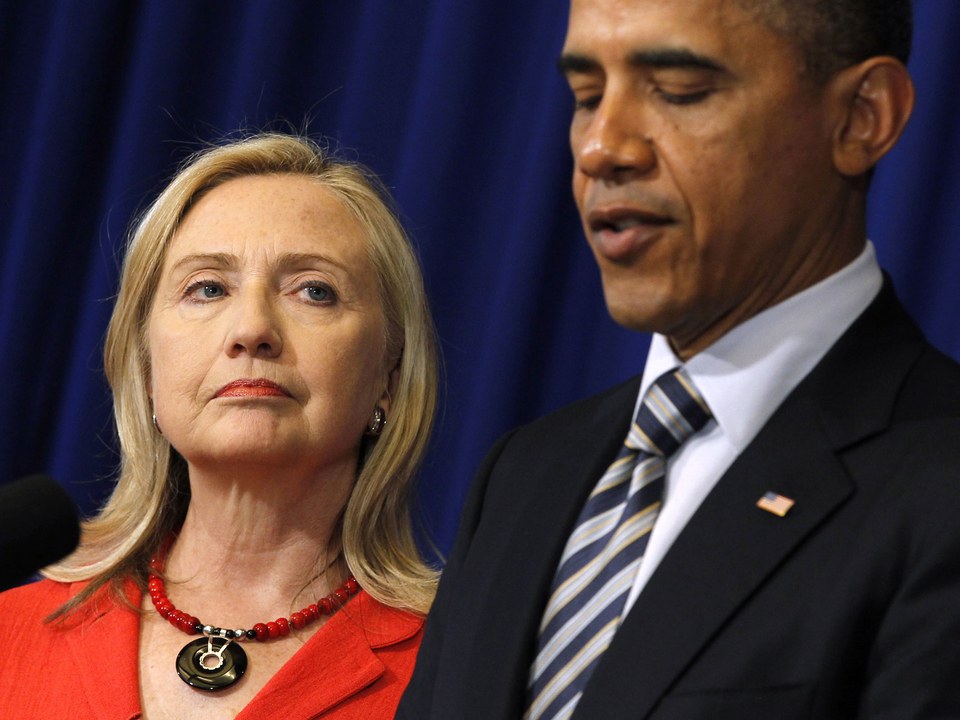
We shouldn’t be surprised by evidence of fascism in the Obama administration

Hillary Clinton and Barack Obama

There were plenty of signs that Obama was a pretty typical leftist authoritarian. Everything we knew about his ideology before he was elected should have told us that he was in favor of big government, and opposed to private businesses and families. If there was a conflict between liberty and government overreach, then Obama could be counted on to come down on the side of big government.

Here’s a reminder from The Federalist about why we shouldn’t be surprised by what was revealed in the House Intelligence Committee memo.

Excerpt:

Remember Frank VanderSloot? He was one of eight Mitt Romney donors that an Obama campaign website targeted in April 2012, listing each by name and condemning them for the crime of having donated to Obama’s opponent. The post described VanderSloot as a “wealthy individual” with a “less-then-reputable record.”

It didn’t stop with this public shaming of a private citizen. As the Wall Street Journal’s Kim Strassel later noted, the Obama campaign’s site was a clear signal to harass and intimidate Romney donors, which is exactly what happened:

Twelve days later, a man working for a political opposition-research firm called an Idaho courthouse for Mr. VanderSloot’s divorce records. In June, the IRS informed Mr. VanderSloot and his wife of an audit of two years of their taxes. In July, the Department of Labor informed him of an audit of the guest workers on his Idaho cattle ranch. In September, the IRS informed him of a second audit, of one of his businesses. Mr. VanderSloot, who had never been audited before, was subject to three in the four months after Mr. Obama teed him up for such scrutiny.

The last of these audits was only concluded in recent weeks. Not one resulted in a fine or penalty. But Mr. VanderSloot has been waiting more than 20 months for a sizable refund and estimates his legal bills are $80,000. That figure doesn’t account for what the president’s vilification has done to his business and reputation.

Using the IRS to target political enemies was nothing new for the Obama administration in 2012. In Obama’s January 2010 State of the Union address, he infamously disparaged the U.S. Supreme Court—to the justices’ faces—for its ruling in Citizens United. He claimed the ruling would “open the floodgates for special interests” to influence elections—by which he meant conservative groups. He returned to this theme again and again in subsequent speeches, warning that Citizens United would enable shadowy organizations, maybe even foreign-controlled corporations, to infiltrate our politics with “dark money.”

Obama’s message was clear: these conservative advocacy groups should be targeted. The IRS got the message, and from 2010 to 2013 it systematically targeted conservative nonprofits applying for tax-exempt status. If your group had “tea party” or “patriots” in its name, the IRS came after you. Hundreds of individuals and groups, mostly comprised of private citizens with moderate means, were subjected to exhaustive and expensive IRS audits. The feds demanded detailed donor and member information, reading lists, and in some cases the contents of prayers offered at meetings. The applications were held up for years.

Last October, the IRS signed a consent decree in federal court admitting that it targeted conservative groups. But of course nothing ever happened to those responsible. The IRS official at the heart of the targeting scandal, Lois Lerner, retired with a full pension and no disciplinary action was ever taken against any IRS employee. When the scandal broke in 2013, Obama feigned outrage, calling the agency’s behavior “outrageous” and assuring the public that the IRS should be “held fully accountable.”

But of course the IRS was simply responding to Obama’s openly expressed suggestion that these groups were suspicious and improperly engaged in campaigning. Obama didn’t have to issue a direct order to get the IRS to do his political dirty work, he just had to make himself clear.

And it wasn’t just the IRS persecuting conservative groups. The Obama administration also went after religious people – people of moral character and conscience.

More:

The same sort of politicization and abuse of power unfolded throughout the executive branch under Obama. Consider the contraceptive mandate. The Affordable Care Act invested the U.S. secretary of Health and Human Services with enormous power over the country’s health insurance markets, including the ability to define what sort of contraceptive coverage employers had to provide. Employers with strong religious objections to contraception and related abortifacients, like Hobby Lobby and the Little Sisters of the Poor (an order of Catholic nuns who care for the poor elderly), were effectively told by the Obama administration to shut up and violate their faith.

In both of those cases, Obama’s Justice Department went all the way to the Supreme Court to try to force those employers to comply with the dictates of the HHS secretary. That Obama’s Justice Department failed in both cases shouldn’t diminish the fact that both HHS and DOJ carried on a highly politicized campaign against religious conservatives who refused to go along with federal rules stemming from Obama’s signature legislative accomplishment.

On this blog, I wrote many times about the fascist activities of the Holder DOJ and then the Lynch DOJ, after his departure. Basically, the Obama administration thought that it was perfectly reasonable to weaponize the entire federal government – from IRS, to EPA, to HHS, and beyond – against their political opposition. Both the Republican party, and also private citizens, private businesses and private charities.

Study: raising children without a father causes harm to the children

Lets take a closer look at a puzzle

I thought it might be a good idea to take a look at a recent research paper on father absence. My purpose in posting this study is to remind people to think about what children need when making relationship decisions. Fathers are more of a necessity for children than a nice-to-have.

The paper about a large-scale study was posted at NCBI NIH.

The abstract says:

The literature on father absence is frequently criticized for its use of cross-sectional data and methods that fail to take account of possible omitted variable bias and reverse causality. We review studies that have responded to this critique by employing a variety of innovative research designs to identify the causal effect of father absence, including studies using lagged dependent variable models, growth curve models, individual fixed effects models, sibling fixed effects models, natural experiments, and propensity score matching models. Our assessment is that studies using more rigorous designs continue to find negative effects of father absence on offspring well-being, although the magnitude of these effects is smaller than what is found using traditional cross-sectional designs. The evidence is strongest and most consistent for outcomes such as high school graduation, children’s social-emotional adjustment, and adult mental health.

I was curious to see what specific problems fatherlessness causes for children, according to this redo of previous studies.

The conclusion explains:

The body of knowledge about the causal effects of father absence on child well-being has grown during the early twenty-first century as researchers have increasingly adopted innovative methodological approaches to isolate causal effects. We reviewed 47 such articles and find that, on the whole, articles that take one of the more rigorous approaches to handling the problems of omitted variable bias and reverse causality continue to document negative effects of father absence on child well-being, though these effects are stronger during certain stages of the life course and for certain outcomes.

We find strong evidence that father absence negatively affects children’s social-emotional development, particularly by increasing externalizing behavior. These effects may be more pronounced if father absence occurs during early childhood than during middle childhood, and they may be more pronounced for boys than for girls. There is weaker evidence of an effect of father absence on children’s cognitive ability.

Effects on social-emotional development persist into adolescence, for which we find strong evidence that father absence increases adolescents’ risky behavior, such as smoking or early childbearing. The evidence of an effect on adolescent cognitive ability continues to be weaker, but we do find strong and consistent negative effects of father absence on high school graduation. The latter finding suggests that the effects on educational attainment operate by increasing problem behaviors rather than by impairing cognitive ability.

The research base examining the longer-term effects of father absence on adult outcomes is considerably smaller, but here too we see the strongest evidence for a causal effect on adult mental health, suggesting that the psychological harms of father absence experienced during childhood persist throughout the life course. The evidence that father absence affects adult economic or family outcomes is much weaker. A handful of studies find negative effects on employment in adulthood, but there is little consistent evidence of negative effects on marriage or divorce, on income or earnings, or on college education.

Despite the robust evidence that father absence affects social-emotional outcomes throughout the life course, these studies also clearly show a role for selection in the relationship between family structure and child outcomes. In general, estimates from IFE, SFE, and PSM models are smaller than those from conventional models that do not control for selection bias. Similarly, studies that compare parental death and divorce often find that even if both have significant effects on well-being, the estimates of the effect of divorce are larger than those of parental death, which can also be read as evidence of partial selection.

Right now, we’re living in a time where people think that it’s ok to do whatever they feel like doing. People seem to treat relationships as if they are meant to provide the grown-ups with satisfaction, and the needs of the children are often neglected. Any kind of warning or appeal to evidence is dismissed by those who want to bend and break the rules.

Well, when you take a look at the studies, you actually find that there are rules about how to go about relationships in order to achieve results. It seems to me that children’s needs ought to be an important consideration when making relationship decisions. Men shouldn’t have babies with bad mothers, and women shouldn’t have babies with bad fathers. It ought to be an important criterion for choosing a mate and conducting a relationship: are we making decisions protecting children and giving them what they need?

And it turns out that there are studies that tell you how to prepare for making a stable commitment, too. Like this one, which found that the number of premarital sex partners reduces relationship stability and quality. This is just an example, there are many more studies that provide a lot more information about how to do things right.

I think today, people want to make decisions about what to do based on feelings. If it feels good, do it. But this approach doesn’t work anywhere in life. It doesn’t work when choosing a major, when choosing a job, when choosing how to spend money. It just never works. Nothing useful is ever achieved by putting feelings above reason and evidence.

People shouldn’t be surprised when they break the rules and then get negative outcomes. It just takes a little reading first to find out what is likely to work and what isn’t. There are real victims to bad decisions. There are mistakes that can’t be fixed with happy talk and a positive attitude. We seem to have gotten addicted to the idea that every damaging mistake can be fixed by making everyone around say happy words about the mistake. But the truth is that when you make bad decisions, the damage exists independently of what people say about it.

It’s not the mean people making moral judgments that causes fatherless kids to have higher anxiety or be more violent or get pregnant earlier or abuse drugs. It’s the fatherlessness. The only hope that children have to avoid the consequences of bad decisions by parents is for the moral people to set boundaries and teach moral wisdom with evidence.