
Category Archives: News

For Christmas Day, let’s remember George Washington and the Battle of Trenton

Washington crosses the Delaware river before the Battle of Trenton

My favorite book about the American Revolutionary war by far is called “1776”. It’s written by famous historian David McCullough. The part of the book that really stuck out to me was the Battle of Trenton. I think that this battle really defines the essential character of America, as seen in the decision-making of its great general and first President, George Washington.

In the book, I learned about how George Washington and his revolutionary army had suffered a string of defeats at the hands of the powerful Commonwealth army, and their mercenary allies. It was the middle of a freezing cold winter, and the many of the sickly and ill-equipped American troops were just days from having their enlistment contracts run out. Some of the troops were not waiting for their enlistments to expire, they were just deserting. In droves.

Washington was losing, and was just days from losing his Continental Army. If the Americans lost the revolutionary war, then it would mean that every man who signed the Declaration of Independence would be hanged as a traitor. The American revolutionaries had risked everything for liberty, and they were about to lose everything – their money, their property and even their lives.

I found a page that summarizes the battles leading up to the Battle of Trenton.

First battle, a defeat for Washington:

The Battle of White Plains

October 28, 1776

RESULT: BRITISH VICTORY

With the British army maneuvering to make his Harlem Heights position untenable, George Washington withdrew from the island of Manhattan, and established a new encampment further north near White Plains, New York.

On October 28, 1776, a flank attack by the British on this new position resulted in the collapse of Washington’s line. Thankfully, he was able to orchestrate an orderly withdrawal that preserved the army. Unfortunately, Washington’s retreat further exposed Fort Washington, which remained garrisoned on Manhattan.

Next, another defeat for Washington:

The Battle of Fort Washington

November 16, 1776

RESULT: BRITISH VICTORY

Following the defeat of George Washington’s army at White Plains, New York, British General William Howe focused his army’s attention on Fort Washington, the last post defended by the Continental army on Manhattan.  Although Washington hoped to abandon the fort, his officers convinced him that it needed to be held in order to keep British ships from ascending the Hudson River.

During a carefully-orchestrated, all-out attack on November 16, 1776, British and Hessian forces overwhelmed the fort’s garrison after vicious fighting. When he heard the attack begin, Washington, who had stationed himself across the Hudson River in New Jersey, travelled across the river to the enter the fort and personally inspect its defenses. Several officers accompanied Washington, including Generals Israel Putnam, Hugh Mercer, and Nathanael Greene. They convinced Washington to leave the fort just 30 minutes before it was surrounded.

And then, another defeat for Washington:

Evacuation of Fort Lee

November 20, 1776

RESULT: BRITISH VICTORY

After the fall of Fort Washington, George Washington made plans for the evacuation of Fort Lee, which stood across the Hudson River in New Jersey. In a letter written to John Hancock on November 19, 1776, the general wrote that “…Fort Lee was always considered as only necessary in conjunction with [Fort Washington]…,” and that it would be abandoned as soon as provisions and other supplies were removed.

Unfortunately, a large British force succeeded in scaling the heights close to the fort on November 20, 1776. Faced with superior numbers, Washington called for the immediate evacuation of the fort, which resulted in the loss of dozens of cannon, 2-300 tents, and 1,000 barrels of flour.

That brings us to the Battle of Trenton. Across the Delaware river from Washington’s army was an encampment of Hessian mercenaries, fighting for the British. The Hessians believed that Washington’s Continental army was in full retreat. The British generals had already written home to the King to tell him that the war was nearly over, and that they had won. But had they?

Washington crosses the Delaware

Here is what Washington decided to do on December 25th, 1776:

General George Washington’s commitment to cross the Delaware River on Christmas 1776 foreshadowed the many hardships faced as well as the eventual victory of the Continental Army during the American Revolution. At first glance, the decision to transport 2,400 Continental soldiers across an icy river in one night, directly into a severe winter storm of sleet and snow seems irrational.

Washington’s decision, however, was based on strategic motivation, understanding that the Continental Army desperately needed a victory after months of intense fighting with several significant defeats and no major victories. Washington also understood that the element of surprise was the only way that he and his army stood a chance of defeating the highly trained Hessian mercenaries.

On the morning of December 25, 1776, Continental soldiers woke up in their camps along the Delaware River to a frozen, snowy covered ground. Weather conditions worsened and temperatures continued to drop throughout the day. Late in the afternoon, the Continentals left their tents and began to form along the river in anticipation of the night’s events. Washington kept almost all of the details of the crossing a secret; as a result, none of the soldiers knew anything about their upcoming mission.

Washington’s crossing of the Delaware River on December 25, 1776 allowed his army to strike the Hessians at Trenton the next morning.

Washington’s plan was to cross the river at night, march to the nearby town of Trenton, New Jersey, and attack the Hessian garrison right before dawn. Time was Washington’s greatest enemy; to combat it his orders called for the various regiments to assemble at their designated crossing points no later than sunset. The close proximity to the crossing points allowed the soldiers to begin the journey immediately after nightfall struck and complete the crossing no later than midnight. Once across, Washington intended for the armies to reassemble and march approximately ten miles to Trenton, arriving there no later than five o’clock in the morning to achieve surprise. Despite his meticulous planning, the schedule failed almost before it even began.

Many of the regiments did not arrive at the river until well after dark. Additionally, a severe winter storm that included wind, rain, snow, hail, and sleet met the soldiers at the banks of the river significantly slowing their crossing. Many of the boats had to combat ice jams and unfavorable currents. To make matters even worse, the extreme darkness caused by the storm made it hard for the boatmen to see the opposite shore.

The necessity of using larger ferries to carry pieces of artillery across the river caused even more delays. Washington crossed the river with John Glover’s Marblehead mariners and upon arrival debated whether or not to cancel the entire operation because it was more than three hours behind schedule. Washington decided it was too costly to retreat and he painfully watched as his army continued to trickle across the river.

If you were standing by the river along with Washington watching his sick, frozen, ill-equipped army struggle across the Delaware, then you would probably think that Washington had lost the element of surprise. This attack was just taking too long to happen. Maybe Washington would give up his plan, because things hadn’t gone his way. But Washington didn’t quit – he persisted.

The Battle of Trenton, December 25, 1776
The Battle of Trenton, December 25, 1776 (click for larger image)

The Battle of Trenton

This is how the battle went down in Trenton, New Jersey:

Immediately following his famous crossing of the Delaware River, General George Washington marched the Continental Army to Trenton, New Jersey. The army’s forces included horses, guns, wagons, and soldiers, stretching for nearly one mile. The weather was worse than it had been crossing the river, but the army continued to proceed as Washington rode up and down the column pressing his men to carry on.

Shortly after eight o’clock on the morning of December 26, 1776, the Continental Army started its charge on the city. Three columns marched through thick snow with Washington personally leading the middle charge. As the soldiers pushed forward, artillery began to fire. At the same time, German drums urgently called the Hessians to arms. To his astonishment, Washington had maintained the element of surprise.

Immediately after the firing began, three Hessian regiments ran from their quarters ready to fight, quickly forming ranks. As the Hessians grouped, the Continental Army entered the city at two points: John Stark marched into the city on River Road from the west, while Nathanael Greene and Washington arrived from the north.

Andreas von Wiederholdt, a Hessian lieutenant, incorrectly reported to Colonel Johann Rall that the Continental Army had surrounded Trenton and there was no available route for retreat. As a result, Rall decided to counterattack Washington within the city and not retreat across Assunpink Creek. This proved to be costly as Washington’s forces occupied the highest ground in the city and had clear views of all of Rall’s movements.

Time after time, Washington countered Rall’s efforts to outflank the Continentals. Eventually, Washington’s forces overpowered the Hessians. Rall was mortally wounded and many of his soldiers broke ranks, fleeing from the fighting. Normally very disciplined, Rall’s regiment was confused and disoriented without their commander. They retreated to an orchard east of Trenton where they were forced to surrender.

Despite the large number of Hessians that escaped Trenton, Washington still won a crucial strategic and material victory. In only one hour of fighting, the Continental Army captured nearly nine hundred Hessian officers and soldiers as well as a large supply of muskets, bayonets, swords, and cannons. Washington ordered his soldiers to treat the Hessian prisoners in a humane manner, and the general quickly focused his attention on what to do next. Washington assembled all of his officers in Trenton to discuss whether they should attack another post, hold their position in Trenton, or retreat back across the Delaware. Washington decided that because of the condition of his army, the best move was to return to their camps across the River.

When the Continental Army returned to camp on the Pennsylvania side of the Delaware River, soldiers were exhausted. They had marched and fought for two straight days through rain, snow, sleet, and hail. Washington knew that his army had far exceeded expectations at Trenton and that they faced many more challenges going forward.

Washington won two more battles in rapid succession. Many of his troops re-enlisted because of these victories. There were many battles remaining to fight, and many hardships such as the winter at Valley Forge. But the Battle of Trenton was the turning point of the revolution. George Washington would not let a string of defeats stop him.
Did the early church invent the divinity of Jesus over a long period of time?

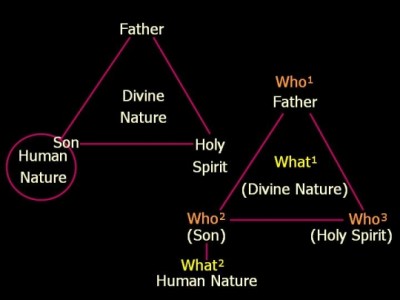
The Christian doctrine of the Trinity

How early is the doctrine of the divinity of Jesus?

When I answer this question, I only want to use the earliest, most reliable sources – so I can defend them on historical grounds using the standard rules of historiography.

The 4 sources that I would use are as follows:

  • The early creed in 1 Corinthians 15:3-8, and 1 Corinthians 1
  • A passage in Philippians 2
  • Two passages from Mark, the earliest gospel
  • A passage from Q, which is an early source of Matthew and Luke

So let’s see the passages.

1 Corinthians

I’ve written before about the early creed in 1 Corinthians 15:3-8, which skeptical scholars date to 1-3 years after the death of Jesus, for a variety of reasons I covered in the previous post. Here’s the creed which definitely makes Jesus out to be more than an ordinary man. Ordinary men don’t get resurrection bodies after they die.

Here’s the passage: (1 Cor 15:3-8)

3For what I received I passed on to you as of first importance: that Christ died for our sins according to the Scriptures,

4that he was buried, that he was raised on the third day according to the Scriptures,

5and that he appeared to Peter, and then to the Twelve.

6After that, he appeared to more than five hundred of the brothers at the same time, most of whom are still living, though some have fallen asleep.

7Then he appeared to James, then to all the apostles,

8and last of all he appeared to me also, as to one abnormally born.

Additionally, 1 Corinthians 1:21-25 talks about Jesus being “the power of God and the wisdom of God”. Paul is identifying Jesus with the divine.

21For since in the wisdom of God the world through its wisdom did not know him, God was pleased through the foolishness of what was preached to save those who believe.

22Jews demand miraculous signs and Greeks look for wisdom,

23but we preach Christ crucified: a stumbling block to Jews and foolishness to Gentiles,

24but to those whom God has called, both Jews and Greeks, Christ the power of God and the wisdom of God.

25For the foolishness of God is wiser than man’s wisdom, and the weakness of God is stronger than man’s strength.

But it gets even stronger! You all probably already know that the most important passages in the Old Testament for Jews is the famous “Shema“, which is found in Deuteronomy 6:4-9. The Shema is a strong statement of Jewish monotheism.

Here’s the passage:

4 Hear, O Israel: The LORD our God, the LORD is one.

5 Love the LORD your God with all your heart and with all your soul and with all your strength.

6 These commandments that I give you today are to be upon your hearts.

7 Impress them on your children. Talk about them when you sit at home and when you walk along the road, when you lie down and when you get up.

8 Tie them as symbols on your hands and bind them on your foreheads.

9 Write them on the doorframes of your houses and on your gates.

So how does Paul fit Jesus in with this strong statement of Jewish monotheism?

Paul alludes to the Shema in 1 Corinthians 8:4-6.

4So then, about eating food sacrificed to idols: We know that an idol is nothing at all in the world and that there is no God but one.

5For even if there are so-called gods, whether in heaven or on earth (as indeed there are many “gods” and many “lords”),

6yet for us there is but one God, the Father, from whom all things came and for whom we live; and there is but one Lord, Jesus Christ, through whom all things came and through whom we live.

Holy mackerel! How did that get in there? Paul is splitting the roles of God in the the Shema and identifying Jesus in one of the divine roles! Jesus is not an ordinary man. That passage “through whom all things came” foreshadows John identifying Jesus as “the Word of God”, which “became flesh and dwelt among us”. Holy snark – did you guys know that was all in here so early?

The date for 1 Corinthians is 55 AD. It should be noted that skeptical scholars like James Crossley accept these passages, and you can check it out in the debate audio yourself.

Philippians

Check out Philippians 2:5-11.

5Your attitude should be the same as that of Christ Jesus:

6Who, being in very nature God, did not consider equality with God something to be grasped,

7but made himself nothing, taking the very nature of a servant, being made in human likeness.

8And being found in appearance as a man, he humbled himself and became obedient to death— even death on a cross!

9Therefore God exalted him to the highest place and gave him the name that is above every name,

10that at the name of Jesus every knee should bow, in heaven and on earth and under the earth,

11and every tongue confess that Jesus Christ is Lord, to the glory of God the Father.

The date for Philippians is 60-61 AD. Still within the lifetime of the eyewitnesses, and written by an eyewitness who was in contact with the other eyewitnesses, like Peter and James, whom Paul spoke with numerous times on his journeys to Jerusalem.

Mark’s gospel

Mark’s gospel is the earliest and atheists like James Crossley date it to less than 40 AD, which is 10 years after the death of Jesus at most. When you read the gospel of Mark, you are getting the earliest and best information available about the historical Jesus, along with Paul’s epistles. So what does Mark say about Jesus? Is Jesus just a man, or is he something more?

Check out Mark 12:1-9:

1He then began to speak to them in parables: “A man planted a vineyard. He put a wall around it, dug a pit for the winepress and built a watchtower. Then he rented the vineyard to some farmers and went away on a journey.

2At harvest time he sent a servant to the tenants to collect from them some of the fruit of the vineyard.

3But they seized him, beat him and sent him away empty-handed.

4Then he sent another servant to them; they struck this man on the head and treated him shamefully.

5He sent still another, and that one they killed. He sent many others; some of them they beat, others they killed.

6“He had one left to send, a son, whom he loved. He sent him last of all, saying, ‘They will respect my son.’

7“But the tenants said to one another, ‘This is the heir. Come, let’s kill him, and the inheritance will be ours.’

8So they took him and killed him, and threw him out of the vineyard.

9“What then will the owner of the vineyard do? He will come and kill those tenants and give the vineyard to others.

And Mark 13:32, talking about the date of the final judgment.

32“No one knows about that day or hour, not even the angels in heaven, nor the Son, but only the Father.

And again, this passage is establishing a hierarchy such that Jesus is being exalted above all men and the angels, too. And the passage is embarrassing to the early church, because it makes Jesus look ignorant of something, so they would not have made this passage up. Jesus is not an ordinary man, he is above the angels – God’s unique Son.

The “Q” source for Matthew and Luke

Here’s Matthew 11:27, which is echoed in Luke 10:22:

27“All things have been committed to me by my Father. No one knows the Son except the Father, and no one knows the Father except the Son and those to whom the Son chooses to reveal him.

22“All things have been committed to me by my Father. No one knows who the Son is except the Father, and no one knows who the Father is except the Son and those to whom the Son chooses to reveal him.”

Since this passage is in both of Matthew and Luke, but not in Mark, scholars believe that it is in the earlier “Q” source used by both Matthew and Luke. Q predates both Matthew and Luke, and so it is also fairly early (maybe 67-68), although not as early as Mark and Paul. Bill Craig writes that this passage is also embarrassing because it says that no one knows Jesus.

Wages of low-income workers have risen faster than middle and high income workers

In Trump's America, low-wage workers see the highest wage increases
In Trump’s America, low-wage workers see the highest wage increases

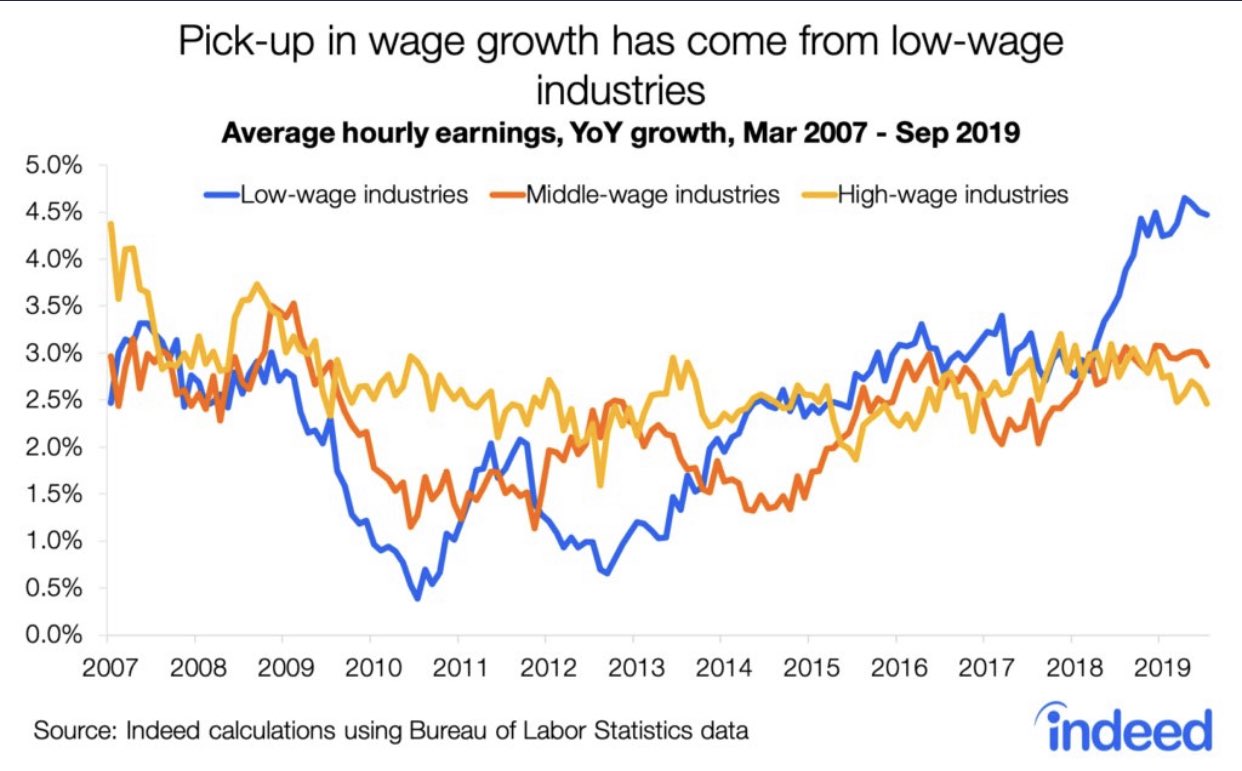
By now, everyone has heard about how the unemployment rate is at a record low. Not only that, but the unemployment rates for women, blacks and hispanics are also at record lows. But did you know that wages have been increasing at the highest rate for low-income workers? That’s right. It’s low-wage workers who are seeing their incomes go up the most.

Here’s an analysis done by an economist at Indeed.com, one of the largest online job boards:

The US economy added 130,000 jobs in August, and the unemployment rate was flat at 3.7%.

After this report, we can all take a breath, but not a big one. While we are still seeing many of the disconcerting trends of the past few months, the labor market continues to grow at a healthy rate.

Before assuming that the total job growth number in August is skewed because of Census hiring, remember that these are real jobs taken by real workers. Even if you remove government hiring, which accounts for around 34,000 jobs, this is still a number that is high enough to keep up with population growth. This month’s report reflects a slowing labor market but not necessarily one heading straight for a recession.

Wage growth strongest for low-wage industries

At this point in the expansion, we’d expect wage growth to pick up, but it is continuing to stall. In fact, wage growth continues to be strongest for workers in lower-wage industries. Labor force participation grew in the month, signaling a labor market still drawing workers off the sidelines. Job seekers are still benefiting from this job market, but let’s not count on this lasting forever.

That analysis was done in August of this year, and as you may have heard, the numbers since then have been even better.

CNBC explained:

The jobs market turned in a stellar performance in November, with nonfarm payrolls surging by 266,000 and the unemployment rate falling to 3.5%, according to Labor Department numbers released Friday.

Those totals easily beat the Wall Street consensus. Economists surveyed by Dow Jones had been looking for solid job growth of 187,000 and saw the unemployment rate holding steady from October’s 3.6%.

[…]In addition to the robust November gains, revisions brought up totals from the two previous months. September’s estimate went up 13,000 to 193,000 and the initial October count increased by 28,000 to 156,000. Those changes added 41,000 to the previous tallies and brought the 2019 monthly average to 180,000, compared with 223,000 in 2018.

So my point here is simple. Democrats are mad because they lost the election, and they really aren’t interested in whether president Trump is doing a good job or a bad job. The thing is, president Trump is doing a terrific job if all you care about is numbers. I understand that Democrats love their New York infanticide, their Seattle mayor pedophilia, their Democrat FBI agent adultery, their black face Virginia governor, their Clinton-funded Steele dossier, etc. But for the rest of us who just want to have a job, keep what we earn, and spend it how we want, this has been a great presidency.

It’s not just low unemployment and increased wages. Conservatives are happy about a never-ending stream of conservative judges filling up vacancies on federal courts.

Far-left Politico is not too happy about this:

The Senate confirmation of Lawrence VanDyke and Patrick Bumatay to the 9th U.S. Circuit Court of Appeals this month brought to nine the number of appointments President Donald Trump has made to the 29-member bench that serves as the last stop for nearly all legal complaints lodged in nine Western states. Democratic-appointed judges now hold a three-seat majority, compared with 11 at the start of Trump’s presidency.

If the trend continues, it represents a major shift in the liberal wing of the judiciary, meaning lawsuits for progressive causes won’t find a friendly ear as easily as they have. The circuit has been the go-to venue for activist state attorneys eager to freeze Trump policies on health care, immigration and other social issues. It ruled against Trump’s weakening of Obamacare’s contraceptive mandate, as well as multiple versions of his travel ban.

It’s now weighing the administration’s overhaul of the federal family planning program, the “public charge” rule that denies green cards for individuals who participate in programs like Medicaid — and it could take up the “conscience rule” allowing health providers to opt out of providing care on religious or moral grounds.

[…]The 9th Circuit isn’t the only court whose makeup has changed through Trump’s conservative nominees and McConnell’s singular focus on confirming judges. The 1st Circuit in Boston and 3rd Circuit in Philadelphia now have Republican-appointed majorities.

[…]A 9th Circuit panel of four Democratic appointees and seven Republican appointees in July allowed the administration’s overhaul of the Title X federal family planning program to take effect. The policy bars clinics that provide or refer patients for abortions from receiving program funds for reproductive health services like STD screenings and contraception and prompted Planned Parenthood to quit over the change. Another 9th Circuit panel this year ruled in favor of letting Trump’s Justice Department distribute grants to cities that use the money to crack down on illegal immigration.

[…]The Trump administration will likely seek a reversal of two separate lower court injunctions against the health provider conscience rule and has been asked by DOJ to freeze a recent nationwide hold on Trump’s order to deny legal immigrants entry to the U.S. if they can’t cover their health care costs.

If you have some time, and you want to really understand why the Democrats are so angry, I really recommend this recent show featuring Andrew Klavan:

And I also wanted to reflect on what the booming Trump economy has meant to me personally. I made more money from my mutual funds this year than I earned as a senior software engineer! I understand that “orange man bad” and “impeach the m*th*rf#$%&r. But I cannot deny that I am doing well financially, and it’s very clear from economists that this is directly the result of massive tax cuts, deregulation, and smart trade policies.

Politics isn’t about how you feel, and how you look to your friends. It’s more important than that. We need to have policies that solve problems for people who are struggling to get their American dream. Donald Trump has delivered those policies, and the results are not subject to debate. We have the numbers, and the numbers are very, very good.