Category Archives: News

Study: female same-sex marriages have the highest rates of divorce

Sometimes, when I raise the fact that women initiate 69% of divorces, I get the response that this number is men’s fault. For example, pro-marriage Christian feminists and sociologists will say “it’s because men are less emotionally intelligent, they don’t meet the needs of women”. If that’s true, then we should expect that lesbian relationships will be the most committed. Are they?

Here’s a study from August 2022, published in the Journal of Family History.

The abstract says:

The trends in marriage and divorce among male and female same-sex couples in urban and rural Norway were compared to different-sex marriages. Norway legalized same-sex living in 1993 and marriage in 2009. Cohorts from 1993 to 2018 were included. The 2009 gender-neutral marriage law appears to have had minimal impact on the rate of same-sex unions and divorces. Moreover, divorce risks are highest in female same-sex marriages, whereas male same-sex marriages have the same divorce risk levels as different-sex marriages. The divorce risk is declining for same-sex marriages in urban areas, while the opposite is observed in rural areas.

And down in the results section, we have this:

Female same-sex marriages had the highest total divorce rate throughout the period, followed by male same-sex marriages. The highest total divorce rate was observed among female same-sex marriages formed in 2003, with 59.1% divorced before 2018.

Now, some people will say, but this is just one country. Yes, but it’s a same-sex marriage affirming country. They’ve had same-sex unions since 1993, and same-sex marriage since 2009. So critics can’t blame disapproval of LGBT for these numbers. And this study agrees with previous studies.

Now, let’s make a comment about this.

I think this data suggests a wonderful question for men to use in the course of vetting a candidate wife for marriage. Just casually mention the study, and then ask her “what do you think the explanation for this is?”

There will be one group of women who say “that’s easy. women are very emotional, and that causes them to have more difficulty keeping to their commitments. It’s something that men should test for. Men should choose women who have a habit of taking on tough tasks, and seeing them through to the end. And maintaining their relationship obligations with difficult or demanding family members, friends, elderly pets, etc.” That’s the right answer. I like women who do STEM degrees and work hard jobs in the competitive private sector, they tend to be good at sticking with tough situations and engineer solutions, instead of quitting.

But there’s another group that will reply “these numbers are the result of external forces that are conspiring against women to make them fail. It’s all the fault of insufficient resources, or social disapproval, or sexism, or the males in their lives.” That’s the wrong answer. I avoid women who do easy degrees like English, psychology, etc. They tend to go straight to a safe unionized job teaching children in the public school monopoly. That’s not good training for commitment-keeping. It shows that they like to do easy things. Marriage is hard work. Don’t pick a wife who likes fun and thrills. Pick a wife who engineers solutions to problems.

I do understand that women expect high quality communication and emotional intelligence in their relationships. To those women, I would just say, you need to choose better men. You need to know up front what marriage is about in the long-run, and you need to choose the things that you really need for the long run.

I wrote this post to try to help men avoid disasters when making their relationship choices. The best we can do as men is to take responsibility for our own choices. That means not letting ourselves be carried away by emotions. We have to test by asking questions. And even better than listening to an answer, is looking at the actions. Always look for women who keep their commitments when it goes against their self-interest. They are out there. Pick one.

Atheist Jerry Coyne explains why morality is impossible for atheists

Let’s review what you need in your worldview in order to have a rationally grounded system of morality.

You need 5 things:

1) Objective moral values

There needs to be a way to distinguish what is good from what is bad. For example, the moral standard might specify that being kind to children is good, but torturing them for fun is bad. If the standard is purely subjective, then people could believe anything and each person would be justified in doing right in their own eyes. Even a “social contract” is just based on people’s opinions. So we need a standard that applies regardless of what people’s individual and collective opinions are.

2) Objective moral duties

Moral duties (moral obligations) refer to the actions that are obligatory based on the moral values defined in 1). Suppose we spot you 1) as an atheist. Why are you obligated to do the good thing, rather than the bad thing? To whom is this obligation owed? Why is rational for you to limit your actions based upon this obligation when it is against your self-interest? Why let other people’s expectations decide what is good for you, especially if you can avoid the consequences of their disapproval?

3) Moral accountability

Suppose we spot you 1) and 2) as an atheist. What difference does it make to you if you just go ahead and disregard your moral obligations to whomever? Is there any reward or punishment for your choice to do right or do wrong? What’s in it for you?

4) Free will

In order for agents to make free moral choices, they must be able to act or abstain from acting by exercising their free will. If there is no free will, then moral choices are impossible. If there are no moral choices, then no one can be held responsible for anything they do. If there is no moral responsibility, then there can be no praise and blame. But then it becomes impossible to praise any action as good or evil.

5) Ultimate significance

Finally, beyond the concept of reward and punishment in 3), we can also ask the question “what does it matter?”. Suppose you do live a good life and you get a reward: 1000 chocolate sundaes. And when you’ve finished eating them, you die for real and that’s the end. In other words, the reward is satisfying, but not really meaningful, ultimately. It’s hard to see how moral actions can be meaningful, ultimately, unless their consequences last on into the future.

Theism rationally grounds all 5 of these. Atheism cannot ground any of them.

Let’s take a look at #4: free will and see how atheism deals with that.

Atheism and free will?

Here’s prominent atheist Jerry Coyne’s editorial in USA Today to explain why atheists can’t ground free will.

Excerpt:

And that’s what neurobiology is telling us: Our brains are simply meat computers that, like real computers, are programmed by our genes and experiences to convert an array of inputs into a predetermined output. Recent experiments involving brain scans show that when a subject “decides” to push a button on the left or right side of a computer, the choice can be predicted by brain activity at least seven seconds before the subject is consciously aware of having made it. (These studies use crude imaging techniques based on blood flow, and I suspect that future understanding of the brain will allow us to predict many of our decisions far earlier than seven seconds in advance.) “Decisions” made like that aren’t conscious ones. And if our choices are unconscious, with some determined well before the moment we think we’ve made them, then we don’t have free will in any meaningful sense.

If you don’t have free will, then you can’t make moral choices, and you can’t be held morally responsible. No free will means no morality.

Here are some more atheists to explain how atheists view morality.

William Provine says atheists have no free will, no moral accountability and no moral significance:

Let me summarize my views on what modern evolutionary biology tells us loud and clear — and these are basically Darwin’s views. There are no gods, no purposes, and no goal-directed forces of any kind. There is no life after death. When I die, I am absolutely certain that I am going to be dead. That’s the end of me. There is no ultimate foundation for ethics, no ultimate meaning in life, and no free will for humans, either.

Richard Dawkins says atheists have no objective moral standards:

In a universe of blind physical forces and genetic replication, some people are going to get hurt, other people are going to get lucky, and you won’t find any rhyme or reason in it, or any justice. The universe that we observe has precisely the properties we should expect if there is, at bottom, no design, no purpose, no evil and no good, nothing but blind, pitiless indifference… DNA neither knows nor cares. DNA just is. And we dance to its music. (Richard Dawkins, River Out of Eden: A Darwinian View of Life (1995))

When village atheists talk about how they can be moral without God, it’s important to ask them to justify the minimum requirements for rational morality. Atheists may act inconsistently with their worldview, believing in free will, expecting praise and blame for complying with the arbitrary standards of their peer group, etc. But there is nothing more to morality on atheism that imitating the herd – at least when the herd is around to watch them. And when the herd loses its Judeo-Christian foundation – watch out. That’s when the real atheism comes out – the atheism that we’ve seen before in countries that turned their backs on God, and the moral law. When God disappears from a society, anything is permissible.

Trump admin pushing election integrity measures ahead of 2026 elections

I was on vacation all last week and took Monday off as well, so most of the posts were repeats. But it’s Monday night, and I have a fresh post set for Tuesday morning. If you asked me what the biggest mistake of the Trump 2016 administration was, it was neglecting the state level changes to election policy in blue states that made it easier for voter fraud to happen.

Here is the latest story from Daily Signal:

The Republican National Committee is executing President Donald Trump’s election-integrity agenda ahead of the 2026 midterm elections.

[…]Trump signed an executive order in March requiring states to use proof of U.S. citizenship for federal voter registration, setting Election Day as the uniform deadline for receiving ballots in federal elections, and conditioning federal election funding on compliance with those and other election-integrity rules.

The RNC is working to defend Trump’s executive order in states where practices prohibited by the directive continue. While the president is taking the national approach to election integrity, the RNC is coming alongside him with a state-by-state approach.

“We are challenging these things on a state-by-state basis to make sure that they are compliant with the statutory schemes as constructed now, and that they provide the most balanced security as we can have in those states,” the official said.

So what are the changes that the RNC is pushing for? They are going after states that have a universal mail-in ballot system, where election officials automatically send absentee ballots to all registered voters in the state, regardless of whether individuals have asked for one.

They are also going after states that don’t update their voter rolls to remove ineligible voters—such as those who have died, moved away, or become inactive. If you don’t remove ineligible voters, you make it easier to commit voter fraud by duplicate voting or fraudulent voting.

They are also going after states that have “ballot harvesting”, such that third parties (e.g., campaign workers, family members, or organizations) can gather and submit completed ballots from multiple voters without limits, deadlines, or strict tracking requirements.

Now, when I read all this, I was thinking of the Secretaries of State in blue states like Michigan and Pennsylvania. Can you really improve election integrity scores in blue states? Well the article talks about some of their wins in blue states, so yes – they really are doing it.

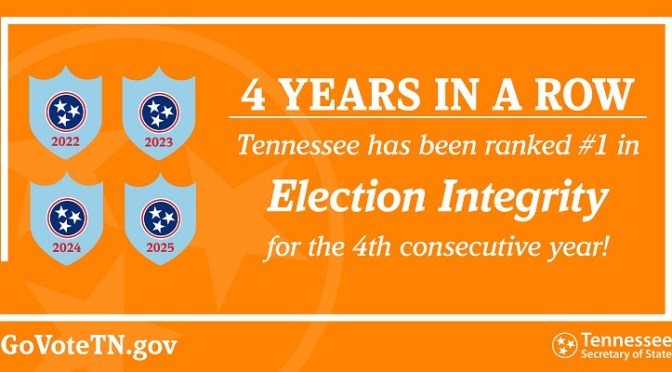
Here is a ranking of states for election integrity:

Rank State 2024 Vote
1-t Tennessee R
1-t Arkansas R
3 Alabama R
4 Louisiana R
5-t Florida R
5-t Georgia R
7-t Indiana R
7-t Oklahoma R
9 South Carolina R
10 Missouri R
11-t Mississippi R
11-t Ohio R
11-t Texas R
11-t Wisconsin R
15 Kentucky R
16 Iowa R
17 Kansas R
18 North Carolina R
19 Nebraska R
20-t New Hampshire D
20-t South Dakota R
22 Montana R
23 Virginia D
24-t Arizona R
24-t Idaho R
24-t Pennsylvania R
24-t Rhode Island D
28 Utah R
29 West Virginia R
30 Wyoming R
31 Michigan R
32 Alaska R
34 Maryland D
35-t Delaware D
35-t North Dakota R
37 New Mexico D
38-t Colorado D
38-t Connecticut D
38-t Maine D
41 Illinois D
42-t Minnesota D
42-t New Jersey D
42-t New York D
45 Massachusetts D
46 Washington D
47 Nevada R
48-t Oregon D
48-t Vermont D
50 California D
51 Hawaii D


Notice how most of the red states have good election integrity, whereas most of the blue states have poor election integrity. That’s because most people who live in blue states like Washington cannot rationally ground objective moral values and objective moral duties, and so they just behave immorally.

My advice to people in blue states is to move out to red states, where you are sure your vote will count.