Category Archives: Commentary

How should Christians respond to the Supreme Court’s decision to redefine marriage?

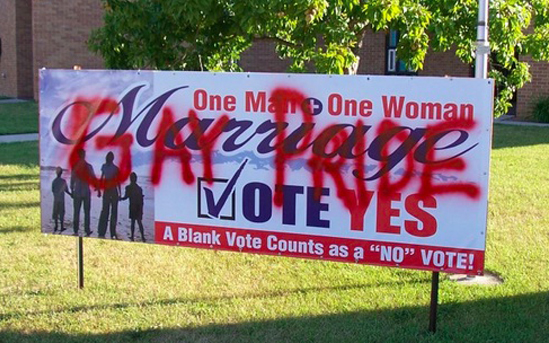
Gay activist vandalizes pro-marriage sign

In case you haven’t heard, the Supreme Court voted to redefine marriage to remove the focus on creating and raising children in stable relationships. Now marriage is just for any two or more people who have feelings for each other, and when the feelings go, so does the marriage. The commitment is gone, the child-centered focus is gone. It’s just about the needs of selfish adults.

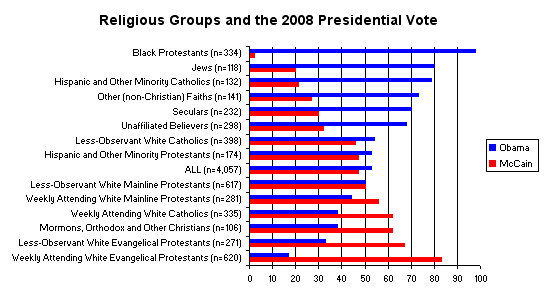
Which Religions Voted for Obama in 2008?

And more:

2008 voting broken by religious groups
2008 voting broken down by religious groups

So, remember that when you are processing today’s decision on gay marriage – not every person who calls herself a Christian actually is what she claims to be. For many of them, religion is just a custom, like the clothes they wear, or the food they eat. They don’t really believe a word of the Bible, and just want to dance and sing in church for the sake of their own happiness. There is nothing cognitive going on in some churches. No understanding, no authenticity.

You can read Justice Scalia’s dissent to the decision here.

How should Christians respond?

This post by Lenny Esposito at Come Reason made me laugh. He writes about how Christians should respond to same-sex marriage, since the Supreme Court is about to rule on it, and is guaranteed to rule against natural marriage.

Lenny has arguments against same-sex marriage that are made on the basis of logic and evidence. But not everyone is happy with his approach.

He writes:

I did receive a few responses from people who wrote something to the effect of “All we need is the Gospel. Share the Word with them.” I’ve run into such thinking before, with those who question the necessity of rigorous training in logic and apologetics. They think such things are “of men.” They admonish me and other believers to simply let loose the “the sword of the Spirit, which is the word of God” (Eph. 6:17) to fight our battles.

I think such talk is sincere but misguided. First of all, we live in a post-Christian culture. The Bible is not taken to be the final answer on issues such as same-sex marriage. That’s why if I quote the Bible to a person who supports homosexual unions, it really doesn’t sway them at all. In fact, many times it solidifies their stance since they see themselves as more modern and progressive than some 2,000 year-old book.

Anyone who has been paying attention to the changes of belief about this issue can quickly see my point. We’ve been offering Biblical admonition against homosexuality and same-sex marriage for over 30 years. Which way did the culture shift? Which way did the Church shift? According to a newly released Pew study, over 60% of Catholic and mainline Protestants support same-sex marriage.1 Even among Evangelicals, the support for same-sex marriage has DOUBLED in the last ten years.2 All this even though the scriptural admonitions against homosexuality are clear and have been discussed repeatedly, especially in churches.

In the words of Dr. Phil, “How’s that workin’ for ya?” I can answer that: it isn’t.

I’m actually not sure that any churches have talked about the Bible says about any issue in the real world. Mine certainly never does, and the pastors are all quite proud of preaching the gospel every week and never talking about current events, law or policy. It’s just Bible, Bible, Bible all the time, and never a word about how it is supported by evidence, or how it applies to real world issues. No wonder churched Christians get the idea that Christianity is just about their emotional state, and not about reality.

More from Lenny:

While I do believe that the Christians who think quoting scripture is the proper way to face these questions are sincere, they are trying to make scripture into something that it is not. They think scriptures are some kind of secret weapon that cannot be resisted. They see it as a sort of mystical summons of the Holy Spirit who will magically change those with whom they’re engaging; a few phrases that one only needs to voice in order to change people’s hearts and minds.

But “the Word” is not a magical incantation and it’s wrong to think of it that way. Such is an unbiblical view of scripture itself. Yes, the Holy Spirit is the one who transforms lives. It is he would is responsible for our understanding our sinfulness and our need for Christ. But that doesn’t mean the Spirit will reshape every unregenerate idea, even among believers. That’s why Paul didn’t quote scripture to the Athenians in Acts 17 when he witnessed to them. Instead, he used popular poets and thinkers they were familiar with to make his point. When Paul was held prisoner in Jerusalem, he didn’t quote scripture to his captors, but appealed to Roman law (Acts 22:25) in order to escape flogging.

I thought it was worth quoting what Lenny said. I think he is more familiar with the normal church  background where people rely on feelings and nudges and intuitions, and are hyper-spiritual about everything.

So what do you think? Is he right about this?

He didn’t provide a case against same-sex marriage in his post, so I’ll just link to my case against same-sex marriage, and summarize the main points below:

  1. Celebrating same-sex unions is bad for children
  2. Celebrating same-sex unions is bad for public health
  3. Celebrating same-sex unions is bad for business and religious liberty

And of course there have been more recent studies since I wrote that which are relevant, like this one that I blogged about previously. There’s much more to the case for natural marriage than my 3 points, but it’s a start.
Does God’s omniscience conflict with human free will?

Here’s the setup for the question, from Come Reason ministries.

Excerpt:

Hello,

Christian doctrine holds that God is all knowing (1 John 3:20), and humans have free will (Deuteronomy 30:19 is my favorite example). however, at my favorite apologetics debate board, I have seen skeptics raise an objection to these points several times. the basic logic behind their arguments is this:

  1. A being with free will, given two options A and B, can freely choose between A and B.
  2. God is omniscient (all-knowing).
  3. God knows I will choose A.
  4. God cannot be wrong, since an omniscient being cannot have false knowledge.
  5. From 3 and 4, I will choose A and cannot choose B.
  6. From 1 and 5, omniscience and free will cannot co-exist.

I have read many counter-arguments from apologetics sites, but they were either too technical (I couldn’t understand them), or not satisfying. so, I was wondering what would your input be on this issue?

Thank you,

Justin

Ever heard that one? I actually had that one posed to me by a guy I used to work with who had a Ph.D in computer science from Northwestern. So this is an objection you may actually here.

Here’s Lenny Eposito’s answer:

Hi Justin,

Thanks for writing. This is a great question as it shows how even those who appeal to logic can have biases that blind them. Let’s examine this argument and see if it follows logically.

Premises 1 and 2 in your outline above are the main premises to the argument and are not disputed. The Christian worldview argues that every human being is a free moral agent and is capable of making choices simply by exercising their will, not under compulsion or because of instinct. Also, it is a long held doctrine of Christianity that God is all-knowing. The Bible says that God knows “the end from the beginning (Isaiah 46:10).” For omniscience to be truly knowledgeable it must be correct knowledge, so premise number 4 is also granted.

However, point number 5 is where the logic falters. Those who argue in this manner make the mistake of thinking that because God possesses knowledge about a specific matter, then he has influenced it. That does not follow at all. Just because God can foresee which choice you will make, it does not mean you couldn’t still freely choose the other option.

Let me give you an example. I have a five year old son. If I were to leave a chocolate chip cookie on the table about a hour before dinner time and my son was to walk by and see it, I know that he would pick up the cookie and eat it. I did not force him to make that decision. In fact, I don’t even have to be in the room at all. I think I know my son well enough, though, to tell you that if I come back into the kitchen the cookie will be gone. His act was made completely free of my influence, but I knew what his actions would be.

In examining the argument, the assumption is made in premise 3 that because God knows I will choose A somehow denies me the choice of B. That is the premise that Christianity rejects. Omniscience and free will are not incompatible and it is a non-sequitor to claim otherwise.

Thank you Justin for this interesting question. I pray that you will continue to defend the gospel of our Lord and may He continue to bless you as you seek to grow in Him.

That’s a great answer and should work in ordinary conversations.

More technical

J.W. Wartick maps out the arguments more fully with symbolic logic here on his Always Have A Reason blog. But I’ll just excerpt the gist of it.

Excerpt:

It is necessarily true that if God knows x will happen, then x will happen. But then if one takes these terms, God knowing x will happen only means that x will happen, not that x will happen necessarily. Certainly, God’s foreknowledge of an event means that that event will happen, but it does not mean that the event could not have happened otherwise. If an event happens necessarily, that means the event could not have happened otherwise, but God’s foreknowledge of an event doesn’t somehow transfer necessity to the event, it only means that the event will happen. It could have been otherwise, in which case, God’s knowledge would have been different.

[…]Perhaps I could take an example. Let’s say that I’m going to go to classes tomorrow (and I do hope I will, I don’t like missing classes!). God knows in advance that I’m going to go to classes tomorrow. His knowledge of this event means that it will happen, but it doesn’t mean that I couldn’t choose to stay in and sleep for a while, or play my new copy of Final Fantasy XIII, or do something more useless with my time. If I chose to, say, play Final Fantasy XIII (a strong temptation!), then God simply would have known that I would play FFXIII. His knowledge does not determine the outcome, His knowledge is simply of the outcome.

If we choose A, God would foreknow A. If we choose B, God would foreknow B. His foreknowledge of our choices is contingent on our making free choices.

Move over housing bubble and student loan bubble: here’s pension bubble!

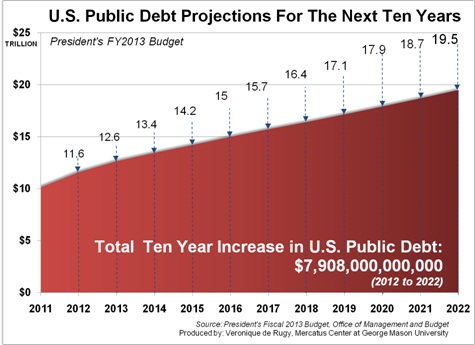
Obama 2013 Budget Debt Projection

Recently, I was talking to Dina about which state I would like to live in. I looked at a whole bunch of factors like tax rates, housing prices, religious liberty laws, voting patterns… but I also looked at state obligations to pay pensions.

Let’s take a look at the story from the Washington Examiner to see why this is important.

It says:

Years of gimmicks and politically motivated benefit increases for government workers have left America’s states and municipalities with pension funds that are short at least $1.5 trillion — and possibly as much as $4 trillion if the investment returns of these funds don’t live up to expectations in coming years.

[…]Since 2007, states and localities have been forced to increase annual contributions into pensions by $43 billion, or 65 percent, and in various places these rising payments are crowding out other government services or driving taxes higher or both. Retirement debt has even played a crucial role in high-profile government bankruptcies — including in Detroit; Stockton, California; and Central Falls, Rhode Island. Fixing the problem is proving expensive, and it won’t happen quickly in places with the worst debt.

[…][O]fficials in Stockton spent years enhancing benefits to workers without understanding the debts they were accruing. The city agreed back in the 1990s, for instance, to pay not only its own share of contributions into the pension system, but those of staff, too. It also guaranteed healthcare for life for retirees.

[…]Facing $400 million in pension debt and $450 million in promises for future healthcare, the city declared bankruptcy in 2012. Employees lost some of their perks, like healthcare in retirement, but citizens suffered, too. Trying to save money, the city cut essential services, including the police department, and crime soared.

[…]Places that cannot reform pensions, or where legislators were slow to act, are inevitably seeing tax increases to finance these steep obligations. In Pennsylvania, 164 school districts applied in 2014 to increase property taxes above the state’s 2.1 percent tax cap. Every one of them listed pension costs as a reason for the higher increases. In West Virginia, the state has given cities the right to impose their own sales tax to pay for increased pension costs.

Several cities, including Charleston, have already gone ahead with the new tax. Chicago Mayor Rahm Emanuel tried to impose a $250 million property tax increase last year to start wiping out pension debt in the Windy City, where pensions are only 35 percent funded. When the City Council balked, Chicago instead passed $62 million in other taxes, including a levy on cell phone use, as a stopgap measure. But the city faces a pension bill that is scheduled to rise by half a billion dollars annually in 2016.

I was able to find a helpful table that shows the solvency of all the public sector pension plans in each state. There are sensible states where I could live. It’s also important to look at the trend to see what direction the state is moving in, and thankfully the table had that information.

Anyway, here is the point I want to make about this.

When I look at these numbers, I feel sad, because it means that I have to be careful about my spending, and not spend too much on things that are fun in the short-term. I also cannot stop working to take a year off to go backpacking in Europe, because that would wreck my resume, and lose me a whole bunch of earned income. Sometimes, reality causes us to feel bad like that, so we run away from it. We find people who will agree with our feelings, and we shut out people who see things clearly. But we as Christians should not make decisions based on intuitions and feelings. And it doesn’t even work if you wrap up a bad decision in spiritual language, i.e. – “God told me…”, either. As much as I might feel like spending my money on frivolous things, I know in my mind that I cannot do that. I don’t like having constraints on my freedom, but to ignore data like this in my decision-making would not end well for me.

Sue Bohlin of Probe Ministries recently wrote a wonderful post about short-term pain versus long-term pleasure.

She writes:

Decision-making often involves choosing between short-term pleasure or short-term pain. (Usually it’s more like short-term inconvenience.)

Short-term pleasure often leads to long-term pain, and short-term pain often leads to long-term pleasure. What doesn’t work, and is a horribly unrealistic expectation for life, is short-term pleasure leading to long-term pleasure! (Wouldn’t THAT be nice?!)

Maturity and wisdom is displayed by the choices we make, especially when we exercise patience and self-control, not insisting on the instant-gratification jolt of “I want it NOW!!!” Many of our choices for pleasure in the right-now end up costing us down the road, causing pain later. You know, like that fourth brownie that tastes soooooo good in the moment, but then you can’t zip up your jeans a few days later. Or indulging your child’s demands and whims today because you want to be the “cool parent” and you want them to like you, but then you start to notice the ugliness of that child’s sense of self-absorbed entitlement. Short-term pleasure, even when that pleasure is simply trying to avoid pain, results in long-term unpleasant consequences.

But when we recognize the value of self-control and self-denial in the present, so that we can reap the harvest of pleasure in the future, that’s wisdom. Mark Twain advised, “Do one thing every day you don’t want to do.” That’s good advice, but of course God thought of that much earlier! Using self-control and self-denial is how we fulfill the biblical idea of not indulging the flesh (Galatians 5:16).

[…]Jesus said, “If anyone wants to become My follower, he must deny himself, take up his cross daily, and follow Me.” (Luke 9:23) Denying ourselves, taking up our cross, and following Jesus are all about short-term pain with major long-term pleasures!

Sue is wise. And her newest post is all about how to deal with feelings.

She says:

What is the biblical perspective on how to handle overwhelming feelings?

There are healthy and unhealthy ways to do that.

The healthy way to deal with strong feelings starts with thinking wisely about feelings in general. Our pastor often says that feelings are real (we do feel them, often intensely), but they’re not reliable (they make terrible indicators of what is true). So we should acknowledge them, but not be led by them.

Especially powerful, overwhelming feelings.

Allowing yourself to be controlled by your feelings is unwise and immature. The flip side of that is our example of Jesus in the Garden of Gethsemane. No one ever experienced the strength of horrific feelings like He did, to the point of sweating blood. He allowed Himself to feel His feelings, but then He turned in trust to His Father, submitting to His will. He set the bar for how to handle overwhelming feelings: feel the feelings, and trust the Lord.

Often, though, especially in the young, people deal with their strong feelings in unhealthy ways.

Feel the feelings, but don’t let them into your decision-making.