All posts by Wintery Knight

https://winteryknight.com/

Jay Richards: eight common myths about wealth, poverty and the free market

I have a key that will unlock a puzzling mystery

Have you read Jay Richards’ book “Money, Greed and God?” Because if you haven’t, he’s written a series of articles that summarize the main points of the book.

The index post is here.

Here are the posts in the series:

  • Part 1: The Eight Most Common Myths about Wealth, Poverty, and Free Enterprise
  • Part 2: Can’t We Build A Just Society?
  • Part 3: The Piety Myth
  • Part 4: The Myth of the Zero Sum Game
  • Part 5: Is Wealth Created or Transferred?
  • Part 6: Is Free Enterprise Based on Greed?
  • Part 7: Hasn’t Christianity Always Opposed Free Enterprise?
  • Part 8: Does Free Enterprise Lead to An Ugly Consumerist Culture?
  • Part 9: Will We Use Up All Our Resources?
  • Part 10: Are Markets An Example of Providence?

Parts 4 and 5 are my favorites. It’s so hard to choose one to excerpt, but I must. I will choose… Part 4.

Here’s the problem:

Myth #3: The Zero Sum Game Myth – believing that trade requires a winner and a loser. 

One reason people believe this myth is because they misunderstand how economic value is determined. Economic thinkers with views as diverse as Adam Smith and Karl Marx believed economic value was determined by the labor theory of value. This theory stipulates that the cost to produce an object determines its economic value.

According to this theory, if you build a house that costs you $500,000 to build, that house is worth $500,000. But what if no one can or wants to buy the house? Then what is it worth?

Medieval church scholars put forth a very different theory, one derived from human nature: economic value is in the eye of the beholder. The economic value of an object is determined by how much someone is willing to give up to get that object. This is the subjective theory of value.

And here’s an example of how to avoid the problem:

How you determine economic value affects whether you view free enterprise as a zero-sum game, or a win-win game in which both participants benefit.

Let’s return to the example of the $500,000 house. As the developer of the house, you hire workers to build the house. You then sell it for more than $500,000. According to the labor theory of value, you have taken more than the good is actually worth. You’ve exploited the buyer and your workers by taking this surplus value. You win, they lose.

Yet this situation looks different according to the subjective theory of value. Here, everybody wins. You market and sell the house for more than it cost to produce, but not more than customers will freely pay. The buyer is not forced to pay a cost he doesn’t agree to. You are rewarded for your entrepreneurial effort. Your workers benefit, because you paid them the wages they agreed to when you hired them.

This illustration brings up a couple important points about free enterprise that are often overlooked:

1. Free exchange is a win-win game.

In win-win games, some players may end up better off than others, but everyone ends up better off than they were at the beginning. As the developer, you might make more than your workers. Yet the workers determined they would be better off by freely exchanging their labor for wages, than if they didn’t have the job at all.

A free market doesn’t guarantee that everyone wins in every competition. Rather, it allows many more win-win encounters than any other alternative.

2. The game is win-win because of rules set-up beforehand. 

A free market is not a free-for-all in which everybody can do what they want. Any exchange must be free on both sides. Rule of law, contracts, and property rights are needed to ensure exchanges are conducted rightly. As the developer of the house, you’d be held accountable if you broke your contract and failed to pay workers what you promised.

An exchange that is free on both sides, in which no one is forced or tricked into participating, is a win-win game.

On this view, what you really need to fear as a consumer is government intervention that restricts your choices in the marketplace, or makes some choices more expensive than they need to be (tariffs).

If you care about poverty, it’s often tempting to think that it can only be solved one way – by transferring wealth from the rich to the poor. But that is a very mistaken view, as any economist will tell you. The right way to create prosperity is by creating laws and policies that unleash individual creativity. Letting individuals create innovative products and services, letting them keep what they earn, making sure that the law doesn’t punish entrepreneurs – that incentivizes wealth creation. Fixing poverty does not mean transferring wealth, it means giving people more freedom to create wealth on their own. Free trade between nations is an important way that we encourage people to create better products and services that what they have available in their own countries.

Economists agree on the benefits of free trade

Who could possibly disagree with free trade? Well, many people on the left do. But economists across the spectrum of ideology (university and private sector and public sector) agree on the benefits of free trade.

Harvard economist Greg Mankiw explains what most professional economists agree on.

Excerpt:

Here is the list, together with the percentage of economists who agree:

  1. A ceiling on rents reduces the quantity and quality of housing available. (93%)
  2. Tariffs and import quotas usually reduce general economic welfare. (93%)
  3. Flexible and floating exchange rates offer an effective international monetary arrangement. (90%)
  4. Fiscal policy (e.g., tax cut and/or government expenditure increase) has a significant stimulative impact on a less than fully employed economy. (90%)
  5. The United States should not restrict employers from outsourcing work to foreign countries. (90%)
  6. The United States should eliminate agricultural subsidies. (85%)
  7. Local and state governments should eliminate subsidies to professional sports franchises. (85%)
  8. If the federal budget is to be balanced, it should be done over the business cycle rather than yearly. (85%)
  9. The gap between Social Security funds and expenditures will become unsustainably large within the next fifty years if current policies remain unchanged. (85%)
  10. Cash payments increase the welfare of recipients to a greater degree than do transfers-in-kind of equal cash value. (84%)
  11. A large federal budget deficit has an adverse effect on the economy. (83%)
  12. A minimum wage increases unemployment among young and unskilled workers. (79%)
  13. The government should restructure the welfare system along the lines of a “negative income tax.” (79%)
  14. Effluent taxes and marketable pollution permits represent a better approach to pollution control than imposition of pollution ceilings. (78%)

Socialist economic policies don’t work because they are making policies that are based on economic myths. We know that these myths are myths because of economics is a mathematical science, and because we have tried good and bad policies in different times and places. We have calculations and we have experience to know what works and what doesn’t work. If you want to help the poor, you have to respect what economists know about how wealth is created. The solution is not to “spread the wealth around”, it’s to encourage people to create more wealth by inventing things that people freely choose to buy.

Making monergism make sense: a middle-knowledge approach to salvation

Lets take a closer look at a puzzle

This article at Free Thinking Ministries was written by my friend Tim Stratton. In it, he tries to rescue Calvinism from the horror of double-predestination.

Excerpt: (links removed)

Many reformed folks (freely?) choose to reject Molinism because they contend that this theological view “smells of synergism.” What is this stench that reportedly makes John Calvin turn over in his grave? Simply put, synergism is the view that man plays at least a small part in his own salvation process. Monergism, on the other hand, is the view that God is the author of salvation from beginning to end.

Since Molinism affirms that man is free to choose to reject God’s saving grace or not, many Calvinists jump to the conclusion and assume that Molinism must be synergistic. This does not necessarily follow.[1] Consider one possible model:

1- God, by nature, is a volitional unmoved mover who is free to choose between options in accord with His nature. (This is supported via the Kalam and the Argument from Time).

2- By God’s grace, humans are created in the “image of God.” By nature, then, we are free to choose between options in accord with our nature. (This is supported via the Freethinking Argument).

3- Adam & Eve freely chose to disobey God and this sin completely separates humanity from God. This is what it means to have a “totally depraved sin nature.” (Every aspect of man is separated from God).

4- In this state of depraved separation from God (sin nature), humans do not even know God exists if merely left to our own devices.

5- If humans do not even know God exists, then, left to our own devices and apart from God’s grace, it would be impossible to choose to love and follow God (thus, Pelagianism is impossible on this view).

6- God, in His love for all people, provides amazing prevenient grace to all people (Romans 1:20), writing the law on the human heart (Romans 2:15), conviction of the Holy Spirit (John 16:8-9), and draws all men (John 12:32). This is commonly referred to as “common grace.”

7- Therefore, by God’s grace, human nature has changed from a “totally separated from God nature” to a nature that has now experienced enough divine revelation (influences) allowing all mankind to start making some free and volitional choices in accord with our new nature; namely, to choose to resist God’s grace and revelation, or not.[2] Mankind is without excuse because we do not have to resist what God has made clear (Romans 1:18-20).[3]

[Note: According to Calvinist, Matt Slick (albeit inadvertently), Mark 4:10-12 implies that if an unregenerate person gets access to clear and accurate information, then they possess the ability to become Christians!]

8- If one does not reject or continually resist the grace and revelation God provides them, then God will continually provide more and more until the person reaches the point of “no return” and will become saved.

Thus, God does ALL the work in salvation from beginning to end on this Molinistic model; all the human can do is freely resist God’s grace and revelation, but he or she does not have to! The human does nothing to gain salvation apart from God’s grace on this Monergistic Model of Molinism.

I think that Stratton’s formulation above does indeed keep God as the sole initiator of salvation. And that’s good. But it also makes sure that human resistance to God is allowed, and that’s good. We want salvation to be 100% by faith alone in Christ alone. But we don’t want God to be the cause of people not being saved (because he is the ONLY ONE who can save them, and he chooses not to save them). On Stratton’s view, God wants everyone to be saved. If anyone is saved, it’s because God did ALL THE WORK to lead them and secure their salvation with the death of Jesus on the cross. But, on Stratton’s view, humans do get a choice – the choice to trust God or not. And so, if a person is not saved, then it’s their fault – not God’s. This works.

Read his whole post, and see what you think about it.

Facebook enlists left-wing Politifact and Snopes to censor criticism of Democrats

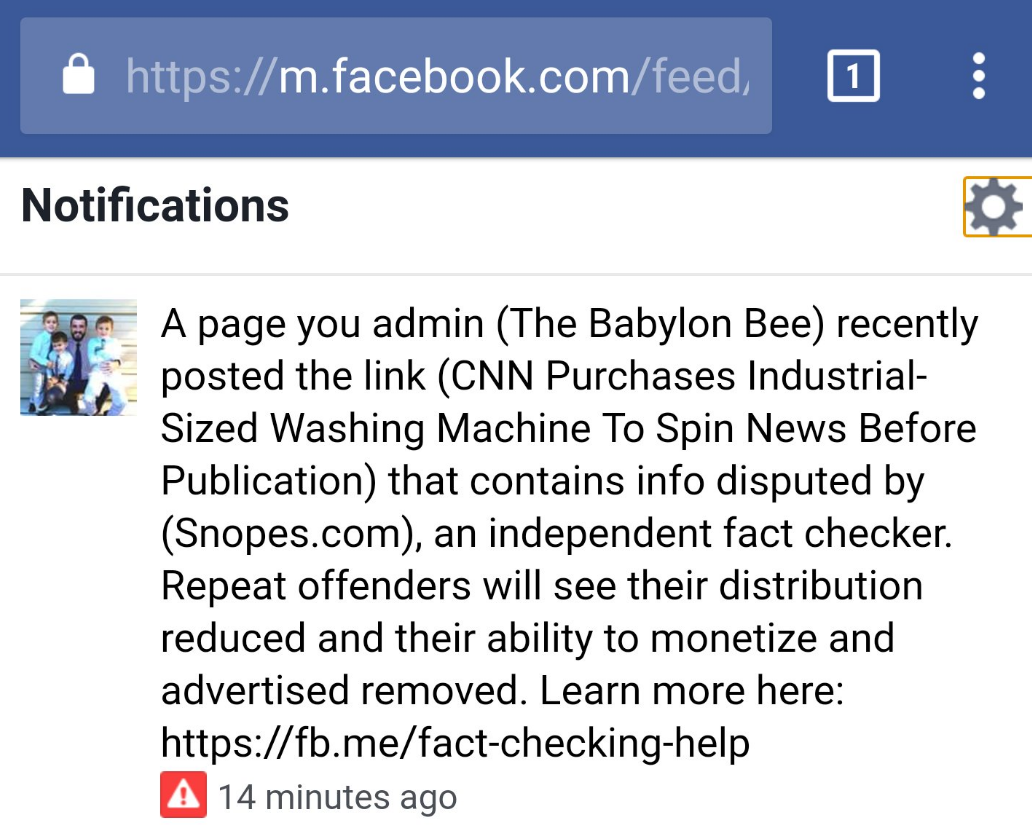
This week, I was appalled to see that the Babylon Bee, a Christian satire web site, was attacked by Facebook for writing a satire critical of the radically leftist CNN.

Look:

Facebook is so good at checking facts and censoring conservatives

This is what Facebook sent to Adam Ford for his satire of CNN. Since Facebook cited Snopes, I thought it might be a good idea to talk about two Facebook “fact checkers”, and an example of their “fact-checking”.

First, a story from The Daily Signal. Then, we’ll see examples of how Facebook’s censorship allies are biased against conservatives.

Let’s look at the first far-left Facebook partner: Politifact. Politifact is just a group of journalists from the Tampa Bay Times newspaper.

Avik Roy, health care policy expert at Forbes magazine, writes about Politifact’s assessment of Obama’s promise to Americans about keeping their health plans after Obamacare.

2008 PolitiFact before the election: ‘We rate his statement True’

Roy writes: (links removed)

On October 9, 2008, Angie Drobnic Holan of PolitiFact published an article using the site’s “Truth-O-Meter” to evaluate this claim: “Under Barack Obama’s health care proposal, ‘if you’ve got a health care plan that you like, you can keep it.’” The article assures us in its headline that “Obama’s plan expands [the] existing system,” and continues that “Obama is accurately describing his health care plan here…It remains to be seen whether Obama’s plan will actually be able to achieve the cost savings it promises for the health care system. But people who want to keep their current insurance should be able to do that under Obama’s plan. His description of his plan is accurate, and we rate his statement True.”

[…]As per PolitiFact’s usual M.O., Holan didn’t seek out any skeptical health-policy experts to suss out the veracity of Senator Obama’s signature claim. Instead, its sources included Jonathan Cohn, a passionate Obamacare supporter at The New Republic, and various interviews and statements of Mr. Obama. Holan simply took the “keep your plan” promise at face value, dismissing as dishonest anyone who dared suggest that Obama’s claim would be impossible to keep. “His opponents have attacked his plan as ‘government-run’ health care,” she wrote, the scare-quotes around “government-run” being visible to all.

PolitiFact’s pronouncements about Obamacare were widely repeated by pro-Obama reporters and pundits, and had a meaningful impact on the outcome of the election. Indeed, in 2009, PolitiFact won the Pulitzer Prize for its coverage of the 2008 campaign.

Here’s the screen capture from 2008:

Politifact caught with its pants on fire

Before the election, it’s true! And Obama got re-elected, because people believed that. But what happened after the election?

2013 PolitiFact after the election: ‘We rate his statement Pants On Fire’

Roy writes: (links removed)

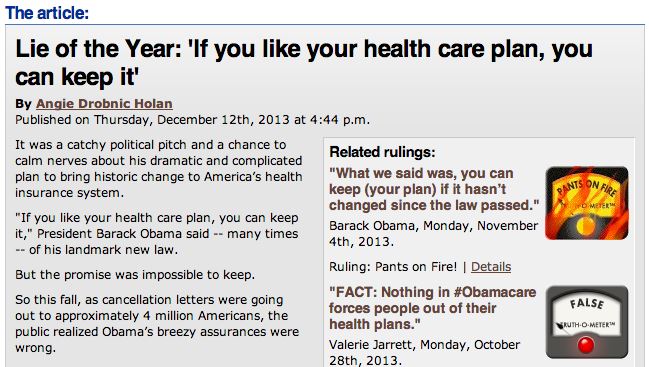
On December 12, [2013] the self-appointed guardians of truth and justice at PolitiFact named President Obama’s infamous promise—that “if you like your health care plan, you can keep it”—its 2013 “Lie of the Year.”

[…]On November 4, Jacobson rated as “Pants on Fire” the President’s new claim that “what we said was, you can keep [your plan] if it hasn’t changed since the law passed.” Both pieces were edited by Angie Drobnic Holan, who had initially granted PolitiFact’s seal of approval to Senator Obama’s 2008 promise. Holan delivered the coup de grâce, declaring as PolitiFact’s “Lie of the Year” the “keep your plan” promise.

“The promise was impossible to keep,” says Holan in her December piece. Now she tells us! But none of the key facts that made that promise “impossible” in 2008 had changed by 2013. The President’s plan had always required major disruption of the health insurance market; the Obamacare bill contained the key elements of that plan; the Obamacare law did as well. The only thing that had changed was the actual first-hand accounts of millions of Americans who were losing their plans now that Obamacare was live.

And the screen capture from 2013:

Politifact says: we were just kidding! Kidding!

So when Politifact rates a statement by a Democrat as true, what they really mean is that it’s pants-on-fire-false, but it’s election time so they don’t say that. It’s not like the critical assessments of Obamacare from health policy experts were not out there between 2007-2012. It’s just that the liberal journalism-major bloggers at Politifact couldn’t be bothered to read them. And this is who Facebook is using as a fact checker, because Facebook has one way of seeing issues – the radical leftist way. If you disagree, then they censor your content. Because Facebook employees are close-minded, anti-intellectual socialists who hate free speech.

What about Snopes? Maybe Snopes is a more reliable “fact checker” than Politifact?

The Daily Caller explains:

Snopes’ main political fact-checker is a writer named Kim Lacapria. Before writing for Snopes, Lacapria wrote for Inquisitr, a blog that — oddly enough — is known for publishing fake quotes and even downright hoaxes as much as anything else.

[…]She described herself as “openly left-leaning” and a liberal. She trashed the Tea Party as “teahadists.” She called Bill Clinton “one of our greatest” presidents. She claimed that conservatives only criticized Lena Dunham’s comparison of voting to sex because they “fear female agency.”

[…]Lacapria — in another “fact check” article — argued Hillary Clinton hadn’t included Benghazi at all in her infamous “we didn’t lose a single person in Libya” gaffe. Lacapria claimed Clinton only meant to refer to the 2011 invasion of Libya (but not the 2012 Benghazi attack) but offered little fact-based evidence to support her claim.

After the Orlando terror attack, Lacapria claimed that just because Omar Mateen was a registered Democrat with an active voter registration statusdidn’t mean he was actually a Democrat. Her “fact check” argued that he might “have chosen a random political affiliation when he initially registered.”

Snopes is just spin for Democrat gaffes – playing defense for the DNC. And Facebook using them to check facts, because Facebook is basically joined at the hip to the Democrat party.

Can we verify that Snopes actually lies in order to defend Democrats. Well, yes –right here. Snopes lied about American flags being present throughout the first day of the 2016 Democrat convention.

It’s groups like these who are being relied upon to spot “fake news” for Facebook. When you are on Facebook, it’s important to understand that it is a web site run by Democrats, for the benefit of Democrats. There is no balance. There is no critical thinking. The simple fact of the matter is that many fake news stories are pushed by the leftist mainstream media, and ignored by the leftist “fact checkers”. Here’s one recent example of how that works.