
All posts by Wintery Knight

https://winteryknight.com/

Why should a woman marry a man while she’s still under 25?

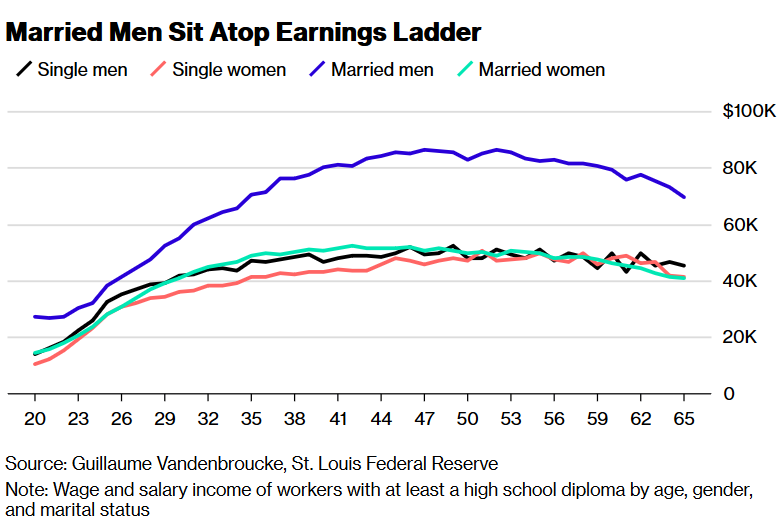
Married men seem to enjoy a boost in earnings from age 23-43
Married men seem to enjoy a boost in earnings between age 22-45

I saw a bunch of pro-marriage friends were tweeting about this article from the St. Louis Federal Reserve which talks about how well married men do financially compared to single men, and using it as a reason to argue that men should get married. The article from the St. Louis Reserve doesn’t have much commentary, but this article from the far-left Washington Post by Brad Wilcox has a lot to say.

Excerpt:

Marriage has a transformative effect on adult behavior, emotional health, and financial well-being—particularly for men.

[…]Men who get married work harder and more strategically, and earn more money than their single peers from similar backgrounds. Marriage also transforms men’s social worlds; they spend less time with friends and more time with family; they also go to bars less and to church more.

[…]Our research, featured in a recent report, “For Richer, For Poorer: How Family Structures Economic Success in America,” indicates that men who are married work about 400 hours more per year  than their single peers with equivalent backgrounds. They also work more strategically: one Harvard study found that married men were much less likely than their single peers to quit their current job unless they had lined up another job.

This translates into a substantial marriage premium for men. On average, young married men, aged 28-30, make $15,900 more than their single peers, and married men aged 44-46 make $18,800 more than their single peers.

That’s even after controlling for differences in education, race, ethnicity, regional unemployment, and scores on a test of general knowledge. What’s more: the marriage premium operates for black, Hispanic, and less-educated men in much the same way as it does for men in general.

For instance, men with a high-school degree or less make at least $17,000 more than their single peers.

So, what about these differences between married men and single men? Are men able to earn more if they have a wife to support them and care for their needs? Or is it just that women prefer men who are already able to take care of themselves?

Well, in most cases, it’s the former:

2. Married men are motivated to maximize their income. For many men, this responsibility ethic translates into a different orientation toward work, more hours, and more strategic work choices. Sociologist Elizabeth Gorman finds that married men are more likely to value higher-paying jobs than their single peers.

This is partly why studies find that men increase their work hours after marrying and reduce their hours after divorcing. It’s also why married men are less likely to quit a current job without finding a new job. Indeed, they are also less likely to be fired than their single peers.

3. Married men benefit from the advice and encouragement of their wives. Although there is less research on this, we suspect that men also work harder and more strategically because they are encouraged to do so by their wives, who have an obvious interest in their success. One study appears to buttress this point, finding that men with better-educated wives earn more, even after controlling for their own education.

4. Employers like married men with children.  There is evidence that employers  prefer and promote men who are married with children, especially compared to their childless male peers and to mothers. Married men are often seen as more responsible and dedicated workers and are rewarded with more opportunities by employers. While illegal bias and long-held stereotypes appear to play a role in this historic preference, it nonetheless helps explain why married family men get paid more.

Now what’s the purpose of me writing this? Well, I’m actually NOT writing this to pressure men to get married. Why not? Because although marriage was a pretty good deal 100 years ago, it’s not as good of a deal under the current laws and policies, e.g. – no-fault divorce, the threats of false accusations, the Sexual Revolution, etc. So I wouldn’t advise a man to rush into marriage to just anybody in order to get the financial (and health) benefits of having a wife. Marriage is only safe when you choose a woman carefully.

But I am writing this to women who are being told by the culture to delay marriage, and especially to delay marriage to use your youth and beauty to “have fun” with boys who won’t commit to marriage. If a woman loves a marriage-focused man and really wants to take care of him and support him, then early marriage is one of the very best ways to really help him during the years (22-45) when it really makes a difference. Marrying a man who wants marriage when you’re still young means that he will have many, many measurable benefits.

It’s important to marry a man when the marriage has the potential to do the most good for him in areas like health, career, finances and children. Men typically don’t want to marry women who are older, because they have more sexual experience and because they get used to giving a man sex in order to get him to do what she wants. Once a woman gets used to doing this, it becomes much harder to trust a good man to lead, and to give a man respect as a leader.

In addition, men know that women never change who they are really attracted to. If a woman chooses superficially attractive men who won’t commit over and over, then even if she “settles” for a man later on, she probably won’t be able to be attracted him. Men know not to choose women who won’t value them for their traditional moral values, conservative politics and ability to perform traditional male roles like providing. Men know that a woman who feels that she is “settling” for less than she deserves is more likely to disrespect him, and to withhold sex from him.

Now pro-marriage parents and pro-marriage pastors will typically tell you that they want to let their daughters decide when to marry, so that they will be happy having “fun” before marriage, and happy being provided for after marriage. But when those women are done playing the field and in their mid-thirties, their relatives and pastors are not thinking about what men’s interests are. They’re thinking about how to get this woman married, regardless of the man’s interests. And men know that. So they aren’t going to be bullied or shamed into a marriage after the window when it benefits them has closed. If parents and pastors want their daughters married AT ALL, then they need to encourage women to be self-controlled and marriage-focused EARLY.
Yale University computer science professor takes a look at protein formation probabilities

How did life begin?
How did life begin?

When I was in graduate school, we studied a book called “Mirror Worlds”, authored by famous computer science professor David Gelernter at Yale University. This week, I noticed that Dr. Gelernter had written an article in the prestigious Claremont Review of Books. In his article, he applies his knowledge of computer science to the problem of the origin of life.

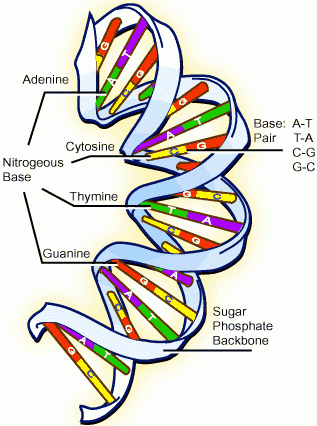
Evolution, if it is going to work at all, has to explain the problem of how the basic building blocks of life – proteins – can emerge from non-living matter. It turns out that the problem of the origin of life is essentially a problem of information – of code. If the components of proteins are ordered properly, then the sequence folds up into a protein that has biological function. If the sequence is not good, then just like computer code, it won’t run.

Here’s Dr. Gelernter to explain:

How to make proteins is our first question. Proteins are chains: linear sequences of atom-groups, each bonded to the next. A protein molecule is based on a chain of amino acids; 150 elements is a “modest-sized” chain; the average is 250. Each link is chosen, ordinarily, from one of 20 amino acids. A chain of amino acids is a polypeptide—“peptide” being the type of chemical bond that joins one amino acid to the next. But this chain is only the starting point: chemical forces among the links make parts of the chain twist themselves into helices; others straighten out, and then, sometimes, jackknife repeatedly, like a carpenter’s rule, into flat sheets. Then the whole assemblage folds itself up like a complex sheet of origami paper. And the actual 3-D shape of the resulting molecule is (as I have said) important.

Imagine a 150-element protein as a chain of 150 beads, each bead chosen from 20 varieties. But: only certain chains will work. Only certain bead combinations will form themselves into stable, useful, well-shaped proteins.

So how hard is it to build a useful, well-shaped protein? Can you throw a bunch of amino acids together and assume that you will get something good? Or must you choose each element of the chain with painstaking care? It happens to be very hard to choose the right beads.

Gelernter decides to spot the Darwinist a random sequence of 150 elements. Now the task the Darwinist is to use random mutation to arrive at a sequence of 150 links that has biological function.

[W]hat are the chances that a random 150-link sequence will create such a protein? Nonsense sequences are essentially random. Mutations are random. Make random changes to a random sequence and you get another random sequence. So, close your eyes, make 150 random choices from your 20 bead boxes and string up your beads in the order in which you chose them. What are the odds that you will come up with a useful new protein?

[…]The total count of possible 150-link chains, where each link is chosen separately from 20 amino acids, is 20150. In other words, many. 20150 roughly equals 10195, and there are only 1080 atoms in the universe.

What proportion of these many polypeptides are useful proteins? Douglas Axe did a series of experiments to estimate how many 150-long chains are capable of stable folds—of reaching the final step in the protein-creation process (the folding) and of holding their shapes long enough to be useful. (Axe is a distinguished biologist with five-star breeding: he was a graduate student at Caltech, then joined the Centre for Protein Engineering at Cambridge. The biologists whose work Meyer discusses are mainly first-rate Establishment scientists.) He estimated that, of all 150-link amino acid sequences, 1 in 1074 will be capable of folding into a stable protein. To say that your chances are 1 in 1074 is no different, in practice, from saying that they are zero. It’s not surprising that your chances of hitting a stable protein that performs some useful function, and might therefore play a part in evolution, are even smaller. Axe puts them at 1 in 1077.

In other words: immense is so big, and tiny is so small, that neo-Darwinian evolution is—so far—a dead loss. Try to mutate your way from 150 links of gibberish to a working, useful protein and you are guaranteed to fail. Try it with ten mutations, a thousand, a million—you fail. The odds bury you. It can’t be done.

Keep in mind that you need many, many proteins in order to have even a simple living cell. (And that’s not even considering the problem of organizing the proteins into a system).

So, if you’re a naturalist, then your only resources to explain the origin of life are chance and mutation. As Dr. Gelernter shows, naturalistic explanations won’t work to solve even part of the problem. Not even with a long period of time.  Not even if you use the entire universe as one big primordial soup, and keep trying sequences for the history of the universe. It just isn’t possible to arrive at sequences that have biological function in the time available, using the resources available. The only viable explanation is that there is a computer scientist who wrote the code without using trial and error. Something that ordinary software engineers like myself and Dr. Gelernter do all the time. We know what kind of cause is adequate to explain functioning code.

I’m learning about Bernie Sanders from his employees and supporters

This Bernie Sanders supporter shot Republican Congressmen at a baseball game

One way to learn about a political candidate is by looking at the kinds of people who work for them. Candidates don’t say anything in their campaign speeches or campaign ads that might hurt their chances of being elected. But if you listen to their employees, and look at the actions of their employees, you can find out where they stand. Let’s look at two employees of Bernie Sanders.

Here is the latest reported by the Daily Wire:

A far-left campaign staffer for 2020 Democratic Party presidential candidate Sen. Bernie Sanders (I-VT) appeared to repeatedly advocate for the use of extreme violence in an undercover video that was released on Tuesday by James O’Keefe’s Project Veritas.

Sanders campaign Iowa field organizer Kyle Jurek was busted making the following statements in a variety of settings:

  • On reaching people that he deems to be “fascists”: “The only thing that works, the only thing that fascists understand is violence. So, the only way you can confront them is with violence.”

  • On what happens if Trump is re-elected: “F***ing cities burn.”

  • On if Trump supporters should be “re-educated”: “I mean, we gotta try, so like, in Nazi Germany after the fall of the Nazi party there was a s**t ton of the populace that was f***ing Nazified. Germany had to spend billions of dollars re-educating their f***ing people to not be Nazis. Like, we’re probably going to have to do the same f***ing thing here. That’s kind of what Bernie’s whole f***ing like, ‘hey, free education for everybody!’ because we’re going to have to teach you to not be a f***ing Nazi.”

  • On Soviet gulags: “There’s a reason Joseph Stalin had gulags, right?”

  • On what will happen if Sanders does not win the Democratic nomination: “If Bernie doesn’t get the nomination or it goes to a second round at the DNC convention, f***ing Milwaukee will burn. It’ll start in Milwaukee and then when they f***ing, and when the police push back on that, other cities will just f***ing [explosion sound and gesture]. … Be ready to be in Milwaukee for the DNC convention. That’s all I’m gonna say. …”

  • On using violence against those who use offensive free speech: “Whatever it takes, and that’s why they’re like ‘oh, anti-fascists are violent,’ it’s because we’re willing to go above and beyond what the law says is acceptable, like oh free speech, yeah like they try to be like ‘oh you’re against free speech’ and no, we’re not against free speech, we’re against f***ing hate speech, and if your speech is something that like these people shouldn’t exist, then I don’t give a f*** if it’s free speech or not, you don’t need, like free speech has repercussions. … Yeah, there are consequences to your f***ing speech, right? And if your speech is calling for the elimination of people based on race, or gender, or religious like for whatever reason, things that people can’t change, then you should expect a f***ing violent reaction and you deserve a violent reaction because that’s just not an acceptable thing. It’s not acceptable.”

  • On wanting to “throw down”: “I’m ready to throw down now. I don’t want to wait and have to wait for f***ing DNC [against] the billionaire class. The f***ing media, pundits. Walk into that MSNBC studios, drag those motherf***ers out by their hair and light them on fire in the streets.”

  • On what will happen to those who oppose Sanders’ agenda: “Well, I’ll tell you what, in Cuba, what did they do to reactionaries? … Do you wants to fight against the revolution? You’re gonna die for it motherf***er.”

And here is the video:

OK, fine. So that’s what the people who work for Bernie Sanders say. But what about their actions? Do they actually put their words into practice in their actions?

The far-left Washington Post explains:

The man suspected of firing dozens of rounds into an Alexandria baseball field Wednesday morning has been identified by federal law enforcement officials as James T. Hodgkinson, 66, of Belleville, Ill.

A Facebook page belonging to a person with the same name includes pictures of Democratic presidential candidate, Bernie Sanders, and rhetoric against President Trump, including a post that reads: “Trump is a Traitor. Trump Has Destroyed Our Democracy. It’s Time to Destroy Trump & Co.”

Now, you might say, “well that’s not what Bernie Sanders believes, that’s just what his employees and supporters believe”. The thing is, Bernie Sanders has been defending communist regimes FOR DECADES, and those regimes kill millions and millions of innocent people. So you really have to look at what Bernie Sanders says about those murderous communist regimes if you want to know what he thinks is an acceptable cost for implementing the communism he admires so much.

Here is a good re-cap about what Bernie Sanders has said in the past about countries that adopted communism:

Naturally, Bernie Sanders is not going to say anything in an election campaign that would cause voters to not vote for him. That’s why it’s important to look at his employees, supporters, and previous statements.