All posts by Wintery Knight

https://winteryknight.com/

The psychological motivation of those who embrace postmodernism

Can a person be postmodern and a Christian? Not for long

Famous analytical philosopher John Searle has written a book “Mind, Language And Society: Philosophy In The Real World”, explaining what’s factually wrong with postmodernism. In the introduction, he explains what postmodernism is, and what motivates people to accept postmodernism.

He writes:

[…][W]hen we act or think or talk in the following sorts of ways we take a lot for granted: when we hammer a nail, or order a takeout meal from a restaurant, or conduct a lab experiment, or wonder where to go on vacation, we take the following for granted: there exists a real world that is totally independent of human beings and of what they think or say about it, and statements about objects and states of affairs in that world are true or false depending on whether things in the world really are the way we say they are. So, for example, if in pondering my vacation plans I wonder whether Greece is hotter in the summer than Italy, I simply take it for granted that there exists a real world containing places like Greece and Italy and that they have various temperatures. Furthermore, if I read in a travel book that the average summer temperature in Greece is hotter than in Italy, I know that what the book says will be true if and only if it really is hotter on average in the summer in Greece than in Italy. This is because I take it for granted that such statements are true only if there is something independent of the statement in virtue of which, or because of which, it is true.

[…]These two Background presuppositions have long histories and various famous names. The first, that there is a real world existing independently of us, I like to call “external realism.” “Realism,” because it asserts the existence of the real world, and “external” to distinguish it from other sorts of realism-for example, realism about mathematical objects (mathematical realism) or realism about ethical facts (ethical realism). The second view, that a statement is true if things in the world are the way the statement says they are, and false otherwise, is called “the correspondence theory of truth.” This theory comes in a lot of different versions, but the basic idea is that statements are true if they correspond to, or describe, or fit, how things really are in the world, and false if they do not.

The “correspondence theory of truth” is the view of truth assumed in books of the Bible whose genre is such that that they were intended by the authors to be taken literally, (with allowances for symbolism, figures of speech, metaphors, hyperbole, etc.).

But what about the postmodernists, who seek to deny the objectivity of external reality?

More Searle:

Thinkers who wish to deny the correspondence theory of truth or the referential theory of thought and language typically find it embarrassing to have to concede external realism. Often they would rather not talk about it at all, or they have some more or less subtle reason for rejecting it. In fact, very few thinkers come right out and say that there is no such thing as a real world existing absolutely, objectively, and totally independently of us. Some do. Some come right out and say that the so-called real world is a “social construct.”

What is behind the denial of objective reality, and statements about external reality that are warranted by evidence?

It is not easy to get a fix on what drives contemporary antirealism, but if we had to pick out a thread that runs through the wide variety of arguments, it would be what is sometimes called “perspectivism.” Perspectivism is the idea that our knowledge of reality is never “unmediated,” that it is always mediated by a point of view, by a particular set of predilections, or, worse yet by sinister political motives, such as an allegiance to a political group or ideology. And because we can never have unmediated knowledge of the world, then perhaps there is no real world, or perhaps it is useless to even talk about it, or perhaps it is not even interesting.

Searle is going to refute anti-realism in the rest of the book, but here is his guess at what is motivating the anti-realists:

I have to confess, however, that I think there is a much deeper reason for the persistent appeal of all forms of antirealism, and this has become obvious in the twentieth century: it satisfies a basic urge to power. It just seems too disgusting, somehow, that we should have to be at the mercy of the “real world.” It seems too awful that our representations should have to be answerable to anything but us. This is why people who hold contemporary versions of antirealism and reject the correspondence theory of truth typically sneer at the opposing view. 

[…]I don’t think it is the argument that is actually driving the impulse to deny realism. I think that as a matter of contemporary cultural and intellectual history, the attacks on realism are not driven by arguments, because the arguments are more or less obviously feeble, for reasons I will explain in detail in a moment. Rather, as I suggested earlier, the motivation for denying realism is a kind of will to power, and it manifests itself in a number of ways. In universities, most notably in various humanities disciplines, it is assumed that, if there is no real world, then science is on the same footing as the humanities. They both deal with social constructs, not with independent realities. From this assumption, forms of postmodernism, deconstruction, and so on, are easily developed, having been completely turned loose from the tiresome moorings and constraints of having to confront the real world. If the real world is just an invention-a social construct designed to oppress the marginalized elements of society-then let’s get rid of the real world and construct the world we want. That, I think, is the real driving psychological force behind antirealism at the end of the twentieth century.

Now, I’ll go one step further than Searle.

People, from the Fall, have had the desire to step into the place of God. It’s true that we creatures exist in a universe created and designed by God. But, there is a way to work around the fact that God made the universe and the laws that the universe runs on, including logic, mathematics and natural laws. And that way is to deny logic, mathematics and natural laws. Postmodernists simply deny that there is any way to construct rational arguments and support the premises with evidence from the real world. That way, they imagine, they are free to escape a God-designed world, including a God-designed specification for how they ought to live. The postmoderns deny the reliable methods of knowing about the God-created reality because logic and evidence can be used to point to God’s existence, God’s character, and God’s actions in history.

And that’s why there is this effort to make reality “optional” and perspectival. Everyone can be their own God, and escape any accountability to the real God – the God who is easily discovered through the use of logic and evidence. I believe that this is also behind the rise of atheists, who feign allegiance to logic and science, but then express “skepticism” about the origin of the universe, the fine-tuning of the universe, objective morality, the minimal facts concerning the historical Jesus, and other undeniables.

Wayne Grudem explains what the Bible says about spending, saving and charity

Bible study that hits the spot

A practical lecture on money – spending, saving, charitable giving – from famous pastor Wayne Grudem.

I like the way that Wayne Grudem navigates the Bible finding the passages that tell you who God is, so that you can make better decisions by analyzing alternatives and choosing the one that gives your Boss a maximum return on investment. He’s very practical.

The MP3 file is here.

The PDF outline is here.

Spending:

  • Christianity does not teach asceticism (= don’t enjoy anything in this world), Paul condemns it in 1 Timothy 4:1-5
  • When you buy nice things, even if it is a little more expensive, it’s an opportunity to be thankful for nice things that God has provided
  • Even being rich is OK, but don’t let it make you haughty and arrogant, and don’t set your hopes on your money (see 1 Tim 6:17)
  • It is important for you to earn money, and you are supposed to use it to support yourself and be independent
  • It is possible to overspend and live recklessly (Luke 15:13) and it’s also possible to overspend and live too luxuriously
  • Increasing your income through career progression is wise, because it allows you to give away more and save more
  • God gives us freedom to decide how much we spend, how much we give away, and how much we save
  • every choice a Christian makes with money will give him or her more or less reward in his or her afterlife
  • Do not spend more than you have – you should make every effort to get out of debt as quickly as possible

Saving:

  • Saving money is wise so you can help yourself and others, and have money in your old age when you will not be working
  • If you do not save your own money, you end up being dependent on others (e.g. – family or taxpayers)
  • Not saving money for the future is a way of “putting God to the test” (Matt 4:7)
  • You are to “be dependent on no one”, to the extent that you can (1 Thes 4:12)
  • We don’t know the future, that’s why we should prepare for an emergency, and buy insurance to guard (James 4:13-17)
  • It’s right for us to learn how to save to be able to buy bigger assets, like a car or a college education
  • Saving and investing in stocks and bonds lets people in business start and grow companies, creating jobs and new products
  • Don’t over-save, trusting too much in money more than you trust in God (Ps 62.10; Matt 6:19,24; Luke 12:15-21)

Giving:

  • it is required for the people of God to give something out of what they earn, but no percentage is specified (Deut 26:12-13)
  • you do not give money to become right with God, you can’t earn your salvation
  • a Christian gives to show God that you trust him to take care of you, and to experience trusting him through your giving
  • the quality of your resurrection life with God is affected by giving you do for the Kingdom (Phil 4, Matt 6:19-21; 1 Tim 6:18-19)
  • when you get involved in the lives of others and give to them, you have the joy of experiencing caring for others (Acts 20:35)
  • it’s possible to give too little, but it’s also possible to give too much – be careful about pride creeping in as well

The first part of this lecture made me think of my treat for the week, which is to get a double chicken burrito bowl after my weight lifting. It is very easy to say grace when you are hovering over a double chicken burrito bowl. It is good to have nice things especially when it makes you thankful for what you have.

I was so happy listening to this talk because he was condemning bad stewardship, which I see in a lot of young people these days. I was happy until he got to the part about trusting in your savings for your security, and then I thought – that’s what I do wrong! I save a lot but it’s not just for emergencies and to share with others, like he was saying – I want a sense of security. This was more of a temptation in my 20s than it is now in my 30s, though.

Charity should hurt

I can remember being in my first full-time job as a newly hired junior programmer when the 2001 recession struck. I would cry while signing checks to support William Lane Craig’s Reasonable Faith ministry, because I was so scared. I had no family or friends where I lived to help me if anything went wrong, and that’s been the story of my working life. If anything goes wrong, there is no backup. But it’s that experience of crying when I gave that allows me to say today “that’s when I became the man I am, that’s what a man does when he is a follower of Jesus”. If you are not doing the actions of charity, then you will not having the experience of trusting God and letting him lead you. There is more to the Christian life than just saying the right things – you have to do the right things.

Don’t follow your heart

If you’re scared about giving when you are young, then do what I did in my 20s: work 70-hour weeks, get promoted often, and save everything you earn. I volunteered every Saturday for 9 months in order to get my first white-collar part-time job when I was still in high-school. The faster you increase your savings, the easier it’s going to be to take a genuine interest in caring for the people around you. Read Phil 1 (fellowship), Phil 2 (concern for others), and Phil 4 (charity). Turn off your emotions and desires when it comes to choosing what to study and what work to do, and put Philippians into practice. Your freedom to give is very much tied to the quality of your decisions of what to study, where to work, how much you spend on entertainment, and so on. That’s why you need to turn off your feelings and desires and do what works, even it it’s not fun, and even if it involves responsibilities, expectations and obligations.

Is Snopes reliable? Is Snopes biased? Are Snopes fact-checks accurate?

A while back, there were some demonstrations at the Capitol building in Washington, D.C. Democrat representative Alexandria Ocasio-Cortez, a former bartender and waitress, told everyone that she had nearly died because the rioters broke into her office.

It was later discovered that she was never in the Capitol bulding.

Newsweek reported AOC’s version of the events:

Ocasio-Cortez said that rioters actually entered her office, forcing her to take refuge inside her bathroom after her legislative director Geraldo Bonilla-Chavez told her to “hide, hide, run and hide.”

“And so I run back into my office,” Ocasio-Cortez said. “I slam my door. There’s another kind of like back area to my office, and I open it, and there’s a closet and a bathroom. And I jump into my bathroom.”

Ocasio-Cortez said [she] was hiding behind the door “and then I just start to hear these yells of, ‘Where is she?’”

As members of the mob banged against the door, Ocasio-Cortez believed “this was the moment where I thought everything was over.”

“And the weird thing about moments like these is that you lose all sense of time,” Ocasio-Cortez continued. “In retrospect, maybe it was 4 seconds. Maybe it was 5 seconds, maybe it was 10 seconds. Maybe it was one second, I don’t know. It felt like my brain was able to have so many thoughts.”

“In between the screams and the yells,” Ocasio-Cortez added, “I mean, I thought I was going to die.”

Daily Wire explains that Newsweek had to correct their story after it emerged that AOC’s version was not true:

Republican Rep. Nancy Mace (R-SC), whose office is two doors down from Democratic Rep. Alexandria Ocasio-Cortez, noted that “insurrectionists” never made it to their hall when the U.S. Capitol building was breached on Jan. 6.

[…]Mace argued that Newsweek was misleading in how they categorized AOC’s own account in an effort to “fan fictitious news flames.”

Maps don’t lie:

Map of Capitol AOC

Newsweek issued a correction:

After Rep. Mace criticized Newsweek’s coverage, the outlet issued a correction to amend the description of Ocasio-Cortez’s account as follows: “Ocasio-Cortez said that an individual actually entered her office, forcing her to take refuge inside her bathroom after her legislative director Geraldo Bonilla-Chavez told her to ‘hide, hide, run and hide.’”

Newsweek’s correction note reads: “A previous version of this story stated that Ocasio-Cortez’s office was entered by rioters. Ocasio-Cortez’s office was actually entered by a Capitol police officer that did not identify himself. Newsweek regrets the error.”

So that’s the error, which was acknowledged by Newsweek. But what does Snopes think? Did they side with AOC’s delusional conspiracy theory? Or did they side with reality, facts and evidence?

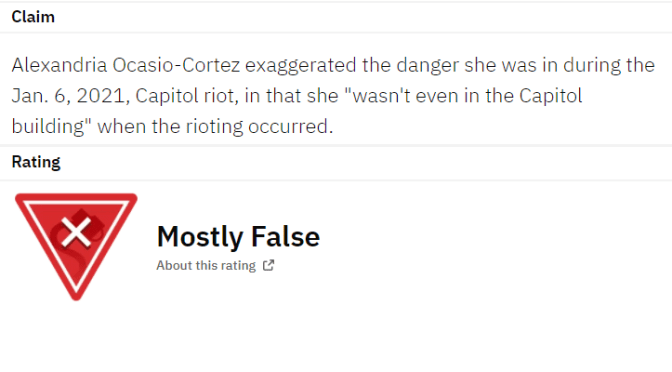
Well, they report that the claim that AOC wasn’t even in the Capitol building as “Mostly False“.

They wrote:

Claim

Alexandria Ocasio-Cortez exaggerated the danger she was in during the Jan. 6, 2021, Capitol riot, in that she “wasn’t even in the Capitol building” when the rioting occurred.

Rating

Mostly False

But their own fact-check acknowledges that the claim “she wasn’t even in the Capitol building” is TRUE:

What’s True

Ocasio-Cortez wasn’t in the main Capitol building where the House and Senate Chambers are located.

The more important point – the actual claim that people are making – is that the rioters never broke into AOC’s office. According to Newsweek, AOC says “rioters actually entered her office”. Newsweek’s correction says that the rioters never actually broke into her office. Conservatives are agreeing with Newsweek’s correction. Only Snopes seems to have a problem with the facts reported by Newsweek. They just can’t bring themselves to accept reality, that AOC lied in order to appear to be a victim.

Snopes’ “fact check” will be used by left-wing Big Tech companies to suppress the truth that was admitted by Newsweek in their correction to their original AOC-sourced story. People on the secular left are so desperate to appear to be victims, that it affects their sanity. It’s like a mental illness. And when they are called on it, they all circle the wagons and defend their conspiracy theories.

And this isn’t the first time that Snopes has failed.

Not the first time

In fact, the author of the Snopes article has been caught up in left-wing conspiracies before, and had to issue a retraction:

Why didn’t Snopes fire her after the first retraction? Well, my conclusion that Snopes is mostly a conspiracy website for secular leftists. Their writers mostly publish conspiracy theories, urban legends, myths, delusions, lies and other counterfactual nonsense on their web site. And the goal of their website is mostly just to give comfort to secular leftists who have failed at life, and are now living in a dream world where all their failures are caused by those conservative people who they look down on, who achieved more success in practical private sector jobs than they have with their many worthless debt-fueled non-STEM degrees.

So how would I rate Snopes as a fact-checker?

Rating: Mostly False.