All posts by Wintery Knight

https://winteryknight.com/

Round-up of US media interviews with Stephen Harper

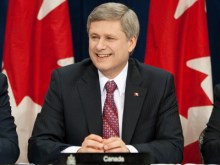
Canadian Prime Minister Stephen Harper

I spotted this round-up of media interviews with Stephen Harper on the Canadian blog Blue Like You. I’ve already blogged about the CNBC interview with optimistic Larry Kudlow here. That interview focused on economic policy.

In the Fox Business interview with Alexis Glick, (video here), she explains how Canada was able to avoid the subprime lending crisis.

Immediately after I talked to the vice chairman of the Swedish central bank, I interviewed — in a “First on Fox Business” — Canadian Prime Minister Stephen Harper about a lot of things: Everything from his meeting with President Obama last week, to NAFTA to the “Buy American” clause in the stimulus to carbon emissions and the Canadian Sands to the banking system. Why has Canada’s banking system withstood the financial crisis while other countries banking systems like the U.S. are in such dire straits? In 2008, the World Economic Forum ranked Canada’s banking system the healthiest in the world. The U.S. was ranked 40th. Canada’s system has much stronger federal regulations and lower mandatory leverage ratios. Canada’s firms never engaged in subprime mortgage lending. For over a decade, Canada has posted budget surpluses; only in the last quarter did they enter into a recession. What is working? What lessons could we learn from them? Take a look. Prime Minister Harper is very impressive.

Canada does not believe in forcing banks to make loans based on ACORN’s vision of social justice. I explained how Democrats like Carter and Clinton forced banks to make these loans and how Republicans tried in vain to stop them, here.

The Wall Street Journal interview was more focused on foreign policy. You may have heard of Harper’s recent free trade deal with Peru. But did you know that Canada also signed a free trade deal with Colombia?

But the mention of Canadian and American political opposition to free-trade agreements with Colombia has sparked a change in the PM’s unflappable manner. For a fleeting moment, what sounds a lot like frustration emerges. “I’m not going to say it’s a perfect government, but we have a government in Colombia that is democratically elected, that has increased democratic norms, that has taken on the insurgency, that is moving that country forward economically and politically. And it is in a hemisphere where we have an increasing number of real serious enemies and opponents.”

Meanwhile, the economically-illiterate, protectionist ACORN lawyer rejected a free trade deal with Colombia.

And did know that Canada has been taking a leading role in foreign policy?

Since establishing a minority government in January 2006, this prime minister and his Conservative Party have restored Canada’s international prestige by increasing military funding and tenaciously supporting Canada’s dangerous NATO mission in the Afghan province of Kandahar. No NATO ally has put more on the line against the Taliban, and Mr. Harper seems to sense not just the opportunity but the need for Canada to capitalize on it. There is a vacuum in conservative leadership in North America and on the world stage, and Mr. Harper is stepping into it. His objective would appear to be the restoration of liberal-democratic resolve against tyranny.

You want Reaganesque? I’ll give you Reaganesque:

An unreliable NATO has implications for Canada not least because Russia is once again becoming a menace. The Kremlin’s claim to the Arctic seabed can be discounted, he argues, because it is being pursued through the United Nations Law of the Sea Treaty. But other provocations are worrisome. “They are testing our airspace more frequently than they have been doing in a long, long time,” he says. “It’s the aggression in the Arctic, aggression more generally, an aggression that is increasingly troublesome just to be troublesome.”

Check this out: 2 CF-18 fighters intercepted a Russian bomber that was snooping near Canadian airspace just last week. Look, if Obambi wants to focus on increasing welfare and nationalizing health care, then maybe Canadians will have to pick up the slacker’s slack.

I rarely say this, but I am going to say it for this WSJ interview: READ. THE. WHOLE. THING.

UPDATE: Welcome, Canadian visitors from Blue Like You! Thanks for the link Joanne! I’ve just blogrolled you! I am hoping Stephen Harper gets his majority soon, so he can get rid of those pesky HRCs that keep going after Ezra Levant.

UPDATE 2: I noticed in the comments on Blue Like You that they referenced this interview from CNN with Wolf Blitzer. Here is the video and a news article from the National Post. Ooops. I think the commenter Allison meant a more recent CNN interview with Fareed Zakaria which is here.

UPDATE 3: Welcome visitors from Post-Darwinist! Thanks for linking to me,  Denyse!

Full report from William Lane Craig’s Quebec debating tour

I received William Lane Craig’s report from his Ontario and Quebec speaking tours in my e-mail inbox. The report is not yet posted on his web site, so I reproduce the portion related to his debate at McGill against Shabir Ally below. (I wanted to post everything, but it was too much)

Here’s what Bill says about debating Shabir at McGill University in Montreal:

The next evening was my debate at the English-speaking McGill University with the Muslim apologist Shabir Ally on “Did Jesus Rise from the Dead?” I began by presenting a case for Jesus’ resurrection, and Shabir then followed. Shabir is a very slick customer, a skilled debater and smooth speaker. Whereas my debating style tends to be pretty formal, ticking off one point after another, Shabir began his opening speech by telling a joke, which got the audience laughing, and even presenting to me a small souvenir gift from Montréal. I thought to myself, “Boy, I’m already ten points behind just on audience rapport!” But my experience is that these first impressions fade pretty quickly as the debate unfolds.

So I figured I should just carry out my plan to attack his view hard, while continuing to be gracious personally. Shabir defends a very strange view of what happened to Jesus. He holds that Jesus was crucified (despite the Qur’an’s denial of that fact) but that he was only apparently dead when he was taken down from the cross and laid in the tomb. Before he could die in the tomb, God assumed him into heaven and thereafter gave visions of Jesus to the disciples. In that way, Shabir is able to affirm the historicity of Jesus’ crucifixion, burial, empty tomb, post-mortem appearances, and the disciples’ belief in his resurrection, but all without Jesus’ being raised from the dead!

Unfortunately, to my surprise, Shabir didn’t even mention his theory in his opening speech but just presented a wishy-washy, feel-good talk about Islam and Christianity. “Now what should I do?” I thought. “If I attack his view when he hasn’t even presented it, I’m really going to come across as mean-spirited. But if I wait till the rebuttals, there won’t be enough time to present my critique.” As I said, I decided to go after his view anyway, explaining to the audience that this is his position in his published work.

As a preliminary observation, I pointed out that no true Muslim could embrace his view, since the Qur’an could not be more straightforward or unambiguous: “They did not kill him; they did not crucify him” (4:157). I even quoted the Arabic “wa maa qataluhu, wa maa salabuhu.” I charged that Shabir, in denying the Qur’an, had already deserted Islam for a mishmash of Christianity and Islam, which I dubbed “Chrislam.” I said that if you’re going to embrace Chrislam, why not go all the way and become a Christian?

I then argued that Shabir should do this because his view faces insuperable historical and theological objections. Historically, it has inadequate explanatory scope (since mere visions of Jesus would not explain the disciples’ belief in Jesus’ resurrection), weak explanatory power (since the early Church distinguished visions of Christ from resurrection appearances of Christ), and little plausibility (since it is highly improbable that Jesus was taken down alive).

The theological objections are even more problematic: (1) The theory provides too little, too late. For in virtue of his crucifixion, Jesus has already suffered shame, humiliation, and defeat in the minds of his enemies. (2) By misleading the disciples into thinking that Jesus was risen from the dead, Allah himself is to blame for foisting the religion of Christianity on the world, resulting in hundreds of millions rejecting Islam and going to hell! Shabir had little to say in response to these objections, except to reiterate that there’s no way of knowing that Jesus was really dead.

So in the end the palm of victory went clearly to the Christian side. But sad to say, there were very few Muslims in the audience. I hear through the grapevine that Muslims are increasingly disaffected with Shabir because of his compromises on orthodox Islam. In fact the Muslim Student Association at McGill, which had promised to help promote the debate, called at 4:00 p.m. the very afternoon of the debate to say that they weren’t coming and had decided to schedule a meeting of their own that night! So it appears that the Muslim community is losing confidence in Shabir.

His newsletter contains more about his speaking in Quebec at the University of Montreal and the University of Laval. The newsletter also discusses his debate with Shelly Kagan of Yale University, held at Columbia University. And he concludes with his upcoming speaking engagements. Please pray for Bill and consider supporting him by donating to Reasonable Faith.

Rush Limbaugh speaks at 2009 CPAC conference

Links to entire speech is here.

GatewayPundit says the speech was carried live on CNN and Fox News. I’m watching CNN right now and the CNN anchorwoman is calling Rush “divisive” for asking Democrats to stick to their oath to defend the Constitution. (That’s the clip they played, she called that divisive)