Good post on the effects of government regulation, over at the Competitive Enterprise Institute’s Open Market blog.
Excerpt:
A story in the Star Tribune in Minneapolis St. Paul shows how adverse effects of such needlessly onerous standard can spill over into other areas. In this case, a meat plant had to shut its doors, putting 200 people out of work because their water exceeded EPA’s standard by 8 parts per billion. EPA can’t show that the Clinton era its standard won’t save a soul, but we do know that economic hard times hurt many.
Here’s an excerpt from the Strib piece:
More than 200 workers in a small town 90 minutes west of Minneapolis have lost their jobs after a beef slaughtering plant was forced to shut down because its water contained excessive levels of arsenic, a condition the plant owner said he couldn’t afford to fix in time to avoid federal penalties.
“I’m done,” said William Gilger, owner of North Star Beef Inc. in Buffalo Lake, Minn.
The Heritage Foundation has a good post on how the EPA intends to expand their control of the economy in order to save us from global cooling warming.
In essence, the endangerment finding says that global warming and climate change pose a serious threat to public health and safety and thus almost anything that emits carbon dioxide and other greenhouse gases could be regulated under the Clean Air Act.
The endangerment finding is the first step in a long regulatory process that could lead to EPA requiring different regulations and units of emissions requirements for each gadget that emits carbon dioxide. The first target would be automobiles, but the EPA’s Advanced Notice of Proposed Rulemaking (ANPR) suggested regulations of almost everything that moves, including new regulations smaller items such lawnmowers and forklifts. The ANPR also suggests putting speed limiters on large trucks on the table as a means of reducing carbon dioxide and even suggested sharkskin boats oozing bubbles to reduce emissions from the shipping industry.
…Beyond things that move, the agency could go after things that stand still. More than a million energy using businesses, buildings, and farms could also be hit with crushing administrative burdens and costly controls. And even if EPA decides not to go that far, they will almost certainly be sued into doing so.
And they have a forecast of the potential costs of this regulation:
However, the economic damage would be similar to any carbon capping bill passed by Congress and perhaps even worse. Dr. David Kreutzer and Dr. Karen Campbell of The Heritage Foundation’s Center for Data Analysis found the economic costs of EPA regulations to be:
• Cumulative gross domestic product (GDP) losses are nearly $7 trillion by 2029 (in inflation adjusted 2008 dollars)
• Single-year GDP losses exceed $600 billion (in inflation-adjusted 2008 dollars).
• Annual job losses exceed 800,000 for several years.
• Some industries will see job losses that exceed 50 percent.
If you tax or regulate something, you get less of it. If you cut taxes and remove regulations, you get more of it. The best protection a worker has is not onerous taxes and regulations on their employer. The best protection a worker has is a choice among a huge number of employers. If you want a choice of employers, try creating conditions that employers actually want.
Republicans care about creating conditions that allow businesses to create jobs. We want this because we believe that people should not dependent on the government for their livelihood. Your ability to choose your employer is part of your liberty. Democrats care about inventing a faked crisis using junk science in order to justify government-coerced redistribution of wealth.
I wanted to go over this article by William Lane Craig which includes a discussion of the empty tomb, along with the other minimal facts that support the resurrection. The entire paper was also presented orally to the students and faculty at California State University, Fresno in 2005, and a full recording is available here. The paper covers all of Craig’s preferred set of minimal facts, which he uses in debates.
The word resurrection means bodily resurrection
The concept of resurrection in use among the first converts to Christianity was a Jewish concept of resurrection. And that concept of resurrection is unequivocally in favor of a bodily resurrection. The body (soma) that went into the grave is the body (soma) that came out.
Craig explains what this means with respect to the fast start of Christian belief:
For a first century Jew the idea that a man might be raised from the dead while his body remained in the tomb was simply a contradiction in terms. In the words of E. E. Ellis, “It is very unlikely that the earliest Palestinian Christians could conceive of any distinction between resurrection and physical, ‘grave emptying’ resurrection. To them an anastasis without an empty grave would have been about as meaningful as a square circle.”
And:
Even if the disciples had believed in the resurrection of Jesus, it is doubtful they would have generated any following. So long as the body was interred in the tomb, a Christian movement founded on belief in the resurrection of the dead man would have been an impossible folly.
It’s significant that the belief in the resurrection started off in the city where the tomb was located. Anyone, such as the Romans or Jewish high priests, who wanted to nip the movement in the bud could easily have produced the body to end it all. They did not do so, because they could not do so, although they had every reason to do so.
There are multiple early, eyewitness sources for the empty tomb
Paul’s early creed from 1 Corinthians 15:3-7, dated to within 5 years of the crucifixion, implies the empty tomb.
Craig writes:
In the formula cited by Paul the expression “he was raised” following the phrase “he was buried” implies the empty tomb. A first century Jew could not think otherwise. As E. L. Bode observes, the notion of the occurrence of a spiritual resurrection while the body remained in the tomb is a peculiarity of modern theology. For the Jews it was the remains of the man in the tomb which were raised; hence, they carefully preserved the bones of the dead in ossuaries until the eschatological resurrection. There can be no doubt that both Paul and the early Christian formula he cites pre-suppose the existence of the empty tomb.
The dating of the resurrection as having occurred “on the third day” implies the empty tomb. The date specified for the resurrection would have been the date that the tomb was discovered to be empty.
The phrase “on the third day” probably points to the discovery of the empty tomb. Very briefly summarized, the point is that since no one actually witnessed the resurrection of Jesus, how did Christians come to date it “on the third day?” The most probable answer is that they did so because this was the day of the discovery of the empty tomb by Jesus’ women followers. Hence, the resurrection itself came to be dated on that day. Thus, in the old Christian formula quoted by Paul we have extremely early evidence for the existence of Jesus’ empty tomb.
The early pre-Markan burial narrative mentions the empty tomb. This source pre-dates Mark, the earliest gospel. The source has been dated by some scholars to the 40s.
The empty tomb story is part of the pre-Markan passion story and is therefore very old. The empty tomb story was probably the end of Mark’s passion source. As Mark is the earliest of our gospels, this source is therefore itself quite old. In fact the commentator R. Pesch contends that it is an incredibly early source. He produces two lines of evidence for this conclusion:
(a) Paul’s account of the Last Supper in 1 Cor. 11:23-5 presupposes the Markan account. Since Paul’s own traditions are themselves very old, the Markan source must be yet older.
(b) The pre-Markan passion story never refers to the high priest by name. It is as when I say “The President is hosting a dinner at the White House” and everyone knows whom I am speaking of because it is the man currently in office. Similarly the pre-Markan passion story refers to the “high priest” as if he were still in power. Since Caiaphas held office from AD 18-37, this means at the latest the pre-Markan source must come from within seven years after Jesus’ death. This source thus goes back to within the first few years of the Jerusalem fellowship and is therefore an ancient and reliable source of historical information.
Lack of legendary embellishments
The empty tomb narrative in the gospels lacks legendary embellishments, unlike later 2nd century forgeries that originated outside of Jerusalem.
The eyewitness testimony of the women
This is the evidence that has been the most convincing to skeptics, and to me as well.
The tomb was probably discovered empty by women. To understand this point one has to recall two facts about the role of women in Jewish society.
(a) Woman occupied a low rung on the Jewish social ladder. This is evident in such rabbinic expressions as “Sooner let the words of the law be burnt than delivered to women” and “Happy is he whose children are male, but woe to him whose children are female.”
(b) The testimony of women was regarded as so worthless that they were not even permitted to serve as legal witnesses in a court of law. In light of these facts, how remarkable must it seem that it is women who are the discoverers of Jesus’ empty tomb. Any later legend would certainly have made the male disciples to discover the empty tomb. The fact that women, whose testimony was worthless, rather than men, are the chief witnesses to the empty tomb is most plausibly accounted for by the fact that, like it or not, they were the discoverers of the empty tomb and the gospels accurately record this.
The earliest response from the Jewish high priests assumes the empty tomb
This report from Matthew 28 fulfills the criteria of enemy attestation, although Matthew is not the earliest source we have. Oh, well.
In Matthew 28, we find the Christian attempt to refute the earliest Jewish polemic against the resurrection. That polemic asserted that the disciples stole away the body. The Christians responded to this by reciting the story of the guard at the tomb, and the polemic in turn charged that the guard fell asleep. Now the noteworthy feature of this whole dispute is not the historicity of the guards but rather the presupposition of both parties that the body was missing. The earliest Jewish response to the proclamation of the resurrection was an attempt to explain away the empty tomb. Thus, the evidence of the adversaries of the disciples provides evidence in support of the empty tomb.
Note how careful Craig is not to imply that the guard tradition is historical, because we can’t prove the guard as a “minimal fact“, since it doesn’t pass the standard historical criteria.
Critical responses to the empty tomb
Richard Carrier tried to argue that the testimony of women was accepted, in his debate with Craig, but Craig showed that this was only possible in two cases: 1) if they were testifying about their status as widows, or 2) if no male witnesses were available, e.g. – they had all been killed. Audio of the debate is here. Carrier’s admission of defeat is here, on his blog. Craig’s post-debate response to Carrier is here and here.
Further study
To see a debate betwen Craig and the well-known skeptic Bart Ehrman, click here for the 12 part playlist. The first two parts are embedded below, containing Craig’s entire 20 minute opening speech. The full transcript of the debate is here, so you can follow along.
To hear a related lecture by Craig on the topic of “Who did Jesus think he was?”, click here. The video is here. This lecture was delivered in February, 2009 at Columbia University, probably the most secular leftist university in the United States. Yes, the same university that invited Ahmadinejad to speak.
This is not at all unusual for CNN. Notice how those on the left cannot even bear to hear the words of those they disagree with. That is telling, and it foreshadows the oncoming fascism that I predicted earlier based on the leaked Department of Homeland Security report that portrays Republicans as potential terrorists because they are not secular socialists.
Michelle Malkin, (who I think is very pretty and funny and smart), was interviewed on Fox News at the Sacramento Tea Party. She explains exactly why these protests are happening: fiscal irresponsibility, including high taxes, huge spending, massive deficits, corruption, fraud and government waste. And these protests are as much against big spending Republicans, as Democrats.
And Glenn Beck is even more explicit. (H/T The Heritage Foundation). This is not about Democrats or Republicans. It is about economic policy. Period.
There were 225,481 attendees, according to PJTV. Over 800 protests occurred, across all 50 states! But Gateway Pundit reports that Obama is unaware of the protests. Yes, he’s unaware of many things, I’m sure. In fact, that’s his specialty. (UPDATE: The Campaign Spot says 337,682 on Thursday April 16th)
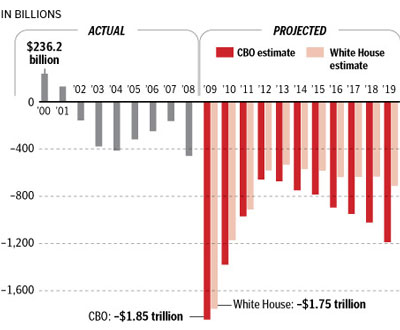
In her related post entitled The word of the week is “crazy”, The Anchoress has a funny caption over the graph showing the budget deficit projections under Obama’s plan. Her caption is: If you do not like this chart and think something should be done about it, you are “crazy“. Yes, according to socialists, everyone who objects to socialism is crazy!
If you do not like this chart and think something should be done about it, you are "crazy" (H/T The Anchoress)
And here is a bit more of her post: (go read the whole thing!)
That headline is interesting, not only are the Tea Party folk “insane” but they are also “anti-Obama.” Recall, back in the day, if you were any sort of opponent to Clinton policies or if you donated to a candidate other than a Clinton, you were “anti-Clinton” or, as I liked to say, an “anti-Clintite”. Of course for the last 8 years, protesters were just reasonable people with reasonable, moderate and patriotic concerns. They were not “anti-Bush” and they were not “crazy” or “insane.” Those protesters, originating from the left, were smart, and deserving of respect and respectful media coverage. Hell, when the DHS wrote about “leftwing extremism”, they felt no need to even mention them as part of a vague “suspect ‘em all” strategy. Imagine that.
But now if you are protesting, you’re just a crazy “anti-Obamite.”
Remember, these grass-roots protests of the tax-and-spend policies of the Democrats, which have been adopted in response to a crisis caused by the Democrats (videos showing Democrats are linked there). If you still believe that Democrats are fiscally conservative, check out this video of Obama giving a serious economic policy speech during the election campaign.

 WINTERY KNIGHT