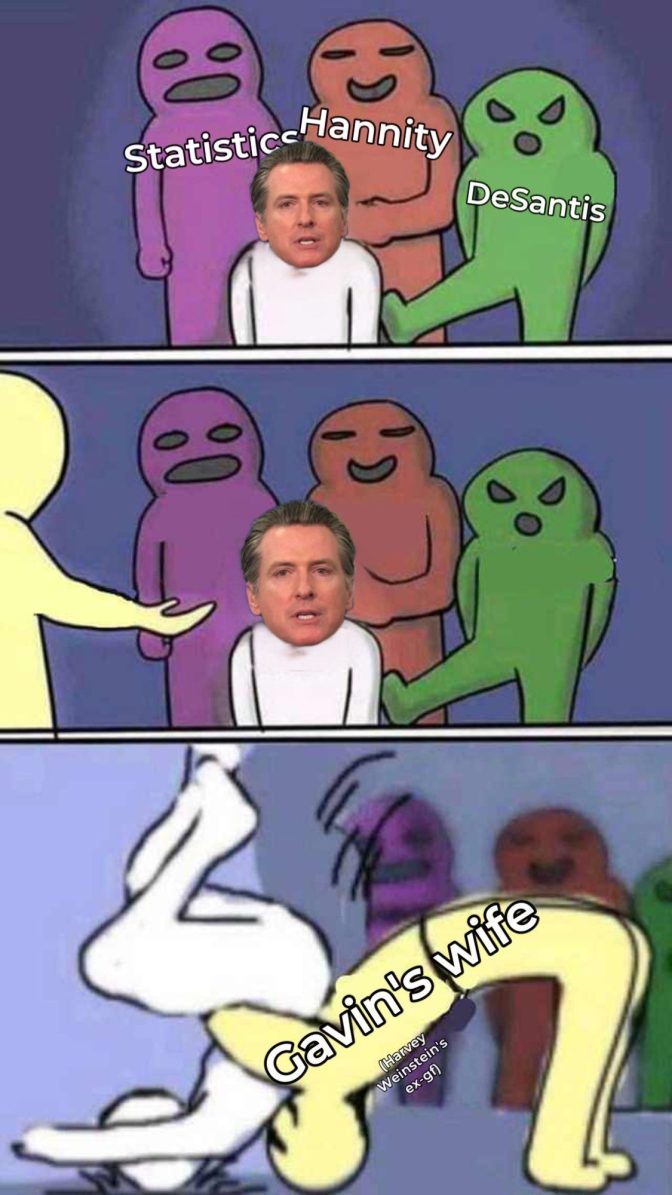
I thought that this report from NBC News (archived) that Gavin Newsom’s WIFE ended the debate, even after both debaters wanted to stay on and extend the debate, was interesting:
What the audience didn’t see — and what at least five sources shared with NBC News — is that off-screen, there were significant disagreements happening. The DeSantis and Newsom teams were both arguing that the other side was breaking the rules that were agreed upon in advance — particularly keeping distance between the candidates and their guests.
According to four sources in the DeSantis camp — one who witnessed the moment in the room and three others who were standing backstage (where there was no press or live studio audience) — Newsom’s wife, Jennifer Siebel Newsom, came into the debate room on at least two occasions to raise some objections.
She also made her way to the stage during the break after the candidates agreed to extend the debate and put an end to it.
A fifth source on the ground, unaffiliated with either campaign, confirmed that Siebel Newsom ended the debate on her husband’s behalf, saying, “We’re done.”
“Gavin Newsom got beat so badly last night his wife literally had to throw in the towel for him. It was embarrassing,” DeSantis spokesman Andrew Romeo said.
To me, it looks like her husband was getting beaten like a rented mule, and she wanted to stop the bleeding.
Gavin Newsom Wife Ends His Debate With DeSantis Early
Let’s see some clips from the debate. If you only have time for 1, then watch the bottom two clips, the poop map and California “freedoms”.
DeSantis: Newsom’s Father-in-Law Moved to Florida
DeSantis: California Basically ‘Legalized Retail Theft’
DeSantis, Newsom Spar Over Gender Transitions for Minors
Newsom: Elective Abortions Should Be Legal at Any Point in Pregnancy
DeSantis Holds Up San Francisco Poop Map
‘Pornography’: DeSantis Holds Up Page of ‘Gender Queer’
DeSantis: In California, You’re Free to Poop in Public
I watched the entire debate, and I thought it was FAR better than debates put on by the corporate news media. The strength of the debate was that they focused on evidence related to a number of interesting topics. The moderator would show a slide comparing the two states on some data: unemployment, crime, etc. And then they would discuss it. In this post, I link to a review and some clips.
DeSantis and Newsom had a lenghty exchange on COVID-19 lockdowns while discussing the economy in their respective states.
When DeSantis was discussing how businesses were doing better in Florida, Newsom interjected by asking if that was the opinion of Disney.
“That’s an interesting point with Disney because I had Disney open during COVID and we made them a fortune and we saved a lot of jobs,” DeSantis said. “You had Disney closed inexplicably for over a year, you were not following science, you were a lockdown governor, you did a lot of damage to your people.”
At one point, Newsom tried to deny the evidence that the moderator presented for discussion. Newsom just assert that Florida was worse than California. DeSantis replied to his assertion with a peer-reviewed study from the medical journal The Lancet that showed that Florida had a lower standardized death rate than California. This sort of exchange happened throughout the debate, with Newsom denying the evidence, making assertions with no support, and then DeSantis refuting him with evidence.
Here’s a clip:
Here’s another section of the article, about border security:
The two governors had sharply contrasting views on the border. Newsom accused DeSantis of being heartless toward illegal immigrants and DeSantis said that the policies of Newsom and fellow Democrats were creating dangerous lawlessness in America.
Newsom defended the Biden administration’s record on the border, which has seen record numbers of illegal immigrants cross in every year of Joe Biden’s presidency.
[…]He then criticized DeSantis for sending a group of illegal immigrants to Martha’s Vineyard, a wealthy area and popular vacation spot in Massachusetts.
DeSantis said that Newsom was spreading a “flurry of lies.” He pointed to the Biden administration’s reassurance that the border is “secure” and said “they are lying to you, we know that’s not true.”
The Florida governor pointed out that “California is a sanctuary state” and said that “they thumb their nose at federal immigration law.”
DeSantis explained that this status has consequences. He brought up a story of Los Angeles refusing to cooperate with Immigration and Customs Enforcement in the case of an illegal immigrant with multiple arrests.
“He ends up murdering the mother of a three-year-old little girl,” he said. “Those policies are deadly, they do not work.”
He also said that Matha’s Vineyard is a sanctuary jurisdiction.
“These liberal elites, they like to impose those burdens on you, they don’t want to have to face the consequences,” DeSantis said.
Here’s a clip:
The article also has a section on teachers sexualizing children with LGBT pornography in the schools:
First, he asked DeSantis if schools should be focusing on reading, writing, and math instead of getting into issues around social values.
DeSantis said that it wasn’t appropriate for schools to indoctrinate children, but it’s also important to respect parental rights and eliminate inappropriate material from classrooms.
He held up a page from a book called “Gender Queer” that depicted sex acts.
“Some of it’s blacked out, you would probably not be able to put this on air, this is pornography, it’s cartoons that’s aimed at children, and it’s wrong,” he said.
Hannity asked Newsom if he was comfortable with books like “Gender Queer,” which depict sex acts, in school districts.
[…]The California governor called the removal of books from classrooms a “cultural purge.”
[…]DeSantis responded by saying that California’s schools are being used to “impose a liberal agenda.”
“He says California respects parents’ rights, this is rich,” DeSantis said. “He’s been telling a lot of whoppers tonight, this may be the biggest.”
He then spoke about California’s education policies.
“In California, if you’re a parent in Iowa and New Hampshire, your child can go to California without your knowledge and without your consent and get hormone therapy, puberty blockers, and a sex change operation all without you knowing or consenting,” DeSantis said.
He called the policy fundamentally “radical” and “extreme.”
“It’s not for you to decide, it’s for parents to decide,” the Florida governor said while pointing to Newsom.
Here’s a clip: (more evidence)
And another clip:
Finally, the article had a section on homelessness.
Newsom said that the issues has been “decades” in the making in California since the sate started shutting down mental health institutions. He said he was the first governor in the country to tackle the issue “head on.”
[…]DeSantis then held up a map of San Francisco that showed incidents of feces and human waste being reported on the street.
“This is an app where they plot the human feces that are found on the streets of San Francisco, and you see how almost the whole thing is covered, because that is what has happened in one of the previous greatest cities this country has ever had,” he said.
DeSantis said that feces on the street has become a fact of life in San Francisco, except “when a dictator comes to town.”
He was referring to a recent visit by China’s leader Xi Jinping.
“Then they cleaned up the streets, they lined the streets with Chinese flags, they didn’t put American flags there, they cleaned everything up,” DeSantis said. “So they’re willing to do it for a communist dictator, but they’re not willing to do it for their own people.”
And the clip: (more evidence)
And here is DeSantis’ concluding speech:
If you missed the debate, it was well worth watching. At least the people debating had to stick to policy and evidence.
Gavin Newsom’s wife gets on stage to stop the fight
I thought that this report from NBC News that Gavin Newsom’s WIFE ended the debate, even after both debaters wanted to stay on and extend the debate, was interesting:
What the audience didn’t see — and what at least five sources shared with NBC News — is that off-screen, there were significant disagreements happening. The DeSantis and Newsom teams were both arguing that the other side was breaking the rules that were agreed upon in advance — particularly keeping distance between the candidates and their guests.
According to four sources in the DeSantis camp — one who witnessed the moment in the room and three others who were standing backstage (where there was no press or live studio audience) — Newsom’s wife, Jennifer Siebel Newsom, came into the debate room on at least two occasions to raise some objections.
She also made her way to the stage during the break after the candidates agreed to extend the debate and put an end to it.
A fifth source on the ground, unaffiliated with either campaign, confirmed that Siebel Newsom ended the debate on her husband’s behalf, saying, “We’re done.”
“Gavin Newsom got beat so badly last night his wife literally had to throw in the towel for him. It was embarrassing,” DeSantis spokesman Andrew Romeo said.
To me, it looks like her husband was getting beaten like a rented mule, and she wanted to stop the bleeding.
The debate between DeSantis and Newsom will take place on Fox News at 9 p.m. Eastern on Thursday, Nov. 30.
I’ll be watching using this link. (I don’t have cable)
Washington Examiner explains why this will be a better debate than the other presidential debates:
One man has made cutting carbon emissions his state’s top policy priority. The other has prioritized energy production.
One made his state the most welcoming sanctuary jurisdiction for migrants from all over the world. The other signed one of the nation’s strictest anti-illegal immigration laws ever.
One oversees a state higher education system that has abandoned standardized tests and embraced mandatory diversity, equity, and inclusion loyalty oaths. The other is fighting the higher education cartel and returning academic standards to classrooms.
The substantive policy contrasts between California Gov. Gavin Newsom and Florida Gov. Ron DeSantis couldn’t be starker. Both men not only represent the future of their respective parties, but both also have track records guiding their states in new directions.
Newsom versus DeSantis is a debate our country needs right now. Do we keep mandating more expensive cars, homes, and appliances while also prohibiting energy production from record amounts of public land? Or do we let people drive the cars they want, build the homes they want, and produce the energy they need to make a good life affordable for all?
Do we keep our southern border open, releasing every migrant who claims asylum into the country — most of the claims are without merit — bankrupting cities from Denver to New York? Or do we return illegal immigrants to Mexico, eliminating the incentive that is causing a historic wave of mass migration across the hemisphere?
These are big questions that our political debates should be focusing on.
Basically, when you watch Nikki Haley and Vivek Pharmaswampy, you’re looking at people who haven’t got the achievements that allow us to know what they would really do. DeSantis has conservative achievements by the dozen. Newsom is the same on the leftist side. Lots of actions, lots of leftist results. Elections should be about results vs results. Not about zingers, insults, clothing, make-up, etc. After all, we have to live with results.


 WINTERY KNIGHT