
I always get excited when the annual report on Canadian healthcare comes out. A lot of people in my office love single payer healthcare. Except they don’t know how it works in countries that have tried it. They imagine that it works well. They love the idea that healthcare will be free for them. But when I get my hands on a good study, it means a lot of fools are about to get a beat down.
Here’s the latest from the Fraser Institute, reported by True North:
Canadians are waiting longer than ever to see a healthcare specialist and receive treatment in 2023, according to a recent Fraser Institute report.
The Fraser Institute polled physicians from 12 specialties and ten provinces for almost three decades.
This year, the data collected from January to June consisted of 1,269 physicians responses. The report, titled Waiting Your Turn: Wait Times for Health Care in Canada, 2023 Report, showed the results of this year’s survey.
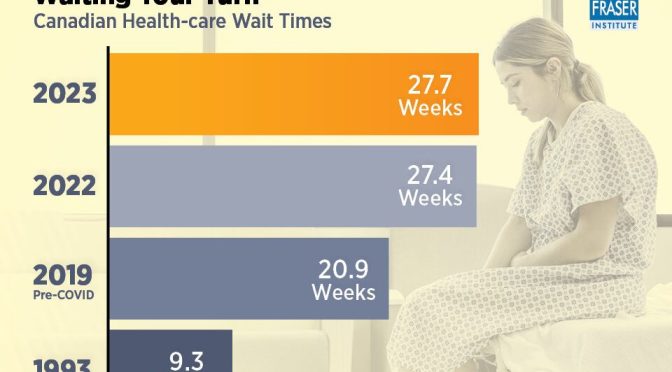
A median wait time of 27.7 weeks between referral from a general practitioner and receipt of treatment was reported in 2023. This is longer than the 27.4 weeks reported in 2022. This year’s wait time is the longest recorded in the survey’s history and is 198% longer than the 9.3-week wait time documented in 1993.
The 27.7 week number is the total of two different delays. The delays to get referred to a specialist, and the delay to get actual treatment:
The 27.7-week total was broken down into two segments – a referral by a general practitioner to consultation with a specialist takes 14.6 weeks, followed by consultation with a specialist and receiving treatment, which takes 13.1 weeks.
Well, there’s a saying in business. You can have a product or a service fast, or you can have it good, or you can have it cheap. Pick two out of 3. So, Maybe Canadian healthcare is not fast, but maybe it’s good, and maybe it’s cheap.
Let’s turn to the Fraser Institute again:
-
Canadians often misunderstand the true cost of our public health care system. This occurs partly because Canadians do not incur direct expenses for their use of health care, and partly because Canadians cannot readily determine the value of their contribution to public health care insurance.
-
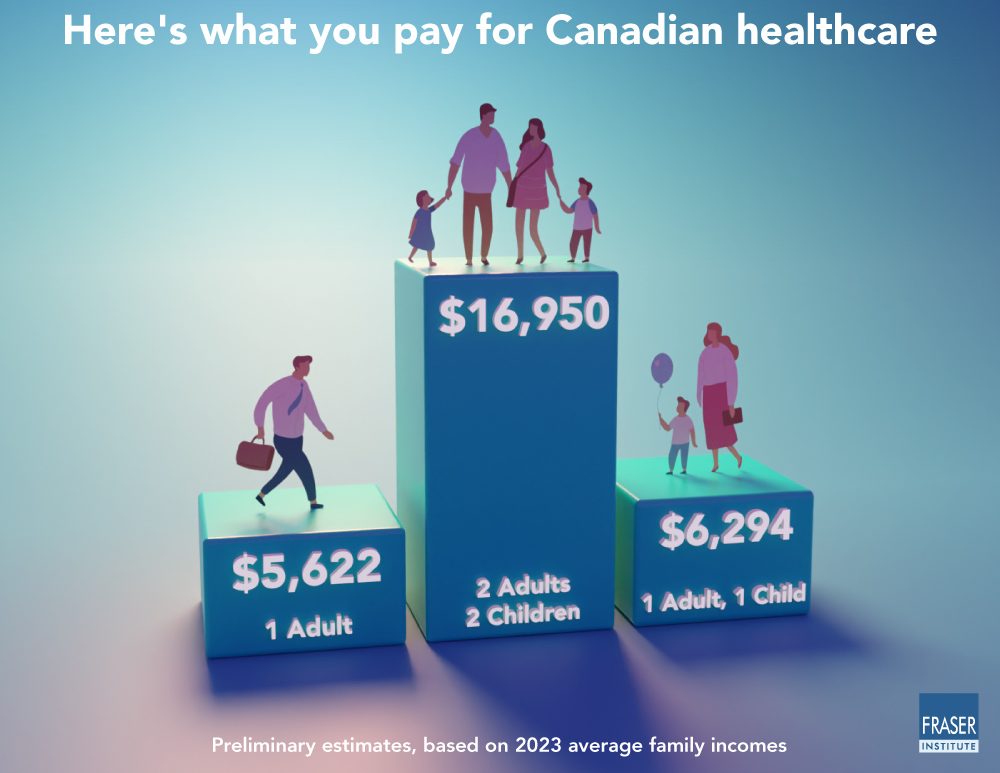
In 2023, preliminary estimates suggest the average payment for public health care insurance ranges from $5,373 to $17,039 for six common Canadian family types, depending on the type of family.
-
Between 1997 and 2023, the cost of public health care insurance for the average Canadian family increased 4.2 times as fast as the cost of clothing, 2.1 times as fast as the cost of food, 1.8 times as fast as the cost of shelter, and 1.7 times as fast as the average income.
-
The 10 percent of Canadian families with the lowest incomes will pay an average of about $644 for public health care insurance in 2023. The 10 percent of Canadian families who earn an average income of $80,946 will pay an average of $7,715 for public health care insurance, and the families among the top 10 percent of income earners in Canada will pay $44,314.
OK, so Canadians aren’t getting healthcare fast, and they’re not getting healthcare cheap. Maybe they’re getting really really good healthcare, though.
Here are the numbers from a new study from the non-profit Angus Reid Institute, in partnership with the Canadian Medical Association:
- Most Canadians believe health care has worsened in the country over the last decade. Currently, 68 per cent of Canadians believe this, an increase from the 42 per cent who said the same in 2015.
- The Angus Reid Institute’s Health Care Access Index, first created one year ago, finds three-in-ten (29%) facing Chronic Difficulty accessing the health care they say they need. One-in-three (34%) are facing fewer, but still some, barriers, while just one-in-six (16%) have little trouble with finding and receiving care from Canada’s health system.
- Half of Canadians either don’t have a family doctor (19%) or struggle to see the one they have (29%).
- Persistent problems in the health care system have left seven-in-ten (68%) pessimistic there will be improvements to the system in the next two years and more than half (56%) doubtful things will change for the better even five years down the line.
- Those who believe their province does a poor or terrible job measuring health care performance (68%) significantly outnumber those who instead believe their provincial government is doing great or good on this front (24%). Two-thirds (67%) believe health care performance would be improved by their province making key health care performance indicators publicly available.
I know that a some Americans like to pick political leaders and policies based on their feelings. They want to feel good. They want to be liked. People who like single payer tend to be people with enormous student loan balances for worthless non-STEM degrees. They work in easy jobs in the public sector. They join labor unions because they’re scared of competition and accountability. Many of them work in daycare or they teach little children, because they don’t want to be challenged by adults. When you look at the numbers on healthcare in different countries, it’s very clear what works and what doesn’t work. Americans need to be smarter than Canadians. We have to vote based on reason and evidence.
 WINTERY KNIGHT
You’ve also mentioned in the past that the Canadian government also prioritizes people as “more valuable” i.e., will pay into the system more — so younger people will get prioritized.
Take for instance, my 80-year old Canadian mother, who has some back/spine/hip problems, likelihood she’ll have to wait closer to 3.5 years (yes, years, not months) for any type of reparative surgery.
At this point, my parents see their traveling days coming to an end and we’re going to have to visit them (and they’ll no longer be coming over to visit).
LikeLike
We had one reader from Calgary who had a similar wait, and she just flew down to Arizona for a couple of days and got it done out of pocket. The problem is that all her income up to that point was taxed by the government. So she had to pay twice. Once through taxes, and once to American health care.
LikeLiked by 2 people
Seems to me, your 80 year old mother, alongside your father, have paid more into the system, longer, than the current group the system seems to favor. Sounds like the system needs a little more of real equity and fairness, not to mention the old “honor thy father and mother” thing!
LikeLike
Yes, but if you look at single-payer healthcare as being about VOTE BUYING, and not about healthcare, then it makes sense. The young person’s sex change is a priority, but not the old person’s hip replacement. The young person’s breast enlargement is a priority, but not the old person’s knee replacement. The young person’s in-vitro fertilization is a priority, but not the old person’s cancer. That’s why Canada underperforms America in health care outcomes. If you get sick, they offer you MAID, which is just suicide administered by doctor.
LikeLiked by 1 person
And now our Liberal-NDP coalition government just added dental care to the system.
LikeLike
IT IS NOT working at all! I am a Canadian and I can tell you wait times are horrendous. If you need a specialist you may wait a year or more! I don’t think I will set foot in our healthcare system again because now they want to kill you with MAID.
LikeLiked by 1 person
One of the listeners to our podcast from Calgary was needing a knee replacement, and they told her wait one year. She flew to Arizona and got it done right away. She had to pay out of pocket.
LikeLiked by 1 person