
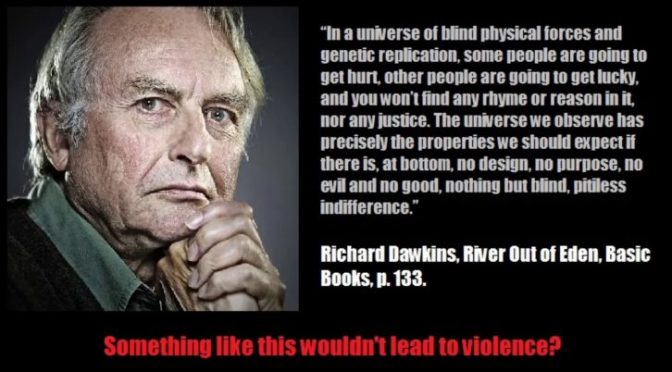
I noticed that there was a news story about how belief in God is declining even further in America. And it’s happening the most among younger Americans. In this post, I wanted to talk about the common atheist idea that you can just remove God, and life will go on as before, with everything making perfect sense.
I don’t think I’ve ever written a post about ALL the changes that happen when a person ejects a Creator / Moral Lawgiver from their worldview. And now I don’t have to, because this blogger has done the work for us.
He introduces his post like this:
I recently wrote an article targeted at committed atheists who claim that Christians carry all the burden of proof. There, I pointed out that atheism is not a neutral position and is justified only if it, too, can provide answers for the hard questions of science and human experience. In this article, though, I’d like to offer something similar only targeted to the agnostic, who flirts with the idea that this universe may be devoid of a God after all. My intent is to get such persons to consider the impact that true atheism would logically have on their beliefs and values, and to consider whether this package deal sounds more reasonable than theism.
Now, I’ve interacted with the author a little by e-mail, and it turns out that he actually spent a good part of his life living as a functional atheist. And he’s got a bunch of friends and relatives who don’t exactly fit in with the standard raised-in-a-Christian-home happy path. And best of all, he’s a software engineer, so you know he’s practical and sensible about these topics.
Here are the major areas of worldview that are affected by the rejection of God:
- Meaning
- Sovereignty
- Morality
- Rights
- Mind
- Free Will
- Science
When I talk about these things, I usually talk about the 3 Ms: Mind, Meaning, Morality. You can see he’s got a lot more there. And he quotes a lot of prominent atheists that you’ve probably heard of: Richard Dawkins, Sam Harris, Sean Carroll, Jerry Coyne, etc.
Here’s the one on Rights:
Universal human rights presuppose that each of us has unique, intrinsic value. The Founding Fathers asserted that our rights were endowed by God, and Scripture claims it is His own image within us that makes us special. If you dispense with this idea, what standard do you use to ground human rights?
We are not equal by any measure one could offer, such as fitness, talent, race, or intelligence. Even grounding it in our mere humanity is arbitrary, since there is no higher standard that would favor humans over the rest of the biological world, and some animals are more fit or intelligent than young, elderly, or disabled humans. Animal rights activists understand this and traffic in this “speciesist” notion. They point out the blight of the human race’s impact on nature, and do not temper that with any belief in the special value of humanity.
The loss of intrinsic human value leads to creative redefinitions for personhood and rights which traffics in things like contribution to society and a life worth living. This road leads to infanticide for the unwanted, eugenics for the unfit, and euthanasia for the elderly. We saw these ideas on display in Nazi Germany as well as, to an extent, the US and other European countries. However, they have been making a comeback in an increasingly secular western culture that has forgotten its dark past. But what principle does atheism offer you to object to any of this beyond your instinctive revulsion?
The conclusion cannot be missed:
Embracing atheism has consequences. Removing God from your life is not like removing a piece of furniture from your house. It’s more like replacing the foundation, which impacts anything that has been built upon it. I’ve discussed several important things that are affected, but many more could be offered, like beauty and the arts, logic, truth, and even the reliability of our senses. In fact, every area of thought and life are affected, or are at least fair game for deconstruction by the universal acid that is atheism.
He also links to a post by James Bishop in the comments, featuring TONS of interesting quotes by famous atheists, about the implications of adopting the worldview of atheism.
Here’s one by former Cornell University paleontologist Will Provine:
Let me summarize my views on what modern evolutionary biology tells us loud and clear … There are no gods, no purposes, no goal-directed forces of any kind. There is no life after death. When I die, I am absolutely certain that I am going to be dead. That’s the end for me. There is no ultimate foundation for ethics, no ultimate meaning to life, and no free will for humans, either.
Is Provine smarter than the average atheist? I think he is, and he’s certainly thought about it more than the average Twitter atheist in his 20s.
I guess what I would say to young atheists is that you probably haven’t 1) evaluated the evidence for a Creator / Designer / Moral Lawgiver at age 14, and 2) you certainly haven’t considered the implications of the decision.
Earlier this week, I wrote a post about an educated 24-year-old feminist woman who was trying to get a man to commit to her. She was choosing men and the timing of sexual activity based on her atheist worldview. As she tells her story, you can clearly see the difference that the worldview makes in the area of relationships. She doesn’t have the resources in her atheism to conduct herself wisely enough to get the results she is looking for.
What kind of “Constitution” can there be for a relationship, if the universe is an accident, human beings are robots made out of meat, and the purpose of life is to be happy here and now? Relationships are stable when each person is able to execute self-sacrificial love. Can you ground a respectful, committed relationship in a worldview of “survival of the fittest”? I think not. And yet this is the approach that most young people take.
 WINTERY KNIGHT