
I was discussing a recent debate that a friend attended between an atheist musician named Dan Barker and a Christian with a doctorate in New Testament Studies named Justin Bass.
According to my friend’s report, the atheist questioned the existence of Nazareth, and then went on from there to assert that everything we know about Jesus is legendary.
This is what the atheist’s argument sounds like:
- If the New Testament contains reliable history about Jesus, then Nazareth must exist.
- Nazareth does not exist.
- Therefore, the New Testaments does not contain reliable history about Jesus. (M.T. 1,2)
I was able to find a web site where an atheist was making the claim that Nazareth did not exist at the time of Jesus. So this is not completely outside the realm of mainstream atheism. I doubled checked with two more people who attended the debate that Barker indeed made an argument like the one above.
Two things to say about this 3-step argument. First off, when speaking to atheists, Christians only care about making a case for the resurrection. This is for two reasons. One, our goal is to disprove atheism, and the historical argument for the resurrection is the most evidenced miracle claim in the New Testament. Nazareth is not part of that core of minimal facts about the resurrection of Jesus. Second, it’s possible to be a Christian by accepting a core of Christian dogma (e.g. – the Apostle’s Creed), while remaining agnostic or even skeptical of other things in the Bible. Nazareth is not part of that core of minimal facts that must be affirmed in order to become a Christian.
The problem I have with atheists is that they pick and choose from the Bible according to their own agenda. Every Christian has read basic books on the resurrection by people like Lee Strobel, Michael Licona, William Lane Craig, J. Warner Wallace and so on. This is like table stakes for living a Christian life. We all know how to make a case based off of minimal facts for the resurrection. When Christians get into debates about Jesus, we want to make a case for the core of historical knowledge about him, minimal facts that almost no one disagrees with. But many atheists aren’t like that. They want to pick and choose a few verses out of the Old Testament and the New Testament that they personally find distasteful to them, and then deny the minimal facts about Jesus on that basis. I don’t think that it makes sense to deny evidence for widely-accepted facts by bringing up minor problems that are irrelevant to the well-attested core facts.
But it’s worse than that – we actually DO know that Nazareth existed, and we know it not from some fundamentalist preacher, but from atheist Bart Ehrman.
Ehrman writes in his book:
One supposedly legendary feature of the Gospels commonly discussed by mythicists is that the alleged hometown of Jesus, Nazareth did not exist but is itself a myth. The logic of this argument, which is sometimes advanced with considerable vehemence and force, appears to be that if Christians made up Jesus’ hometown, they probably made him up as well. I could dispose of this argument fairly easily by pointing out that it is irrelevant. If Jesus existed, as the evidence suggests, but Nazareth did not, as this assertion claims, then he merely came from somewhere else. Whether Barack Obama was born in the U.S. or not (for what it is worth, he was) is irrelevant to the question of whether he was born.
Since, however, this argument is so widely favored among mythicists, I want to give it a further look and deeper exploration. The most recent critic to dispute the existence of Nazareth is René Salm, who has devoted an entire book to the question, called The Myth of Nazareth. Salm sees this issue as highly significant and relevant to the question of the historicity of Jesus: “Upon that determination [i.e., the existence of Nazareth] depends a great deal, perhaps even the entire edifice of Christendom.”
So that seems like a fair representation of the argument I outlined above.
Bart’s response is long, but here’s part of it:
There are numerous compelling pieces of archaeological evidence that in fact Nazareth did exist in Jesus’ day, and that like other villages and towns in that part of Galilee, it was built on the hillside, near where the later rock-cut kokh tombs were built. For one thing, archaeologists have excavated a farm connected with the village, and it dates to the time of Jesus. Salm disputes the finding of the archaeologists who did the excavation (it needs to be remembered, he himself is not an archaeologist but is simply basing his views on what the real archaeologists – all of whom disagree with him — have to say). For one thing, when archaeologist Yardena Alexandre indicated that 165 coins were found in this excavation, she specified in the report that some of them were late, from the fourteenth or fifteenth centuries. This suits Salm’s purposes just fine. But as it turns out, there were among the coins some that date to the Hellenistic, Hasmonean, and early Roman period, that is, the days of Jesus. Salm objected that this was not in Alexandre’s report, but Alexandre has verbally confirmed (to me personally) that in fact it is the case: there were coins in the collection that date to the time prior to the Jewish uprising.
Aalm also claims that the pottery found on the site that is dated to the time of Jesus is not really from this period, even though he is not an expert on pottery. Two archaeologists who reply to Salm’s protestations say the following: “Salm’s personal evaluation of the pottery … reveals his lack of expertise in the area as well as his lack of serious research in the sources.” They go on to state: “By ignoring or dismissing solid ceramic, numismatic [that is, coins], and literary evidence for Nazareth’s existence during the Late Hellenisitic and Early Roman period, it would appear that the analysis which René Salm includes in his review, and his recent book must, in itself, be relegated to the realm of ‘myth.’”
Read Bart’s whole excerpt from his book in his post.
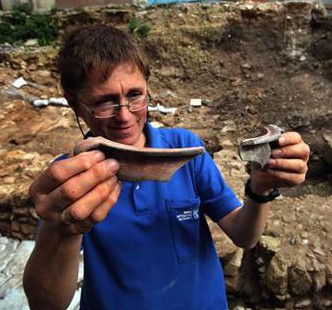
I did a quick double check on the archaeologist Ehrman mentioned, and found an Associated Press story about another archaelogical discovery made by archaeologists in Nazareth. This time, it’s not the coins, but pottery fragments. The date range on the pottery is 100 before Jesus’ birth to 100 years after Jesus’ birth.
Even though Ehrman is an atheist, I think that he understands how to do history. You can’t be a credentialed historian and throw out the early proclamation of Jesus’ resurrection because of doubts about Old Testament violence. You can’t be a credentialed historian and throw out the conversions of Paul and James because you don’t know whether there was one angel or two angels at the empty tomb. Denying the core facts about Jesus by bringing up concerns about peripheral issues is not a responsible way to investigate the historical Jesus.
One final point. This happens when discussing scientific evidence with atheists, too. I was discussing the scientific evidence for the origin of the universe and the cosmic fine-tuning with an atheist – mentioning names, dates and places related to the discoveries – and she cut me off with “Am I going to Hell?”
 WINTERY KNIGHT
I wondered if Jesus of Nazareth was a mistranslation of Jesus of the the Nazarites .
Nothing written abut him would have precluded him from having taken those vows for a time during his early ministry and it would change nothing in the narrative.
LikeLike
The biggest problem with that line of reasoning is that Nazareth is specifically mentioned as a town in Galilee where Jesus grew up (See Matthew 2:23 and Luke 2:4, for example).Talk of Nazareth in the NT wasn’t limited to the term “Jesus of Nazareth.”
LikeLike
” and she cut me off with “Am I going to Hell?””
I hope you were kind enough to tell her either “yes,” or “I don’t know, but, God will not force you into Heaven against your will.”
LikeLike
Good answers!
LikeLike
The second answer is Frank Turek’s, not mine. I am an equally opportunity apologetics thief – I also steal from you all the time, but I try to remember to credit you by putting it in quotations followed by your “name.”
LikeLike
The mythicist case is unconvincing to the vast majority of scholars. It’s considered a fringe case. It shows how desperate some of these atheists are, however. It’s almost as though if there’s one thing in the Bible that’s true, it all has to be true. It’s a very fundementalist mindset.
On another note, I agree with WK about the minimal beliefs to be a Christian. If you believe the following three things, you’re a Christian.
1. Jesus was God in the flesh, full God and full man. He was the Messiah.
2. Jesus was crucified by the Romans
3. He then rose from the dead into heaven, where he reigns with God.
On a very primitive theological level, you don’t really have to believe in a triune god, you don’t have to believe in the virgin birth. All you have to believe in is Jesus as savior, and in Jesus’ physical, bodily resurrection. The spiritual resurrection doesn’t make sense either theologically or in the context of second temple Judaism.
LikeLike
My minimum is the Apostles creed, which has a lot more than yours.
LikeLike
Do you prefer Apostle’s Creed over Nicene? If so, why? More minimalist than Nicene? Thanks!
LikeLike
I like the Nicene creed better, but it is longer.
LikeLike
There is more required than just to “believe” these three points to be a Christian. Even if those were the only core doctrines (which I don’t think is the case), more is needed than simply believing them to be true. Demons believe they are true. And there are plenty of people that believe them to be true and who are not saved because they refuse to submit to the lordship of Christ and will not accept Him as Savior. One has to both believe the core doctrines of salvation to be true AND make an act of the will to accept Christ’s offer of salvation and vow to follow Him. This is what it means to have faith. One cannot have saving faith without an act of the will to choose the salvation being offered by God.
LikeLike
That’s very true, good point.
LikeLike
The demons remain unsaved, not because there is something inadequate about their faith, but because there is no redemption for non-humans in Christ’s sacrifice upon the cross. In other words, even if demons were to add some type of submission to Christ’s Lordship to their “belief”, they STILL would not be saved.
LikeLike
So, are you saying that a human with the same attitude toward God that demons have (i.e. they believe Jesus died for sins and that salvation is through Him, but hate Him anyway) has saving faith?
LikeLike
No, what I am saying is that pointing to “the faith of demons” is not a valid example of the “plenty of people that believe them to be true and who are not saved because they refuse to submit to the lordship of Christ and will not accept Him as Savior”. Do you believe that if the demons simply stopped hating Him that they would then be redeemed based upon the merits of Christ’s death upon the cross? While it is desirable that those who believe the gospel also live in obedience to Christ, to front load belief with anything more than “belief” is to blur the lines of distinction between justification and practical sanctification.
LikeLike
Likewise, I know of NO ONE, nor have I ever heard of anyone, who believes in the historical reality of the death, burial and bodily resurrection of Christ and who also hates Him.
LikeLike
—“No, what I am saying is that pointing to “the faith of demons” is not a valid example of the “plenty of people that believe them to be true and who are not saved because they refuse to submit to the lordship of Christ and will not accept Him as Savior”.”
Well, I wasn’t pointing to demons as an example of people who believe but refuse to submit. I was using both demons and humans who refuse to submit to Christ as evidence that one needs more than mere belief that the gospel is true to be saved.
And there are plenty of humans who believe that Jesus is the Son of God who died to pay the penalty for sin, and yet refuse to accept Him as Savior. This is often a step along the way to atheism where they outright deny God. And it’s often caused by the problem of evil, where something bad has happened to the person himself or a loved one, and he blames God. Thus some raised in church who still believe in the tenets of the faith can reject Christ’s sacrifice without disbelieving it.
LikeLike
Lindsay, I wanted to let you know that I have a tremendous amount of respect for you and your opinions. I cannot count the number of times I have been moved to make a comment on a topic, only to find when I go to do so that you have already been there and done it, and in many cases in such well informed and logical thinking that I have no way to add to or improve upon what you have said. So, please know that I do not lightly disagree with some of what you have said here. I just see it as very problematic to include a vow of obedience (“follow”ing) as part and parcel belief. A vow is a promise, and rather than us making a promise to obtain justification, we are to believe in the promise of salvation that God has made to all those who simply believe in that promise as confirmed by his resurrection of Christ from the dead. It is a free gift. I certainly understand that there are negative consequences for believers who are willfully disobedient, but I cannot consider their not obtaining justification to be such a consequence. On that note, let me say peace to you my sister, and offer encouragement to you to keep the Christ-centered wisdom and logic coming.
LikeLike
jmg123,
Thank you for your kind words.
I do believe that merely thinking Christ’s sacrifice is the way to be saved is not sufficient to actually be saved. There has to be an act of the will to turn away from sin (repent) and turn to Christ for salvation. Salvation is free. No amount of good works can earn it. But we do have to accept it. Just knowing the free gift is there and how to obtain it doesn’t mean we have obtained it. We have to take the step of faith to trust Christ for salvation.
People have used the analogy of a chair before to illustrate this idea. One can believe that a chair will hold you up if they were to sit in it. But that isn’t placing faith in the chair. It’s not until you actually sit in the chair that you have placed faith in it to hold you up. And it’s not until you have actually trusted Christ for your personal salvation that you have placed faith in Him and have salvation. Believing Christ would save you if you trusted Him is not enough. You have to actually trust Him and that means making a decision that He will be your God and Savior.
LikeLike
That is very well put, Lindsay. I have heard the analogy of researching surgeons prior to a needed surgery. Once that surgeon (Surgeon in Christianity) is selected, that is the point of intellectually knowing that he (He) is the best. The demons know that much. It is not until we sign off on the authorization forms (or possibly not until the Surgeon makes His first incision), that we have sincerely placed our trust in him (Him). At that point, we are literally in the Surgeon’s hands.
I am sure that a more experienced Christian like you or someone else here can do a better job on this analogy, but it seems to make sense to me anyway. God bless and thanks for the great posts!
LikeLike
Lindsay said, Well, I wasn’t pointing to demons as an example of people who believe but refuse to submit. I was using both demons and humans who refuse to submit to Christ as evidence that one needs more than mere belief that the gospel is true to be saved.”
I understand that, but there is NOTHING that the demons can do to be saved. Humans, however, are not in the same boat. When you say that “Demons believe” in the truth of the gospel you imply that since they do believe and are not saved, it is an example of how mere belief in the truth of the gospel is not enough to effect salvation. The reason they are not saved has nothing to do with any deficiency in their faith. The problem is in what they are : demons, not in anything they refuse to do.
I also understand where you are coming from with your chair example of faith. I’ve heard many times a similar example of the tight rope walker over Niagara falls with the wheelbarrow. The problem in both cases is that this is a re-definition of what the word “belief / faith” (greek pistis) means (and has historically mean’t) in normal conversation. If you tell me your name is Lindsay Harold, and I tell you that I believe you, do I need to make some kind of an supplementary commitment in order for my belief of what you have said to be “true” belief? Belief simply means to be persuaded or convinced that something is true and not false. Note for instance that in Acts 28:24 those to whom Paul spoke are contrasted in their response to what he said. The verse says that some were “persuaded” (peitho) by what Paul said – these were the believers, but the rest “disbelieved” (apisteo) him – these of course were the unbelievers.
Even in the purpose statement of the Gospel of John itself, “belief” is described as the persuasion that a certain claim is true, and such belief (with no adders indicated) is said to be sufficient for obtaining eternal life:
John 20:30-31 “And truly Jesus did many other signs in the presence of His disciples, which are not written in this book; but these are written that you may BELIEVE THAT JESUS IS THE CHRIST, THE SON OF GOD, and that believing you may have life in His name.”
Do I think there should be commitment to obedience toward Christ in a believer’s life? Absolutely! But that’s something a believer is called to do, not something thats done to BECOME a believer.
LikeLike
I attended the debate as well, and that was not Barker’s argument. He argued that since there was no archaeological evidence that Nazareth existed as a city during the early first century, it would be anachronistic to refer to Jesus in the Gospels as “Jesus of Nazareth.” He did not conclude immediately that the Gospels are therefore not historically reliable, but developed about a half dozen other arguments to support that thesis.
LikeLike
We’ll see when the audio comes out. I spoke to three people, and one told me that this was the only thing he said that was on topic. His exact phrase was something like “if the Bible can’t get Nazareth right, then why should we trust it for anything else it says about Jesus?” The rest was just off topic red meat for his supporters, about Old Testament violence. The topic of the debate was historical Jesus. I was also told that he skipped his cross examination period, preferring not to engage with his opponent.
Here is the text of a couple comments I pulled off of Justin’s wall from people who attended the debate:
And another:
And another:
This seems to support the other accounts I heard that Barker had little to say about the topic of the debate, which was the historical Jesus.
LikeLike
That’s correct, he did include that anachronism as one piece of evidence that should lead one to conclude that the New Testament is not historically trustworthy regarding its description of Jesus. But it would be incorrect to describe him as resting his entire case on this one piece.
As for the rest of his statement, I think it did go in a different direction than Dr. Bass (or the audience, including myself) had anticipated. Rather than build a case for the mythicist hypothesis, he used several pieces of evidence (such as the Nazareth anachronism) to undercut historicity, and then moved into a different line of argumentation to undercut Jesus’ status as “Lord.” The debate itself was titled, “Jesus of Nazareth: Lord or Legend?” My assessment (which Barker eventually referred to explicitly) was that his goal was to argue contra “Lord,” while Dr. Bass argued contra “Legend.”
What was described as “red meat” was a legitimate attack on Jesus’ character, intended to discredit him as someone worthy of worship, i.e., a “Lord.”
LikeLike
Also, regarding the cross-examination, there was plenty of “engagement” between Dr. Bass and Barker during the former’s allotted time. As an audience member, I felt that Dr. Bass’ approach in that section was counterproductive, and it’s possible that Barker agreed. He stated that he preferred to answer questions from the audience than ply Dr. Bass with additional questions.
LikeLike