Bill Jack wants to make one thing perfectly clear: Bakers should not be forced to make a cake that would violate their conscience or freedom of expression.
Jack, of Castle Rock, Colo., is making national headlines over an experiment he conducted in the wake of attacks on Christian business owners who refuse to provide services for same-sex marriages.
Last year, the Colorado Civil Rights Commission ruled that the Masterpiece Cakeshop in Lakewood unlawfully discriminated against a gay couple who wanted a wedding cake. Jack Phillips, the owner of the cake shop, is a devout Christian, and his attorneys argued that to force him to participate in the gay wedding would violate his religious beliefs.
The Civil Rights Commission saw it differently.
So if Christian bakers who oppose gay marriage are compelled under law to violate their beliefs — what about bakers who support gay marriage? Would they be compelled to make an anti-gay marriage cake?
[…]As you probably guessed, the bakeries rejected Jack’s request for what some would call “anti-gay” cakes.
“If he wants to hate people, he can hate them not here in my bakery,” Azucar Bakery owner Marjorie Silva told 7NEWS. She called the writing and imagery “hateful and offensive.”
But hating Christians enough to force your morality on them with fines and emprisonment – that’s not hatred at all.
More:
So Jack filed a discrimination complaint with the Colorado Civil Rights Commission — just as the gay couple did in the Masterpiece Cakeshop case.
Using the commission’s logic — if a Christian baker is forced to violate his beliefs, shouldn’t all bakers be forced to violate theirs, too?
Absolutely not, says the Colorado Civil Rights Commission.
It ruled that Azucar did not discriminate against Jack based on his creed. It argued that the bakery refused to make the cakes because of the “derogatory language and imagery,” The Denver Channel reported.
Jack told me it’s a double standard — pure and simple.
“I think it is hypocritical,” he said. “It’s unequal treatment before the law. The Colorado Anti-Discrimination Act is being used to coerce businesses to participate in events that violate their consciences.”
Jack said he decided to conduct his experiment to prove the Colorado law was “only being applied to Christian business people.”
“Christians need to understand that this is the state of Christianity in the United States,” he said. “We are now second-class citizens. Our free speech is being censored.”
To be clear, Jack believes the bakeries had the right to deny him service. His point was to draw attention to the hypocrisy.
“I stand for liberty for all, not liberty for some,” he said. “If we don’t have liberty for all, then we have liberty for none.”
So. Although Christians may have voted for these laws thinking that they were “nice”, the truth is that every scrap of Christianity that anyone finds of offensive is going to become illegal. At some point, we are all going to have to choose between the Bible and being punished by the state.
Fertility rates in European countries (click for larger image)
This is from the radically leftist New York Times, of all places.
They write:
Recently, Sex and Society, a nonprofit group that provides much of Denmark’s sex education, adjusted its curriculum. The group no longer has a sole emphasis on how to prevent getting pregnant but now also talks about pregnancy in a more positive light.
It is all part of a not-so-subtle push in Europe to encourage people to have more babies. Denmark, like a number of European countries, is growing increasingly anxious about low birthrates. Those concerns have only been intensified by the region’s financial and economic crisis, with high unemployment rates among the young viewed as discouraging potential parents.
The Italian health minister described Italy as a “dying country” in February. Germany has spent heavily on family subsidies but has little to show for it. Greece’s depression hasfurther stalled its birthrate. And in Denmark, the birthrate has been below the so-called replacement rate needed to keep a population from declining — just over two children per woman — since the early 1970s.
“For many, many years, we only talked about safe sex, how to prevent getting pregnant,” said Marianne Lomholt, the national director of Sex and Society. “Suddenly we just thought, maybe we should actually also tell them about how to get pregnant.”
The demographic shift is more pressing in Europe than almost any other major region, save Japan. There are an estimated 28 Europeans 65 or older for every 100 residents ages 20 to 64, almost twice the world average, according to the United Nations, and compared with 24.7 for the United States. By the end of the century, the United Nations expects the European figure to double.
Such trends will transform societies, potentially reducing economic growth and increasing stress on public pension systems and requiring more elder care. Japan already faces existential questions in a country whereadult diaper sales are beginning to eclipse those of baby diapers.
But there is not a consensus about the impact of demographics. Some see a natural maturing of developed societies. Others see disaster ahead, because with fewer workers and more retirees, the active work force faces an increased burden to sustain social programs.
Productivity gains over time, though, can make up for such population stresses. Declining birthrates can also lead to labor shortages, and Germany has faced a gap in skilled labor. But that is hardly an issue now for much of Europe, which is mired in high unemployment.
OK, so it’s a crisis. But how did it happen?
Nicholas Eberstadt explains what’s happening to marriage and parenting, in this Wall Street Journal article.
Why is it happening?
All around the world today, pre-existing family patterns are being upended by a revolutionary new force: the seemingly unstoppable quest for convenience by adults demanding ever-greater autonomy. We can think of this as another triumph of consumer sovereignty, which has at last brought rational choice and elective affinities into a bastion heretofore governed by traditions and duties—many of them onerous. Thanks to this revolution, it is perhaps easier than ever before to free oneself from the burdens that would otherwise be imposed by spouses, children, relatives or significant others with whom one shares a hearth.
People are rejecting responsibilities, expectations, and obligations because they are selfish.
When he talks about Europe, he offers an explanation for this:
Now consider Europe, where the revolution in the family has gained still more ground. European demographers even have an elegant name for the phenomenon: They call it the Second Demographic Transition (the First being the shift from high birth rates and death rates to low ones that began in Europe in the early industrial era and by now encompasses almost every society). In the schema of the Second Demographic Transition, long, stable marriages are out, and divorce or separation are in, along with serial cohabitation and increasingly contingent liaisons. Not surprisingly, this new environment of perennially conditional, no-fault unions was also seen as ushering in an era of more or less permanent sub-replacement fertility.
According to Eurostat, the European Union’s statistical agency, the probability of marriage before age 50 has been plummeting for European women and men, while the chance of divorce for those who do marry has been soaring. In Belgium—the birth-land of the scholars who initially detected this Second Transition—the likelihood of a first marriage for a woman of reproductive age is now down to 40%, and the likelihood of divorce is over 50%. This means that in Belgium the odds of getting married and staying married are under one in five. A number of other European countries have similar or even lower odds.
Europe has also seen a surge in “child-free” adults—voluntary childlessness. The proportion of childless 40-something women is one in five for Sweden and Switzerland, and one in four for Italy. In Berlin and in the German city-state of Hamburg, it’s nearly one in three, and rising swiftly. Europe’s most rapidly growing family type is the one-person household: the home not only child-free, but partner- and relative-free as well. In Western Europe, nearly one home in three (32%) is already a one-person unit, while in autonomy-prizing Denmark the number exceeds 45%. The rise of the one-person home coincides with population aging. But it is not primarily driven by the graying of European society, at least thus far: Over twice as many Danes under 65 are living alone as those over 65.
“Perenially conditional, no-fault unions”. That means that either party can leave at any time, for any reason.
Basically, people became skeptical of objective morality and the afterlife, and they have decided to follow their hearts and go more the most happiness they can have in this life. And they’ve noticed that relationships with other people – with all the nasty expectations, obligations and responsibilities – get in the way of this self-centeredness. To get married and have children is to embrace responsibility. It means that you are accepting the obligation to learn the needs of other people and care for those needs. Something has gone wrong in European society where these social obligations declined, just as religion declined. And the same thing is being taught to the next generation in our most prestigious universities.
This is a bird’s-eye view. I’ll have a closer look at the problem in my next post.
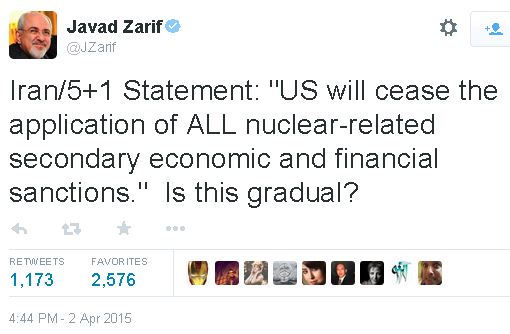
Iran’s chief negotiator: all the sanctions cease immediately
This is the top article on the Wall Street Journal right now. It’s written by two former Secretaries of State, Henry Kissinger and George P. Shultz.
They are assessing the Iran deal:
While Iran treated the mere fact of its willingness to negotiate as a concession, the West has felt compelled to break every deadlock with a new proposal. In the process, the Iranian program has reached a point officially described as being within two to three months of building a nuclear weapon. Under the proposed agreement, for 10 years Iran will never be further than one year from a nuclear weapon and, after a decade, will be significantly closer.
[…]Progress has been made on shrinking the size of Iran’s enriched stockpile, confining the enrichment of uranium to one facility, and limiting aspects of the enrichment process. Still, the ultimate significance of the framework will depend on its verifiability and enforceability.
[…]Under the new approach, Iran permanently gives up none of its equipment, facilities or fissile product to achieve the proposed constraints. It only places them under temporary restriction and safeguard—amounting in many cases to a seal at the door of a depot or periodic visits by inspectors to declared sites. The physical magnitude of the effort is daunting. Is the International Atomic Energy Agency technically, and in terms of human resources, up to so complex and vast an assignment?
In a large country with multiple facilities and ample experience in nuclear concealment, violations will be inherently difficult to detect. Devising theoretical models of inspection is one thing. Enforcing compliance, week after week, despite competing international crises and domestic distractions, is another. Any report of a violation is likely to prompt debate over its significance—or even calls for new talks with Tehran to explore the issue. The experience of Iran’s work on a heavy-water reactor during the “interim agreement” period—when suspect activity was identified but played down in the interest of a positive negotiating atmosphere—is not encouraging.
Compounding the difficulty is the unlikelihood that breakout will be a clear-cut event. More likely it will occur, if it does, via the gradual accumulation of ambiguous evasions.
When inevitable disagreements arise over the scope and intrusiveness of inspections, on what criteria are we prepared to insist and up to what point? If evidence is imperfect, who bears the burden of proof? What process will be followed to resolve the matter swiftly?
The agreement’s primary enforcement mechanism, the threat of renewed sanctions, emphasizes a broad-based asymmetry, which provides Iran permanent relief from sanctions in exchange for temporary restraints on Iranian conduct. Undertaking the “snap-back” of sanctions is unlikely to be as clear or as automatic as the phrase implies. Iran is in a position to violate the agreement by executive decision. Restoring the most effective sanctions will require coordinated international action. In countries that had reluctantly joined in previous rounds, the demands of public and commercial opinion will militate against automatic or even prompt “snap-back.” If the follow-on process does not unambiguously define the term, an attempt to reimpose sanctions risks primarily isolating America, not Iran.
The gradual expiration of the framework agreement, beginning in a decade, will enable Iran to become a significant nuclear, industrial and military power after that time—in the scope and sophistication of its nuclear program and its latent capacity to weaponize at a time of its choosing. Limits on Iran’s research and development have not been publicly disclosed (or perhaps agreed). Therefore Iran will be in a position to bolster its advanced nuclear technology during the period of the agreement and rapidly deploy more advanced centrifuges—of at least five times the capacity of the current model—after the agreement expires or is broken.
That doesn’t sound like a good deal to me.
It sounds like we are trading permanent relief from sanctions. Those sanctions were built up over years of negotiations with the UN countries. Sanctions that are not easy to “snap back” if Iran breaks the deal, because they require negotiations with many different UN countries again – it won’t be automatic. That’s the “asymmetry” they are talking about in the article. Iran can break the agreement unilaterally, or just block the inspections, and the sanctions will stay off until we get agreement with the UN countries.
Here’s the former Democrat campaign worker, and now State Department spokeswoman Marie Harf:
She is confused by all the “big words” that these two Secretaries of State used in the article above.
Iran will begin using its latest generation IR-8 centrifuges as soon as its nuclear deal with the world powers goes into effect, Iran’s foreign minister and nuclear chief told members of parliament on Tuesday, according to Iran’s semi-official FARS news agency.
If accurate, the report appears to make a mockery of the world powers’ much-hailed framework agreement with Iran, since such a move clearly breaches the US-published terms of the deal, and would dramatically accelerate Iran’s potential progress to the bomb.
Iran has said that its IR-8 centrifuges enrich uranium 20 times faster than the IR-1 centrifuges it currently uses.
According to the FARS report, “Iran’s foreign minister and nuclear chief both told a closed-door session of the parliament on Tuesday that the country would inject UF6 gas into the latest generation of its centrifuge machines as soon as a final nuclear deal goes into effect by Tehran and the six world powers.”
It said that Foreign Minister Mohammad Javad Zarif and Atomic Energy Organization of Iran (AEOI) head Ali Akbar Salehi made the promise when they briefed legislators on the framework agreement, and claimed the move was permitted under the terms of the deal.
Oh, I guess was wrong. This is a good deal! For Iran.
Sigh. I guess if you want to be even more horrified by the Iran deal, you can listen to an interview that Hugh Hewitt did with Wall Street Journal columnist Bret Stephens, and there’s a transcript as well for those who would rather read about the incompetence of the Obama administration rather than hear about the incompetence of the Obama administration.


 WINTERY KNIGHT