
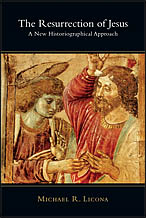
And what a big book it is! 718 pages!
Here are the details from Brian Auten:
Michael Licona, Research Professor of New Testament at Southern Evangelical Seminary, has just released a monumental new book: The Resurrection of Jesus: A New Historiographical Approach
From the publisher:
Could there be any new and promising approach to the question of the historicity of Jesus’ resurrection? Yes, answers Michael Licona. And he convincingly points us to a significant deficiency in approaching this question: our historiographical orientation and practice. He then carefully and effectively applies his principles and methods to the question of Jesus’ resurrection.
This book is sure to become required reading for anyone exploring this field, as Michael Licona has made an extremely significant contribution to scholarship in this area.
The book is $27 dollars on Amazon, but you probably won’t need another book on the resurrection. I try not to buy books by people who haven’t debated anyone on the other side, but that won’t be a problem with Licona. He’s debated everybody on the other side – like Bart Ehrman, Richard Carrier and Shabir Ally. He’s battle-tested.
I took a look at the endorsements, and I recognize tons of historians.
Here’s one:
“Licona has tackled his subject energetically, with near-obsessive thoroughness. He concludes that if one approaches the sources without an a priori commitment to the impossibility of resurrection, the ‘Resurrection Hypothesis’ is the interpretation that most adequately accounts for the evidence. Thus, the book boldly challenges the naturalistic presuppositions of post-Enlightenment historical criticism. At the very least, Licona has shown that the usual naturalistic explanations of the resurrection tradition are, on the whole, weak, speculative and often tendentious. “I am not aware of any scholar who has previously offered such a thorough and fair-minded account of the historiographical prolegomena to the resurrection question. Furthermore, Licona’s discussion of the ‘bedrock’ historical evidence is appropriately nuanced and carefully modulated, not claiming more than can be supported by the consensus findings of qualified scholars. This lends credibility to his conclusions. Licona has presented a fair and vigorous case for his position. No doubt many readers will be unconvinced by his arguments, but no one can accuse him of naivet? or of ignoring counterarguments. “This study spans fields that are too rarely brought into conversation: New Testament studies and historiographical theory. Licona is to be commended for this undertaking and for producing a study that has both wide range and significant depth.”
If you’re looking for a book on the resurrection, this might be a good one. Seems like it will cover everything.
UPDATE: Wow, big Mike Licona post up at Reason to Stand. Lots of Mike Licona videos.
 WINTERY KNIGHT