
From the UK Daily Mail. (H/T Verum Serum)
After months of dithering over how to rein in its vast deficit, the Greek government has been forced to plead for a £93billion international bail-out package and implement hugely unpopular austerity measures, to be voted on today.
Amid the rioting, the euro plunged, stock markets crashed and German Chancellor Angela Merkel admitted the very ‘future of Europe’ was at stake.
[…]In the most horrific incident, 20 terrified staff were trapped in the burning Marfin bank after it was firebombed by protesters. The mob blocked firefighters from getting to the blaze.
Two women and a man suffocated in the smoke as they tried to escape the flames. Bank officials told reporters one woman had been pregnant.
A fire department official said their lives could have been saved had ‘ crucial minutes’ not been lost getting through the rioters’ blockades.
The death toll is now up to four.
The socialists have owned Greece for most of the last 30 years
What happened in Greece? Marketwatch wrote about their recent elections in 2009.
Excerpt:
The political drama is about socialist George Papandreou’s electoral victory over the conservatives and his rise to the same position, prime minister of Greece, which his father and grandfather had held before him.
The tragedy will come if he is tempted to follow in his father’s populist footsteps, as his campaign rhetoric suggests he will. Such a choice might prove disastrous not only for Greece but for the rest of the European Union as well.
Greece’s turn left is unique, even in the wake of the economic perplexity that has gripped the world since summer 2008.
[…]Promises to raise public-sector salaries are problematic enough, but to raise wages beyond the amount eroded by inflation, as Pasok said it would, is altogether derelict. So is the thought that such spending, along with 3 billion euros in aid to small businesses, can be financed by further taxing the rich and cracking down on tax evasion.
In 1981, the Greek socialist party formed the first socialist government in Greece’s history, and subsequently governed the country for most of the 1980s, 1990s and early 2000s. They were the main opposition party between 2004 and 2009.
And here’s what happened:
| Year | Debt (Million € equivalent) | Number of civil servants |
| 1960 | 33 | 185,000 |
| 1970 | 226 | 280,000 |
| 1980 | 1,062 | 400,000 |
| 1985 | 4,828 | 600,000 |
| 1990 | 22,304 | 815,000 |
| 2007 | 234,776 | 1,050,000 |
That’s right, they had the equivalent of Barack Obama in charge, for a long, long time. Tax and spend, hope and change.
The crisis of debt in Europe
And check out this alarming analysis from RealClearMarkets: (H/T Belmont Club via ECM)
Virtually every country in the EU spends more than it takes in and has made long-term fiscal promises to an aging work force that it can’t keep. A little over a year ago, economist Jagadeesh Gokhale, writing for the National Center for Policy Analysis, produced a pithy – and scary – summation of the fiscal challenges faced by Europe. Don’t read it if you have trouble sleeping.
“The average EU country,” he concluded, “would need to have more than four times (434%) its current annual gross domestic product in the bank today, earning interest at the government’s borrowing rate, in order to fund current policies indefinitely.”
In other words, Europe would have to have the equivalent of roughly $60 trillion in the bank today to fund its very general welfare benefits in the future. Of course, it doesn’t.
Things haven’t changed much since that study was done. So suppose they don’t put aside all that money. What then? By 2035, Gokhale reckons, the EU will need an average tax rate of 57% to pay for its lavish welfare state.
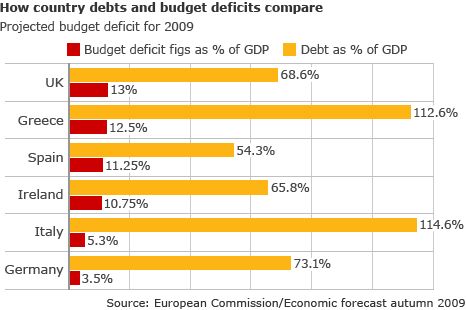
Today, Greece is only the tip of a very large iceberg. Portugal, Spain, Italy and Ireland together owe $3.9 trillion in short- and medium-term debts, an amount larger than their combined GDP, estimated last year at $3.3 trillion.
Picture:
Don’t let socialists run your country. They spend too much!
 WINTERY KNIGHT
Greece is less socialist than a populist state. Socialism in name only (the tradition of calling yourself “socialist” while promoting strange non-socialistic ideas is a venerable one!). You say, “socialism hurts poor”, but consider that the best places to live in Europe, by any standard measure of public health, well-being and comfort, are Scandinavian nations–which are unabashedly social-democratic, and (by your standards at least) extremely leftist. How would you explain that?
LikeLike
I’m not sure that I agree with your bare assertion that the SOCIALIST party isn’t SOCIALIST, especially when I referenced their SOCIALIST policies in the post. Did you have a specific policy in mind, like TAX CUTS, which would NOT be SOCIALIST?
I explain your other statements by asking you to provide a quotation and a link for your claims. I.e. – what reason do I have to believe your assertions? See, when you make a claim, it’s just your opinion, unless you have some facts.
Here are some facts on health care outcomes, for example.
Hmmmn. There must be something wrong with my facts, since they are from the prestigious Stanford University, yet they seem to falsify your claims about health care.
Please be careful in your comments. Make a statement, cite some evidence, provide a link. Try to cite peer-reviewed literature if you can. It helps me to be able to approve comments that are actually useful, rather than being mere assertions. Please don’t cite the New York Times, the United Nations, or Michael Moore films.
LikeLike
The wonderful Leftist paradise in Scandinavia is a bit of a myth.
The international accounting and consulting firm KPMG found that when disposable income was adjusted for cost of living, Scandinavians were the poorest in Western Europe. Norway and Sweden were second and third-lowest for adjusted income.
Read more at Suite101: The Swedish Myth Debunked http://www.suite101.com/article.cfm/libertarian/115408#ixzz0nLDhaMun
LikeLike
Thanks for this comment. Welfare states cost money and it also discourages people from marrying and having children, which is why these Sweden is cutting taxes now.
LikeLike
The elderly in Greece face starvation, the corrupted politicians now attack and try to extinguish the elderly. Thats the so simple and yet so true fact.
LikeLike