Tag Archives: World War 2

Friday night movie: Midway (1976)

Here’s tonight’s movie:

Description:

The Battle of Midway, fought over and near the tiny U.S. mid-Pacific base at Midway atoll, represents the strategic high water mark of Japan’s Pacific Ocean war. Prior to this action, Japan possessed general naval superiority over the United States and could usually choose where and when to attack. After Midway, the two opposing fleets were essentially equals, and the United States soon took the offensive.

Japanese Combined Fleet commander Admiral Isoroku Yamamoto moved on Midway in an effort to draw out and destroy the U.S. Pacific Fleet’s aircraft carrier striking forces, which had embarassed the Japanese Navy in the mid-April Doolittle Raid on Japan’s home islands and at the Battle of Coral Sea in early May. He planned to quickly knock down Midway’s defenses, follow up with an invasion of the atoll’s two small islands and establish a Japanese air base there. He expected the U.S. carriers to come out and fight, but to arrive too late to save Midway and in insufficient strength to avoid defeat by his own well-tested carrier air power.

Yamamoto’s intended surprise was thwarted by superior American communications intelligence, which deduced his scheme well before battle was joined. This allowed Admiral Chester W. Nimitz, the U.S. Pacific Fleet commander, to establish an ambush by having his carriers ready and waiting for the Japanese. On 4 June 1942, in the second of the Pacific War’s great carrier battles, the trap was sprung. The perserverance, sacrifice and skill of U.S. Navy aviators, plus a great deal of good luck on the American side, cost Japan four irreplaceable fleet carriers, while only one of the three U.S. carriers present was lost.

IMDB rating: [6.7/10]

Battle map:

Battle of Midway Map
Battle of Midway Map (click for larger image)

Image found here:

http://www.warfaremagazine.co.uk/articles/The-Battle-of-Midway/41

Happy Friday!
Friday night movie: Decision Before Dawn (1951)

For Friday night, I thought I’d re-post a movie I like a lot.

IMDB rating: [7.5/10]

Description:

WWII is entering its last phase: Germany is in ruins, but does not yield. The US army lacks crucial knowledge about the German units operating on the opposite side of the Rhine, and decides to send two German prisoners to gather information. The scheme is risky: the Gestapo retains a terribly efficient network to identify and capture spies and deserters. Moreover, it is not clear that “Tiger”, who does not mind any dirty work as long as the price is right, and war-weary “Happy”, who might be easily betrayed by his feelings, are dependable agents. After Tiger and another American agent are successfully infiltrated, Happy is parachuted in Bavaria. His duty: find out the whereabouts of a powerful German armored unit moving towards the western front.

Happy Friday!

Ronald Reagan’s 40th anniversary D-Day speech: the boys of Pointe du Hoc

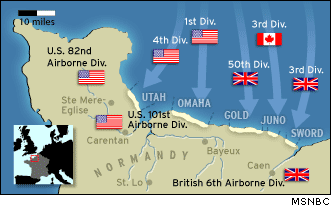
June 6, 1944 D-Day Normandy Invasion Map

It’s June 6th, today, and it’s the anniversary of D-Day: the Allied invasion of northern France – the beginning of the end of World War 2. One of the most pivotal events of that day was the assault on German gun emplacements by members of the Army Rangers at a fortified position called “Pointe du Hoc”.

President Ronald Reagan recognized the soldiers who attacked Pointe du Hoc back in 1984:

You can read the full transcript of that speech here.

Ronald Reagan also made the case for gratitude and vigilance:

Here’s the hymn that starts to play at the end:

The Boys of Pointe du Hoc

Here’s a summary of the Pointe du Hoc mission:

[Lt. Col. James Earl] Rudder took part in the D-Day landings as Commanding Officer of the United States Army’s 2nd Ranger Battalion. His U.S. Army Rangers stormed the beach at Pointe du Hoc and, under constant enemy fire, scaled 100-foot (30 meter) cliffs to reach and destroy German gun batteries. The battalion’s casualty rate for this perilous mission was greater than 50 percent. Rudder himself was wounded twice during the course of the fighting. In spite of this, they dug in and fought off German counter-attacks for two days until relieved. He and his men helped to successfully establish a beachhead for the Allied forces.

You can watch a three-clip documentary on it, too: part 1, part 2, part 3.

Although initially, the Rangers did not find the guns where they had expected them, they did find them further back behind the cliffs and destroyed them there, removing a threat to the forces that would be landing later.

What does D-Day mean to Christians in particular?

A Christian friend asked me what she should be thinking about when I sent her one of the videos above, and so I wrote her this to explain why I sent her the video:

To make you close your eyes and think in a more practical way about what it means for someone to sacrifice their lives to save you, of course. What it means to look up cliffs at machine guns, barbed wire and mortars raining death on you and to take a rope in your hands and to climb up a sheer cliff, under heavy fire, in order to save generations yet unborn and freedom itself.

To think about a concrete example helps us to be able to appreciate what Christ did for us in giving his life for us so that we could be free of sin, as well.

This is the insight that drives my entire interest in war and military history, in fact.

What does this mean: “Greater love has no man than this, that a man lay down his life for his friends.”

The more you know about D-Day, the more fearful what Jesus did appears, and the more you can be grateful.

Bullets and shrapnel are scary… and so are nails and lashes. Why on Earth would anyone endure either for me? And what should my response be to it?

I think it is helpful to explain Christianity to those who are not yet Christian, and for Christians to fully appreciate what Christianity is all about.

We were in peril. And now we have been saved. But at a cost.

I think that it’s important for Christians to look to history, art, poetry and music to help them to reflect and comprehend the sacrifice that Christ made for us in dying on the cross to protect us from peril. What must the cross have looked like to Jesus? It must have been something like what the Omaha beach looked like to the Americans landing in Normandy. Jesus saw whips, thorns and nails, and the heroes of Normandy saw 88 mm AT guns, 81 mm mortars and MG42 machine guns. How should you feel about people who face death on your behalf? Think about it.