
Tag Archives: Vladimir Putin

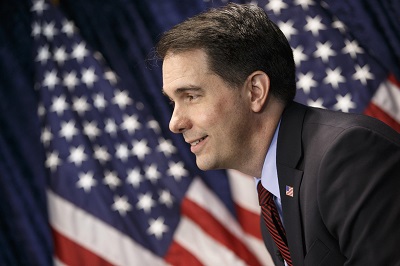
Scott Walker discusses foreign policy and national security with Hugh Hewitt

Wisconsin Governor Scott Walker

Hugh Hewitt is a horrible RINO Republican establishment guy (backed Romney), but I sometimes listen to his show.

I got this audio and transcript from Hugh Hewitt’s blog.

The MP3 file is here. (19 minutes)

And here are the relevant parts of the transcript:

HH: You mentioned today, you called it “the safety issue,” not the “national security issue,” that sort of brings, explain to people why you use that terminology.

SW: I do, because I think it’s come to the forefront not so much because “national security,” that, to me, as I said [at lunch], is on page 6A of the newspaper where only a handful of us read into that. But when people see the videos, when they see the Jordanian burned alive in a cage, when they see the Egyptian Christians who were beheaded, when they see some of these other folks from around the world, including James Foley, who went to Marquette University where my son’s a junior, and suddenly, that becomes very real to everyday Americans.

HH: One of the beheaded Islamic State videos.

SW: Absolutely, whose parents are actually from New Hampshire, not far from where I was at a weekend ago, and you just realize, you can see it on your phone, you can see it on your iPad. You don’t need the filter of the network news or the daily newspaper to tell you how bad this is. It suddenly becomes an issue of safety, because that’s not something, national security, foreign policy is something over there. Safety is something you feel inside your chest, you feel in your heart. And I think increasingly, Americans feel a sense of concern that particularly if they have family members or loved ones that ever want to travel again, they see France, they see Canada, they see other places around the world, not just the Middle East, and it’s a safety issue. And they, and then I would just add to this, as they look at this more closely, they see a president whose drawn a line in the sand and crossed it, who called ISIS just a year ago the “jayvee squad,” who called Yemen last fall a success story, who calls Iran now a place where we can do business. Think about how screwed up that is. I remember the movie in the 80s, Trading Places…

HH: Right.

SW: …you know, with Dan Akroyd and Eddie Murphy, it’s like Iran and Israel are trading places in the sequel. In the eyes of this president, our ally is supposed to be Israel. Our adversary has been historically Iran. And yet this administration completely does it the other way around. We need to call radical Islamic terrorism for what it is, and a commander-in-chief who’s willing to act.

HH: Now I asked maybe one of your potential competitors yesterday, Senator Marco Rubio, who I know is a friend of yours.

SW: Good guy, yeah.

HH: I asked him yesterday would you disown and agreement that this president signs with Iran that leaves Iran uranium enrichment. What’s Scott Walker think about the deal, because that’s the outline, it appears?

SW: Absolutely.

HH: Would you reject that deal if you took the Oval Office?

SW: Absolutely, on Day One. I mean, to me, it is, the concept of a nuclear Iran is not only problematic for Iran, and certainly for Israel, but it opens the doors. I mean, the Saudis are next. You’re going to have plenty of others in the region. People forget that even amongst the Islamic world, there is no love lost between the Saudis and the Iranians. And so they’re going to want to have a nuclear weapon if the Iranians have a nuclear weapon. This is something that just escalates right before our eyes. And the fact that this administration began these discussions essentially conceding that they’re going to allow enrichment to go forward with the Iranians just shows you that they don’t have the same level of concern that I think I and Senator Rubio and many others out there have, that a nuclear Iran is a problem for the entire world, not just for Israel.

HH: Does the rising of these headlines, Saudi Arabia may be going to war with Yemen before this broadcast is over, if some of these Reuters reports are true.

SW: Right.

HH: And the Quds Force general is in Tikrit, right? So the world’s on fire. Does this hurt a governor’s claim to the presidency and elevate perhaps senators who have been there or other people who have been abroad and done that sort of thing? Or does it help you?

SW: Well, I think leadership is the fundamental ingredient that’s important in anything, particularly when it comes to foreign policy. And I won’t belittle any of the other would-be candidates. I would say, though, that my lifetime, the most significant president when it comes to foreign policy was a former governor, Ronald Reagan. The most faulty president, I would argue, when it comes to foreign policy and national security is a first term senator by the name of Barack Obama, who was on the Foreign Affairs Committee. And so, just those qualifications alone aren’t enough. Now again, I think Senator Rubio and I are very much aligned on these issues. I agree with a number of my other colleagues who might be prospective candidates should I and others get into the race in the future. What people need to look at is what do you bring to the table, who do you surround yourself with, what kind of leadership style do you have, and people, I think in this case in particularly, not just in the travels and the studies, need to know how you think. In this case, I think Americans more than anything want a commander-in-chief of the future who does a couple of things – 1) calls out radical Islamic terrorism for what it is, and says we will do whatever it takes to take the fight to them before they bring the fight to us, because unlike the Cold War, when containment was enough, when the Soviet Union and the United States could have leaders like Gorbachev and Reagan talking about containment, that’s not enough. When you have, not only with ISIS and al Qaeda, but you have an Iran, you have other places around the world groups that that want to not only annihilate Israel, but annihilate us in America, it’s like a virus. You’ve got to eradicate it. You can’t take out part of it, or it will come back.

HH: You also have people like Putin, Governor Walker…

SW: Absolutely.

HH: …who are pushing everywhere, and we’ve got Baltic allies. And people are wondering whether or not we’d actually come to their defense if Putin pushes into Estonia or Latvia or Lithuania. What do you think?

SW: We absolutely have to. I mean, NATO is the strongest military alliance we’ve had in history. It was part of, through Reagan’s leadership, but certainly part of the ingredient that allowed us to win the Cold War without firing a shot. If we don’t defend NATO members in a scenario like that, now I think we preempt that by showing strength in even dealing with Ukraine, which is not a NATO member, but is very much geographically aligned with what we’re talking about. Remember, Putin isn’t just aggressive for the sake of being aggressive. He’s a nationalist. He believes in the history of Russia and the old Soviet Union. Part of what you see here is the old Lenin adage that you probe with bayonets. If you find mush, you proceed. If you find steel, you withdraw. Well, in Ukraine, he’s found mush, and he’s found mush not only from the United States, but from others like, others and NATO partners out there. If it were to extend, and my belief is we need a president who’s going to act aggressively by giving lethal force to the Ukrainians and others to try to preempt that from happening. But a couple of weeks ago, I met with the president of Estonia. Certainly, we saw a week ago the Lithuanian leadership is literally giving out literature telling their own citizens what to do if Russians invade. Latvia, I just talked to someone the other day whose mother immigrated here from Latvia, and in each of those Baltic states, there are real serious concerns about what happens if we don’t deal with this in Ukraine. We need American leadership not just for America’s sake, but for the world.

If you find that interesting, listen to the whole thing or read the transcript. He also talks about education reform, if you’re into that. I am.

We don’t talk much about foreign policy as Christians, but it is important for us to understand it in order to promote the good, and achieve good results. We can’t just be led by our feelings, we have to do what works, and that requires understanding how the world works.

Obama to Ukraine: if you like your Crimea, you can keep your Crimea

Stephen F. Hayes explains (in the Weekly Standard) how screwed we really are with the Democrats running our foreign policy.

Excerpt:

On February 23, five days before Russia invaded Ukraine, National Security Adviser Susan Rice appeared on Meet the Press and shrugged off suggestions that Russia was preparing any kind of military intervention: “It’s in nobody’s interest to see violence returned and the situation escalate.” A return to a “Cold War construct” isn’t necessary, Rice insisted, because such thinking “is long out of date” and “doesn’t reflect the realities of the 21st century.” Even if Vladimir Putin sees the world this way, Rice argued, it is “not in the United States’ interests” to do so.

Wow, I’m shocked that the Youtube video caused Benghazi liar didn’t see the invasion of Ukraine coming.

But it’s not just her:

On February 28, Russian troops poured into Ukraine. As they did, Secretary of State John Kerry spoke to Foreign Minister Sergei Lavrov, his Russian counterpart. Kerry briefed reporters after their talk, plainly unaware of the developments on the ground. Kerry said that Russia wants to help Ukraine with its economic problems. Lavrov had told him “that they are prepared to be engaged and be involved in helping to deal with the economic transition that needs to take place at this point.”

Hours later, television screens across the world displayed images of Russian soldiers infiltrating Crimea and Russian artillery rolling through Sevastopol. Obama administration officials told CNN’s Barbara Starr that the incursion was not “an invasion” but an “uncontested arrival” and that this distinction was “key” to understanding the new developments.

Oh yes! Just like Hitler was helping out Poland with their economic problems.

Why is this happening? Well, a better question would be, why didn’t it happen sooner:

For five years, the Obama administration has chosen to see the world as they wish it to be, not as it is. In this fantasy world, the attack in Fort Hood is “workplace violence.” The Christmas Day bomber is an “isolated extremist.” The attempted bombing in Times Square is a “one-off” attack. The attacks in Benghazi are a “spontaneous” reaction to a YouTube video. Al Qaeda is on the run. Bashar al-Assad is a “reformer.” The Iranian regime can be sweet-talked out of its nuclear weapons program. And Vladimir Putin is a new, post-Cold War Russian leader.

This foreign policy failure didn’t come from nowhere. There’s a whole list of failures that made Putin believe that the Democrats are weak on foreign policy.

Look:

Let me be clear. When Obama halted the scheduled missile defense shield in Europe, that was the end of Ukrainian sovereignty. We have to understand that Democrats are not just totally inept at fiscal policy and on social issues. They are also horrible at foreign policy. How many screw-ups must we witness before we understand that these people are not serious, and we shouldn’t be electing them?

What should the United States do now to punish Russia for invading Ukraine?


FairTaxNancy tweeted this list of seven responses for Obama to choose from Fox News columnist K. T. McFarland.

Here are some:

First: I will reverse my decision to halt the missile shield in Poland and the Czech Republic.  America will go ahead as originally planned and build the missile shield, but an accelerated basis.  That means U.S. military personal will be working alongside Polish and Czech military to construct and operate the systems. The missile shield is designed to protect Europe from Iranian missiles, but you get the point. Uniformed U.S. military will soon be stationed near the Russian border.

Second: I will reverse course on the defense budget.  Your defense minister just announced Russia is negotiating basing rights in seven nations around the world. He also said you were rebuilding old Soviet era military bases in central Asia.  Your parliament has just voted unanimously to invade Ukraine.  In light of that, this is no time for my Secretary of Defense to announce we’re gutting our military.

Fifth: I will send a trade delegation to Poland and other countries in Central Europe to explore ways of helping them use fracking technologies to develop their own gas reserves.  Chevron and Shell have already signed a $13 billion deal with Ukraine.  I expect others to follow.

At the same time I will throw roadblocks in front of any American energy company that seeks to develop your eastern Siberian fields.  Your existing oil fields in western Siberia have, maybe, a decade left.  You need our technology to develop new ones.  You’re not getting it.

Investors Business Daily had another list of seven energy policies that would deter Russia from aggression.

Here are some:

2. America should expand fracking. The U.S. is enjoying an energy renaissance, thanks to fracking, horizontal drilling and other technological advances.

But almost all of the gains in oil and natural gas production have been on private lands. Obama should move to open up public lands to energy exploration.

3. Promote LNG [Liquid Natural Gas] exports. LNG facilities are expensive to build. But the biggest obstacle is regulatory. The U.S. requires approval from the Federal Energy Regulatory Commission, as well as an export license from the Energy Department. DOE licenses can take months, with the last four permits taking more than two years. It can take five years before an Energy Department OK turns into real exports. The Obama administration should work to streamline the regulatory process.

More LNG exports will bring down the price of natural gas worldwide. Many European LNG import facilities have been idle or running at low capacity. Exporters are sending shipments to Asia, where prices are even higher than Europe.

LNG exports will further reduce America’s trade deficit. Some argue that the U.S. should keep natural gas at home to give America an energy advantage. Chemical firms in particular want cheap natgas for fuel and as a raw material. But if domestic natgas prices rise, it should encourage more production. Shale output can be ramped up or down relatively quickly.

4. Allow U.S. petroleum exports. America has banned petroleum exports since the Arab oil boycotts of the 1970s. But with the U.S. poised to be the world’s No. 1 producer, whatever logic the prohibition once had is long gone.

The ban helps keep a wide gap between U.S. light sweet crude vs. London-based Brent — $6.28 a barrel as of Monday.

An export ban hurts U.S. producers and discourages output. It mostly benefits refineries, which are ramping up exports of refined fuels — at the global price.

Lifting the export ban in particular would have speedy impact on global crude prices, dealing a quick hit to Putin’s pocketbook.

5. OK Keystone XL pipeline. There are many reasons to back the Keystone XL pipeline from Canada to the Gulf of Mexico. It would create thousands of jobs, lower oil prices and reduce the risk of crude-by-rail accidents. The oil is going to be produced anyway, which even the Obama administration admits.

That would hit Putin in his pocketbook, and show him that we are serious about deterring future aggression.

And finally, in yesterday’s post on the Russia-Ukraine conflict, I linked to an article with 8 responses, written by moderate Republican Senator Marco Rubio.

He had eight recommendations, and here are three of them:

Second, President Obama should dispatch Secretary of State John Kerry and Defense Secretary Chuck Hagel to Kiev to show U.S. support for Ukraine’s transitional government, and urge our allies in the European Union and NATO to send representatives there as well. The United States should convene an emergency meeting of NATO to develop a strong united response from the trans-Atlantic alliance. And we should send high-level delegations to our allies in Central and Eastern Europe to reinforce the fact that we are standing by them. As part of this work with our allies, we should develop a series of economic and security assurance measures to help the transitional government in Kiev remain stable and carry out a democratic transition.

[…]Seventh, the Obama administration should immediately add more Russian officials to the Magnitsky list, which places travel bans and other sanctions on them – something President Obama failed to do in December. Living in Miami, I have seen in recent years the wave of Russian tourists coming to our city and state to spend money and buy property. Many are government officials or allies whose wealth stems from allegiance to Putin, and we should limit their ability to travel here.

Finally, in the Senate, Majority Leader Harry Reid should immediately halt his effort to force a Senate vote on Rose Gottemoeller next week to be under secretary of state for arms control and international security. As I, Sens. John Cornyn and Jim Risch said yesterday, we shouldn’t even be thinking about arms-control negotiations with Russia anytime soon. And especially not negotiations led by a State Department official, such as Ms. Gottemoeller, who has tried to play down and potentially kept information from Congress and our allies about Russian violations of arms-control agreements.

So there are three lists of things that we could do, if we as a nation were serious about protecting democracies from tyrants. In the 1991 Gulf War, America landed an entire army to kick Saddam Hussein out of peaceful Kuwait. But does Obama have the balls for that? I don’t even think he’ll do one thing from the three lists I presented above. He is not that kind of man. He just doesn’t care.