
Tag Archives: Subprime Crisis

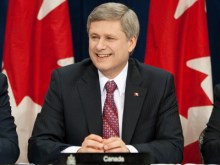
Canadian prime minister Stephen Harper interviewed by Larry Kudlow

Canadian Prime Minister Stephen Harper

Larry Kudlow sat down with Canadian prime minister Stephen Harper and had a conversation about Canada’s economic situation and policies. (Video here)

Kudlow first asks Harper about the banking situation in Canada. Harper says that the banks are run much more tightly in Canada. Harper explains that there are no bailouts planned for Canadian banks because Canadian banks are private institutions.

KUDLOW: Let me begin with an interesting subject here, banking. Everybody’s talking about banking. The Canadian banks appear to be in much better shape than the American banks. They have fewer toxic assets. Their losses aren’t nearly as bad. No one’s talking about bankruptcy up there. I want to learn from our northern cousins. What can you tell us? Why are Canadian banks looking better than our banks?

HARPER: Well first of all I can tell you, it is true. We have, I think, the only banks in the western world where we’re not looking at bailouts or anything like that.

KUDLOW: No TARP money sir, if I’m not mistaken? No TARP money?

HARPER: We haven’t got any TARP money. We’ve gone in and done some market transactions with our banks to improve liquidity. But I think the reasons are really complex, Larry. You know, first of all, our banks are private. We don’t have a Fannie Mae or Freddie Mac equivalent mucking around in the system.

KUDLOW: Is that a lesson right there Prime Minister?

HARPER: Well, I think my observation is those are institutions with a difficult private/public mix. And sometimes private/ public mixes have benefits and sometimes they have the worst of both worlds. We don’t have anything like that. We do have though, a strong system of regulation, and activist regulators, who go and meet with the sector. But they’re macro, prudential kind of regulations. They don’t try and micromanage banks’ decisions. We try and establish good oversight and transparency.

KUDLOW: Do you have leverage and borrowing ratios that might have been enforced? Because that’s clearly one of the breakdowns here in the states?

HARPER: Well, we do have leverage ratios. What’s ironic is that our own banks had not actually achieved those ratios. They were actually working under them. Part of what we…

KUDLOW: They were under leveraged?

HARPER: They were under leveraged.

KUDLOW: Wait, wait. Canadian banks were under leveraged?

HARPER: Under what they could have been.

KUDLOW: I didn’t know there was such a thing on this entire planet earth.

HARPER: Well I think part of what we have done is through the system of regulation we’ve had, we’ve encouraged a fairly cautious culture in the banks. For example, our banks, when they sign mortgages, largely hold those mortgages rather than trading them. So they have a lot more interest in the underlying quality of those mortgages. And we avoided the sub-prime kind of problem.

Kudlow goes on to quiz Harper on individual income tax rates, corporate income tax rates, tax cuts, Canadian energy production, carbon emissions, protectionism/free trade and auto-union bailouts. If you want to know what it is like to have an F.A. Hayek-admiring economist running your country, (BA and MA in Economics from the University of Calgary), read the whole thing!

UPDATE: More interviews with Stephen Harper with CNN, Wall Street Journal and Fox Business are here!

Democrats caused the recession and Republicans tried to stop it

Who caused this economic downturn and what should we do about it?

Almost no one realizes that this entire subprime lending mess was created by the Community Reinvestment Act, which was passed by President Carter, a Democrat, in 1977. Later on in the 1990s, Bill Clinton, another Democrat, passed laws to enforce the original bill. The purpose of the CRA is to force banks to make risky loans to people who can’t afford to repay those loans.

The extremely left-wing Los Angeles Times explains in 1999 that the CRA was passed to force banks to make risky loans.

Under Clinton, bank regulators have breathed the first real life into enforcement of the Community Reinvestment Act, a 20-year-old statute meant to combat “redlining” by requiring banks to serve their low-income communities. The administration also has sent a clear message by stiffening enforcement of the fair housing and fair lending laws.

In 1992, Congress mandated that Fannie and Freddie increase their purchases of mortgages for low-income and medium-income borrowers. Operating under that requirement, Fannie Mae, in particular, has been aggressive and creative in stimulating minority gains… Fannie Mae has agreed to buy more loans with very low down payments–or with mortgage payments that represent an unusually high percentage of a buyer’s income. That’s made banks willing to lend to lower-income families they once might have rejected.

The extremely left-wing New York Times noted in 1999 that the GSEs gave out the risky loans under duress from Democrat Bill Clinton.

Fannie Mae, the nation’s biggest underwriter of home mortgages, has been under increasing pressure from the Clinton Administration to expand mortgage loans among low and moderate income people and felt pressure from stock holders to maintain its phenomenal growth in profits.

In addition, banks, thrift institutions and mortgage companies have been pressing Fannie Mae to help them make more loans to so-called subprime borrowers. These borrowers whose incomes, credit ratings and savings are not good enough to qualify for conventional loans, can only get loans from finance companies that charge much higher interest rates — anywhere from three to four percentage points higher than conventional loans.

According to the New York Times in 2003, George W. Bush tried to stop the Democrats from ruining the economy with these forced loans. He was blocked by Democrats like Barney Frank.

The Bush administration today recommended the most significant regulatory overhaul in the housing finance industry since the savings and loan crisis a decade ago.

”These two entities — Fannie Mae and Freddie Mac — are not facing any kind of financial crisis,” said Representative Barney Frank of Massachusetts, the ranking Democrat on the Financial Services Committee. ”The more people exaggerate these problems, the more pressure there is on these companies, the less we will see in terms of affordable housing.”

Here are some video clips to prove that the Democrats opposed regulating  the GSEs. They are responsible for this mess, along with the irresponsible people who signed up for these loans that they could not repay.

Timeline of the events in the crisis: Bush was the first to recommend regulating the GSEs in April, 2001. In 2003, Bush tried to create a new federal agency to regulate the GSEs. He was blocked from doing so by the Democrats in the Senate. In 2005, Alan Greenspan warned that failing to regulate the GSEs could be a catastrophe. Again, Democrats blocked the effort to regulate Fannie Mae and Freddie Mac. The video shows Democrat Chuck Schumer protesting that regulation is not needed. In 2006, McCain and other Republicans introduced a bill to regulate the GSEs. Again, the Democrats voted against it and nothing happened.

Republicans and Democrats in their own words on the GSE accounting practices: Here we have Republican Rep. Richard Baker, Democrat, Democrat Rep. Maxine Waters, Democrat Rep. Gregory Meeks, Republican Rep. Ed Royce, Democrat Rep. Lacy Clay, Republican Rep. Christopher Shays, Democrat Rep. Arthur Davis, Democrat Rep. Barney Frank, Republican Rep. Don Manzullo. Shays notes that the GSEs make many contributions to Democrats who are blocking their regulation.

Fannie Mae CEO addresses Democrats: Fannie Mae CEO calling Obama and the Dems the “Family” and “Conscience” of Fannie Mae. The Democrats obstructed the regulation of the GSEs while taking political contributions from them, especially Obama. Franklin Raines, Jamie Gorelick and Jim Johnson were all executives at the GSEs and are all Democrats. Other Democrats like Penny Pritzker ran other mortgage banks into the ground, and now work for Obama.

According to Human Events, Obama himself sued banks on behalf of ACORN, to force the banks to make these risky loans.

Obama sued Citibank under the Community Reinvestment Act in a typical ACORN-style lawsuit to force the bank to make these risky loans.  ACORN filed many of this type of lawsuit alleging racism in all of them.

According to opensecrets.org, Obama was also the second-highest recipient of political contributions from the GSEs. The American Spectator notes that he included 5.2 billion dollars of taxpayer money for ACORN in the porkulus bill.

UPDATE 1: The Achoress just posted even more of the history of this mess here. She has a link to Nice Deb’s post which contains about 2 dozen warnings issued by the Bush administration about the looming crisis, including 17 warnings in 2008 alone.

UPDATE 2:  Here’s an even better timeline than mine, by Roger Kimball.