
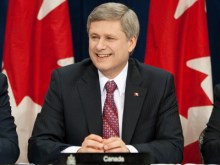
I spotted this round-up of media interviews with Stephen Harper on the Canadian blog Blue Like You. I’ve already blogged about the CNBC interview with optimistic Larry Kudlow here. That interview focused on economic policy.
In the Fox Business interview with Alexis Glick, (video here), she explains how Canada was able to avoid the subprime lending crisis.
Immediately after I talked to the vice chairman of the Swedish central bank, I interviewed — in a “First on Fox Business” — Canadian Prime Minister Stephen Harper about a lot of things: Everything from his meeting with President Obama last week, to NAFTA to the “Buy American” clause in the stimulus to carbon emissions and the Canadian Sands to the banking system. Why has Canada’s banking system withstood the financial crisis while other countries banking systems like the U.S. are in such dire straits? In 2008, the World Economic Forum ranked Canada’s banking system the healthiest in the world. The U.S. was ranked 40th. Canada’s system has much stronger federal regulations and lower mandatory leverage ratios. Canada’s firms never engaged in subprime mortgage lending. For over a decade, Canada has posted budget surpluses; only in the last quarter did they enter into a recession. What is working? What lessons could we learn from them? Take a look. Prime Minister Harper is very impressive.
Canada does not believe in forcing banks to make loans based on ACORN’s vision of social justice. I explained how Democrats like Carter and Clinton forced banks to make these loans and how Republicans tried in vain to stop them, here.
The Wall Street Journal interview was more focused on foreign policy. You may have heard of Harper’s recent free trade deal with Peru. But did you know that Canada also signed a free trade deal with Colombia?
But the mention of Canadian and American political opposition to free-trade agreements with Colombia has sparked a change in the PM’s unflappable manner. For a fleeting moment, what sounds a lot like frustration emerges. “I’m not going to say it’s a perfect government, but we have a government in Colombia that is democratically elected, that has increased democratic norms, that has taken on the insurgency, that is moving that country forward economically and politically. And it is in a hemisphere where we have an increasing number of real serious enemies and opponents.”
Meanwhile, the economically-illiterate, protectionist ACORN lawyer rejected a free trade deal with Colombia.
And did know that Canada has been taking a leading role in foreign policy?
Since establishing a minority government in January 2006, this prime minister and his Conservative Party have restored Canada’s international prestige by increasing military funding and tenaciously supporting Canada’s dangerous NATO mission in the Afghan province of Kandahar. No NATO ally has put more on the line against the Taliban, and Mr. Harper seems to sense not just the opportunity but the need for Canada to capitalize on it. There is a vacuum in conservative leadership in North America and on the world stage, and Mr. Harper is stepping into it. His objective would appear to be the restoration of liberal-democratic resolve against tyranny.
You want Reaganesque? I’ll give you Reaganesque:
An unreliable NATO has implications for Canada not least because Russia is once again becoming a menace. The Kremlin’s claim to the Arctic seabed can be discounted, he argues, because it is being pursued through the United Nations Law of the Sea Treaty. But other provocations are worrisome. “They are testing our airspace more frequently than they have been doing in a long, long time,” he says. “It’s the aggression in the Arctic, aggression more generally, an aggression that is increasingly troublesome just to be troublesome.”
Check this out: 2 CF-18 fighters intercepted a Russian bomber that was snooping near Canadian airspace just last week. Look, if Obambi wants to focus on increasing welfare and nationalizing health care, then maybe Canadians will have to pick up the slacker’s slack.
I rarely say this, but I am going to say it for this WSJ interview: READ. THE. WHOLE. THING.
UPDATE: Welcome, Canadian visitors from Blue Like You! Thanks for the link Joanne! I’ve just blogrolled you! I am hoping Stephen Harper gets his majority soon, so he can get rid of those pesky HRCs that keep going after Ezra Levant.
UPDATE 2: I noticed in the comments on Blue Like You that they referenced this interview from CNN with Wolf Blitzer. Here is the video and a news article from the National Post. Ooops. I think the commenter Allison meant a more recent CNN interview with Fareed Zakaria which is here.
UPDATE 3: Welcome visitors from Post-Darwinist! Thanks for linking to me, Denyse!
 WINTERY KNIGHT