
Tag Archives: Salvation

William Lane Craig explains the doctrine of penal substitutionary atonement

I have a key that will unlock a puzzling mystery

Probably one of the most common questions that you hear from people who don’t fully understand Christianity is this question: “why did Jesus have to die?”. The answer that most Christians seem to hold to is that 1) humans are rebelling against God, 2) Humans deserve punishment for their rebellion, 3) Humans cannot escape the punishment for their rebellion on their own, 4) Jesus was punished in the place of the rebellious humans, 5) Those who accept this sacrifice are forgiven for their rebelling.

Are humans rebellious?

Some people think that humans are not really rebellious at all, but it’s actually easy to see. You can see it just by looking at how people spend their time. Some of us have no time for God at all, and instead try to fill our lives with material possessions and experiences in order to have happy feelings. Some of us embrace just the parts of God that make us feel happy, like church and singing and feelings of comfort, while avoiding the hard parts of that vertical relationship; reading, thinking and disagreeing with people who don’t believe the truth about God. And so on.

This condition of being in rebellion is universal, and all of us are guilty of breaking the law at some point. All of us deserve to be separated from God’s goodness and love. Even if we wanted to stop rebelling, we would not be able to make up for the times where we do rebel by being good at other times, any more than we could get out of a speeding ticket by appealing to the times when we drove at the speed limit, (something that I never do, in any case).

This is not to say that all sinners are punished equally – the degree of punishment is proportional to the sins a person commits. However, the standard is perfection. And worse than that, the most important moral obligation is a vertical moral obligation. You can’t satisfy the demands of the moral law just by making your neighbor happy, while treating God like a pariah. The first commandment is to love God, the second is to love your neighbor. Even loving your neighbor requires you to tell your neighbor the truth – not just to make them feel good. The vertical relationship is more important than the horizontal one, and we’ve all screwed up the vertical relationship. We all don’t want God to be there, telling us what’s best for us, interfering with our fun. We don’t want to relate to a loving God if it means having to care what he thinks about anything that we are doing.

Who is going to pay for our rebellion?

The Christian answer to the problem of our rebellion is that Jesus takes the punishment we deserve in our place.

However, I’ve noticed that on some atheist blogs, they don’t like the idea that someone else can take our punishment for us to exonerate us for crimes that we’ve committed. So I’ll quote from this post by the great William Lane Craig, to respond to that objection.

Excerpt:

The central problem of the Penal Theory is, as you point out, understanding how punishing a person other than the perpetrator of the wrong can meet the demands of justice. Indeed, we might even say that it would be wrong to punish some innocent person for the crimes I commit!

It seems to me, however, that in other aspects of human life we do recognize this practice. I remember once sharing the Gospel with a businessman. When I explained that Christ had died to pay the penalty for our sins, he responded, “Oh, yes, that’s imputation.” I was stunned, as I never expected this theological concept to be familiar to this non-Christian businessman. When I asked him how he came to be familiar with this idea, he replied, “Oh, we use imputation all the time in the insurance business.” He explained to me that certain sorts of insurance policy are written so that, for example, if someone else drives my car and gets in an accident, the responsibility is imputed to me rather than to the driver. Even though the driver behaved recklessly, I am the one held liable; it is just as if I had done it.

Now this is parallel to substitutionary atonement. Normally I would be liable for the misdeeds I have done. But through my faith in Christ, I am, as it were, covered by his divine insurance policy, whereby he assumes the liability for my actions. My sin is imputed to him, and he pays its penalty. The demands of justice are fulfilled, just as they are in mundane affairs in which someone pays the penalty for something imputed to him. This is as literal a transaction as those that transpire regularly in the insurance industry.

So, it turns out that the doctrine of substitionary atonement is not as mysterious or as objectionable as everyone seems to think it is.
William Lane Craig explains the doctrine of penal substitutionary atonement

I have a key that will unlock a puzzling mystery

Probably one of the most common questions that you hear from people who don’t fully understand Christianity is this question: “why did Jesus have to die?”. The answer that most Christians seem to hold to is that 1) humans are rebelling against God, 2) Humans deserve punishment for their rebellion, 3) Humans cannot escape the punishment for their rebellion on their own, 4) Jesus was punished in the place of the rebellious humans, 5) Those who accept this sacrifice are forgiven for their rebelling.

Are humans rebellious?

Some people think that humans are not really rebellious at all, but it’s actually easy to see. You can see it just by looking at how people spend their time. Some of us have no time for God at all, and instead try to fill our lives with material possessions and experiences in order to have happy feelings. Some of us embrace just the parts of God that make us feel happy, like church and singing and feelings of comfort, while avoiding the hard parts of that vertical relationship; reading, thinking and disagreeing with people who don’t believe the truth about God. And so on.

This condition of being in rebellion is universal, and all of us are guilty of breaking the law at some point. All of us deserve to be separated from God’s goodness and love. Even if we wanted to stop rebelling, we would not be able to make up for the times where we do rebel by being good at other times, any more than we could get out of a speeding ticket by appealing to the times when we drove at the speed limit, (something that I never do, in any case).

This is not to say that all sinners are punished equally – the degree of punishment is proportional to the sins a person commits. However, the standard is perfection. And worse than that, the most important moral obligation is a vertical moral obligation. You can’t satisfy the demands of the moral law just by making your neighbor happy, while treating God like a pariah. The first commandment is to love God, the second is to love your neighbor. Even loving your neighbor requires you to tell your neighbor the truth – not just to make them feel good. The vertical relationship is more important than the horizontal one, and we’ve all screwed up the vertical relationship. We all don’t want God to be there, telling us what’s best for us, interfering with our fun. We don’t want to relate to a loving God if it means having to care what he thinks about anything that we are doing.

Who is going to pay for our rebellion?

The Christian answer to the problem of our rebellion is that Jesus takes the punishment we deserve in our place.

However, I’ve noticed that on some atheist blogs, they don’t like the idea that someone else can take our punishment for us to exonerate us for crimes that we’ve committed. So I’ll quote from this post by the great William Lane Craig, to respond to that objection.

Excerpt:

The central problem of the Penal Theory is, as you point out, understanding how punishing a person other than the perpetrator of the wrong can meet the demands of justice. Indeed, we might even say that it would be wrong to punish some innocent person for the crimes I commit!

It seems to me, however, that in other aspects of human life we do recognize this practice. I remember once sharing the Gospel with a businessman. When I explained that Christ had died to pay the penalty for our sins, he responded, “Oh, yes, that’s imputation.” I was stunned, as I never expected this theological concept to be familiar to this non-Christian businessman. When I asked him how he came to be familiar with this idea, he replied, “Oh, we use imputation all the time in the insurance business.” He explained to me that certain sorts of insurance policy are written so that, for example, if someone else drives my car and gets in an accident, the responsibility is imputed to me rather than to the driver. Even though the driver behaved recklessly, I am the one held liable; it is just as if I had done it.

Now this is parallel to substitutionary atonement. Normally I would be liable for the misdeeds I have done. But through my faith in Christ, I am, as it were, covered by his divine insurance policy, whereby he assumes the liability for my actions. My sin is imputed to him, and he pays its penalty. The demands of justice are fulfilled, just as they are in mundane affairs in which someone pays the penalty for something imputed to him. This is as literal a transaction as those that transpire regularly in the insurance industry.

So, it turns out that the doctrine of substitionary atonement is not as mysterious or as objectionable as everyone seems to think it is.

Reformation Day celebrates the supremacy of Scripture and reason in theology

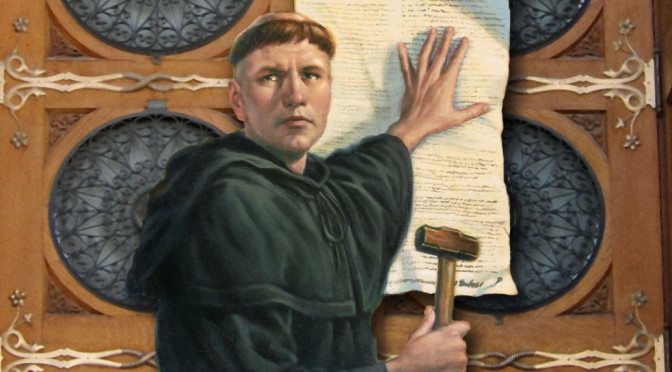
Martin Luther defies the Roman Catholic hierarchy with his 95 Theses

The Ligonier Ministries web site has a summary of the event that kicked off the Reformation.

Excerpt:

On October 31, 1517, Martin Luther tacked up 95 theses on the church door at Wittenberg. With this act, he hoped to provoke a discussion among the scholars about the abuses of the indulgences by the Roman Catholic Church. He was not trying to create a public furor by any means, but within a fortnight, these theses had spread through the country like wildfire. The last thing Luther had in mind was to start some kind of major controversy, but nevertheless major controversy did begin.

From the discussions at Wittenberg, the disputations began to accelerate and escalate. Copies of the theses reached Rome and critical meetings were scheduled with the young monk. In these debates, Luther was maneuvered into proclaiming publicly that he had questions about the infallibility of church councils and also that he thought that it was possible that the pope could err. In 1520 a papal encyclical was issued which condemned Martin Luther as a heretic. Luther burned the document in a public bonfire and his defiance before the church was now a matter of record.

In response, Martin Luther picked up his pen to challenge the entire penitential system of the Roman Catholic Church, which undermined in principle the free remission of sins that is ours in the gospel. By doing so, he was unswervingly advocating his commitment to sola fide, the doctrine of justification by faith alone.

In 1521, Luther was summoned to the Imperial Diet, an authoritative meeting that involved the princes of the church, called by the Emperor of the Holy Roman Empire to be held in the city of Worms in Germany. Luther was an outlaw. For him to appear at the Diet was to risk his very life; therefore, he was given safe conduct by the Emperor to attend. With a few friends, Luther traveled from Wittenberg to Worms. The eyewitnesses of that episode tell us that when Luther’s little covered wagon appeared around the corner of the bend, there were lookouts posted in the church tower at Worms. All the people were agog waiting for the arrival of this notorious person. When Luther’s caravan was sighted, people were throwing their hats in the air, blowing trumpets, and creating all the fanfare of the arrival of the hero. It was the 16th century answer to a ticker-tape parade.

Things, however, became very solemn in a hurry because the next day he appeared before the Diet. His books were stacked on a table in the room, and he was asked and ordered to recant of his writings. This surprised Luther because he thought he was going to have an opportunity to defend his writings; but the only question really of any importance that was asked of him was this: “Are these your writings?” And when he said yes, they said, “Are you ready to recant of them?”

Hollywood has their version of Luther standing there boldly with his fist in the air saying, “Here I stand!” and so on. But instead he dropped his chin on his chest and muttered something that nobody could understand, so they asked him to speak up. “What did you say?” He said, “May I have 24 hours to think about it.” And so Luther was granted a reprieve of 24 hours to return to his room to contemplate the seriousness of this occasion.

The prayer that Luther wrote in that ensuing 24-hour period was one of the most moving prayers I have ever read in my life. In that prayer, Luther cried out for God in his sense of total loneliness fearing that God had abandoned him, and proclaimed, “O Lord, I am Thine, and the cause is Thine, give me the courage to stand.”

And on the morrow, Luther was called once again back to the court and was told to reply to the question. He said to the Diet, “Unless I am convinced by sacred Scripture or by evident reason, I cannot recant, for my conscience is held captive by the Word of God, and to act against conscience is neither right nor safe. Here I stand. I can do no other. God help me.” And with that there was an instant uproar.

The Protestant Reformation emphasizes the responsibility of each person to become familiar with what the Bible teaches for themselves and to make sense of it using the laws of logic for themselves. There is an enormous focus on the individual’s responsibility to puzzle theology out for himself, using the tools available to him: reason, science, Scripture, and history. When doing theology, Protestants do not accept the authority of someone who has a fancy title, fancy hat, fancy robe or fancy staff. Everyone is responsible to read the Bible, read systematic theology, consult history, and determine what the truth is based on evidence, not authority.

The Reformation put forward the famous five Solas: “Sola Scriptura” (Scripture Alone); “Sola Gratia” (Grace Alone); “Sola Fide” (Faith Alone); “Solus Christus” (Christ Alone); and “Soli Deo Gloria” (To God Alone Be Glory). The vertical relationship with God is seen as more important than making people feel good here and now. True beliefs about God are deemed to be more important than being a good social worker. And that’s why Jesus said that the most important commandment is to love God, then secondly, to love your neighbor. It’s important to get that in the right order, because true beliefs about God’s existence, God’s character, and God’s actions in history are the most important things.

The Reformation was the beginning of evangelical Protestantism, which is really the view that the Christian religion ought to be rooted in actual historical events that are documented in the Bible.