
Tag Archives: Religious Freedom

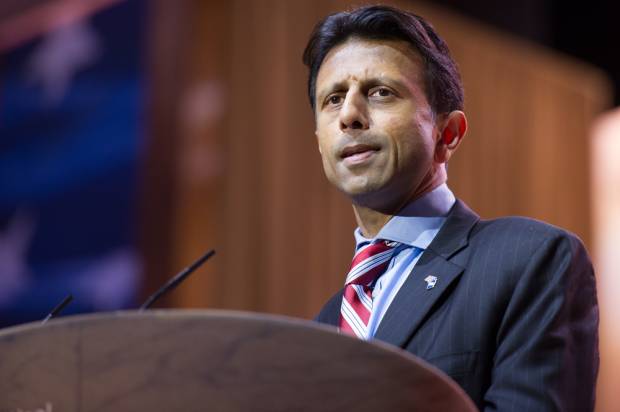
Louisiana governor Bobby Jindal to anti-marriage corporate bullies: “Save your breath”

Louisiana Governor Bobby Jindal

Bobby Jindal is my #2 pick for President, just behind Scott Walker. Previously, I blogged about how Jindal had the best pro-life record of any of the GOP primary candidates. And now were going to see that he is tough on defending marriage, as well.

Jindal defends marriage in the radically leftist New York Times, of all places.

Jindal writes:

THE debate over religious liberty in America presents conservatives and business leaders with a crucial choice.

In Indiana and Arkansas, large corporations recently joined left-wing activists to bully elected officials into backing away from strong protections for religious liberty. It was disappointing to see conservative leaders so hastily retreat on legislation that would simply allow for an individual or business to claim a right to free exercise of religion in a court of law.

Our country was founded on the principle of religious liberty, enshrined in the Bill of Rights. Why shouldn’t an individual or business have the right to cite, in a court proceeding, religious liberty as a reason for not participating in a same-sex marriage ceremony that violates a sincerely held religious belief?

That is what Indiana and Arkansas sought to do. That political leaders in both states quickly cowered amid the shrieks of big business and the radical left should alarm us all.

It might be a surprise for my readers, but big greedy corporations are as liberal as big greedy unions – conservatives don’t like unions or big corporations. We like small businesses. And so does Bobby Jindal.

While Indiana and Arkansas retreat, Jindal wants to double down:

As the fight for religious liberty moves to Louisiana, I have a clear message for any corporation that contemplates bullying our state: Save your breath.

In 2010, Louisiana adopted a Religious Freedom Restoration Act, which prohibits government from unduly burdening a person’s exercise of religion. However, given the changing positions of politicians, judges and the public in favor of same-sex marriage, along with the potential for discrimination against Christian individuals and businesses that comes with these shifts, I plan in this legislative session to fight for passage of the Marriage and Conscience Act.

The legislation would prohibit the state from denying a person, company or nonprofit group a license, accreditation, employment or contract — or taking other “adverse action” — based on the person or entity’s religious views on the institution of marriage.

Some corporations have already contacted me and asked me to oppose this law. I am certain that other companies, under pressure from radical liberals, will do the same. They are free to voice their opinions, but they will not deter me. As a nation we would not compel a priest, minister or rabbi to violate his conscience and perform a same-sex wedding ceremony. But a great many Americans who are not members of the clergy feel just as called to live their faith through their businesses. That’s why we should ensure that musicians, caterers, photographers and others should be immune from government coercion on deeply held religious convictions.

I know that many of you have not heard of Bobby Jindal, but he is one of our best and most conservative candidates. I think that for people who vote primarily for social conservatism, he is the most effective on those issues – much more than all the other candidates. Honestly, I don’t think he cares about being popular, he just does what he thinks is right.
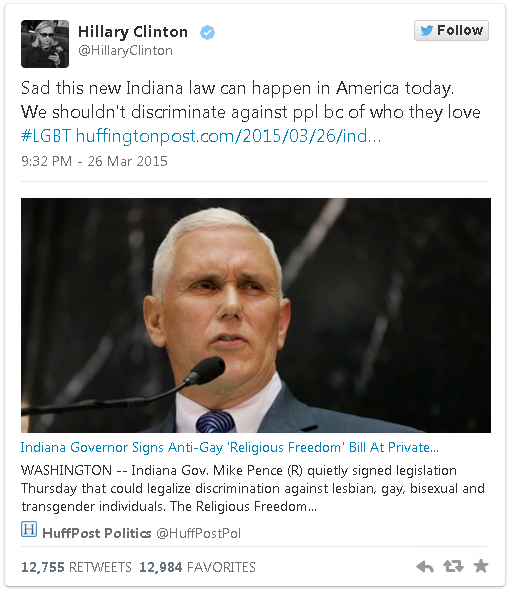
Hillary Clinton attacks Indiana’s religious liberty law

First, let’s take a look at what Jesus says about same-sex marriage.

Matthew 19:1-6:

1 Now when Jesus had finished these sayings, he went away from Galilee and entered the region of Judea beyond the Jordan.

2 And large crowds followed him, and he healed them there.

3 And Pharisees came up to him and tested him by asking, “Is it lawful to divorce one’s wife for any cause?”

4 He answered, “Have you not read that he who created them from the beginning made them male and female,

5 and said, ‘Therefore a man shall leave his father and his mother and hold fast to his wife, and the two shall become one flesh’?

6 So they are no longer two but one flesh. What therefore God has joined together, let not man separate.”

Now, let’s see some reactions to the Indiana law, which I explained in a previous blog post, from people on the secular left.

Hillary Clinton thinks that any arrangement of people who love each other is as good as any other:

Hillary Clinton opposes religious liberty

Her tweet implies support for incestuous relationships being “marriage” as well as polygamy. That is a direct logical implication of calling an arrangement of people who love each other “marriage”.

But she’s not the only one.

Marriage defender Ryan T. Anderson responds to Apple CEO Tim Cook in the Daily Signal.

He writes:

Apple CEO Tim Cook has taken to The Washington Post to tell the nation that, in the words of the headline, “Pro-discrimination ‘religious freedom’ laws are dangerous.”

Notice the scare quotes around “religious freedom.” But the reality is that the only person in favor of discrimination in this debate is Tim Cook.

It is Tim Cook who favors laws that discriminate against people of faith who simply ask to be left alone by government to run their businesses and their schools and their charities in accordance with their reasonable belief that marriage is the union of a man and a woman. It is Tim Cook who would have the government discriminate against these citizens, have the government coerce them into helping to celebrate a same-sex wedding and penalize them if they try to lead their lives in accordance with their faith.

[…]As Sarah Torre and I explained last week, Indiana’s religious freedom law protects citizens from government coercion—it places the burden of proof on the government if it is going to violate liberty. For over 20 years, the federal government has lived by this standard—the Religious Freedom Restoration Act  passed unanimously in the House, with 97 votes in the Senate, and was signed into law by Bill Clinton. Twenty states have passed this law. And 11 additional states have religious liberty protections that state courts have interpreted to provide a similar level of protection.

So, in total, the federal court system and 31 state court systems enforce this level of protection. Why is Tim Cook suddenly opposed to it?

The answer is simple: This isn’t a debate about Religious Freedom Restoration Acts. This is a debate about whether Americans should remain free to live in accordance with the truth about marriage in their public lives. This is a debate about whether or not the government should be able to coerce people into violating their belief that marriage is the union of a man and a woman.

This is what the Indiana law is suppose to defend against:

Again, it’s not a slam dunk – all it says is that when a secular big government sues a person of any religion to force them to deny their faith, then religious liberty can be brought in as part of their defense during their day in court. By the way, always vote for smaller government, then these things don’t even happen because marriage, family and private businesses are less regulated.

How is the law applied?

This article from The Federalist lists 10 examples of how religious freedom laws have been applied.

Here’s one:

7) Muslim prisoner fights to wear short beard: Abdul Muhammad
Abdul Muhammad is a Muslim incarcerated in Arkansas. He was not allowed to grow the 1/2 inch beard his religion commands even though Arkansas permits beards for other reasons. And the same beard would have been allowed in 44 state and federal prison systems in the country. In 2011, he filed suit. He won the suit using the “RFRA for prisoners” — the Religious Land Use and Institutionalized Persons Act. That bill was also signed by Bill Clinton.Earlier this year, Muhammad won his case unanimously at the United States Supreme Court. They held that he’d shown the restriction was a substantial burden on his religious exercise.

And:

9) Florida denies prisoners kosher meals: Bruce Rich

Bruce Rich is an Orthodox Jewish prisoner in Florida, one of the last remaining states in the country that doesn’t provide kosher food for Jewish prisoners. He argued this violates the Religious Land Use and Institutionalized Persons Act of 2000, RFRA for prisoners.

Florida claimed it limited food options to control costs and maintain security. The Becket Fund for Religious Liberty, which took Rich’s case, noted that 35 states and the federal government provided kosher meals without it posing a problem.

[…]Rich withdrew his case once Florida began providing the necessary meals.

Does this law sound like a free pass to discriminate against gays to you? It goes to trial, and religious liberty is part of the defense that the judge considers.

Look at this opinion from another Indiana law professor:

I should stress–and this point was totally lost in the Indiana debate–that RFRA does not provide immunity. It only allows a defendant to raise a defense, which a finder of fact must consider, like any other defense that can be raised under Title VII or the ADA. RFRA is *not* a blank check to discriminate.

Here’s another defense of the Indiana law by an Indiana University law professor who supports same-sex marriage.

You can read another analysis of the religious liberty law from Gabriel Malor, a gay conservative. Actually, I re-tweeted THREE gay conservatives who were in favor of the law yesterday (Gabriel Malor, Milo Yiannopoulos, and Gay Patriot).  This is not what you are hearing in the mainstream media, but is being used as a club to beat Christians into silence. And sadly, many younger evangelicals will respond to this and vote Democrat out of a lack of understanding of the issues.

How to respond to complaints about Indiana’s new religious freedom law

Good news to start your day!

First, the story, from the Daily Signal:

A bill known as the Religious Freedom Restoration Act has been signed into law by the governor.

Supporters of Indiana Senate Bill 101 say that the law protects the free practice of religion, and opponents say the law will allow gay and lesbian individuals to be discriminated against.

For example, the law could permit business owners who felt that being forced to serve a certain customer in a particular case violated their religious beliefs to appeal to a judge. The courts would then decide if their objection was valid or not.

The bill was passed by the House 63-31 on Monday, and was approved by the Senate 40-10.

Gov. Mike Pence, R-Ind.,  approved the legislation today.

“Indiana is rightly celebrated for the hospitality, generosity, tolerance and values of our people, and that will never change,” Pence said in a statement. “Faith and religion are important values to millions of Hoosiers and with the passage of this legislation, we ensure that Indiana will continue to be a place where we respect freedom of religion and make certain that government action will always be subject to the highest level of scrutiny that respects the religious beliefs of every Hoosier of every faith.”

This is the key part:

Sarah Torre, a policy analyst at The Heritage Foundation, told The Daily Signal that the bill is modeled off of the federal Religious Freedom Restoration Act of 1993, which passed with bipartisan support and was signed into law by President Bill Clinton.

The federal law “prohibits substantial burdens on religious exercise unless the government can show a compelling interest in burdening religious liberty and does so through the least restrictive way possible,” said Torre. “Protections for religious freedom, like the one passed in Indiana, provide a commonsense way to balance the fundamental right to religious liberty with compelling government interests.”

Torre said that it’s important to note that the law “doesn’t allow individuals to do whatever they wish in the name of religion:”

“The law is simply a commonsense way of balancing government interests with the fundamental freedom of individuals to live out their faith. There will be times when a state or federal government can show it has a compelling reason for burdening religious expression—to ensure public safety, for instance. But Religious Freedom Restoration Acts set a high bar for the government to meet in order to restrict religious freedom.”

Such legislation at the state and federal level merely protects First Amendment rights, according to Torre.

“A robust conception of religious liberty provides every person the freedom to seek the truth, form beliefs, and live according to the dictates of his or her conscience—whether at home, in worship, or at work,” said Torre.

Torre added that 19 other states have similar laws.

And if that were not enough, here is an Indianapolis Star editorial from law professor at Indiana University School of Law – who supports same-sex marriage – who is in favor of Indiana passing the bill.

He writes:

I am a supporter of gay rights, including same-sex marriage. But as an informed legal scholar, I also support the proposed Indiana Religious Freedom Restoration Act (RFRA).

[…]The bill would establish a general legal standard, the “compelling interest” test, for evaluating laws and governmental practices that impose substantial burdens on the exercise of religion. This same test already governs federal law under the federal RFRA, which was signed into law by President Bill Clinton. And some 30 states have adopted the same standard, either under state-law RFRAs or as a matter of state constitutional law.

[…]But granting religious believers legal consideration does not mean that their religious objections will always be upheld. And this brings us to the issue of same-sex marriage.

Under the Indiana RFRA, those who provide creative services for weddings, such as photographers, florists or bakers, could claim that religious freedom protects them from local nondiscrimination laws. Like other religious objectors, they would have their day in court, as they should, permitting them to argue that the government is improperly requiring them to violate their religion by participating (in their view) in a celebration that their religion does not allow.

But courts generally have ruled that the government has a compelling interest in preventing discrimination and that this interest precludes the recognition of religious exceptions. Even in the narrow setting of wedding-service providers, claims for religious exemptions recently have been rejected in various states, including states that have adopted the RFRA test. A court could rule otherwise, protecting religious freedom in this distinctive context. But to date, none has.

In any event, most religious freedom claims have nothing to do with same-sex marriage or discrimination. The proposed Indiana RFRA would provide valuable guidance to Indiana courts, directing them to balance religious freedom against competing interests under the same legal standard that applies throughout most of the land. It is anything but a “license to discriminate,” and it should not be mischaracterized or dismissed on that basis.

What the secular leftists in the media are saying is that the law gives religious people the right to reject any customer for any reason. Big businesses, which are overwhelmingly leftist, are also reacting the same way. The truth – as we saw above – is nothing like what the secular leftists are saying. The law is simply an echo of a federal law that already exists and was signed by Bill Clinton. Well done, Indiana. Well done, Republican legislators. Well done, Governor Mike Pence.