

Tag Archives: Purpose

Men having a mid-life crisis are searching for meaning in all the wrong places

Two Air Force JTACs discuss mission parameters prior to calling in CAS

I can always count on my good friend Dina to be even more angry at feminists and feminism than I am – she has to deal with young, unmarried women behaving selfishly and irresponsibly every day, and sees the trouble they cause for others.

So when she sent me this article from the UK Telegraph, and told me that I needed to write about how men are going terribly wrong, I knew it was time to balance things out a little on this blog.

Here are the parts I want to comment on:

Something strange happens to men in middle age.

[…]Aches and pains used to disappear quickly, now they hang around for months. Hair no longer grows on the head, you can’t stop it growing out of your ears. You can’t sit down, stand up, or pick up any object without emitting an accompanying grunt. But it’s not the age, it’s the anxiety; those ‘dark nights of the soul’, staring at the ceiling, pondering the ultimate question of middle age: ‘Is that it?’

[…] Some take up the triathlon and wear unfeasibly tight Lycra. “I want to prove that I can still do it,” said a marathon running friend. “I’m fitter than guys half my age.” Some change their appearance. The jeans grow tighter than their lycra. A tattoo appears. Then there’s the sports car because they think that buying something will cure their sadness. But they end up just as unhappy, but at a higher speed.

[…]Studies show that in our forties and fifties levels of happiness and life satisfaction dip to their lowest levels psychological distress is at its height. Forty-five is the most common age for depression to be diagnosed. This is a complex situation with many factors, but in my many conversations with ‘men of a certain age’, I sensed an underlying lack of meaning and purpose, and a sense of having failed in some way.

Many of them had spent their life climbing the corporate ladder only to find out it was leaning against the wrong wall. At one event where I was speaking, I met a judge. He’d spent his life striving to reach that position, only to find that, when he got there, he felt as empty as ever. Another friend returned from a long career teaching overseas. He saw a TV advert featuring men admiring their DIY handiwork and saying, ‘I did that.’ He burst into tears: he felt there was nothing in his life of which he could say, ‘I did that.’ He was wrong. But it didn’t feel that way.

Men are wrong to think that they can produce meaning by achieving pointless worldly goals. Pointless worldly achievements don’t ward off old age, sickness and death. There is not some judging ceremony when you die where the person who has the most stuff, or who had the most sex, or who ran the most marathons, or who traveled to the most countries, wins anything. No man can really achieve objective meaning or purpose through material objects, pleasure, sex, triathlons, alcohol, drugs, sports, gambling, travel, or any kind of this-worldly achievement. The things you build in this world will stay in this world. If you want to build something that lasts outside this world when you die, then you need to get to work on finding out whether God exists, and what he expects from you. It is only by focusing your life on the bigger picture that you will achieve things that actually count.

So how to get a man thinking clearly about meaning and purpose?

First, you should have a serious conversation with him about his plans and goals, and get him to reflect on whether what he is trying to achieve is going to matter. Men like to think that they are living a good, meaningful, purposeful life. They need to be questioned about this. They get so distracted with the good feelings they have watching sports, playing golf, going fishing, home improvement, working out, etc. that they don’t think about the big picture. This article by William Lane Craig may prove useful (video of lecture). Sometimes, a man can decide that the big questions don’t matter at age 12, after he suffers some minor disappointment with God, and then never go back and re-evaluate until age 90. You need to point out to him how stupid it is to decide big questions as a teen, when he hasn’t uncovered any facts to would help him to draw accurate conclusions.

Second, men are often very impatient and dismissive of spiritual things, because they are very practical and evidential. Practical and evidential are good, and this is how they must be approached – they must be made aware of the areas of science, history and philosophy that touch on the big questions. I will never forget one of the engineers in my office asking me about the William Lane Craig vs Lawrence Krauss debate after I told him I blogged on it. This guy builds stuff, fixes cars, everything manly you can imagine. He asked me “did anyone win?” That’s what men care about. Your first goal in getting a man interested in deep questions is to show him how known facts arbitrate disputes, resulting in real winners and losers.

You cannot tell men the answers in advance, because they are explorers and adventurers. Men must be presented with alternatives, and left alone to explore and adjudicate winners and losers on their own, based on careful reasoning and evidence.

By the way, this MP3 file contains the testimony of one of my favorite 3 speakers, Dr. Walter Bradley – a mechanical engineering professor who reached the highest levels of his profession, and made a huge difference for Christ, speaking at dozens of university campuses. I have listened to this lecture dozens of times, and it changed my life. Really good thoughts about meaning and purpose in life.

Disclaimer

Now, as you all know, I do think men should study hard things and work hard jobs that they hate but that pay well, in order to provide for others. But there is a difference between getting your meaning and purpose in life from climbing a ladder at work, and getting your meaning and purpose in life in a relationship with God. The same thing goes for fast cars – I love them, I bought one the week after I started working full-time after graduating. Don’t confuse fast cars with the meaning and purpose you get from partnering to achieve results for your Boss.
Are Christians responsible for making plans and making good decisions?

Here’s a wonderful post on decision making and the will of God posted on Neil’s blog. Neil links to another post where someone is trying to figure out what God wants him to do.

Excerpt:

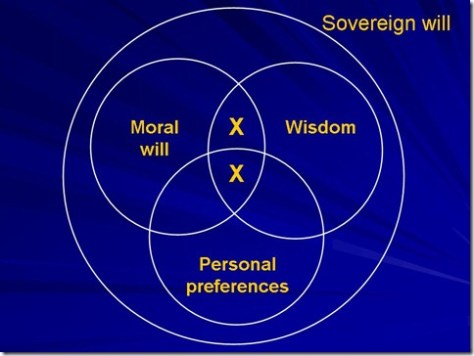
Really short version: Aside from direct and clear personal revelation from God, you don’t have access to his sovereign will when making decisions.  Therefore you must look at other factors.  If it isn’t moral, don’t do it.  If it is moral but not wise, don’t do it.  If it is moral and wise, then use your personal preferences.

Using this model you can end up with a wise and biblical decision, but you have avoided the traps of the “God told me to ____” routine.  People who run around saying that God told them this and that convey a super-spirituality that can leave less mature believers wondering if they really have a relationship with God (i.e., “God doesn’t tell me every little thing to do, so maybe I don’t really know him.”).

He has a helpful picture posted as well:

This is actually a very important topic for me, because I like making plans and making good decisions. I like being the quarterback or squad leader of my own life. I like to pick objectives and then make plans to achieve them. (Nothing too exotic, just simple stuff like saving money or reading more books)

Actually, I really oppose the idea that God has a magical fairy tale will for each person that will make them happy and fulfilled. For me, life isn’t like that. I don’t expect God to lead me along like a child at a scavenger hunt. I expect to survey the battlefield where I am and then do something to make a difference. There are lots of things you can do that will please God. Should you focus on your career and sponsor apologetics conferences? Or should you use your spare time preparing Sunday school lessons? There are lots of good things you could do to please God. Your job is to pick the one that will be the most effective. It doesn’t matter if it makes you happy, it only matters if it’s effective and if you are good at it.

Who is Rifleman Dodd?

A while back, I was busily working my way through the U.S. Marine Corps Official Reading List, and I came across a book by C.S. Forester called Rifleman Dodd, or alternatively titled Death to the French. It’s a work of historical fiction that takes place during the Napoleonic wars. The story is about a British marksman named Dodd, who is cut off from his own lines during a withdrawal maneuver. He is subsequently left to fend for himself behind enemy lines. An ordinary man might be full of despair and forget about his mission entirely. But Dodd is no ordinary man. Not only does he find a way to survive by finding food to eat, water to drink and places to sleep, but he also tries to remember his orders and to think about what he can do to advance the cause of his General, the Duke of Wellington.

Here’s an excerpt from a gritty book review:

It’s about a green-coated British infantry rifleman in the Napoleonic Wars, an age when rifles were a novelty and most of the army was red-coated and carried muskets. Private Matthew Dodd gets separated from his regiment during a retreat and finds himself stranded behind enemy (French) lines in Portugal. With the occasional aid of some natives, but mostly on his own, he harasses the French with his rifle and tries to prevent them from building a bridge across the Tagus River. It’s a remarkable tale of survival and solitary achievement, of a rank-and-file soldier who lives by his wits and slowly learns to make plans without orders, and shows leadership qualities and a knowledge of warfare.

I think we’re in the same situation as Dodd.

There is no point in us looking for breadcrumb trails to happiness at this point. That’s not the point of Christianity. The point of Christianity is friendship with God, imitation of Christ, honoring moral obligations, self-sacrificial love for your neighbor (and even your enemies!), and dedication to the truth – whether anyone else likes you or not. It’s not supposed to make you happy, and it’s not necessarily going to be a normal life like everyone else has. Things may not work out the way you’d like them to.

We seem to be making such a big deal about compassion and forgiveness in the Christian life these days – such a big emphasis on our feelings. Almost like we have forgotten that we have obligations to our friend – and his objectives. A relationship doesn’t mean that one person completely disregards the character and goals of the other person and then is automatically granted forgiveness whenever they want it. That’s not a friendship – that’s using someone else for your own ends. Maybe it’s time to remember what this is all about.

Wayne Grudem explains what the Bible says about capital punishment

Theology that hits the spot

Reformed Baptist theologian Wayne Grudem speaks on the Bible and capital punishment.

About Wayne Grudem:

Grudem holds a BA from Harvard University, a Master of Divinity from Westminster Theological Seminary, and a PhD from the University of Cambridge. In 2001, Grudem became Research Professor of Bible and Theology at Phoenix Seminary. Prior to that, he had taught for 20 years at Trinity Evangelical Divinity School, where he was chairman of the department of Biblical and Systematic Theology.

Grudem served on the committee overseeing the English Standard Version translation of the Bible, and in 1999 he was the president of the Evangelical Theological Society. He is a co-founder and past president of the Council on Biblical Manhood and Womanhood. He is the author of, among other books, Systematic Theology: An Introduction to Biblical Doctrine, which advocates a Calvinistic soteriology, the verbal plenary inspiration and inerrancy of the Bible, the body-soul dichotomy in the nature of man, and the complementarian (rather than egalitarian) view of gender equality.

The MP3 file is here.

The PDF outline is here.

Topics:

  • what kinds of crimes might require CP?
  • what did God say to Noah about CP?
  • what does it mean that man is made in the image of God?
  • is CP just about taking revenge?
  • what does CP say about the value of human life?
  • does CP apply to animals, too?
  • could the statements supporting CP be understood as symbolic?
  • one purpose of CP is to protecting the public
  • another purpose of CP is to deter further wrongdoing
  • but the Biblical purpose of CP is to achieve justice by retribution
  • does the Pope make a good argument against CP?
  • what is the role of civil government in achieving retribution?
  • do people in Heaven who are sinless desire God to judge sinners?
  • should crimes involving property alone be subject to CP?
  • is the Mosaic law relevant for deciding which crimes are capital today?
  • should violent crimes where no one dies be subject to CP?
  • is CP widespread in the world? why or why not?
  • what are some objections to CP from the Bible?
  • how do you respond to those objections to CP?
  • should civil government also turn the other cheek for all crimes?
  • what is the “whole life ethic” and is it Biblical?
  • what do academic studies show about the deterrence effect of CP?
  • how often have innocent people been executed in the USA?
  • should there be a higher burden of proof for CP convictions?

The Bible is awesome because it gives us knowledge about God’s character. How are we supposed to act in a way that is pleasing to God if we don’t know what he thinks of the issues of the day? We won’t know how we are supposed to act unless we know who God is first. And that’s why when we read the Bible we should be looking to find out the truth about who God is.