
Tag Archives: Producer

Supreme Court sides with Conservative Party against price-fixing monopoly

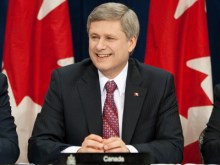
Prime Minister Stephen Harper

Story here from the Vancouver Sun. (H/T Andrew)

Excerpt:

The Canadian Wheat Board cannot spend money on advocacy to protect its monopoly, following a Supreme Court of Canada decision Thursday against hearing an appeal from the Winnipeg-based agency, which asserts that it has been silenced by the Conservative government.

Without giving reasons, the high court declined the appeal application to a Federal Court of Appeal ruling that sided with the federal government in its 2006 order from then-agriculture minister Chuck Strahl for the board to refrain from spending its money on lobbying.

[…]The federal Conservatives are seeking to end the board’s monopoly, which is controlled by farmers. The monopoly makes the agency one of the world’s biggest exporters of wheat and barley.

The board maintains that the monopoly ensures farmers receive the best prices for their grain, but the federal government, along with some farmers, say that they would be better off in a free market, selling their products on their own.

Conservatives are for a free market and competition, because we believe that it is the best way for consumers to get a low price and high quality. The proper role of government is to ensure that no organization or business enjoys monopoly status due to the government insulating them from competition. The Canadian Wheat Board is just one option, but farmers should have other choices to sell their product.

Capitalism is opposed to monopolies and it is the proper role of government to make sure that no government policy is set up to favor one corporation over any competitor. Let the farmers choose what is best for them. Choice and competition.

How changing prices signal buyers and sellers in a free market economy

Here’s a lesson in capitalism from the New York Times. (H/T ECM)

Excerpt:

The oil industry has been on a hot streak this year, thanks to a series of major discoveries that have rekindled a sense of excitement across the petroleum sector, despite falling prices and a tough economy.

These discoveries, spanning five continents, are the result of hefty investments that began earlier in the decade when oil prices rose, and of new technologies that allow explorers to drill at greater depths and break tougher rocks.

“That’s the wonderful thing about price signals in a free market — it puts people in a better position to take more exploration risk,” said James T. Hackett, chairman and chief executive of Anadarko Petroleum.

And what do we learn from this? Do oil prices go up because of greed? No.

When supply is low or uncertain, but demand is high, then prices must rise. Rising oil prices signal consumers to curtail their consumption, and they signal producers to invest more and take more risks to find more oil.

The government must not interfere to set prices lower when prices rise due to a shortage. Lower prices means that producers will not invest or take risks in order to find more oil for consumers. We have to let producers have their profits in order to for them to invest and take risks to find more oil. And when more oil is found, the price of oil will go down naturally, without the government having to get involved. The more government gets involved, the more opportunity there is for corruption.

Share