
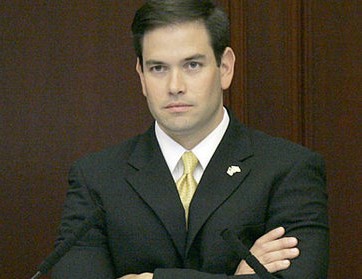
Here’s a profile of Marco Rubio posted by Rachel Alexander at The Stream.
She writes:
On Monday night, Florida Senator Marco Rubio became the third major Republican candidate to announce he was officially running for president, after Senators Ted Cruz and Rand Paul. He made the announcement from the Freedom Tower in downtown Miami, considered the Ellis Island of Florida, where Cuban refugees seeking political asylum from Castro’s communist regime were processed by the federal government in the ’60s and early ’70s. It made a powerful statement, that the son of refugees is now running for president.
Rubio’s parents came to America before the Castro regime, and took menial jobs. He told the cheering crowd, “My father stood behind a small portable bar in the back of a room so that tonight I could stand behind this podium in front of this room.”
Rubio has been an outspoken critic of Obama’s efforts to relax relations with Cuba, and takes a hawkish approach to foreign policy. Earlier this year, he published the book American Dreams, which lays out how to rise to success economically in the U.S.
The youngest candidate in the race, Rubio reached out to younger voters in his speech, saying, “This election is not just about what laws we will pass, it is a generational choice about what kind of country we will be.”
He has lots of experience and a track record we can analyze:
A lawyer, Rubio worked his way up through the political system, serving in the Florida House from 2000 to 2008 and eventually becoming Speaker. While there he developed a reputation for pursuing innovative policy ideas and while Speaker of the Florida House, he wrote a book, 100 Innovative Ideas for Florida’s Future, which contained many ideas he implemented while Speaker.
He went on to defeat liberal Republican turned Democrat Charlie Crist in a surprising underdog campaign to become U.S. Senator in 2010, making him an instant Tea Party favorite. The New York Times magazine declared him the “first Senator from the Tea Party.”
His most exciting policy is his tax policy:
On the fiscal side of the conservative equation, Rubio’s new tax reform proposal is raising some eyebrows. Introduced with conservative stalwart Sen. Mike Lee (R-Utah), the plan would consolidate income tax rates into just two, 15 percent and 35 percent, eliminate capital gains taxes on investment income for individuals, combine all corporate tax rates to 25 percent, and resuscitate the child tax credit, which had shrunk under the Obama administration. However, individuals making as little as $75,000 would be subject to the 35 percent rate. Many conservatives prefer the more radical flat tax option advocated by Ted Cruz and Rand Paul.
Mike Lee is my favorite conservative in the Senate.
Rubio is a solid conservative in terms of voting:
He has a 98.67 percent lifetime rating from the American Conservative Union, higher than most other Republican Senators.The Pulse 2016, a new site tracking the presidential election, gave Rubio an A grade on handling the Indiana religious freedom law controversy. The site noted that during an appearance on The Five, Rubio spoke “intelligently, knowledgeably, and at length about the need to protect the rights of Christians to follow their religious convictions.”
But he doesn’t have the executive accomplishments of a Scott Walker or a Bobby Jindal, since he isn’t a governor.
This is his biggest flaw:
Since taking office, Rubio has disappointed the Tea Party once, in 2013, when he joined a bipartisan group of Democrats and moderate Republicans to propose a path to citizenship for illegal immigrants, which went further than even Jeb Bush’s plan. Bush supports a path for legal status only. Rubio’s legislation failed, and at CPAC earlier this year, he said he now would only support a path to citizenship after securing the border.
Rubio is a strong candidate, but I can’t forgive him for endorsing a path to citizenship for those who break the law coming into the United States without a work permit. I don’t even favor work permits for people who break the law, much less permanent residencies, much less citizenship. Rubio is far to the left of me on immigration. But if you take away that negative, he is a formidable candidate in the general election. He would make an extremely difficult opponent for Hillary Clinton, or whoever the Democrats choose.
I am OK with him being our candidate in the general, and I think he would be as electable as Scott Walker, my top choice. If we were just choosing positions, I agree most with Cruz, but Cruz lacks accomplishments and I don’t see intelligent policies coming out of his mouth – the kinds of policies that can move us in a conservative direction, while still appealing to independents.
But I rank Rubio fifth in my list:
- Gov. Scott Walker
- Gov. Bobby Jindal
- Gov. Rick Perry
- Sen. Ted Cruz
- Sen. Marco Rubio
I like Rick Santorum more than Marco Rubio, but I’m not sure if he’s running. Carly Fiorina and Ben Carson are not on my list because of lack of experience, but I would love to see them run and be present to speak at the debates – I like listening to them both. They are both stars, but maybe not ready for the Presidency.
Rand Paul is a good candidate on fiscal policy. His statements on social policy are good, but he lacks accomplishments.His foreign policy is too much like Obama’s for me. He has said some good things, but he lacks accomplishments. I don’t want any more weakness and appeasement. Paul is to the left of Cruz and Rubio on foreign policy – I don’t want him on my list. But I’d put him in charge of the Federal Reserve in an instant.
We have SO MANY good candidates, and the Democrats have picked themselves a stinker. It’s so good! I feel bad that young people are so lousy on the marriage issue, but maybe with a good leader, we can change some of their minds during the debates? Do young people even watch debates?
 WINTERY KNIGHT