Tag Archives: Planning

New study: 1 in 8 divorces is caused by student loan debt

I already mentioned the studies that show that marrying a non-virgin is less stable than marrying a virgin. But what about student loans? Are they a risk factor for divorce, too? I was reading over at Captain Capitalism and saw this CNBC article, which discusses data relevant to our recent discussion about whether men ought to prefer debt-free virgins without tattoos.

Excerpt:

When it comes to student loan debt, “for richer, for poorer” doesn’t quite cut it.

In general, finances are the leading cause of stress in a relationship, according to a study by SunTrust Bank, but student debt takes a particularly hard toll on a marriage.

More than a third of borrowers said college loans and other money factors contributed to their divorce, according to a recent report from Student Loan Hero, a website for managing education debt.

In fact, 13 percent of divorcees blame student loans specifically for ending their relationship, the report found. Student Loan Hero surveyed more than 800 divorced adults in June.

Now, when deciding whether to marry and who to marry, it does make sense to me to think about what needs to be bought and how much these things cost, and where the money will come from. It just makes sense to me that people who are REALLY interested in marriage will be interested in doing what works to prepare for marriage. You can’t just do whatever you want before marrying, because marriage involves being faithful to your spouse, and buying things that you need for the marriage enterprise, like a home, and baby stuff. It doesn’t make any sense to say “I want to get married” and then not prepare for marriage by being careful about what behavior marriage requires of you.

This 2017 article from Harvard Business Review is interesting.

It says:

Examining 46,934 resumes shared on Glassdoor by people who graduated between 2010 and 2017, the researchers looked at each person’s college major and their post-college jobs in the five years after graduation. They then estimated the median pay for each of those jobs (also using Glassdoor data) for employees with five years of experience or less. Their key finding: “Many college majors that lead to high-paying roles in tech and engineering are male dominated, while majors that lead to lower-paying roles in social sciences and liberal arts tend to be female dominated, placing men in higher-paying career pathways, on average.”

Here’s the plot, and you can click it to expand it:

Starting salaries by major, broken out by gender
Median salaries by major, broken out by gender – don’t study things at the bottom!

Maybe we can just simplify this whole issue by saying “it’s unwise to marry people who choose not to prepare themselves for marriage”. That goes for men and women, by the way. Basically, you can avoid student loans if you study something that you don’t feel like studying, and work jobs that you don’t feel like working, and don’t buy things that you feel like buying. Don’t marry people who are led by their feelings. Marry someone who demonstrates self-control.

Anyway, I feel obligated to post a relevant Dave Ramsey video, just to remind everyone that stewardship of money is a Christian virtue, and that being forgiven by Jesus for your sins doesn’t make you good with money.

This one from 2014: (H/T Robb)

When I was in high school, I was far more interested in becoming an English teacher than I was in becoming a software engineer. It was my Dad who overruled my choice of college major when I was still in high school. He had me take a first-year English course at a local university. When I saw how politicized and useless it was (they were studying all sorts of politically correct postmodern relativist stuff, instead of the Great Works, and they weren’t trying to learn any wisdom from any of it), I chose computer science. I did what was likely to work, instead of what was easy and fun and made me feel good. I think this makes me a grown-up. And marriage should only be done if there are two grown-ups involved in the enterprise.
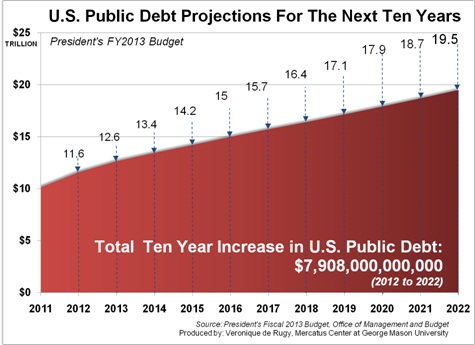
Move over housing bubble and student loan bubble: here’s pension bubble!

Obama 2013 Budget Debt Projection

Recently, I was talking to Dina about which state I would like to live in. I looked at a whole bunch of factors like tax rates, housing prices, religious liberty laws, voting patterns… but I also looked at state obligations to pay pensions.

Let’s take a look at the story from the Washington Examiner to see why this is important.

It says:

Years of gimmicks and politically motivated benefit increases for government workers have left America’s states and municipalities with pension funds that are short at least $1.5 trillion — and possibly as much as $4 trillion if the investment returns of these funds don’t live up to expectations in coming years.

[…]Since 2007, states and localities have been forced to increase annual contributions into pensions by $43 billion, or 65 percent, and in various places these rising payments are crowding out other government services or driving taxes higher or both. Retirement debt has even played a crucial role in high-profile government bankruptcies — including in Detroit; Stockton, California; and Central Falls, Rhode Island. Fixing the problem is proving expensive, and it won’t happen quickly in places with the worst debt.

[…][O]fficials in Stockton spent years enhancing benefits to workers without understanding the debts they were accruing. The city agreed back in the 1990s, for instance, to pay not only its own share of contributions into the pension system, but those of staff, too. It also guaranteed healthcare for life for retirees.

[…]Facing $400 million in pension debt and $450 million in promises for future healthcare, the city declared bankruptcy in 2012. Employees lost some of their perks, like healthcare in retirement, but citizens suffered, too. Trying to save money, the city cut essential services, including the police department, and crime soared.

[…]Places that cannot reform pensions, or where legislators were slow to act, are inevitably seeing tax increases to finance these steep obligations. In Pennsylvania, 164 school districts applied in 2014 to increase property taxes above the state’s 2.1 percent tax cap. Every one of them listed pension costs as a reason for the higher increases. In West Virginia, the state has given cities the right to impose their own sales tax to pay for increased pension costs.

Several cities, including Charleston, have already gone ahead with the new tax. Chicago Mayor Rahm Emanuel tried to impose a $250 million property tax increase last year to start wiping out pension debt in the Windy City, where pensions are only 35 percent funded. When the City Council balked, Chicago instead passed $62 million in other taxes, including a levy on cell phone use, as a stopgap measure. But the city faces a pension bill that is scheduled to rise by half a billion dollars annually in 2016.

I was able to find a helpful table that shows the solvency of all the public sector pension plans in each state. There are sensible states where I could live. It’s also important to look at the trend to see what direction the state is moving in, and thankfully the table had that information.

Anyway, here is the point I want to make about this.

When I look at these numbers, I feel sad, because it means that I have to be careful about my spending, and not spend too much on things that are fun in the short-term. I also cannot stop working to take a year off to go backpacking in Europe, because that would wreck my resume, and lose me a whole bunch of earned income. Sometimes, reality causes us to feel bad like that, so we run away from it. We find people who will agree with our feelings, and we shut out people who see things clearly. But we as Christians should not make decisions based on intuitions and feelings. And it doesn’t even work if you wrap up a bad decision in spiritual language, i.e. – “God told me…”, either. As much as I might feel like spending my money on frivolous things, I know in my mind that I cannot do that. I don’t like having constraints on my freedom, but to ignore data like this in my decision-making would not end well for me.

Sue Bohlin of Probe Ministries recently wrote a wonderful post about short-term pain versus long-term pleasure.

She writes:

Decision-making often involves choosing between short-term pleasure or short-term pain. (Usually it’s more like short-term inconvenience.)

Short-term pleasure often leads to long-term pain, and short-term pain often leads to long-term pleasure. What doesn’t work, and is a horribly unrealistic expectation for life, is short-term pleasure leading to long-term pleasure! (Wouldn’t THAT be nice?!)

Maturity and wisdom is displayed by the choices we make, especially when we exercise patience and self-control, not insisting on the instant-gratification jolt of “I want it NOW!!!” Many of our choices for pleasure in the right-now end up costing us down the road, causing pain later. You know, like that fourth brownie that tastes soooooo good in the moment, but then you can’t zip up your jeans a few days later. Or indulging your child’s demands and whims today because you want to be the “cool parent” and you want them to like you, but then you start to notice the ugliness of that child’s sense of self-absorbed entitlement. Short-term pleasure, even when that pleasure is simply trying to avoid pain, results in long-term unpleasant consequences.

But when we recognize the value of self-control and self-denial in the present, so that we can reap the harvest of pleasure in the future, that’s wisdom. Mark Twain advised, “Do one thing every day you don’t want to do.” That’s good advice, but of course God thought of that much earlier! Using self-control and self-denial is how we fulfill the biblical idea of not indulging the flesh (Galatians 5:16).

[…]Jesus said, “If anyone wants to become My follower, he must deny himself, take up his cross daily, and follow Me.” (Luke 9:23) Denying ourselves, taking up our cross, and following Jesus are all about short-term pain with major long-term pleasures!

Sue is wise. And her newest post is all about how to deal with feelings.

She says:

What is the biblical perspective on how to handle overwhelming feelings?

There are healthy and unhealthy ways to do that.

The healthy way to deal with strong feelings starts with thinking wisely about feelings in general. Our pastor often says that feelings are real (we do feel them, often intensely), but they’re not reliable (they make terrible indicators of what is true). So we should acknowledge them, but not be led by them.

Especially powerful, overwhelming feelings.

Allowing yourself to be controlled by your feelings is unwise and immature. The flip side of that is our example of Jesus in the Garden of Gethsemane. No one ever experienced the strength of horrific feelings like He did, to the point of sweating blood. He allowed Himself to feel His feelings, but then He turned in trust to His Father, submitting to His will. He set the bar for how to handle overwhelming feelings: feel the feelings, and trust the Lord.

Often, though, especially in the young, people deal with their strong feelings in unhealthy ways.

Feel the feelings, but don’t let them into your decision-making.

Should you execute a plan that requires God’s intervention to work?

I have a fictional story that I’m going to use to make a point.

Here it is:

A terrible storm came into a town and local officials sent out an emergency warning that the riverbanks would soon overflow and flood the nearby homes. They ordered everyone in the town to evacuate immediately.

A faithful Christian woman heard the warning and decided to stay, saying to herself, “I will trust God and if I am in danger, then God will send a divine miracle to save me.”

Her neighbor came by her house and said to her, “I’m leaving and there is room for you in my car, please come with me!” But the woman declined his offer. “I have faith that God will save me.”

As the woman stood on her porch watching the water rise up the steps, a man in a canoe paddled by and called to her, “Hurry and come into my canoe, the waters are rising quickly!” But the woman again said, “No thanks, God will save me.”

The floodwaters rose higher pouring water into her living room and the woman had to retreat to the second floor. A police motorboat came by and the policeman saw her at the window. “I will come up and rescue you!” he shouted. But the woman refused, waving him off saying, “Use your time to save someone else! I have faith that God will save me!”

The flood waters rose higher and higher and the woman had to climb up to her rooftop.

A helicopter spotted her and dropped a rope ladder. A rescue officer came down the ladder and he pleaded with the woman, “Grab my hand and I will pull you up!” But the woman STILL refused, folding her arms tightly to her body. “No thank you! God will save me!”

Shortly after, the house broke up and the floodwaters swept the woman away and she drowned.

When in Heaven, the woman stood before God and asked, “I put all of my faith in You. Why didn’t You come and save me?”

And He said, “Daughter, I sent you a warning. I sent you a car. I sent you a canoe. I sent you a motorboat. I sent you a helicopter. What more were you looking for?”

I think the lesson from this made-up story is that it’s good to not make plans that are risky and reckless, and therefore unlikely to work. If your plan requires God to do anything in order for it to work, you better get a new plan. I think instead you should do everything you can to make your plan work, and then pray about it for your own peace of mind, and for a blessing that God will use it and bless it to produce a great result.

Look at this passage from the Bible.

Matthew 4:5-7:

Then the devil took Him into the holy city and had Him stand on the pinnacle of the temple,

and said to Him, “If You are the Son of God, throw Yourself down; for it is written,

He will command His angels concerning You’;

and

On their hands they will bear You up,
So that You will not strike Your foot against a stone.’”

Jesus said to him, “On the other hand, it is written, ‘You shall not put the Lord your God to the test.’”

When you are deciding how your life is going to count, don’t try to hit a home run on the first at bat. Don’t try to swing for a knockout punch in the first round. Make a plan that is cautious and will bear fruit in time. Don’t make a plan that will only work if a miracle occurs, that would be putting God to the test. God is not honored by lousy plans that fail and make people of faith look foolish. We have to appear as if we know what we are doing, and it is easier to love and lead others if we have our own life in order, first. For example, you can’t share with others if you don’t have your own financial house in order.

Now I’ve actually done stupid things that were unlikely to work myself a few times, and they obviously did not work. But I have found a good way to avoid doing this. If you surround yourself with good advisors, then they will tell you not to do stupid things, or they will tell you how to do something else that achieves the same result. It’s good to have advisors and good to let them know what you are planning to do so they can tell you not to do it.