Is there any subject more controversial than the question of the legitimacy of the modern State of Israel? Is it the eternal home of the Jewish people, promised to them by God Himself? Or is it the illegitimate home of violent Jewish occupiers, an apartheid state guilty of ethnic cleansing? Or is it something in between? In the midst of the often emotional arguments on both sides, it is helpful to review five simple truths about the Mideast conflict.
And the list of 5 points:
There is no such thing as a historic “Palestinian people” living in the Middle East.
There were anti-Jewish intifadas in Palestine two decades before the founding of the State of Israel in 1948.
Jewish refugees fleeing from Muslim and Arab countries were absorbed by Israel after 1948; Arab refugees fleeing from Israel after 1948 were not absorbed by Muslim and Arab countries
Only one side in the Israeli-Palestinian conflict is truly committed to peaceful co-existence.
The current uprisings throughout the Muslim and Arab world today remind us that Israel cannot fairly be blamed for all the tension and conflicts in the region.
And what I think is the most significant point:
4. Only one side in the Israeli-Palestinian conflict is truly committed to peaceful co-existence.It is often stated that if the Palestinians put down their weapons, there would be no more war but if the Israelis put down their weapons, there would be no more Israel. This is not to say that all Palestinians are warmongers and all Israelis are doves. But the vast majority of Israelis are not driven by a radical ideology that calls for the extermination of their Arab neighbors, nor are they teaching their children songs about the virtues of religious martyrdom.
Israel does not relish spending a major portion of its budget on defense, nor does it relish sending its sons and daughters into military service. It simply will not surrender Jerusalem, its historic and religious capital, and it will not commit regional suicide by retreating to indefensible borders. In return it simply asks the Palestinians to say, “We embrace your right to exist.”
I think point #4 tells you everything you need to know.
I just finished reading Thomas Sowell’s “Intellectuals and Society” and I really recommend it. I mean – this is the book of the year from 2010. If you have no interest at all in economics and politics, you should definitely buy this book and read it. If you have never read anything about conservative economics and policy, then this is the place to start. It covers a little bit of economics, a little bit of jurisprudence, a little bit of education, a little bit of foreign policy… you name it – it’s in there. And in plain English. Thomas Sowell is my favorite economist, and the economist favored most by all conservatives. I own about a DOZEN of his books. He’s that good.
I wanted to talk to you about what was in chapter 7 “Intellectuals and War” and chapter 8 “Intellectuals and War: Repeating History”. So I searched and searched and found a summary of Sowell’s arguments in those chapters.
On the international scene, trying to assuage aggressors’ feelings and look at the world from their point of view has had an even more catastrophic track record. A typical sample of this kind of thinking can be found in a speech to the British Parliament by Prime Minister Neville Chamberlain in 1938: “It has always seemed to me that in dealing with foreign countries we do not give ourselves a chance of success unless we try to understand their mentality, which is not always the same as our own, and it really is astonishing to contemplate how the identically same facts are regarded from two different angles.”
Like our former ambassador from the Carter era, Chamberlain sought to “remove the causes of strife or war.” He wanted “a general settlement of the grievances of the world without war.” In other words, the British prime minister approached Hitler with the attitude of someone negotiating a labor contract, where each side gives a little and everything gets worked out in the end. What Chamberlain did not understand was that all his concessions simply led to new demands from Hitler — and contempt for him by Hitler.
What Winston Churchill understood at the time, and Chamberlain did not, was that Hitler was driven by what Churchill called “currents of hatred so intense as to sear the souls of those who swim upon them.” That was also what drove the men who drove the planes into the World Trade Center.
Pacifists of the 20th century had a lot of blood on their hands for weakening the Western democracies in the face of rising belligerence and military might in aggressor nations like Nazi Germany and imperial Japan. In Britain during the 1930s, Labor Party members of Parliament voted repeatedly against military spending, while Hitler built up the most powerful military machine in Europe. Students at leading British universities signed pledges to refuse to fight in the event of war.
All of this encouraged the Nazis and the Japanese toward war against countries that they knew had greater military potential than their own. Military potential only counts when there is the will to develop it and use it, and the fortitude to continue with a bloody war when it comes. This is what they did not believe the West had. And it was Western pacifists who led them to that belief.
Then as now, pacifism was a “statement” about one’s ideals that paid little attention to actual consequences. At a Labor Party rally where Britain was being urged to disarm “as an example to others,” economist Roy Harrod asked one of the pacifists: “You think our example will cause Hitler and Mussolini to disarm?”
The reply was: “Oh, Roy, have you lost all your idealism?” In other words, the issue was about making a “statement” — that is, posturing on the edge of a volcano, with World War II threatening to erupt at any time. When disarmament advocate George Bernard Shaw was asked what Britons should do if the Nazis crossed the channel into Britain, the playwright replied, “Welcome them as tourists.”
That was explained even more in the book with more examples from history.
Most people think that Thomas Sowell is a libertarian, but he isn’t a full libertarian. He just reports the evidence. If the evidence is pro-war, then he’s pro-war. Ronald Reagan and Margaret Thatcher called this view “peace through strength”. There is only one reason why evil people do not attack – because they think that good people have the firepower tomake them pay dearly for their aggression, and – and this is very important – the will to use it. In the book, Sowell explains how the the left responded to the horror of world war one by undermining the will of the people to fight. They minimized patriotism and heroism, and emphasized charges of “imperialism”, moral equivalence, and lots of sob stories about victims.
In France, after the First World War, the teachers’ unions launched a systematic purge of textbooks, in order to promote internationalism and pacifism.
Books that depicted the courage and self-sacrifice of soldiers who had defended France against the German invaders were called “bellicose” books to be banished from the schools.
Textbook publishers caved in to the power of the teachers’ unions, rather than lose a large market for their books. History books were sharply revised to conform to internationalism and pacifism.
The once epic story of the French soldiers’ heroic defense against the German invaders at Verdun, despite the massive casualties suffered by the French, was now transformed into a story of horrible suffering by all soldiers at Verdun— French and German alike.
In short, soldiers once depicted as national heroes were now depicted as victims— and just like victims in other nations’ armies.
[…]France, where pacifism and internationalism were strongest, became a classic example of how much it can matter.
During the First World War, France fought on against the German invaders for four long years, despite having more of its soldiers killed than all the American soldiers killed in all the wars in the history of the United States, put together.
But during the Second World War, France collapsed after just six weeks of fighting and surrendered to Nazi Germany.
At the bitter moment of defeat the head of the French teachers’ union was told, “You are partially responsible for the defeat.”
Charles de Gaulle, Francois Mauriac, and other Frenchmen blamed a lack of national will or general moral decay, for the sudden and humiliating collapse of France in 1940.
At the outset of the invasion, both German and French generals assessed French military forces as more likely to gain victory, and virtually no one expected France to collapse like a house of cards — except Adolf Hitler, who had studied French society instead of French military forces.
Did patriotism matter? It mattered more than superior French tanks and planes.
Everybody wants peace. Everyone – on both sides of the issue. The problem is that one side – the leftists – call their opponents names like “imperialist” and talk “disarmament” and “dialog” as if they have have the answer to peace. That doesn’t work and it has never worked. Pacifism only “works” in the classroom, where naive children are forced to parrot the opinions of their secular leftist teachers who have no expertise in war or history. What has actually worked in history is peace through strength. Strength deters wars, strength deters violence. Strength – and the will to use that strength to restrain evil.
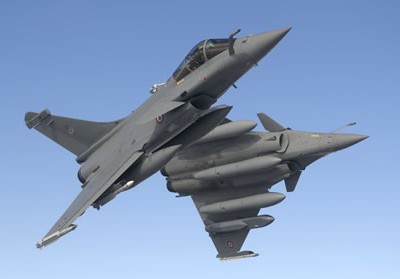
The French Navy’s flagship set off from the southern naval port of Toulon at 1210 GMT, with 20 warplanes, most them Rafale and older Super Etendard combat jets, as well as helicopters and two E-2 Hawkeye surveillance aircraft.
Tugs pulled it from the wharf as dozens of onlookers watched it depart.
“The aircraft carrier is 24 hours by sea from the Libyan coast but will take 36 to 48 hours to get there, to take the time to load on the fighter jets that will participate in the operations and to hold some landing exercises,” a military source said.
The aircraft carrier was to be escorted by three frigates — the anti-submarine Duplex, the anti-air Forbin and the multi-mission stealth Aconit — and the oil tanker La Meuse, military officials said.
The French naval group was to be protected by a nuclear attack submarine, they added.
French warplanes also continued sorties over Libya early Sunday as part the West’s biggest intervention in the Arab world since the 2003 US-led invasion of Iraq.
Saturday, French jets spearheaded the West’s assault with four air strikes in Libya, destroying several armoured vehicles of forces loyal to the embattled Libyan strongman.
Sarkozy is, of course, the leader of the French conservatives. And of the free world? France started combat operations in Libya on March 10th!
Learn more about the French Rafale fighters here (they are fairly new), and the Charles de Gaulle here. It is a CVN, not a CV. Extremely capable, and fairly new.



 WINTERY KNIGHT