
Tag Archives: Peace in Our Time

Obama told us that Yemen was a success of his foreign policy

The Wall Street Journal reports:

The Obama administration’s calculated gamble during the past three years in Yemen has crumbled in recent days, leaving the country on the brink of a civil war with U.S. troops involved in counterterror operations withdrawing amid intense fighting.

What happened in Yemen, according to descriptions by current and former officials and experts, was a miscalculation about the changes unleashed by the Arab Spring revolutions. It involved an overreliance by Washington on a promising new leader who ultimately was unable to hold off rival forces and tensions, they said.

As a result, a country President Barack Obama last year cited as a model of American counterterrorism success has now descended into chaos, with U.S. influence and drone strikes no match for at least four sides at war with one another.

“In many ways, this is all the Thanksgiving Dinner from hell,” said Jon Alterman, a former State Department official and director of the Middle East program at the Center for Strategic and International Studies. “It is people who have been dealing with each other for a long time, none are satisfied, and the fight has broken out. And the first thing is figuring out who the different sides are.”

The U.S. and allies such as Yemen’s neighbor Saudi Arabia had tried to take advantage of the Arab Spring revolution in Yemen in 2011. They supported a new, friendly regime led by President Abed Rabbo Mansour Hadi.

The White House hailed Mr. Hadi’s leadership and—with his cooperation—carried out dozens of drone strikes against the country’s al Qaeda offshoot. Meanwhile, they collected intelligence and training Yemeni forces to battle the terrorist group al Qaeda in the Arabian Peninsula, or AQAP.

But the Obama administration limited its involvement with others in Yemen, and was largely removed from numerous tribal leaders and the rising rebel group known as the Houthis, according to former U.S. officials and foreign policy experts. The success of the White House’s involvement with Yemen relied largely on Mr. Hadi staying in power, they said, adding that the White House had few alternatives. That is why the U.S. approach was upended last month when Shiite-linked Houthi rebels, believed to be backed by Iran, seized control of Yemen’s capital and forced Mr. Hadi to flee. Forces loyal to Mr. Hadi are now warring against the Houthis, and U.S. officials believe, against his predecessor, Ali Abdullah Saleh.

The Yemeni president has asked Gulf countries to intervene militarily against the Houthis as they advance toward his base in the southern city of Aden, according to Saudi media reports quoting Mr. Hadi’s foreign minister. Over the past few days, the Houthis have been advancing southward into the major southern city of Taiz, where they have encountered resistance and large street protests against them. Houthi gunmen fired live ammunition and tear gas on Monday into crowds of demonstrators in the city, wounding at least seven people. Meanwhile, militants claiming allegiance to Islamic State carried out dramatic suicide attacks in an area that had traditionally been the safe haven for rival AQAP, which some believe could trigger competitive jihadist attacks.

The Houthis had already taken over the airport and some government buildings in Taiz and erected checkpoints in the southern city when the violence flared, said local government officials and protest organizers, who reported the casualties.

[…]Before political chaos erupted earlier this year, the U.S. had everything invested in Mr. Hadi. Central Intelligence Agency Director John Brennan was a key liaison to the country when he served as a top White House counterterrorism aide in the first years of the Obama administration. His replacement, Lisa Monaco, had kept in constant contact with Mr. Hadi since then.

In September, President Obama hailed Yemen as a success story in its counterterrorism approach, saying the country’s aggressive pursuit of terrorists would prevent the spread of Islamic State.

Look at the stupidity of Samantha Power:

Samantha Power, the U.S. ambassador to the United Nations, said Sunday that all parties in Yemen should agree to U.N.-backed negotiations and “refrain from any further unilateral and offensive military actions.”

“We are supporting all the right [United Nations] resolutions, but most of the people in Yemen could care a flying fig for a U.N. resolution,” said Barbara Bodine, who was U.S. Ambassador to Yemen at the time of the USS Cole attack.

The Obama administration simply cannot take evil seriously – they keep thinking that everyone in the world is like them, and it’s killing our foreign policy. Obama keeps making promises that him and his party of amateurs and academics cannot keep.
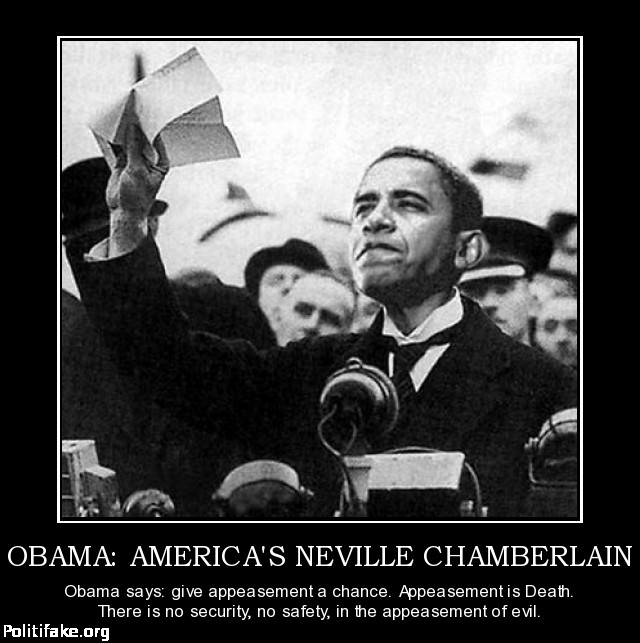
Neville Chamberlain Obama: peace in our time

If you like your doctor, you can keep your doctor. If you like your health plan, you can keep your health plan. If you like your IRS e-mails, you can keep your IRS e-mails. If you like your Tea Party charitable status, you can keep your Tea Party charitable status. If you like your Ukraine, you can keep your Ukraine. If you like your traditional marriage, you can keep your traditional marriage. If you like your State Department transparency, you can keep your State Department transparency. If you like your European missile defense, you can keep your European missile defense. If you like your 12 carrier strike groups, you can keep your 12 carrier strike groups. If you like your full-time work week, you can keep your full-time work week. If you like your health care for veterans, you can keep your health care for veterans. If you like your $8 trillion dollar debt,  you can keep your $8 trillion dollar debt. If you like your coal plant, you can keep your coal plant. If you like your race relations, you can keep your race relations. If you like your freedom to not buy others abortion drugs, you can keep your freedom to not buy others abortion drugs. If you like your F-22 stealth fighter, you can keep your F-22 stealth fighter. If you like your Israel, you can keep your Israel.

We can fix the spending, we can fix the laws, we can fix the fraud, we can fix the corruption, we can repeal Obamacare… but the foreign policy blunders will be very, very hard to fix.

Ron Paul’s isolationist foreign policy views echo Neville Chamberlain

From Doug Ross at Director Blue, 10 fun facts about Ron Paul.

Here’s fact #7:

And so I asked Congressman Paul: if he were President of the United States during World War II, and as president he knew what we now know about the Holocaust, but the Third Reich presented no threat to the U.S., would he have sent American troops to Nazi Germany purely as a moral imperative to save the Jews?

And the Congressman answered:

“No, I wouldn’t. I wouldn’t risk American lives to do that. If someone wants to do that on their own because they want to do that, well, that’s fine, but I wouldn’t do that.”

Paul then looked at me, and I politely thanked him for his time. He smiled at me again and nodded his head, and many of his young followers were also smiling, and nodding their heads in agreement. Clearly, I was the only one in the room who was disturbed by his response.

When I first presented the story of Paul’s comments about the Holocaust to major news media outlets two years ago, they were so stunned they were afraid to publish my story, and as a result it has remained unpublished until now.

I went to great lengths afterwards to learn more about the basis for Paul’s comments. I spoke to Eric Dondero, a former senior aide for Paul, in February 2010. Dondero is quoted in a Weekly Standard article today about Paul’s isolationist beliefs.

When I called Dondero again this morning, and told him I was finally going forward with the story, he told me that Paul had made similar comments to him.

“He told me numerous times it was not worth it to intervene to save the Jews in World War II,” Dondero said. “I don’t think that’s because he’s an antisemite. It’s because he’s an extreme isolationist and he’s trying to be 100% principled–he doesn’t think there’s any reason to intervene for human rights or any other reason anywhere on the planet.”

Calls to Rep. Paul’s congressional office and campaign office last week and this morning were not returned.

It’s not just the Holocaust, either. It’s the wholesale abandonment of the United Kingdom to conquest by Nazi Germany. And it’s not just the United Kingdom. It’s the complete takeover of the Asia-Pacific theater, and Australia, and New Zealand, by Imperial Japan. That’s what Ron Paul would have let happen.

Historians will tell you that Hitler could have been contained if Western leaders had responded militarily when he broke the Locarno treaties by remilitarizing the Rhineland in 1936. Do you think that Ron Paul would have gone to war in 1936 to stop Hitler – when he was still relatively weak? The Polyanna isolationism of Ron Paul is exactly what causes world wars. People like Ron Paul ignore aggressors when they make small invasions and then in a few years we have a world war on our hands. Ron Paul is a warmonger – his naive isolationism gets us into world wars by emboldening and coddling tyrants with a naive stick-your-head-in-the-sand foreign policy. Ron Paul doesn’t know anything about the threat of terrorism – his foreign policy is based on economics theories authored by people who died before nuclear weapons were invented. You can’t trust someone who makes foreign policy using theories, but who is ignorant of the real dangers we face.

“Those who do not learn from history are doomed to repeat it”
– George Santayana 

It’s not a surprise to me that Ron Paul is popular with young people who don’t understand military history and the threat of terrorism. They don’t know who Neville Chamberlain was, or they would recognize Ron Paul as the second coming of Neville Chamberlain.

Thomas Sowell explains what causes wars

Let’s take a look at the lessons of history and find out what really causes wars.

Here’s an article from Townhall.

Excerpt:

On the international scene, trying to assuage aggressors’ feelings and look at the world from their point of view has had an even more catastrophic track record. A typical sample of this kind of thinking can be found in a speech to the British Parliament by Prime Minister Neville Chamberlain in 1938: “It has always seemed to me that in dealing with foreign countries we do not give ourselves a chance of success unless we try to understand their mentality, which is not always the same as our own, and it really is astonishing to contemplate how the identically same facts are regarded from two different angles.”

Like our former ambassador from the Carter era, Chamberlain sought to “remove the causes of strife or war.” He wanted “a general settlement of the grievances of the world without war.” In other words, the British prime minister approached Hitler with the attitude of someone negotiating a labor contract, where each side gives a little and everything gets worked out in the end. What Chamberlain did not understand was that all his concessions simply led to new demands from Hitler — and contempt for him by Hitler.

What Winston Churchill understood at the time, and Chamberlain did not, was that Hitler was driven by what Churchill called “currents of hatred so intense as to sear the souls of those who swim upon them.” That was also what drove the men who drove the planes into the World Trade Center.

Pacifists of the 20th century had a lot of blood on their hands for weakening the Western democracies in the face of rising belligerence and military might in aggressor nations like Nazi Germany and imperial Japan. In Britain during the 1930s, Labor Party members of Parliament voted repeatedly against military spending, while Hitler built up the most powerful military machine in Europe. Students at leading British universities signed pledges to refuse to fight in the event of war.

All of this encouraged the Nazis and the Japanese toward war against countries that they knew had greater military potential than their own. Military potential only counts when there is the will to develop it and use it, and the fortitude to continue with a bloody war when it comes. This is what they did not believe the West had. And it was Western pacifists who led them to that belief.

Then as now, pacifism was a “statement” about one’s ideals that paid little attention to actual consequences. At a Labor Party rally where Britain was being urged to disarm “as an example to others,” economist Roy Harrod asked one of the pacifists: “You think our example will cause Hitler and Mussolini to disarm?”

The reply was: “Oh, Roy, have you lost all your idealism?” In other words, the issue was about making a “statement” — that is, posturing on the edge of a volcano, with World War II threatening to erupt at any time. When disarmament advocate George Bernard Shaw was asked what Britons should do if the Nazis crossed the channel into Britain, the playwright replied, “Welcome them as tourists.”

Most people think that Thomas Sowell is a libertarian, but he isn’t a full libertarian. He just reports the evidence. If the evidence is pro-war, then he’s pro-war. Ronald Reagan and Margaret Thatcher called this view “peace through strength”. There is only one reason why evil people do not attack – because they think that good people have the firepower to make them pay dearly for their aggression, and – and this is very important – the will to use it. We need to be wary of people like Ron Paul who minimize patriotism and heroism, and charge proponents of military power with “imperialism”.

Here’s an article that explains it more.

Excerpt:

In France, after the First World War, the teachers’ unions launched a systematic purge of textbooks, in order to promote internationalism and pacifism.

Books that depicted the courage and self-sacrifice of soldiers who had defended France against the German invaders were called “bellicose” books to be banished from the schools.

Textbook publishers caved in to the power of the teachers’ unions, rather than lose a large market for their books. History books were sharply revised to conform to internationalism and pacifism.

The once epic story of the French soldiers’ heroic defense against the German invaders at Verdun, despite the massive casualties suffered by the French, was now transformed into a story of horrible suffering by all soldiers at Verdun— French and German alike.

In short, soldiers once depicted as national heroes were now depicted as victims— and just like victims in other nations’ armies.

[…]France, where pacifism and internationalism were strongest, became a classic example of how much it can matter.

During the First World War, France fought on against the German invaders for four long years, despite having more of its soldiers killed than all the American soldiers killed in all the wars in the history of the United States, put together.

But during the Second World War, France collapsed after just six weeks of fighting and surrendered to Nazi Germany.

At the bitter moment of defeat the head of the French teachers’ union was told, “You are partially responsible for the defeat.”

Charles de Gaulle, Francois Mauriac, and other Frenchmen blamed a lack of national will or general moral decay, for the sudden and humiliating collapse of France in 1940.

At the outset of the invasion, both German and French generals assessed French military forces as more likely to gain victory, and virtually no one expected France to collapse like a house of cards — except Adolf Hitler, who had studied French society instead of French military forces.

Did patriotism matter? It mattered more than superior French tanks and planes.

Everybody wants peace. Everyone – on both sides of the issue. But it is not weakness but strength that deters wars. Strength, and the will to defeat evil.