
Tag Archives: Palestine

Obama overrides Congress to send $192 million to Palestinian Authority

From the Times of Israel. (H/T Rightscoop via BadBlue)

Excerpt:

US President Barack Obama has lifted a ban on financial aid to the Palestinian Authority.

Obama stated that the aid was “important to the security interests of the United States.”

The US Congress froze a $192 million aid package to the Palestinian Authority after its president, Mahmoud Abbas, defied US pressure and sought to attain UN endorsement of Palestinian statehood last September. The presidential waiver means that aid can now be delivered. …

Section 3 of Congress’s Palestinian Accountability Act, which applies to 2012, stipulates that “no funds available to any United States Government department or agency … may be obligated or expended with respect to providing funds to the Palestinian Authority.” Obama has now signed a waiver, however, the White House said Friday, and asked Secretary of State Hillary Clinton to inform Congress accordingly.

The AFP news agency quoted White House spokesman Tommy Vietor as saying the $192 million aid package would be devoted to “ensuring the continued viability of the moderate PA government under the leadership of [Palestinian Authority] President Mahmoud Abbas and Prime Minister Salam Fayyad.”

Vietor added that the PA had fulfilled its major obligations, such as recognizing Israel’s right to exist, renouncing violence and accepting the Road Map for Peace.

Just for reference, here is a recent rocket attack from the Palestinian area that occurred in March, and one that occurred in April. My opinion is that we should not be sending any foreign aid to the Palestinian Authority when they cannot stop the rocket attacks against Israel.
Did Obama’s foreign policy make America more respected abroad?

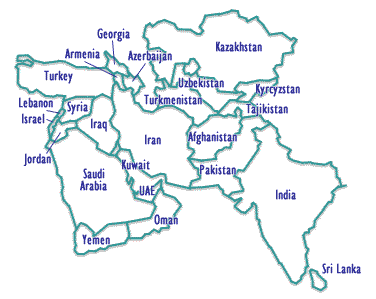
Map of the Middle East

From Investors Business Daily.

Excerpt:

In the Middle East, where U.S. military involvement and diplomacy are most closely watched, President Obama is held in lower regard in the Arab world than President Bush was in the last year of his presidency.

Obama is not only less liked than the supposedly hated Bush, he can’t even hold a candle to Iran’s grubby, menacing Mahmoud Ahmadinejad. Zogby reports that in Egypt, 31% of Egyptians agree with Iran’s policies compared with 3% for Obama’s, with similar figures in Jordan. Among Egyptians, just 5% hold a favorable attitude toward the U.S. compared with 9% in 2008.

[…]Clinton will do no better in bilateral talks with the Turks — a nation that has moved so far away from its long alliance with the U.S. it can only be called a former ally — on Syria, Iran and Israel/Palestine.

In these countries, Obama’s policy can be summed up in a litany of ineffectual maneuvers.

On Syria, the first move was to succor, then to scold as the dictatorship indifferently sheds streams of blood in the streets of Damascus — showing the fundamental disconnect between what the brutal Syrian regime is and what the Obama administration thinks it is.

After throwing Tunisia and Egypt, two pro-Western allies, overboard, the administration ineffectually grasps a problem in Syria as the bodies pile up.

On Iran, Obama policy shows even more weakness. The president wasted two years coddling the monster regime that threatens a region of more than a billion people. He missed a chance to support a student uprising in 2009 and now watches as Iran’s illegal nuclear program speeds ahead with little fear of consequences, more brazen and closer to realization.

Whatever this learning-curve policy amounts to, it garners no international respect.

Then there’s the stance the White House has taken on Israel, abusively telling its ally to retreat to 1967 borders. It emboldened provocations from Palestinian terrorist groups and showed the rest of the Arab world that it pays more to be America’s enemy than its friend. Now the Arab League is moving to recognize Palestine.

It turns out that what foreign powers respect is strength, not weakness.

Michael Brown explains five simple truths about the Middle East conflict

Map of Israel
Map of Israel

Mary sent me this article from TownHall.

Here’s the introduction:

Is there any subject more controversial than the question of the legitimacy of the modern State of Israel? Is it the eternal home of the Jewish people, promised to them by God Himself? Or is it the illegitimate home of violent Jewish occupiers, an apartheid state guilty of ethnic cleansing? Or is it something in between? In the midst of the often emotional arguments on both sides, it is helpful to review five simple truths about the Mideast conflict.

And the list of 5 points:

  1. There is no such thing as a historic “Palestinian people” living in the Middle East.
  2. There were anti-Jewish intifadas in Palestine two decades before the founding of the State of Israel in 1948.
  3. Jewish refugees fleeing from Muslim and Arab countries were absorbed by Israel after 1948; Arab refugees fleeing from Israel after 1948 were not absorbed by Muslim and Arab countries
  4. Only one side in the Israeli-Palestinian conflict is truly committed to peaceful co-existence.
  5. The current uprisings throughout the Muslim and Arab world today remind us that Israel cannot fairly be blamed for all the tension and conflicts in the region.

And what I think is the most significant point:

4. Only one side in the Israeli-Palestinian conflict is truly committed to peaceful co-existence.It is often stated that if the Palestinians put down their weapons, there would be no more war but if the Israelis put down their weapons, there would be no more Israel. This is not to say that all Palestinians are warmongers and all Israelis are doves. But the vast majority of Israelis are not driven by a radical ideology that calls for the extermination of their Arab neighbors, nor are they teaching their children songs about the virtues of religious martyrdom.

Israel does not relish spending a major portion of its budget on defense, nor does it relish sending its sons and daughters into military service. It simply will not surrender Jerusalem, its historic and religious capital, and it will not commit regional suicide by retreating to indefensible borders. In return it simply asks the Palestinians to say, “We embrace your right to exist.”

I think point #4 tells you everything you need to know.