Tag Archives: Nuclear Weapons

Is Obama promising the Russians more unilateral disarmament after the election?

From CNS News, a conversation that was never meant for the public to hear.

Excerpt:

President Barack Obama told Russia’s leader Monday that he would have more flexibility after the November election to deal with the contentious issue of missile defense, a candid assessment of political reality that was picked up by a microphone without either leader apparently knowing.

Outgoing Russian President Dmitry Medvedev said he would pass on Obama’s message to his successor, Vladimir Putin, according to an audio recording of comments the two leaders made during a meeting in Seoul, South Korea. Obama and Medvedev did not intend for their comments to be made public.

What kind of promises might Obama be making?

How about something like this:

Thirty-four lawmakers sent a letter to the White House on Thursday in response to news reports that President Obama had ordered his staff to study the option of reducing America’s nuclear deterrent by 80 percent—down to as few as 300 deployed strategic nuclear warheads. The United States currently has a cap of 1,550 deployed strategic warheads under the so-called New Strategic Arms Reduction Treaty (New START), the controversial arms control pact with Russia that passed the Senate in December 2010.

The concerned lawmakers—who are led by Republican Congressmen Buck McKeon of California, chairman of the House Armed Services Committee (HASC), and Mike Turner of Virginia, head of the HASC’s Subcommittee on Strategic Forces—question whether the president is taking into account the full range of threats that face the United States in its allies.  In the letter, they caution against further nuclear cuts given “the growth in quantity and quality of nuclear weapons capabilities in Russia, the People’s Republic of China, India, Pakistan, North Korea and, perhaps soon the Islamic Republic of Iran” and “the divestment of U.S. conventional military capabilities under [Obama’s] recently announced defense strategy.”

Or maybe he wants to do more of this:

The Obama administration disclosed on Tuesday that it is considering sharing some classified U.S. data as part of an effort to allay Russian concerns about a controversial antimissile shield.

The administration is continuing negotiations begun under former President George W. Bush on a defense technical cooperation agreement with Moscow that could include limited classified data, Deputy Assistant Secretary of Defense Brad Roberts told a House of Representatives’ Armed Services subcommittee.

He gave no details on the sort of data that might be shared under such an agreement.

Or maybe he would do more of this:

U.S. officials have confirmed to Fox News that images aired by Iranian state television do in fact show the secret U.S. drone that went down last week in eastern Iran.

“Yep, that’s it,” one senior official told Fox News. “And it’s intact.”

U.S. officials had been expecting the video to appear. The footage, which shows the aircraft intact, confirms the Iranians have custody of the drone but appears to refute Iranian claims that it shot down the RQ-170 drone.

With early knowledge that the aircraft had likely remained intact, the senior U.S. official also told Fox News that President Obama was presented with three separate options for retrieving or destroying the drone. The president ultimately decided not to proceed with any of the plans because it could have been seen as an act of war, the official told Fox News.

Among the options the U.S. considered were sending in a special-ops team to retrieve the drone; sending in a team to blow up the aircraft; and launching an airstrike to destroy it.

Or even more of this:

The most senior retired military officer to back President Obama’s run for the White House says the president is making a “real mistake” in terminating F-22 production.

Retired Gen. Merrill McPeak, who was the Air Force chief of staff during the 1991 Operation Desert Storm and who credited air power with winning the war, was the first four-star officer to endorse the one-term senator in his presidential campaign. McPeak traveled with Obama to bolster the candidate’s commander-in-chief credentials, much to the chagrin of the general’s fighter pilot colleagues.

But now McPeak is breaking with Obama on the president’s most contentious defense budget decision: ending production of the Air Force’s top-line fighter at 187 aircraft.

“I think it’s a real mistake,” McPeak told FOXNews.com. “The airplane is a game-changer and people seem to forget that we haven’t had any of our soldiers or Marines killed by enemy air since 1951 or something like that. It’s been half a century or more since any enemy aircraft has killed one of guys. So we’ve gotten use to this idea that we never have to breathe hostile air.”

McPeak’s comments come as Obama is in the throes of a major battle with Democrats and Republicans who have voted in committee to fund seven more F-22s.

Obama sent a letter to Congress Monday with a blunt warning.

“I will veto any bill that supports acquisition of F-22s beyond the 187 already funded by Congress,” Obama wrote. “To continue to procure additional F-22s would be to waste valuable resources that should be more usefully employed to provide our troops with the weapons that they actually do need.”

Worst. President. Ever. Unless you are an enemy of the United States, in which case he’s the best president ever!
Iran, the Zetas drug cartel and our porous Southern border

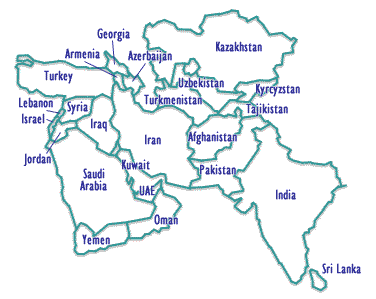
Map of the Middle East

Here’s an excellent assessment of the threat from the American Enterprise Institute.

Excerpt:

The revelation that the Iranian Revolutionary Guards Corps and its Quds Force had plotted to kill Saudi Arabia’s ambassador to the United States–by blowing him up as he dined at a Washington restaurant–is a stark reminder of the nature of the Tehran regime and its ambitions. But perhaps the most disturbing aspect of the story is that Iran’s thugs are developing a strategic partnership with Mexico’s most violent thugs: Los Zetas may only be the second-largest drug cartel in the Drug Enforcement Administration’s rankings, but they’re probably the most lethal. The gang is said to have formed around a platoon’s worth of deserters from Mexico’s special operations forces, and became the elite troops of another Mexican drug organization, the Gulf Cartel. The leader of that cartel got himself arrested, and the Zetas moved out on their own.

[…]The alliance with the Zetas is only the tip of the Iranian iceberg in Latin America. As Roger Noriega and Jose Cardenas have recently written, “Iran has made the Western Hemisphere a priority….The real game changer has been the alliance developed between Iran’s Mahmoud Ahmedinejad and Venezuela’s Hugo Chavez.” In addition to the Quds Force, Iran often operates through Hezbollah, which has established networks in the Lebanese communities that have long-standing enclaves in the trading and port cities of South America. In addition to Chavez, Iran has established closer ties to the Bolivian government of Evo Morales’s and Rafael Correa’s regime in Ecuador.

[…]We underestimate the Quds-Zeta partnership at our peril. The distinction between law enforcement and warfare is increasingly blurred; the Mexican government claims it had a hand in exposing the plot and it was a DEA agent who foiled the attack. While the Obama administration was right to bring charges against the operatives who plotted to kill the Saudi ambassador, this is a response to symptoms, not the disease. The larger problem is the maturing anti-America coalition governments and extremely rich, powerful, and violent groups; thinking of these organizations simply as criminals obscures their political interests–in keeping governments like Mexico’s or Colombia’s weak, in securing sanctuary, in access to the “international commons,” and the like. An appropriate response demands an integrated strategy. The biggest danger is not “militarizing” U.S. policy but in failing to address the fundamental security issues at stake.

The Obama administration’s lack of concern about border security is very disturbing, but they don’t dare to offend their open-borders constituency for a little thing like national security. Even so, the best defense might be a good offense – but is Obama willing to go on the offensive? Not so much. Instead, Obama seems to be resigned to letting Iran have nuclear weapons.

Excerpt:

Khamenei probably approved a strike in Washington because he no longer fears American military might. Iran’s advancing nuclear-weapons program has undoubtedly fortified his spine, as American presidents have called it “unacceptable” yet done nothing about it. And neither George W. Bush nor Barack Obama retaliated against Iran’s murderous missions in Iraq and Afghanistan.

President Obama has clearly shown he wants no part—or any Israeli part—in a preventive military strike against Iran’s nuclear sites. And Mr. Obama has pulled almost all U.S. troops out of Iraq and clearly wants to do the same in Afghanistan. Many Americans may view that as a blessing, but it is also clearly a sign that Washington no longer has the desire to maintain hegemony in the Middle East.

That’s an invitation to someone like Khamenei to push further, to attack both America and Iran’s most detested Middle Eastern rival, the virulently anti-Shiite Saudi Arabia. In the Islamic Republic’s conspiracy-laden world, the Saudis are part of the anti-Iranian American Arab realm, which is currently trying to down Iran’s close ally, Bashar al-Assad’s Syria, and squash the Shiites of Bahrain. Blowing up the Saudi ambassador in Washington would be an appealing counterstroke against the two foreign forces that Khamenei detests most.

The Obama administration will be tempted to respond against Iran with further unilateral and multilateral sanctions. More sanctions aren’t a bad idea—targeted sanctions against the Revolutionary Guards and the sale of gasoline made from Iranian crude can hurt Tehran financially. But they will not scare it. The White House needs to respond militarily to this outrage. If we don’t, we are asking for it.

The longer Obama leaves this, the worse the eventual war in the Middle East is going to be. We should at the very least be pursuing aggressive covert operations against Syrian and Iranian targets. I hope everyone remembers the slap on the wrist that Obama is giving Iran now, so that when we get attacked more and more, with more dangerous weapons, the correct people get the blame.

Navy vice admiral assesses the nuclear arms treaty signed by Obama

Story here from the U.S. Naval Institute web site.

Excerpt:

President Barack Obama was outmaneuvered by the Russians and should have abandoned the New START negotiations instead of seeking a political victory, says former nuclear plans monitor Vice Admiral Jerry Miller, USN (Ret).

“The Obama administration is continuing a dated policy in which we cannot even unilaterally reduce our own inventory of weapons and delivery systems without being on parity with the Russians,” Miller told the U.S. Naval Institute in Annapolis, Md. “We could give up plenty of deployed delivery systems and not adversely affect our national security one bit, but New START prohibits such action – so we are now stuck with some outmoded and useless elements in our nuke force.”

After meeting resistance from several Republicans, the U.S. Senate ratified the New Strategic Arms Reduction Treaty (START) with Russia by a vote of 71-26 on Wednesday.

“The Soviets/Russians were done in by Reagan and our missile defense program because they cannot afford to build such a system,” said Miller. “They instead try to counter our program with rhetoric at the bargaining table. And they won by outmaneuvering Obama.  START plays right into their hands.”

Former President Ronald Reagan’s Strategic Defense Initiative (SDI) is often credited with bankrupting the U.S.S.R. because the Soviets were unable to keep pace with the technology being developed by the United States.

“We have always been superior in quality of our nuclear force, so we did not have to negotiate with a party we do not trust,” said Miller. “If Obama wanted to save some money and improve national defense, he should have gotten out of the nuke negations and acted unilaterally. START is simply a political victory for Obama.”

Miller, who helped prepare the National Strategic Target List and Single Integrated Operational Plan for waging nuclear war and later participated in arms control meetings with the Soviet government, expressed concern that START could leave the United States vulnerable to other emerging threats.

“The treaty prohibits the conversion of an existing ballistic missile system into a missile defense system,” said Miller. “We might want to do that with a Trident or an ICBM sometime in the future, particularly if the Chinese alleged threat materializes.”

Obama put short-term political gain over long-term national security. He gave away the store. He was outmaneuvered because Democrats are not serious or competent on national security issues.