Tag Archives: Nuclear Proliferation

John Bolton: U.S. deal with Iran is an “abject surrender”

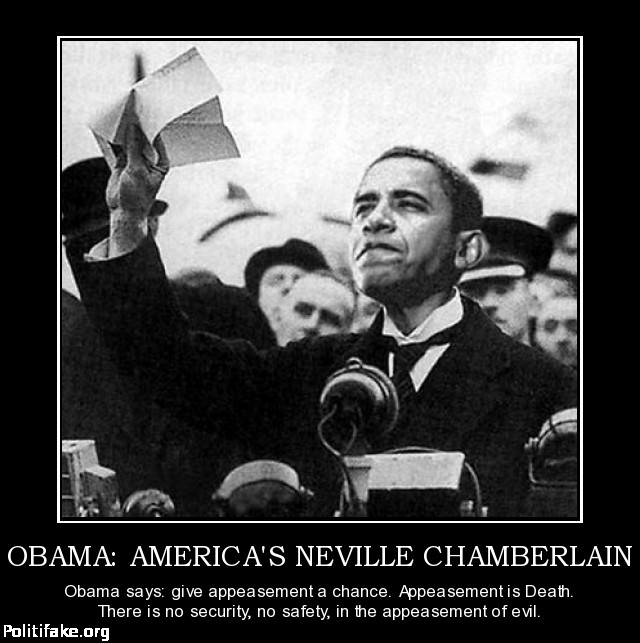
Neville Chamberlain Obama: peace in our time

The Weekly Standard featured a column by foreign policy heavyweight John Bolton.

Excerpt:

Negotiations for an “interim” arrangement over Iran’s nuclear weapons program finally succeeded this past weekend, as Security Council foreign ministers (plus Germany) flew to Geneva to meet their Iranian counterpart.  After raising expectations of a deal by first convening on November 8-10, it would have been beyond humiliating to gather again without result.  So agreement was struck despite solemn incantations earlier that “no deal is better than a bad deal.”

This interim agreement is badly skewed from America’s perspective.  Iran retains its full capacity to enrich uranium, thus abandoning a decade of Western insistence and Security Council resolutions that Iran stop all uranium-enrichment activities. Allowing Iran to continue enriching, and despite modest (indeed, utterly inadequate) measures to prevent it from increasing its enriched-uranium stockpiles and its overall nuclear infrastructure, lays the predicate for Iran fully enjoying its “right” to enrichment in any “final” agreement.  Indeed, the interim agreement itself acknowledges that a “comprehensive solution” will “involve a mutually defined enrichment program.”  This is not, as the Obama administration leaked before the deal became public, a “compromise” on Iran’s claimed “right” to enrichment. This is abject surrender by the United States.

In exchange for superficial concessions, Iran achieved three critical breakthroughs. First, it bought time to continue all aspects of its nuclear-weapons program the agreement does not cover (centrifuge manufacturing and testing; weaponization research and fabrication; and its entire ballistic missile program). Indeed, given that the interim agreement contemplates periodic renewals, Iran may have gained all of the time it needs to achieve weaponization not of simply a handful of nuclear weapons, but of dozens or more.

Second, Iran has gained legitimacy. This central banker of international terrorism and flagrant nuclear proliferator is once again part of the international club.  Much as the Syria chemical-weapons agreement buttressed Bashar al-Assad, the mullahs have escaped the political deep freezer.

Third, Iran has broken the psychological momentum and effect of the international economic sanctions. While estimates differ on Iran’s precise gain, it is considerable ($7 billion is the lowest estimate), and presages much more.  Tehran correctly assessed that a mere six-months’ easing of sanctions will make it extraordinarily hard for the West to reverse direction, even faced with systematic violations of Iran’s nuclear pledges.  Major oil-importing countries (China, India, South Korea, and others) were already chafing under U.S. sanctions, sensing President Obama had no stomach either to impose sanctions on them, or pay the domestic political price of granting further waivers.

Seven billion dollars in funding for a nation that is a known sponsor of anti-American terrorism. What kind of moron makes a deal with a regime that is on record for wanting to attack Israel with nuclear weapons? Some sort of reincarnation of Neville Chamberlain, that’s who.

Previously, the Obama administration had been accuesed of leaking details of a strike plan by Israel against Iranian nuclear facilities.

From ABC News.

Excerpt:

Two reports today about Iran’s nuclear program and the possibility of an Israeli military strike have analysts in Israel accusing the Obama administration leaking information to pressure Israel not to bomb Iran and for Iran to reach a compromise in upcoming nuclear talks.

The first report in Foreign Policy quotes anonymous American officials saying that Israel has been given access to airbases by Iran’s northern neighbor Azerbaijan from which Israel could launch air strikes or at least drones and search and rescue aircraft.

The second report from Bloomberg, based on a leaked congressional report, said that Iran’s nuclear facilities are so dispersed that it is “unclear what the ultimate effect of a strike would be…” A strike could delay Iran as little as six months, a former official told the researchers.

“It seems like a big campaign to prevent Israel from attacking,” analyst Yoel Guzansky at the Institute for National Security Studies told ABC News. “I think the [Obama] administration is really worried Jerusalem will attack and attack soon. They’re trying hard to prevent it in so many ways.”

[…]Thursday’s reports come a week after the results of a classified war game was leaked to the New York Times which predicted that an Israeli strike could lead to a wider regional war and result in hundreds of American deaths. In a column this afternoon titled “Obama Betraying Israel?” longtime defense commentator Ron Ben-Yishai at Yedioth Ahronoth newspaper angrily denounced the leaks as a “targeted assassination campaign.”

“In recent weeks the administration shifted from persuasion efforts vis-à-vis decision-makers and Israel’s public opinion to a practical, targeted assassination of potential Israeli operations in Iran,” Ben-Yishai writes. “The campaign’s aims are fully operational: To make it more difficult for Israeli decision-makers to order the IDF [Israeli Defense Forces] to carry out a strike, and what’s even graver, to erode the IDF’s capacity to launch such strike with minimal casualties.”

Maybe in the next election, Jewish-American voters will think a little more about who to vote for, in view of these facts. Or maybe it will take the actual nuclear destruction of Israel by Iran to get over their prejudices. As a supporter of peaceful democracies like Israel, I hope it doesn’t come to that.
Can the Democrats be trusted to protect our national security?

A Washington Post editorial by three Republican senators highlights a persistent problem.

Excerpt:

Espionage is a dangerous business often seen only through a Hollywood lens. Yet the real-world operations, and lives, that inspire such thrillers are highly perishable. They depend on hundreds of hours of painstaking work and the ability to get foreigners to trust our government.

Sitting in a prison cell in Pakistan is one of those foreigners who trusted us. Shakil Afridi served as a key informant to the United States in the raid that killed Osama bin Laden. This brave physician put his life on the line to assist U.S. efforts to track down the most-wanted terrorist in the world, yet our government left him vulnerable to the Pakistani tribal justice system, which sentenced him to 33 years for treason. The imprisonment and possible torture of this courageous man — for aiding the United States in one of the most important intelligence operations of our time — coincides with a deeply damaging leak in another case.

The world learned a few weeks ago that U.S. intelligence agencies and partners had disrupted an al-Qaeda plot to blow up a civilian aircraft using an explosive device designed by an affiliate in Yemen. This disclosure revealed sources and methods that could make future successes more difficult to achieve. The public release of information surrounding such operations also risks the lives of informants and makes it more difficult to maintain productive partnerships with other intelligence agencies. These incidents paint a disappointing picture of this administration’s judgment when it comes to national security.

[…]The problem stems in part from the media’s insatiable desire for real-world information that makes intelligence operations look like those of filmmakers’ imaginations. That is understandable, but this hunger is fed by inexcusable contributions from current and former U.S. officials.

For example, why did the Obama administration hold a conference call May 7 with a collection of former government officials, some of whom work as TV contributors and analysts, to discuss the foiled bomb threat? In doing so, the White House failed to safeguard sensitive intelligence information that gave us an advantage over an adversary. Broadcasting highly classified information notifies every enemy of our tactics and every current and future partner of our inability to provide them the secrecy that often is the difference between life and death.

[…]When they leave Capitol Hill, former members of Congress and their staff are, by law, prohibited from petitioning their former congressional colleagues for up to two years. Yet nothing restricts former security officials from using their government contacts and experience to provide live commentary on breaking news stories.

Furthermore, nothing limits current officials from using their media contacts to control a story — or to even promote a big-budget movie. We were shocked to learn that the White House has also leaked classified details of the bin Laden raid to Hollywood filmmakers, including the confidential identities of elite U.S. military personnel.

The authors:

Dan Coats, Richard Burr and Marco Rubio, all Republicans, represent Indiana, North Carolina and Florida, respectively, in the U.S. Senate and are members of the Senate Select Committee on Intelligence.

Here’s my take: Democrats want to equalize influence between our country and countries like Iran, China and North Korea. One way they can do this is by undermining our ability to defend our interests abroad. It’s all part of the leftist dream of making everyone “equal” so that there are no disagreements. In a very real sense, leftists are responsible for enabling the human rights abuses and purges that go on in countries like Iran, China and North Korea. They don’t really think that things like shooting pro-Democracy protestors (Iran), coerced abortion (China) and executing Christians for distributing Bibles (North Korea), etc. should be opposed with American influence.

Charles Krauthammer and Ralph Peters on Obama’s foreign policy

What will we do now?

Moderate conservative Charles Krauthammer summarizes Obama’s foreign policy in the Washington Post. (H/T Muddling Towards Maturity)

Excerpt:

It is perfectly obvious that Iran’s latest uranium maneuver, brokered by Brazil and Turkey, is a ruse. Iran retains more than enough enriched uranium to make a bomb. And it continues enriching at an accelerated pace and to a greater purity (20 percent).

It will… make meaningful sanctions more difficult.

[…]But the deeper meaning of the uranium-export stunt is the brazenness with which Brazil and Turkey gave cover to the mullahs’ nuclear ambitions and deliberately undermined U.S. efforts to curb Iran’s program.

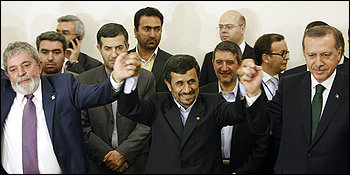
The real news is that already notorious photo: the president of Brazil, our largest ally in Latin America, and the prime minister of Turkey, for more than half a century the Muslim anchor of NATO, raising hands together with Mahmoud Ahmadinejad, the most virulently anti-American leader in the world.

Krauthammer then explains what drove Brazil and Turkey to abandon US interests and side with Iran.

He writes:

They’ve watched America acquiesce to Russia’s re-exerting sway over Eastern Europe, over Ukraine (pressured by Russia last month into extending for 25 years its lease of the Black Sea naval base at Sevastopol) and over Georgia (Russia’s de facto annexation of Abkhazia and South Ossetia is no longer an issue under the Obama “reset” policy).

They’ve watched our appeasement of Syria, Iran’s agent in the Arab Levant — sending our ambassador back to Syria even as it tightens its grip on Lebanon, supplies Hezbollah with Scuds, and intensifies its role as the pivot of the Iran-Hezbollah-Hamas alliance. The price for this ostentatious flouting of the U.S. and its interests? Ever more eager U.S. “engagement.”

They’ve observed the administration’s gratuitous slap at Britain over the Falklands, its contemptuous treatment of Israel, its undercutting of the Czech Republic and Poland, and its indifference to Lebanon and Georgia. And in Latin America, they see not just U.S. passivity as Venezuela’s Hugo Chavez organizes his anti-American “Bolivarian” coalition while deepening military and commercial ties with Iran and Russia. They saw active U.S. support in Honduras for a pro-Chavez would-be dictator seeking unconstitutional powers in defiance of the democratic institutions of that country.

Now take a look at the words of moderate Ralph Peters in the NY Post. (H/T Muddling Towards Maturity)

Excerpt:

What Brazil and Turkey just did wasn’t intended to impede Tehran, but to make it harder for Western powers to impose sanctions. Both countries want Iran to run interference for them.Once Iran gets the bomb and takes the (slight) heat, Brazil and Turkey both intend to go nuclear.

Brazil wants vanity nukes to cement its position as South America’s hegemon, a regional alternative to the US. Turkey’s slow-roll Islamist government dreams of a new Ottoman age — as it turns from the West to embrace the Muslim states it ruled a century ago. After easing Tehran’s path to the bomb, Ankara will claim that it needs its own nuclear capability to maintain regional stability.

But the coming widespread proliferation of nuclear weapons will be profoundly destabilizing. Each Middle Eastern country, especially, that goes nuclear increases the probability of a nuke exchange exponentially.

As Western states fantasize about a “nuclear-weapons-free world,” their developing-world darlings are scrambling like mad to develop nuclear arsenals. And we don’t get it.