
Tag Archives: National Security

Russians develop fifth-generation PAK FA stealth multi-role fighter

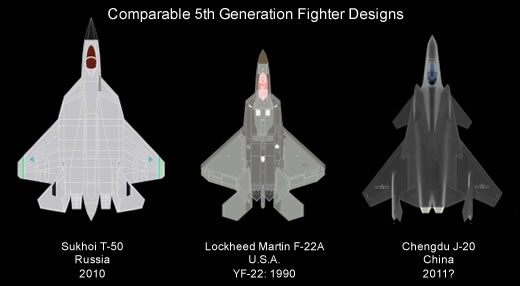
The American F-22, the Russian T-50 and the Chinese J-20

From the Heritage Foundation blog, some disturbing news about fifth generation fighter technology.

Excerpt:

The chief of Russia’s air force announced this week that the PAK FA, Russia’s fifth-generation stealth fighter, will enter service in 2015. This would be close to the time when two U.S. F-35 Joint Strike Fighter variants for the U.S. Air Force (F-35A) and the Navy (F-35C) are expected to attain initial operational capability in 2016. This display means the U.S. must keep its own Joint Strike Fighter program on schedule for production.

The public flight of a PAK FA’s T-50 prototype before the world, at the MAKS–2011 International Aviation and Space Salon, is a demonstration of Russia’s firm commitment to develop this aircraft for its own use and to sell it around the world.

Russian authorities have declared that they intend to acquire 60 PAK FA aircraft by 2020. Russia’s stated objective is to acquire 250 fifth-generation aircraft, but more are possible. India would acquire at least 250 and up to 300 of its PAK FA version, the Fifth-Generation Fighter Aircraft.

With the closure of the U.S. F-22 stealth fighter production line at 187 aircraft, America’s main answer—and that of U.S. allies—to the PAK FA is the F-35, a multirole fighter. While it is too soon to know, the F-35 may ultimately have inferior specifications to the Russian fighter in terms of speed, maneuverability, range, weapons load, and possibly even stealth. In this regard, the Russians have described the future operational PAK FA as a fighter whose “use of composite materials and advanced technologies…minimizes its radio-frequency, optical and infrared visibility.”

[…]Congress should consider the implications of Russia exporting this stealth fighter to other nations. In addition to India, Russia could sell the PAK FA to Iran if the U.N. arms embargo is lifted, or to Arab countries if the U.S. refuses to sell them the F–35, as well as to Venezuela, Vietnam, Indonesia, Malaysia, and perhaps even China, since the PAK FA appears to have more internal bomb capacity than the J–20.

The J-20 is China’s 5th generation stealth fighter.

Meanwhile, the Obama administration has shuttered production of the only thing that can stop these Russian and Chinese fighters – the F-22 Raptor. And the Democrats would love to cut anything else they can get their hands on in order to buy more votes before the 2012 election. It’s like putting drug addicts in charge of a bank vault. They love power, and they’ll do anything to get their fix in the short-term.
Should we cut foreign aid to governments who oppose us at the UN?

From CNS News, a story about foreign policy.

Excerpt:

A Republican amendment to appropriations legislation would bar funding for any government that opposes the U.S. position at the United Nations more often than not. Although unlikely to make it into law, the amendment draws fresh attention to the fact that a majority of countries, including most leading recipients of U.S. foreign aid, would fall into that category.

Among multiple amendments inserted into the State Department and foreign operations authorization bill during a House Foreign Affairs Committee markup last week was one by Rep. Jeff Duncan (R-S.C.) prohibiting any foreign assistance to governments that vote against the U.S. position at the U.N. more than 50 percent of the time.

Grades would be obtained from annual State Department reports on voting practices at the U.N., which have been required under U.S. law for decades, and would relate to votes in the General Assembly during its most recent session, or in the case of members of the Security Council, to their votes in both the council and assembly.

In order to waive the prohibition, the president would, on a case-by-case basis, have to issue Congress with a determination that invoking the waiver was “important to the national interests of the United States.”

Duncan’s amendment passed by a party-line vote of 22-18, and was among those incorporated into the final version of the bill that passed out of the full committee by a 23-20 vote late last Thursday night.

“We’re $14.3 trillion in debt,” the tea party-backed Republican freshman said in a statement Monday. “Why should we pay countries to hate us when they’ve shown they’re willing to do it for free?”

“The United States has no business giving money away to countries and groups who seek to do us harm.”

This bill makes sense, so the Democrats are opposed to it.

Did Obama’s foreign policy make America more respected abroad?

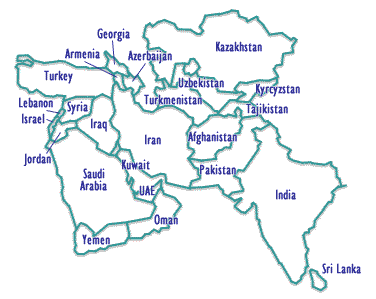
Map of the Middle East

From Investors Business Daily.

Excerpt:

In the Middle East, where U.S. military involvement and diplomacy are most closely watched, President Obama is held in lower regard in the Arab world than President Bush was in the last year of his presidency.

Obama is not only less liked than the supposedly hated Bush, he can’t even hold a candle to Iran’s grubby, menacing Mahmoud Ahmadinejad. Zogby reports that in Egypt, 31% of Egyptians agree with Iran’s policies compared with 3% for Obama’s, with similar figures in Jordan. Among Egyptians, just 5% hold a favorable attitude toward the U.S. compared with 9% in 2008.

[…]Clinton will do no better in bilateral talks with the Turks — a nation that has moved so far away from its long alliance with the U.S. it can only be called a former ally — on Syria, Iran and Israel/Palestine.

In these countries, Obama’s policy can be summed up in a litany of ineffectual maneuvers.

On Syria, the first move was to succor, then to scold as the dictatorship indifferently sheds streams of blood in the streets of Damascus — showing the fundamental disconnect between what the brutal Syrian regime is and what the Obama administration thinks it is.

After throwing Tunisia and Egypt, two pro-Western allies, overboard, the administration ineffectually grasps a problem in Syria as the bodies pile up.

On Iran, Obama policy shows even more weakness. The president wasted two years coddling the monster regime that threatens a region of more than a billion people. He missed a chance to support a student uprising in 2009 and now watches as Iran’s illegal nuclear program speeds ahead with little fear of consequences, more brazen and closer to realization.

Whatever this learning-curve policy amounts to, it garners no international respect.

Then there’s the stance the White House has taken on Israel, abusively telling its ally to retreat to 1967 borders. It emboldened provocations from Palestinian terrorist groups and showed the rest of the Arab world that it pays more to be America’s enemy than its friend. Now the Arab League is moving to recognize Palestine.

It turns out that what foreign powers respect is strength, not weakness.