
Tag Archives: Money

Mitt Romney outspent Rick Santorum 4-1 in Wisconsin

From liberal CNN.

Excerpt:

Ads, phone calls and mailers have bombarded voters in Wisconsin in the days leading up to Tuesday’s vote — the next major battleground in the Republican presidential race.

The Badger State primary has gained significance over the last week as both Mitt Romney’s and Rick Santorum’s campaigns have indicated it could dramatically alter the momentum and duration of the race.

Romney and his allies have outspent their rivals by a little less than a 4-1 margin on television ads in the state, according to figures provided by an unaligned Republican media consultant that tracks ad spending in the nomination race.

Romney leads polls in Wisconsin and is expected to win in the District of Columbia and Maryland, which also vote Tuesday.

And something interesting from The Other McCain:

UPDATE 10:50 p.m. ETChris Moody of Yahoo News writes about Santorum’s campaign in Wisconsin, which included visits to seven bowling alleys and more than a few beers:

He has arguably been one of the hardest working candidates in the race, having labored his way up from the bottom of the polls when he held events in Iowa that literally no one showed up for, to becoming the lead rival to the frontrunner. The man has only taken five days off the campaign trail since last summer, and spent most of that time eking his way along financially. With weak organization to speak of and an entourage that consisted of little more than the candidate and a friend with a Dodge Ram, Santorum went from being the candidate who could hardly get his name on the ballot in some states to becoming a household name.

Ho-hum. Mitt Romney buys another state in the Republican primary. If they were spending the same amount of money, Santorum would win the primary by a landslide. This primary is being decided by money – Mitt Romney’s millions, to be precise. Romney also gets lots of money from global warming socialists and rich Wall Street bankers.

Here are Mitt Romney’s top contributors:

Goldman Sachs $521,180
JPMorgan Chase & Co $356,400
Morgan Stanley $297,550
Credit Suisse Group $296,160
Citigroup Inc $280,050
Bank of America $245,900
Kirkland & Ellis $225,202
Barclays $217,150
HIG Capital $188,500
PricewaterhouseCoopers $185,550
Blackstone Group $178,050
Bain Capital $151,500
Wells Fargo $148,950
UBS AG $140,650
EMC Corp $128,300
Citadel Investment Group $123,625
Elliott Management $123,500
Bain & Co $112,800
Sullivan & Cromwell $106,650
The Villages $97,500

Rick Santorum has to go door to door for his votes.
Blue collar Rick Santorum outspent 7 to 1 by wealthy Mitt Romney in Illinois

From CNS News.

Excerpt:

Dealt a resounding defeat in Illinois’ presidential primary, Republican Rick Santorum brushed off the latest loss to rival Mitt Romney and told his supporters on Tuesday to “saddle up like Reagan did in the cowboy movies” and help him narrow a seemingly insurmountable deficit in delegates.

Santorum had hoped to make a real contest of Illinois, the birthplace of actor turned president Ronald Reagan, but he was outspent in advertising by a 7-to-1 margin by Romney and his allies and fled the state before balloting began.

“We’re heading to Louisiana for the rest of the week, then we’re back here in Pennsylvania and we’re going to pick up a whole boatload of delegates and close this gap and then on to victory,” he told a packed hotel ballroom in Gettysburg, Pa., as more than 1,000 supporters waited outside.

Santorum won the Southern states of Alabama and Mississippi last week. Romney has not posted a win in the South since his January triumph in Florida.

“We’re feeling very, very good about winning Louisiana on Saturday,” Santorum said to cheers.

A 10-day break follows Louisiana before Washington, D.C., Maryland and Wisconsin have primaries on April 3. Santorum is not on the ballot in the nation’s capital, the latest example of his campaign’s struggle to organize.

But Santorum has shown new signs of political life. Aides said the campaign raised more than $9 million in February and has more than $2.6 million on hand for a Republican primary that shows no sign of ending soon.

Santorum campaign sought to downplay the Illinois results, instead looking at adding delegates from rural areas to Santorum’s column in any sum.

Who is funding all of this campaign spending? Here are Mitt Romney’s top contributors:

Goldman Sachs $521,180
JPMorgan Chase & Co $356,400
Morgan Stanley $297,550
Credit Suisse Group $296,160
Citigroup Inc $280,050
Bank of America $245,900
Kirkland & Ellis $225,202
Barclays $217,150
HIG Capital $188,500
PricewaterhouseCoopers $185,550
Blackstone Group $178,050
Bain Capital $151,500
Wells Fargo $148,950
UBS AG $140,650
EMC Corp $128,300
Citadel Investment Group $123,625
Elliott Management $123,500
Bain & Co $112,800
Sullivan & Cromwell $106,650
The Villages $97,500

I pointed out before how Romney’s campaign is fueled by green socialists. His PAC just got $6.4 million from only 98 donors.

New paper on income inequality: Does taxing the rich hurt the middle class?

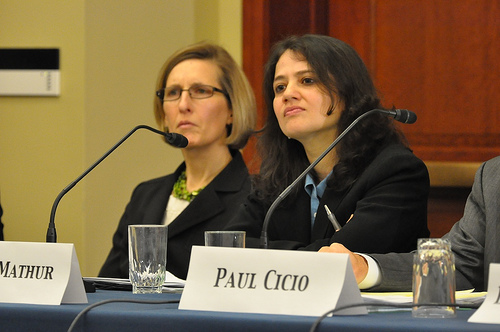
Aparna Mathur (right)

Here’s an article by Indian economist Aparna Mathur.

She writes (in part):

In a recent paper that I co-authored with Kevin Hassett, we explored the effect of high corporate taxes on worker wages. The motivation for the paper came from the international tax literature (summarized by Roger Gordon and Jim Hines in a 2002 paper1) that suggested that mobile capital flows from high tax to low tax jurisdictions. In other words, in any set of competing countries, investment flows are determined by relative rates of taxation. The current U.S. headline rate of corporate tax is 35 percent. The combined federal and state statutory rate of 39 percent is second only to Japan in the OECD. With Japan set to lower its statutory rate later this year, the U.S. rate will soon be the highest in the OECD and one of the highest in the world. What effect do these high rates have on worker wages?

When capital flows out of a high tax country, such as the United States, it leads to lower domestic investment, as firms decide against adding a new machine or building a factory. The lower levels of investment affect the productivity of the American worker, because they may not have the best machines or enough machines to work with. This leads to lower wages, as there is a tight link between workers’ productivity and their pay. It could also lead to less demand for workers, since the firms have decided to carry out investment activities elsewhere.

Our paper was one of the first to explore the adverse effect of corporate taxes on worker wages. Using data on more than 100 countries, we found that higher corporate taxes lead to lower wages. In fact, workers shoulder a much larger share of the corporate tax burden (more than 100 percent) than had previously been assumed. The reason the incidence can be higher than 100 percent is neatly explained in a 2006 paper by the famous economist Arnold Harberger.2 Simply put, when taxes are imposed on a corporation, wages are lowered not only for the workers in that firm, but for all workers in the economy since otherwise competition would drive workers away from the low-wage firms. As a result, a $1 corporate income tax on a firm could lead to a $1 loss in wages for workers in that firm, but could also lead to more than a $1 loss overall when we look at the lower wages across all workers.

Following our paper, several academic economists substantiated our results, using different data sets and applying varied econometric modeling and techniques. Some examples of these studies include a 2007 paper by Mihir A. Desai and C. Fritz Foley of Harvard Business School and James Hines Jr. of Michigan University Law School, a 2007 paper by R. Alison Felix of the Federal Reserve Bank of Kansas City, a 2009 paper by Robert Carroll of The Tax Foundation, and a 2010 paper by Wiji Arulampalam of the University of Warwick and Michael Devereux and Giorgia Maffini of Oxford.3 A recent Tax Notes article that I co-authored summarizes these various studies and also the lessons from the theoretical literature on the topic. The general consensus from theory and empirical work is that while we may argue academically about the size of the effect, there is no disagreement among economists that a sizeable burden of the corporate income tax is disproportionately felt by working Americans. On average, a $1 increase in corporate tax revenues could lead to a dollar or more decline in the wage bill.

Conservatives and liberals have the same goal. We both want to help the poor. Liberals think that taking money from the rich and giving it to the poor helps, but all it does it cause the rich to move their capital and jobs elsewhere, leaving the poor poorer. Conservatives let the rich keep their money and encourage them to risk it trying to make more money by engaging in enterprises that create wealth – creating products and services from less valuable raw materials. In a socialist system, the rich get poorer, but so do the poor. In a capitalist system, the rich get very rich, but the poor also gain more wealth. That’s what happens when corporations like Apple make IPads out of junky raw materials. That’s how wealth is created – by letting people who want to make things keep more of what they earn. We all benefit from encouraging people to make new things and provide value for their neighbors.

Related articles