
Tag Archives: Meaning

Are Christians responsible for making plans and making good decisions?

Here’s a wonderful post on decision making and the will of God posted on Neil’s blog. In his post, Neil explains the Biblical model for making good decisions.

Excerpt:

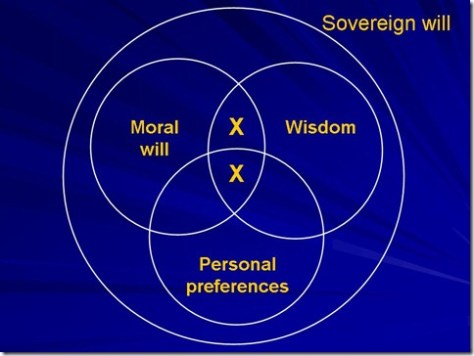
Really short version: Aside from direct and clear personal revelation from God, you don’t have access to his sovereign will when making decisions.  Therefore you must look at other factors.  If it isn’t moral, don’t do it.  If it is moral but not wise, don’t do it.  If it is moral and wise, then use your personal preferences.

Using this model you can end up with a wise and biblical decision, but you have avoided the traps of the “God told me to ____” routine.  People who run around saying that God told them this and that convey a super-spirituality that can leave less mature believers wondering if they really have a relationship with God (i.e., “God doesn’t tell me every little thing to do, so maybe I don’t really know him.”).

He has a helpful picture posted as well:
This is actually a very important topic for me, because I like making plans and making good decisions. I like being the quarterback or squad leader of my own life. I like to pick objectives and then make plans to achieve them. (Nothing too exotic, just simple stuff like saving money or reading more books)

Actually, I really oppose the idea that God has a magical fairy tale will for each person that will make them happy and fulfilled. For me, life isn’t like that. I don’t expect God to lead me along like a child at a scavenger hunt. I expect to survey the battlefield where I am and then do something to make a difference. There are lots of things you can do that will please God. Should you focus on your career and sponsor apologetics conferences? Or should you use your spare time preparing Sunday school lessons? There are lots of good things you could do to please God. Your job is to pick the one that will be the most effective. It doesn’t matter if it makes you happy, it only matters if it’s effective and if you are good at it.

Who is Rifleman Dodd?

A while back, I was busily working my way through the U.S. Marine Corps Official Reading List, and I came across a book by C.S. Forester called Rifleman Dodd, or alternatively titled Death to the French. It’s a work of historical fiction that takes place during the Napoleonic wars. The story is about a British marksman named Dodd, who is cut off from his own lines during a withdrawal maneuver. He is subsequently left to fend for himself behind enemy lines. An ordinary man might be full of despair and forget about his mission entirely. But Dodd is no ordinary man. Not only does he find a way to survive by finding food to eat, water to drink and places to sleep, but he also tries to remember his orders and to think about what he can do to advance the cause of his General, the Duke of Wellington.

Here’s an excerpt from a gritty book review:

It’s about a green-coated British infantry rifleman in the Napoleonic Wars, an age when rifles were a novelty and most of the army was red-coated and carried muskets. Private Matthew Dodd gets separated from his regiment during a retreat and finds himself stranded behind enemy (French) lines in Portugal. With the occasional aid of some natives, but mostly on his own, he harasses the French with his rifle and tries to prevent them from building a bridge across the Tagus River. It’s a remarkable tale of survival and solitary achievement, of a rank-and-file soldier who lives by his wits and slowly learns to make plans without orders, and shows leadership qualities and a knowledge of warfare.

I think we’re in the same situation as Dodd.

There is no point in us looking for breadcrumb trails to happiness at this point. That’s not the point of Christianity. The point of Christianity is friendship with God, imitation of Christ, honoring moral obligations, self-sacrificial love for your neighbor (and even your enemies!), and dedication to the truth – whether anyone else likes you or not. It’s not supposed to make you happy, and it’s not necessarily going to be a normal life like everyone else has. Things may not work out the way you’d like them to.

We seem to be making such a big deal about compassion and forgiveness in the Christian life these days – such a big emphasis on our feelings. Almost like we have forgotten that we have obligations to our friend – and his objectives. A relationship doesn’t mean that one person completely disregards the character and goals of the other person and then is automatically granted forgiveness whenever they want it. That’s not a friendship – that’s using someone else for your own ends. Maybe it’s time to remember what this is all about.


Walt Russell explains how to read the Bible effectively

Bible study that hits the spot

Dr. Walt Russell’s book on the subject of interpreting the Bible is called “Playing With Fire: How the Bible Ignites Change in Your Soul“. I like that book, but I found four articles that summarize the main points of the book so people can understand how to read the Bible at a high livel.

Here is part one which talks about how postmodern relativism is at odds with discovering the original intent of an author.

Excerpt:

Twenty-four year-old “Janet” (not her real name) was angry at my emphasis on seeking to discover authors’ intentions when we read their texts. She was an evangelical Christian and a second grade teacher in a public school. She prided herself in helping her 20 students learn to love literature. She would read them a story as they gathered around her, and then ask each child, “What does the story mean to you?” She prodded them to come up with their own unique meanings. With such strong encouragement, the class of 20 would eventually have 20 different meanings for the one story. Janet sensed that I was a naysayer about such “love of literature.” Pouring a little emotional gasoline on the fire, I said, “Janet, you’re certainly doing your part to insure that these 7 year-olds will never recover from a radically relativistic view of meaning!” Now I had her full attention.

Here is part two which talks about the importance of knowing the genre of a text before you try to interpret it.

Excerpt:

“INDIANS SLAY TIGERS!” — the newspaper headline virtually screams out at you. The thought of something being slain is repulsive. You’re gripped by a mental image of southern India’s Bengal tiger. You imagine its beautiful face, its stripes and piercing eyes. Then your image is shattered by the sudden blast of a high-powered rifle. You see the exquisite creature writhe in pain, fall gracelessly in its tracks and die. Having read no further than the headline, you feel sick, as if you’ve witnessed something tragic.

But should you feel this way? The slaughter of an endangered species — especially one as magnificent as the Bengal tiger — is horrifying, no doubt. But suppose you failed to notice that the headline “INDIANS SLAY TIGERS!” appeared in the sports page of the morning paper. Clearly enough, it now refers to different Indians, different Tigers and a different manner of slaying than you originally thought. And is it really that tragic that the Cleveland Indians badly beat the Detroit Tigers in a major league baseball game last night? Not unless you’re a long-suffering Detroit Tigers’ baseball fan. But how do you now know that the headline is about baseball and not tiger-slaying in India? You look at the words “INDIANS SLAY TIGERS” and you know exactly what each word means. When you combine these words, how can they not mean exactly what you first thought they did — that Indians slay tigers? Answer: because their meanings are communicated (as the meanings of all words are) through genres!

Here is part three which talks about the importance of reading the context of a verse before you try to interpret it.

Excerpt:

“Never Read a Bible Verse!” That’s the title of a little booklet my friend and Christian radio personality, Gregory Koukl, has written to help people read the Bible well. What great advice. “That’s right, never read a Bible verse. Instead, always read a paragraph — at least.” But the current is flowing the other way in our popular sound-bite culture. Not to be left out (or left behind!), the Church has its own version of sound-bite culture: verse-bite culture. In verse-bite culture we take a sentence or sentence-fragment from a biblical paragraph, memorize it out of context, write it on a little card, put it on a billboard, a plaque, a rock, etc. Somehow we think that just because this little chunk of Scripture has a verse number in front of it, it was meant to be a free-standing unit of thought. Nothing could be further from the truth.

Apart from the fact that chapter and verse divisions weren’t added to the New Testament text until 1560 — long after the New Testament’s inspired authorship — there is a more important reason for never reading just a Bible verse, and instead reading at least the paragraph that contains it.

Here is part four which talks about the importance of applying the words of the Bible to your life.

One verse that is often misinterpreted is missing from the articles, but present in the STR lecture. It’s Philippians 1:6 that says “6 being confident of this, that he who began a good work in you will carry it on to completion until the day of Christ Jesus”. Russell says in the lecture that this promise is specifically intended for the church in Philippi, to whom Paul is writing, not necessarily to all Christians. He is giving them a promise just after directly referring to their good work in supporting him in his ministry. Some verses are just not meant for us, and the context reveals it.

Andy Bannister and Michael Ruse discuss how atheists find meaning in life

Two horses fight it out, may the best horse win!
Two horses fight it out, and may the best horse win!

I’m summarizing the most recent episode of the Unbelievable show.

Details:

Atheist philosopher Michael Ruse joins Justin as we spend a second week looking at Andy Bannister’s new book ‘The atheist who didn’t exist’.

Its amusingly titled chapters include ‘The Peculiar Case of the Postmodern Penguin (or: Why Life without God is Meaningless). Michael and Andy debate whether it’s a problem that atheists can’t have meaning with a ‘capital M’.

Here is a summary of the discussion between Ruse and Bannister, and my comments below the summary.

The MP3 file is here.

Summary:

  • Ruse: ultimate questions are serious questions, and some religions are attempting to provide serious answers to those questions
  • Ruse: there is a psychological element to belief in God but it’s not a complete explanation, but it can apply to non-belief as well
  • Bannister: there are psychological reasons why people would prefer unbelief (quotes Thomas Nagel and Aldous Huxley)
  • Bannister: (to Ruse) what do you think would follow next if you got new information that caused you to believe in God?
  • Ruse: I’d feel scared, I’d think of all the reasons that God would dislike me, rather than any reasons why God would save me
  • Bannister: according to the Bible, God is not so much interested in mere belief, but in active trust in him
  • Ruse: without being smug, I just completed 50 years as a college professor of philosophy, and I have a sense of worth from that
  • Ruse: if God turns up, and says that 50 years of being a professor is not good enough, well, I don’t know God, I’m sorry, I did my best
  • Brierley: Andy, explain to us this story of how a penguin explained to you how he invented a subjective meaning in life for himself?
  • Brierley: (reads the story)
  • Bannister: when it comes to reading a book, the real meaning is the meaning the author intended the book to have
  • Bannister: readers can inject their own meaning into the book that has nothing to do with it, but the author gives the real meaning
  • Bannister: meaning in life is like reading a book – you can make up your own meaning, but the author’s meaning is the real meaning
  • Brierley: (to Ruse) on atheism, is there any objective meaning?
  • Ruse: “obviously, someone like myself cannot have meaning with a capital M in that sense”
  • Ruse: the real question is and atheist can find a sense of self-worth, “I find that I’m happier within myself, I can find meaning”
  • Bannister: what would you say to someone who drinks away the family inheritance and gets the same sense of happiness you have?
  • Bannister: what would you say to all the people who are unable to get “a sense of self-worth” from their career, because of where they are born, sickness, etc.
  • Ruse: I have nothing to offer them, some people are born into such awful situations that they are bound to be bad people
  • Ruse: these unfair accidents of birth, etc.,  fits with atheism better
  • Ruse: what we should do is change society so that more people can build a sense of self-worth through achievements
  • Ruse: that way, they can say to God “I used my talents” so they can create feelings of self-worth and happiness (apart from God)
  • Bannister: meaning in life cannot be answered without answering questions related to identity, value, which are rooted in the overall worldview
  • Bannister: on the Christian worldview, you have an infinite worth, your value isn’t determined by circumstances, earnings, friends, etc.
  • Bannister: your value comes from what Jesus was willing to pay to save you, namely, giving his own life for you
  • Bannister: when I travel to meet other Christians in other parts of the world, they have a happiness that should not be there if they are getting happiness from wealth, fame, achievements, etc.
  • Bannister: but when you come to the West, many people who have wealth, fame, achievement, etc. are unhappy
  • Ruse: well maybe who look after a flock of sheep every day may get a sense of self-worth from that, or from other jobs
  • Ruse: I do take Christianity very seriously, it is a grown-up proposal to answer grown-up questions – it works if it is true
  • Ruse: we don’t have to follow Nietzche’s statement that if there is no God, there is no meaning in life – we can find a middle way, we can achieve meaning in life by using our talents to achieve things
  • Bannister: I disagree with Michael, I don’t think that the meaning you invent for yourself is authentic meaning
  • Bannister: distracting yourself with amusing things and happiness is not an answer to the problem
  • Brierley: (to Ruse) are you saying that you have searched for ultimate meaning, and you are settling for subjective meaning?
  • Ruse: my subjective meaning is not second class to objective meaning, “I feel a real deep sense of achievement, of meaning, of self-worth, of having used my talents properly, and I don’t feel in any sense a sense of regret” (what matters to him is how he feels)
  • Bannister: notice how Michael keeps bringing in value judgments. e.g. – “use my talents well”, that implies that there is a right way and a wrong to use your talents, which assumes an objective scale of right and wrong, which makes no sense in atheism
  • Bannister: an atheist can sit in a sun room and enjoy the feelings of happiness generated by the light and heat of the Sun, without asking whether there is a Sun out there
  • Bannister: ultimately, at the end of the day, my concern is not whether something makes me happy or makes me feel fulfilled
  • Bannister: ultimately, at the end of the day, I think there is only one real reason to wrestle with these questions of meaning, and that is to find truth
  • Ruse: sometimes we reach a point where we cannot get to true answers to some questions, sometimes we look for truth, but then give up and confess “I cannot find it” and then move on from there

Is it possible to dispense with God’s advice on your decision-making and achieve something that affects a lot of people, or makes people like you, or makes you famous, etc., and then have that please God? “Look, God, I did something I liked that affected a lot of people, and made them feel happy as they were on their way to Hell because they rejected you”. Will rap musicians answer God by pointing to 50 years of leading people away from chastity with godless music? A lot of people went to see the “NWA” movie that celebrated musicians who have an anti-Christian view of women and violence. Can NWA present their “artistic work” to God and claim that God should be pleased with their successful efforts to get rich and famous? Having feelings of achievement doesn’t mean anything to God.

So what is the standard? How you imitate Jesus – self-control, self-denial and self-sacrifice to honor God – that is the standard. If I had to choose between giving up two hours of my life to summarize this discussion for my readers, and all the fame and fortune that people who make godless TV shows, movies and music have, I would choose to make this debate summary. My goal in life is not to have fun, thrills, travel and feel happy in this world. I have a Boss. Doing without fun, thrills, travel and happy feelings in order to put points on the board for my Boss is objectively meaningful. It’s may not seem like much compared to what James Bond does in million-dollar movies, but at least I am wearing the right uniform, and playing for the right team.

I was telling Dina recently, isn’t it remarkable how rarely in our culture that people actually talk about the big questions? If you look out at the culture, everything seems to be about feeling good, having fun, being liked by others. Not much about ultimate questions, and certainly not a truth-based assessment of the alternatives. .