
Tag Archives: Mammogram

American health care: does it cause poor life-expectancy and high infant mortality?

Probably one of the best health care policy experts writing today is Avik Roy, who writes for Forbes magazine.

Here is his latest column, which I think is useful for helping us all get better at debating health care policy. (H/T Matt from Well Spent Journey)

Excerpt:

It’s one of the most oft-repeated justifications for socialized medicine: Americans spend more money than other developed countries on health care, but don’t live as long. If we would just hop on the European health-care bandwagon, we’d live longer and healthier lives. The only problem is it’s not true.

[…]If you really want to measure health outcomes, the best way to do it is at the point of medical intervention. If you have a heart attack, how long do you live in the U.S. vs. another country? If you’re diagnosed with breast cancer? In 2008, a group of investigators conducted a worldwide study of cancer survival rates, called CONCORD. They looked at 5-year survival rates for breast cancer, colon and rectal cancer, and prostate cancer. I compiled their data for the U.S., Canada, Australia, Japan, and western Europe. Guess who came out number one?

Here is the raw data:
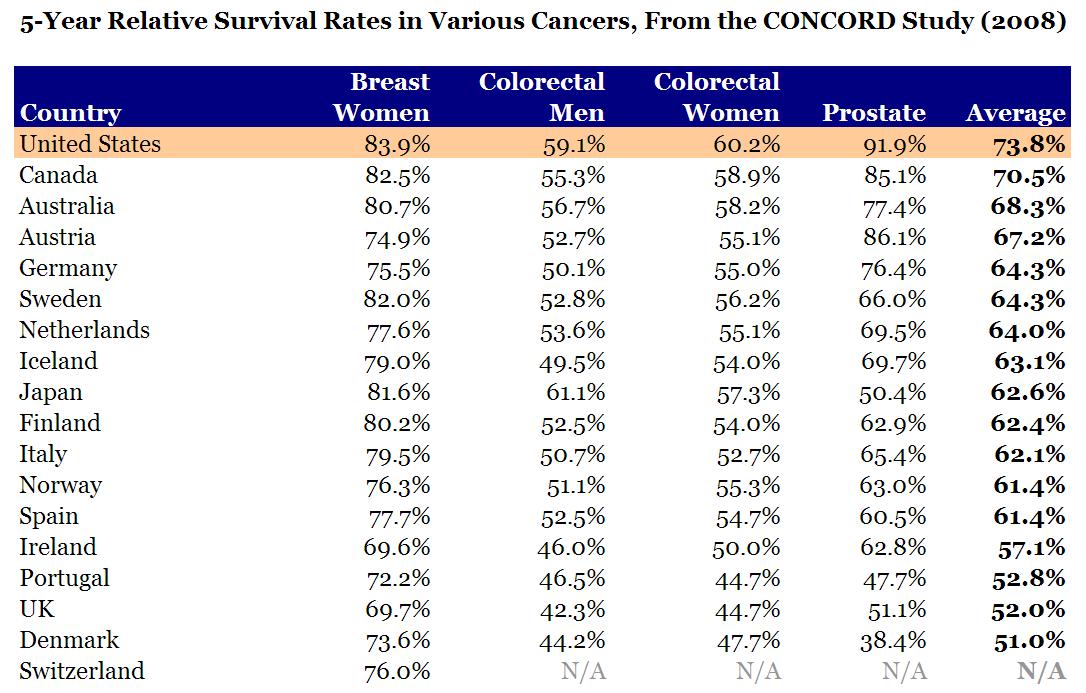
Health care outcomes
Health care outcomes by country and type of treatment

Click here to see the larger graph.

So, what explains this?

The article continues:

Another point worth making is that people die for other reasons than health. For example, people die because of car accidents and violent crime. A few years back, Robert Ohsfeldt of Texas A&M and John Schneider of the University of Iowa asked the obvious question: what happens if you remove deaths from fatal injuries from the life expectancy tables? Among the 29 members of the OECD, the U.S. vaults from 19th place to…you guessed it…first. Japan, on the same adjustment, drops from first to ninth.

It’s great that the Japanese eat more sushi than we do, and that they settle their arguments more peaceably. But these things don’t have anything to do with socialized medicine.

Finally, U.S. life-expectancy statistics are skewed by the fact that the U.S. doesn’t have one health-care system, but three: Medicaid, Medicare, and private insurance. (A fourth, the Obamacare exchanges, is supposed to go into effect in 2014.) As I have noted in the past, health outcomes for those on government-sponsored insurance are worse than for those on private insurance.

To my knowledge, no one has attempted to segregate U.S. life-expectancy figures by insurance status. But based on the data we have, it’s highly likely that those on private insurance have the best life expectancy, with Medicare patients in the middle, and the uninsured and Medicaid at the bottom.

I know that my readers who like to dig deep into economics and policy will love the links at the bottom of the article:

For further reading on the topic of life expectancy, here are some recommendations. Harvard economist Greg Mankiw discusses some of the confounding factors with life expectancy statistics, citing this NBER study by June and Dave O’Neill comparing the U.S. and Canada. (Mankiw calls the misuse of U.S. life expectancy stats “schlocky.”) Chicago economist Gary Becker makes note of the CONCORD study in this blog post. In 2009, Sam Preston and Jessica Ho of the University of Pennsylvania published a lengthy analysis of life expectancy statistics, concluding that “the low longevity ranking of the United States is not likely to be a result of a poorly functioning health care system.”

The funniest thing I have found when talking to people from countries with socialized health care systems, like Canada and the UK, is that they are woefully uninformed about American health care. They literally do not know about free emergency room care, which is free for anyone regardless of insurance – including illegal aliens. They do not know about our expensive Medicaid program, which helps people who cannot afford health insurance. And our very very expensive Medicare program, which provides health care to the elderly – including prescription drugs. I get the feeling that foreign critics of American health care are getting their views from amateur documentaries produced by uneducated Hollywood propagandists, or maybe from TV shows on the Comedy Channel. They certainly are not getting their information from peer-reviewed studies by credentialed scholars from top universities, like the ones cited above.

I have literally spoken to Canadians who think that people in the USA without insurance do not get treatment and just die in the streets from stab wounds. They don’t know about the emergency room rule, or about charity care, or about Medicaid and Medicare. There is a lot of ignorance up there – wilful ignorance, in some cases. And keep in mind that the average Canadian household is paying over $11,000 a year for this substandard health care! They are paying more for less, and that’s not surprising since a large chunk of the taxes that are collected for health care go to overpaid unionized bureaucrats. Naturally, when their left-wing politicians need treatment, the first place they go is to the United States, where they pay out of pocket for the better health care. But that doesn’t stop them from denouncing American health care when they are talking to voters.

Higher infant mortality rates?

One of the other common arguments you hear from uninformed people outside the USA is the higher infant mortality rates argument.

Here’s an article by Stanford University professor Scott Atlas to explain why the argument fails.

Excerpt:

Virtually every national and international agency involved in statistical assessments of health status, health care, and economic development uses the infant-mortality rate — the number of infants per 1,000 live births who die before reaching the age of one — as a fundamental indicator. America’s high infant-mortality rate has been repeatedly put forth as evidence “proving” the substandard performance of the U.S. health-care system.

[…]n a 2008 study, Joy Lawn estimated that a full three-fourths of the world’s neonatal deaths are counted only through highly unreliable five-yearly retrospective household surveys, instead of being reported at the time by hospitals and health-care professionals, as in the United States. Moreover, the most premature babies — those with the highest likelihood of dying — are the least likely to be recorded in infant and neonatal mortality statistics in other countries. Compounding that difficulty, in other countries the underreporting is greatest for deaths that occur very soon after birth.

[…]The United States strictly adheres to the WHO definition of live birth (any infant “irrespective of the duration of the pregnancy, which . . . breathes or shows any other evidence of life . . . whether or not the umbilical cord has been cut or the placenta is attached”) and uses a strictly implemented linked birth and infant-death data set. On the contrary, many other nations, including highly developed countries in Western Europe, use far less strict definitions, all of which underreport the live births of more fragile infants who soon die. As a consequence, they falsely report more favorable neonatal- and infant-mortality rates.

[…]Neonatal deaths are mainly associated with prematurity and low birth weight. Therefore the fact that the percentage of preterm births in the U.S. is far higher than that in all other OECD countries — 65 percent higher than in Britain, and more than double the rate in Ireland, Finland, and Greece — further undermines the validity of neonatal-mortality comparisons.

You can listen to a podcast with Dr. Atlas here, from the Library of Economics web site.

If you want to read more about how American health care compares with health care in socialized systems, read this article by Stanford University professor of medicine Dr. Scott Atlas. And you can get his book “In Excellent Health: Setting the Record Straight on America’s Health Care” from Amazon.

Abortion profiteers Planned Parenthood spending $12 million to re-elect Obama

From Life Site News.

Excerpt:

Hey, America, do you know what you’re funding when your taxes go to “women’s health” via Planned Parenthood? You think I’m going to say abortion, don’t you? I don’t actually need to say that since you’d have to be brain dead not to know that part. But how about to Barack Obama’s re-election? Wait, you say! Not us! We give my money to Planned Parenthood because women’s health is important. Our tax dollars should support this crucial organization.

Government grants and funding to Planned Parenthood in the last reported year, 2009-2010, was $487.4 million — and so far $12 million from the non-profit has been given to re-elect President Obama. That’s right. This organization that says it cares so much about your cervix cares more about it’s proverbial booty.

Never before has the abortion provider spent so much money in an election, reports say. Neither has there been a precedent for the mother hen to leave her roost and go full time on the campaign trail, as Planned Parenthood President Cecile Richards announced she’d be doing for Obama earlier this month. The woman who makes over $400K a year as the leader of the abortion provider has taken a break from her “day job”  running the national death squad to campaign for the president. It’s clear who’s actually ruling the hen house.

As Planned Parenthood reports on its 2010 IRS Form 990, Richards made $420,153. After she announced on October 19th she’d be working full time as a volunteer for Obama, the first thought you might have had is to demand she not take her salary for those few weeks. After all she isn’t working.

Oh wait.

If you recall, we pointed out recently that the real goal of the Planned Parenthood Action Fund is to raise money for political lobbying. So actually, spending $12 million in the election of the most pro-abortion candidate ever and going on the road to help win swing states actually is very much a part of Richards’ job.

It’s very simple, really. The Democrats subsidize Planned Parenthood. Planned Parenthood performs abortions for money. Planned Parenthood donates a portion of their profits back to the Democrats. Democrats encourage children to have sex earlier and earlier. The number of abortions increases as more people have sex and get pregnant. And it goes around and around, with the Democrats and Planned Parenthood laughing all the way to the bank.

Abortions will stop when we stop the flow of taxpayer money. It’s all about the money.

Related posts

Planned Parenthood issues statement admitting that they do not offer mammograms

Life Site News explains the myth and the reality.

Excerpt:

The day before hundreds of pro-life activists prepared to flood Planned Parenthood’s offices with requests to schedule a mammogram, the organization issued a statement admitting that they do not offer the cancer screening procedure at any of their facilities.

The calls were placed today as part of “Call Planned Parenthood to Schedule Your Imaginary Mammogram Day” – an event organized by pro-life activists in response to President Obama’s statement during the presidential debate Tuesday that the abortion organization offers mammograms.

“There are millions of women all across the country, who rely on Planned Parenthood for, not just contraceptive care, they rely on it for mammograms, for cervical cancer screenings,” the president had said, repeating a claim he had made earlier this summer in an interview with Glamour magazine.

But Obama isn’t the only one.

The notion that Planned Parenthood offers mammograms is one of the most enduring myths about the abortion giant. The claim is regularly trotted out by pro-abortion politicians eager to defend taxpayer funding for Planned Parenthood, but wary of invoking its controversial status as the country’s leading provider of abortions.

Not only does Planned Parenthood not provide mammograms, but the abortions they perform have been linked to the epidemic of breast cancer that is afflicting women today. Take a look at the following studies and see for yourself.

Life News reports on a recent study on repeat abortions and breast cancer.

Excerpt:

new study published in the Asian Pacific Journal of Cancer Prevention in February reported a very statistically significant increased risk of breast cancer for women with previous abortions as opposed to women who have never had one.

The study, consisting of 1,351 women and led by researcher Ai-Ren Jiang, reported a statistically significant 1.52-fold elevation in risk for women with induced abortions and a “significant dose-response relationship between (the risk) for breast cancer and number of induced abortions,” meaning the risk climbed with a higher number of previous abortions.

For premenopausal women who have had abortions, the numbers were relatively small, and the observed 16% risk elevation was not statistically significant. However, for those with three or more abortions, the risk climbed to a statistically significant 1.55-fold elevation.

“The results have revealed that induced abortion was related to increased risk of breast cancer. Premenopausal women who had ≥3 times of induced abortion were at increased crude odds ratio (OR) (2.41, 95%CI: 1.09-5.42) and adjusted-OR (1.55, 95%CI: 1.15-5.68),” they wrote. “Postmenopausal women with a previous induced abortion were at increased crude OR (2.04, 95%CI: 1.48-2.81) and adjusted-OR (1.82, 95%CI: 1.30-2.54), and there was a significant increase trend in OR with number of induced abortions (p for trend: 0.0001).”

[…][A] Chinese study in 1995 by L. Bu and colleagues, including Janet Daling of the Fred Hutchinson Cancer Research Center, reported a statistically significant 4.5-fold elevated risk among women with previous induced abortions who developed breast cancer at or before age 35, compared to older women (who experienced a statistically significant 2.5-fold elevated risk).

But wait, that’s just the most recent study, there are others, too.

Study 1: (September 2010)

Based on the expression of estrogen receptor (ER), progesterone receptor (PR) and HER2/neu (HER2), breast cancer is classified into several subtypes: luminal A (ER+ and/or PR+, HER2-), luminal B (ER+ and/or PR+, HER2+), HER2-overexpressing (ER-, PR-, and HER2+) and triple-negative (ER-, PR-, and HER2-). The aim of this case-control study is to determine reproductive factors associated with breast cancer subtypes in Chinese women. A total of 1,417 patients diagnosed with breast cancer in the First Affiliated Hospital, China Medical University, Shenyang, China between 2001 and 2009 and 1,587 matched controls without a prior breast cancer were enrolled.

[…]Postmenopause and spontaneous abortion were inversely associated with the risk of luminal tumors. By contrast, multiparity, family history of breast cancer and induced abortion increased the risk of breast cancer.

Study 2: (March 2010)

OBJECTIVE: To explore the risk factors of breast cancer for better control and prevention of the malignancy.

METHODS: The clinical data of 232 patients with pathologically established breast cancer were investigated in this 1:1 case-control study to identify the risk factors of breast cancer.

RESULTS: The history of benign breast diseases, family history of carcinoma and multiple abortions were the statistically significant risk factors of breast cancer, while breast feeding was the protective factor.

CONCLUSION: A history of benign breast diseases, family history of carcinoma and multiple abortions are all risk factors of breast cancer.

But wait, there’s more.

Birth control pills

Many studies showed that taking birth control pills caused an increased risk of breast cancer.

Study 1: (March 2003)

RESULTS: Among the youngest age group (<35 years, n = 545), significant predictors of risk included African-American race (RR = 2.66: 95% CI 1.4-4.9) and recent use of oral contraceptives (RR = 2.26; 95% CI 1.4-3.6). Although these relationships were strongest for estrogen receptor-negative (ER-) tumors (RRs of 3.30 for race and 3.56 for recent oral contraceptive use), these associations were also apparent for young women with ER+ tumors. Delayed childbearing was a risk factor for ER+ tumors among the older premenopausal women (Ptrend < 0.01), but not for women <35 years in whom early childbearing was associated with an increased risk, reflecting a short-term increase in risk immediately following a birth.

Study 2: (October 2008)

Oral contraceptive use ≥1 year was associated with a 2.5-fold increased risk for triple-negative breast cancer (95% confidence interval, 1.4-4.3) and no significantly increased risk for non-triple-negative breast cancer (Pheterogeneity = 0.008). Furthermore, the risk among oral contraceptive users conferred by longer oral contraceptive duration and by more recent use was significantly greater for triple-negative breast cancer than non-triple-negative breast cancer (Pheterogeneity = 0.02 and 0.01, respectively).

So it turns out that Planned Parenthood does concern itself with breast cancer, just not in the way that Barack Obama seems to think. And the truth is that it is pro-lifers who are doing the most to protect women. Not just from the emotional pain of abortion, but from the increased threat of breast cancer. It’s important to note that pro-lifers think that it is wrong to abort an unborn child just because it is is female, but Obama, the Democrats, and Planned Parenthood all disagree (see the links below). That’s the real war on women.

Related posts on Planned Parenthood